The Recommendation Gap: An Original Data Study by Digital Authority Partners
What You’ll Learn in This AI Brand Mentions Study
Most brands want to get quoted and recommended by AI, and they use the same strategy for both. Those turn out to be two separate outcomes. Digital Authority Partners tracked 49 brands for six weeks and put 29 of the questions their buyers ask to five AI assistants. Twenty-nine of those brands were never named once. Plenty of them were being read the whole time, their pages quoted and their websites linked, while the assistant recommended a different company by name.
This is the companion to our AI Visibility Gap study, which found that 60% of AI citations never appear in the organic top 20 and only 1 in 3 survive a month. That study measured what AI search does with sources. This one measures what gets a company named. We scored every brand on press coverage, domain strength, Wikipedia presence, Wikidata presence and how thoroughly it describes itself on its own homepage, then ran three rounds of collection across ChatGPT, Gemini, Copilot, Perplexity and Google AI Overviews, 4,018 checks in all. All findings are correlational.
For a mid-market brand, that is an opening. Press coverage and domain strength were the strongest links to being quoted, and both take years to build. The one signal that went with being named is how clearly a company explains itself on its own homepage, and the newer brands in our sample already did that better than the household names. Inside the full report you get the signal-by-signal breakdown, the industry and size cuts, a five-step read on where you stand that you can run in an afternoon, and the phases of work in weeks from sign-off.
Study Highlights

59% of Brands Were Never Named by an AI Assistant
Across three rounds of collection, 29 of the 49 brands we tracked were never named once by any of the five assistants. Plenty of them were being read the whole time. Assistants named a brand in about 4.9% of answers, and that rate barely moved across six weeks, at 4.94%, 4.87% and 4.20%, while the pages those same assistants quoted turned over far faster. Being quoted as a source and being recommended by name are separate outcomes with separate causes.

20 of 29 Buyer Questions Produced No Company Name at All
Nine questions out of 29 produced every company name we recorded. The other 20 returned answers with no company in them, and those 20 were the ones asking what something is or how it works. Every question that did produce a name asked for a short list, a comparison, or a provider for a specific job. Semrush found the same shape independently, with comparison questions producing 2.4 times the brand mentions of explainer questions.

36 of 49 Brands Had a Wikipedia Page. It Did Not Change Naming.
Thirty-six of our 49 brands had a Wikipedia page, and the typical one was two-thirds complete. Against being recommended by name, the correlation was 0.03, which is indistinguishable from nothing, and on ChatGPT it came back slightly negative. A Wikidata entry reached 0.07. Both helped with being quoted, at roughly a quarter the strength of press coverage on that same outcome.

One Signal Moved Naming on All 5 AI Assistants: the Homepage
We counted how many kinds of schema describe each company on its own homepage, things like Organization, Product and FAQ. Most had two. That count was the only signal that tracked being named, and it held on every assistant we tested, from 0.39 on Google AI Overviews down to 0.24 on Perplexity. Press coverage runs the other way: it was the strongest link to being quoted at 0.59 and fell to 0.22 against being named.
Regulated Brands Are Named 7x Less Often Than Everyone Else
Healthcare, legal and financial brands were named in 1.28% of answers against 9.36% for software and home services. On being quoted they nearly draw, 1.88% against 1.73%. One well-known hospital system was quoted in 18.2% of its answers and named in 1.5% of them, a twelvefold gap inside a single brand. Nine home services brands ran the opposite way, named 43 times and quoted zero times in 648 chances.

The Typical Mid-Market Brand Was Named in 0.00% of Answers
Household names were named in 7.33% of answers against 4.16% for mid-market brands, but two household software brands carry almost all of that lead at 29.1% and 25.2%. Look at the typical brand instead of the average and the household figure falls to 1.22% and the mid-market figure to 0.00%. Four of the ten household names went unnamed through all three rounds. On the one signal that tracked being named, the newest brands led the whole sample with 3.14 kinds of schema against 2.00 for the household names.
Peek Inside the Guide
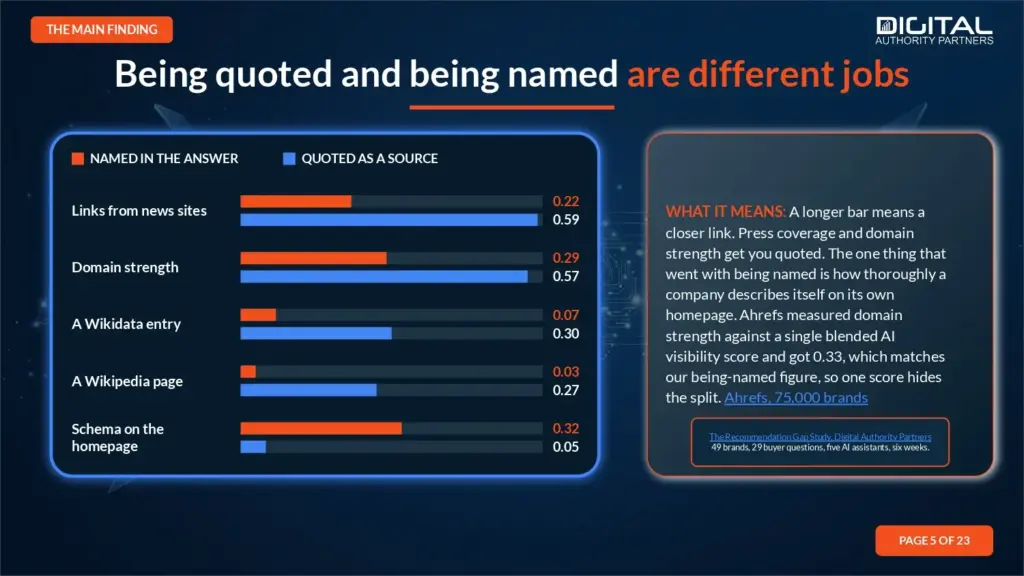
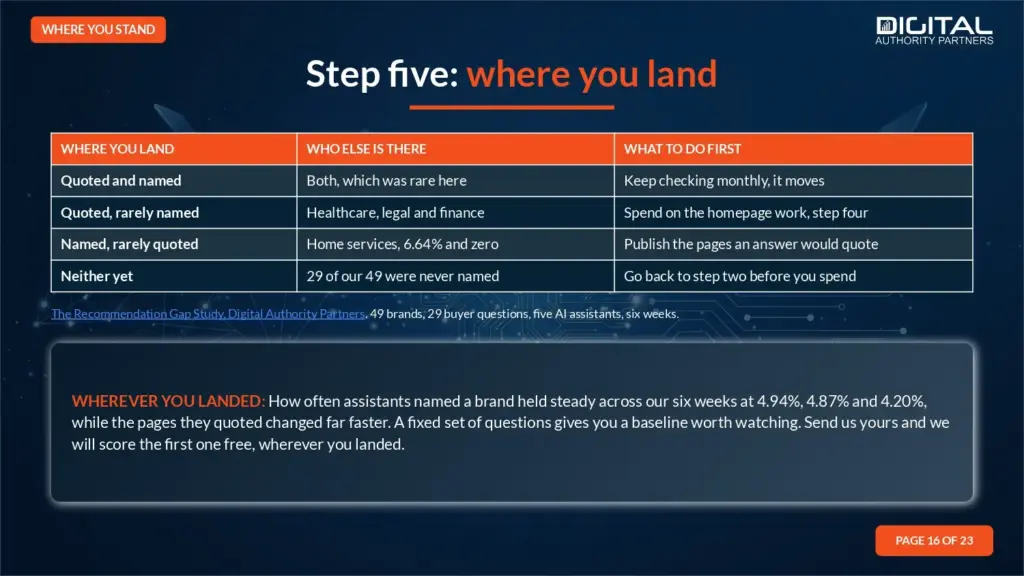
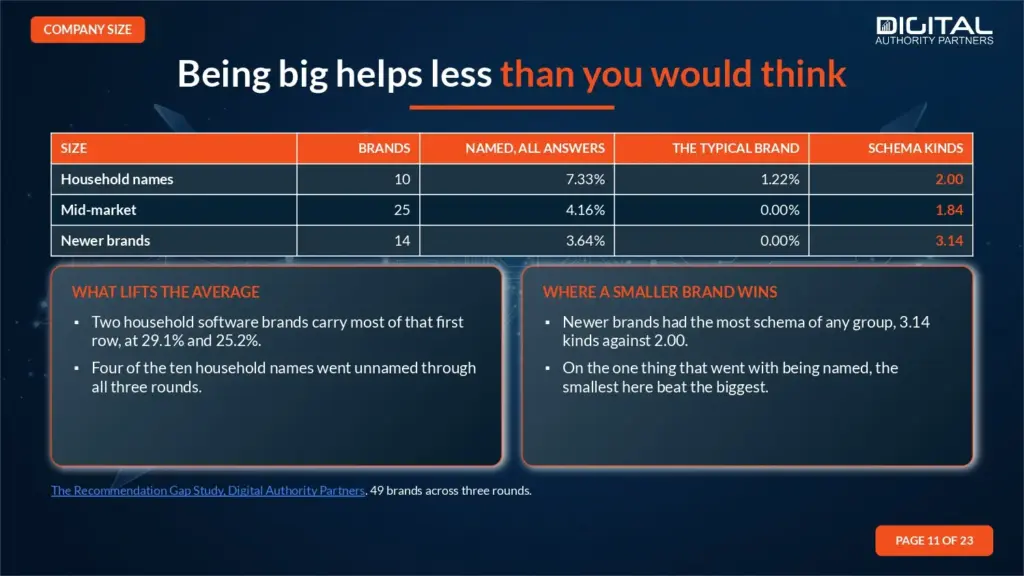
Table of contents
The five buyer questions behind 33,679 organic clicks a month, and what buying that attention would cost.
Why every question that produced a company name looked like one of five shapes.
The arithmetic, set out so you can run it on the questions asked in your own category.
The signal-by-signal breakdown of what goes with being quoted and what goes with being named.
What a Wikipedia page, a Wikidata entry and a complete Wikipedia page each measured against both outcomes.
The homepage finding, assistant by assistant, and what to check before you brief a developer.
The regulated-industry split, and the hospital system quoted in 18.2% of answers and named in 1.5%.
Industry by industry, from software at 11.07% named to financial services at 0.31%.
Company size, and the nine questions out of 29 that produced every name we recorded.
How to decide which of the two outcomes you are buying, and get it signed off in one sentence.
How to test whether the questions you track produce any company name at all.
The four numbers to pull, the benchmarks to read them against, and the four places you can land.
The phases in weeks from sign-off, with a column for your team and a column for ours.
Two dated client results, one single-location clinic and one B2B services company, both published.
Four questions worth asking any agency you shortlist, and what this study cannot tell you.
Similar white papers

Someone searching “alcohol rehab near me” gets a Local Pack and no AI Overview. Someone searching “what is MAT treatment” gets an AI Overview that...
Google treats financial queries differently from every other vertical. The same system that writes confident overviews for recipes and travel applies stricter safety filters to...
The Department of Justice moved the first Title II compliance date to 26 April 2027, which leaves eight months for public entities serving 50,000 people...
Download the Full AI Visibility Gap Study
Free download. No sales call required.