The Multi-Location Medical SEO Scorecard: 24 Signals That Decide Which Locations Win Patient Search
What You’ll Learn From This Multi-Location Medical SEO Scorecard
Patients pick a provider the same way they pick everything else now. They search, read, compare, and decide before your front desk hears from them, and for a group with locations across several markets that moment plays out market by market.
This scorecard shows you where your group stands against the standard the best multi-location groups have built. It maps six areas, twenty-four signals you score Yes, Partial, or No, the benchmark each area clears, and the maturity score that tells you which markets are still open.
- 11 locations ranking #1 on Google: Geode Health
- 90+ #1 rankings across 8 Florida markets: Centella Health Technologies
- #1 in ChatGPT across 8 of 9 neighborhoods: Chicago Pediatric Therapy
Results drawn from DAP published healthcare case studies
Six Things This Scorecard Will Help Your Group Do

1. Score every location against the market-leading bar
The scorecard rates your group across six areas and twenty-four signals, each marked Yes, Partial, or No. Every area ends with the standard market-leading multi-location groups clear, so you measure against a benchmark and see exactly where you stand.

2. Act on the local search opening Google just widened
As AI Overviews spread across healthcare, Google removed them from local provider searches, moving from 100% coverage in December 2023 to 0% in December 2025 (BrightEdge, 2025). The scorecard shows how to claim the Maps, local pack, and organic listings that now decide patient choice.

3. Catch the multi-location issues that hold rankings back
Profile drift across locations, location pages that compete with each other, and schema that breaks at scale are the places in-house teams stall. Each area leads with the hard-at-scale signal so you find these fast.

4. Benchmark against groups that compounded
Geode Health reached 11 locations ranking #1 and drew over 40% of new appointments from local search within three months, at 7X lower acquisition cost than paid search. The scorecard shows what that bar looks like and how to reach it.

5. Test whether AI engines recommend your locations
DAP research found that 66% of the pages AI engines cited in week one were gone by week four, at a 33% average citation retention rate (DAP AI Visibility Gap study, 2026). The scorecard shows how to build AI visibility that holds.

6. Turn your score into the three highest-impact moves
Your marks add up to a maturity band and point to the areas where patient demand is still open in each market. You leave with a clear read on what to fix first across every location.
Peek Inside the Guide
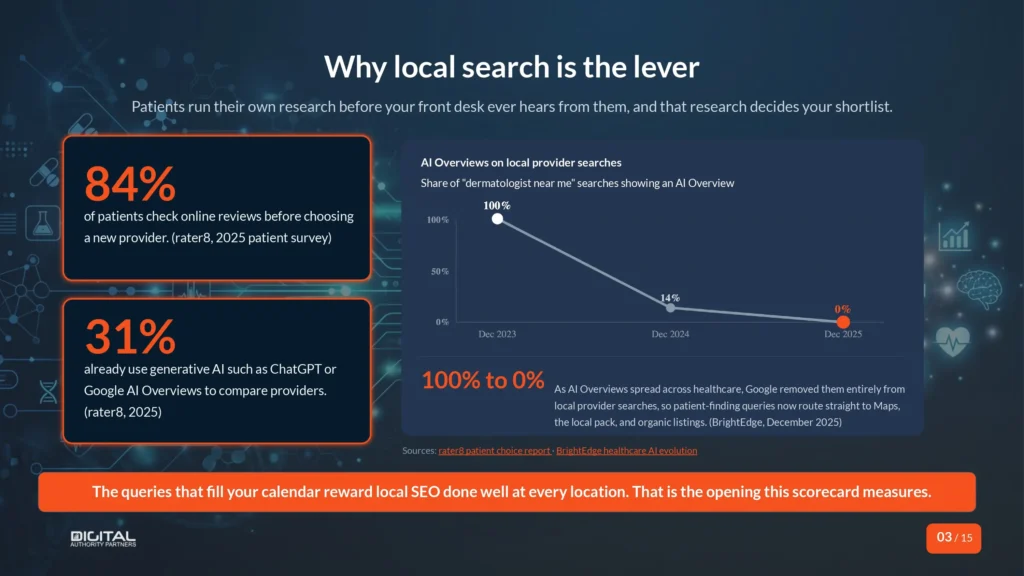
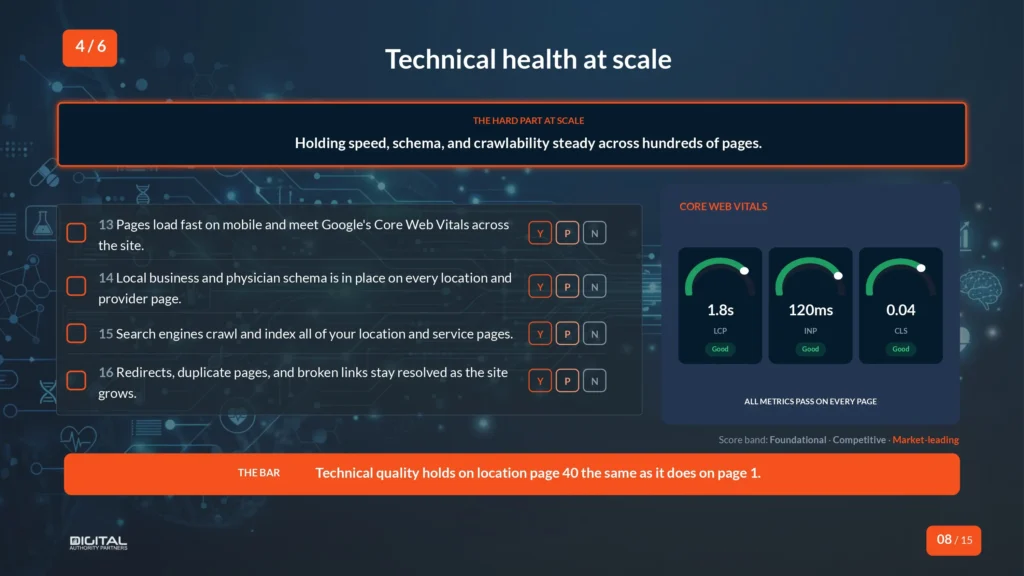
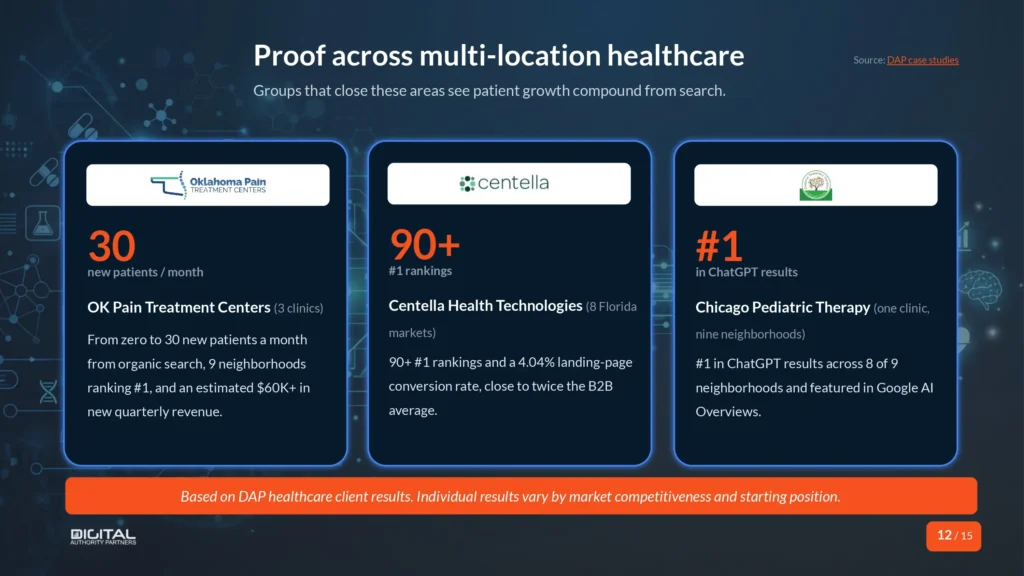
Table of contents
How patients choose providers now, and why reviews and AI both feed search
The local search opening: Google moved provider queries from 100% to 0% AI Overview coverage
What clearing the bar looks like
Verified profiles, matching details, one-tap booking, single-system management
Indexable location URLs, market-specific content, cross-linking, room to scale
Provider bios, patient-question coverage, community context, trust signals
Mobile speed, Core Web Vitals, schema, crawlability, clean redirects
Steady cadence, post-visit invitations, responses, per-market health
Structured answers, AI query testing, corroborating citations, visibility tracking
Market-leading, Competitive, or Foundational, mapped to the markets still open to you
Multi-location healthcare results and how to turn your score into a plan
Similar white papers

Google treats financial queries differently from every other vertical. The same system that writes confident overviews for recipes and travel applies stricter safety filters to...

The Department of Justice moved the first Title II compliance date to 26 April 2027, which leaves eight months for public entities serving 50,000 people...
Most software evaluations finish somewhere a vendor does not control. 6sense measured 94% of buying groups ranking their vendors before speaking to a seller, with...
Have questions about this white paper?
Let’s talk!