The Hospice Visibility Guide: How Families Find Care in Google AI Overviews, ChatGPT, and Gemini
What You’ll Learn in This Hospice Family Acquisition Ebook
Most hospice admissions still begin with a physician or a discharge planner, and that referral remains the foundation of your census. What happens after the referral has changed. The family goes home and looks your hospice up online, and the discharge planner often checks the same way before sharing your name. That research now runs through Google AI Overviews, ChatGPT, and local search.
This guide shows hospice leaders how both audiences search today and what a hospice can do to be found and trusted at that moment. It covers the two kinds of questions families ask, what DAP’s own research shows about the way AI engines choose which providers to name, and the five building blocks that helped a two-county nonprofit hospice reach more families in its licensed area.
- 73% more families reached across a two-county licensed area
- No. 1 rankings across 15 or more Orange County cities
- 407,000 search impressions in an 11-month engagement
Results from DAP’s published United Hospice case study, June 2024 to April 2025. Individual results vary by market, licensure area, and starting position.
Six Things This Guide Will Help Your Hospice Do

1. See where families and referral partners look first
Referrals still start your census, and the research that follows shapes whether a family feels confident in the care ahead. The guide shows what changes when both audiences check you online, including the finding that 32% of U.S. adults used AI tools such as ChatGPT or Gemini for health information in the past year, close to double the 17% recorded in June 2024 (KFF, March 2026).

2. Tell the two kinds of hospice searches apart
Families ask about hospice in two ways, and each way calls for different content. DAP's AI Visibility Gap study found that AI engines name a specific provider on 89% of ready-to-choose searches and only 3% of early learning searches (Digital Authority Partners, 2026). The guide shows which pages serve each type of question and why a hospice needs both.

3. Read a case study from a hospice your size
United Hospice is a nonprofit licensed for two upstate New York counties, and national brands with far larger backlink authority ranked above it on category searches. The guide walks through what changed, from a page for each community in the licensed area to caregiver content written for the person making the decision, and what the results looked like across 11 months.

4. Understand how AI engines pick the providers they name
DAP ran 30 questions across five AI engines over six weeks and reviewed 1,127 cited web pages. One finding: 60% of the pages these engines cite do not rank in Google's top 20 results (Digital Authority Partners, 2026). The guide explains what that means for a local hospice that wants to appear in those answers.

5. Work through the five building blocks
The guide details each one: a page for every community you serve, caregiver content that answers the questions families actually ask, an accurate Google Business Profile with correct service areas, a trusted presence on healthcare directories and publications, and a regular check across AI engines.

6. Check where your own hospice stands today
The guide closes with three questions a hospice leader can answer without any tools: which AI engines name your hospice today, whether you have a page for every community you serve, and whether you have earned a trusted mention in the past year. Any "not yet" points to a clear next step.
Peek Inside the Guide
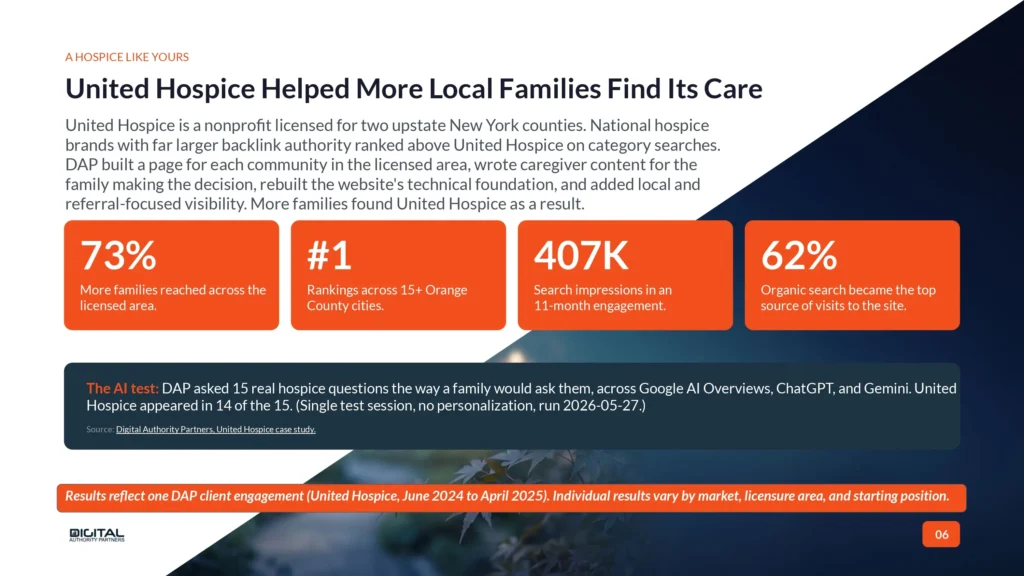
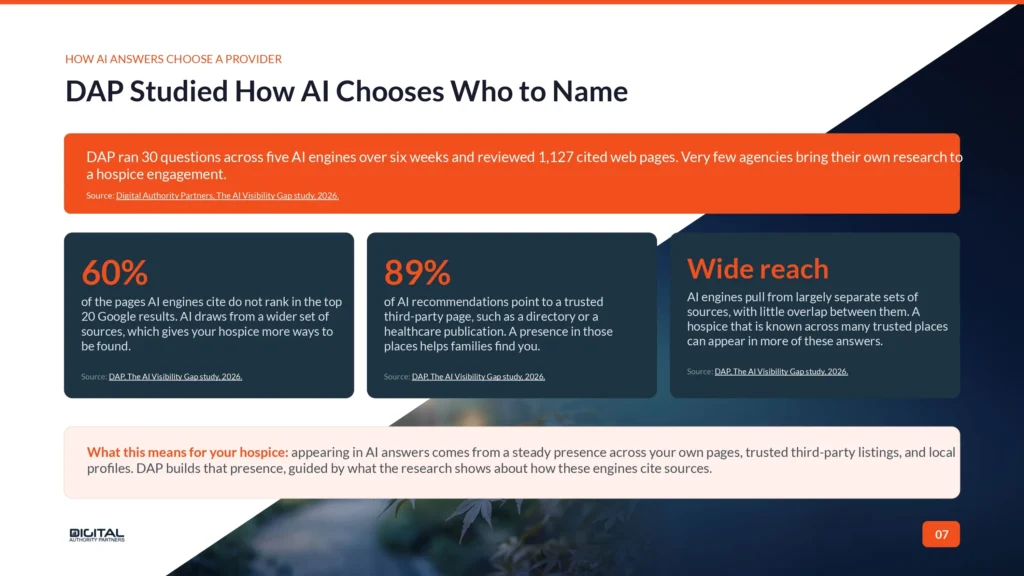
Table of contents
Why the referral still matters, and what the family does next
The share of adults now using AI tools for health information
What a family sees when the answer is clear, local, and well reviewed
Why search and AI engines hold hospice content to a higher standard
The two audiences a strong online presence reaches
The size of the local opportunity, with NHPCO’s hospice and utilization counts
Ready-to-choose searches, and how often AI names a provider
Early learning searches, and why answering them still pays off
Sample searches for both types, with one hospice’s results
What United Hospice faced against national hospice brands
Four results DAP reported across an 11-month engagement
The AI test: 15 family questions across three engines
What DAP found across 30 questions, five engines, and 1,127 cited pages
Why pages outside Google’s top 20 still earn citations
Where AI recommendations point when they name a provider
A page for every community you are licensed to serve
Caregiver content, Google Business Profile, and trusted third-party presence
A monthly check across AI engines
Three questions to see where you can grow
Writing about hospice with compassion and accuracy at once
Working inside your licensed area
Your next step: a 30-minute conversation with a DAP strategist
Similar white papers
Someone searching “alcohol rehab near me” gets a Local Pack and no AI Overview. Someone searching “what is MAT treatment” gets an AI Overview that...

Google treats financial queries differently from every other vertical. The same system that writes confident overviews for recipes and travel applies stricter safety filters to...

The Department of Justice moved the first Title II compliance date to 26 April 2027, which leaves eight months for public entities serving 50,000 people...
Have questions about this white paper?
Let’s talk!