Beyond SEO: The Multi-Channel Patient Acquisition Stack for Modern Healthcare Brands
What You’ll Learn in This Guide
You came looking for help with one channel. The patient in front of you is not thinking in channels at all. They read reviews, ask AI, search, scroll, and compare, then choose the practice that shows up well across all of it. This guide shows you how to turn the one channel you already run into a system that brings in more patients at a lower cost.
Patients research more before they book than they ever have, and every extra step is another moment to become the obvious choice. 84% check online reviews before choosing a provider and over half read at least six. 31% have used generative AI to research or compare providers, and 26% say AI influenced their choice. 35% have chosen a provider based on social media presence. The brands that stay visible are present in more than one place when a patient looks.
The guide maps the full Patient Acquisition Stack: eight channels working across five stages, from a stranger’s first search to a loyal patient who refers their family. You see what each channel does for healthcare brands, which one to fund first based on your specialty and stage, and how the channels compound so each patient costs less than the last to acquire.
Then you learn to read your marketing the way an owner reads a P&L. Set a cost-per-patient ceiling, track patient lifetime value, blended customer acquisition cost, channel attribution, and your LTV to CAC ratio, and run the one-page board scorecard DAP uses for monthly ownership reviews. A 90-day plan turns all of it into motion.
Inside the Guide

The Patient Acquisition Stack
Eight channels mapped across five buyer stages: SEO, AI Search, Paid Search, Paid Social, Email and SMS, Reviews and Reputation, Website and CRO, and Referrals. See exactly which channels do the work at awareness, research, decision, booking, and loyalty.

The Eight Channels at a Glance
A one-page reference for what each channel does for healthcare brands, the stages it serves, and where it earns its keep. Mark each one green, yellow, or red for your practice, and your reds become your build list.

The AI Visibility Gap Study
DAP’s original research tracked 1,127 URLs across ChatGPT, Perplexity, Gemini, Copilot, and Google AI Overviews over six weeks. 66% of week-one citations were gone by week four, 89% of citations behind a brand recommendation pointed to third-party media, and platform overlap topped out at 17%. Four findings tell you how to win in AI search.

The Compounding Effect
Each channel is useful alone and worth more in combination. Layering complementary channels onto an SEO foundation has improved patient inquiry yield by 30 to 50% for the same or lower spend across DAP healthcare engagements, and email returns roughly $36 for every $1 spent.

The Cost Case, in Client Data
Within three months, over 40% of new appointments at Geode Health came from local SEO. For a multi-location mental health network, paid ads would have cost about seven times more per month than the SEO program DAP built. A pain treatment group grew to 30 new patients a month and an estimated $60,000+ in annual revenue from that channel alone.

Where to Start
A fund-first matrix by situation, from opening a new location to behavioral health, med spa, specialty and surgical, and urgent or primary care. Each row names the channel to fund first, the one to add next, and why.

The Four Metrics and the Board Scorecard
Patient LTV, blended CAC, channel attribution, and the LTV to CAC ratio, with the widely used 3 to 1 benchmark. The board scorecard puts the whole engine on one page so you can see whether you are growing, growing efficiently, and getting cheaper to run over time.

Your First 90 Days
A practical sequence: see clearly in the first 30 days, strengthen the foundation by day 60, then layer and measure by day 90.
Peek Inside the Guide
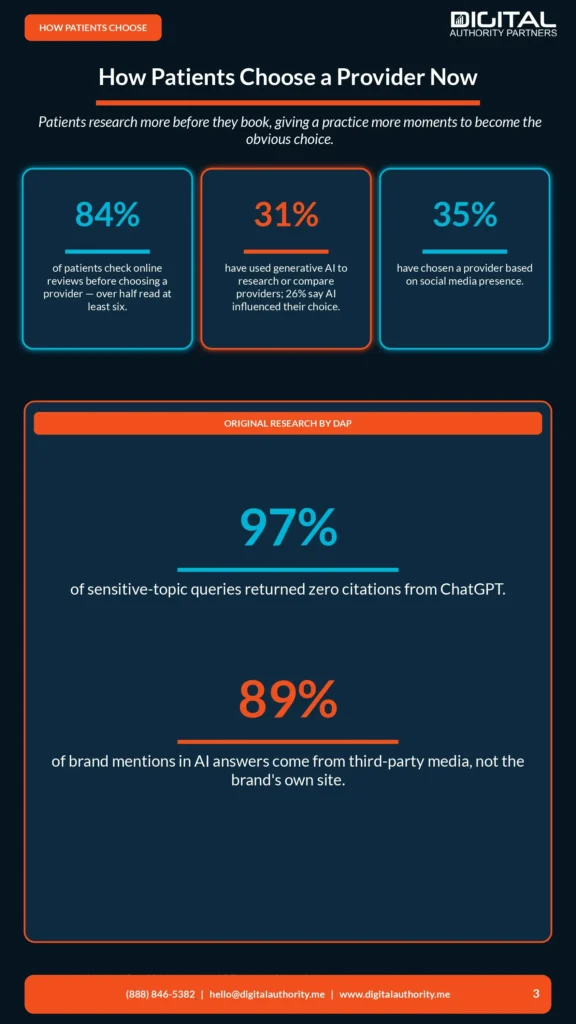
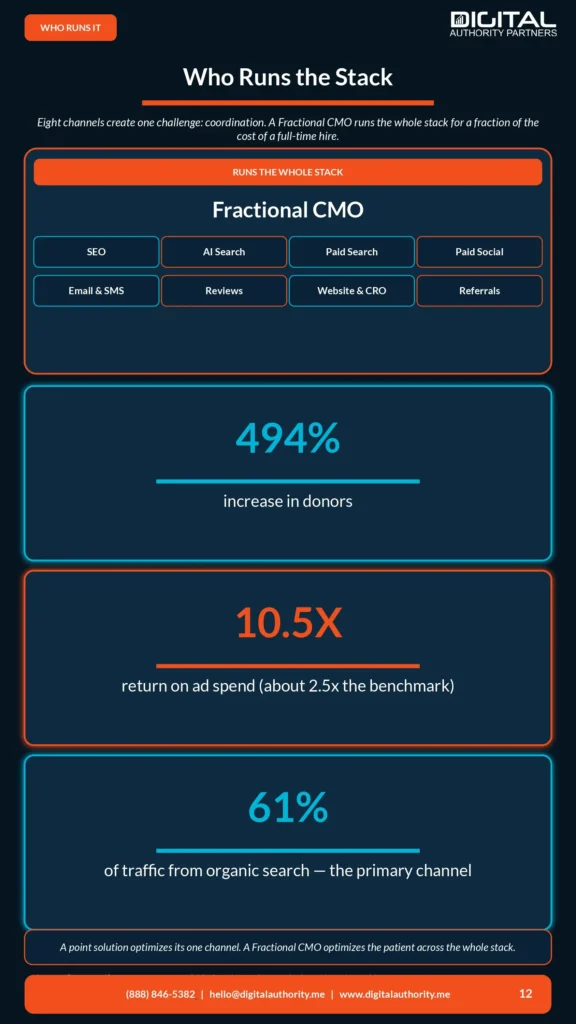
Table of contents
The four outcomes: see every place a patient could find you, pick the one channel to fund first, set a cost-per-patient target, and run a 90-day plan.
The research behavior driving modern healthcare decisions, from reviews to generative AI to social proof, and what it means for your practice.
The eight channels across five stages, plus the at-a-glance reference for what each one does for healthcare brands.
DAP’s original data on how ChatGPT, Perplexity, Gemini, Copilot, and Google AI Overviews cite brands, and the four findings that shape an AI search strategy.
Why channels are worth more together, with client data showing the cost-per-patient advantage of building on a foundation.
The fund-first matrix by specialty and stage, and how a Fractional CMO runs the whole stack for a fraction of a full-time hire.
The four numbers that measure the whole engine, the one-page ownership scorecard, and the 90-day plan to put it in motion.
Similar white papers

Therapy clients search with clear intent, and a well-run Google Ads account puts your practice in front of them at the moment they look for...
Someone searching “alcohol rehab near me” gets a Local Pack and no AI Overview. Someone searching “what is MAT treatment” gets an AI Overview that...

Google treats financial queries differently from every other vertical. The same system that writes confident overviews for recipes and travel applies stricter safety filters to...
Have questions about this white paper?
Let’s talk!