The AI Content Fingerprint: An Original Data Study by Digital Authority Partners
What You’ll Learn in This AI Content Study
Most brands are investing in the two things AI engines overlook: polished author bios and sales pages. When Digital Authority Partners scored 497 pages on 12 content characteristics, author bylines and credentials had no measurable effect on whether an AI engine cited a page. What predicted citation was the type of content itself, and it predicted citation almost as well as the size of the website behind it.
This is the companion to our AI Visibility Gap study, which found that 60% of AI citations never appear in the organic top 20, only 1 in 3 survive a month, and 89% of recommendation citations go to third-party media. That study measured what AI search does. This one answers what earns a citation. We scored 497 organic Google results across 30 queries, six industries, and five intent types, and two independent reviewers classified the judgment-based signals. All findings are correlational.
For a mid-market brand, that is an opening. When how a page is built predicts citation nearly as well as the size of the website, a smaller site built in the formats AI engines return can compete for citations against much larger domains. The brands that keep pouring budget into author bios and service pages are handing those citations to competitors who publish what AI reaches for. Inside the full report you get the signal-by-signal breakdown, the four-layer AI Citation Content Profile, and a 90-day playbook for acting on it.
Study Highlights

The Byline Blind Spot: Author Bylines Had Zero Effect
Author bylines and credentials had no measurable effect on whether an AI engine cited a page. An AI system does not read a bio and judge credibility the way a person does. The authority that moves AI engines lives at the brand level: Wikipedia presence, structured data, and earned media, the places language models learn from. For budget owners, this moves the entire E-E-A-T conversation off the page and onto the brand.

The Editorial Premium: Editorial Cited 7x More Than Forums
Editorial pages were cited 58% of the time and forum posts 8%, a sevenfold gap. Reference and encyclopedia pages topped the list at 75%. Landing and service pages, the ones most companies invest in most heavily, were cited 25% of the time, less than half the editorial rate. The format you publish in changes your odds before a word is written.

Content Structure Predicts 71% of AI Citation
How a page is built predicts whether AI cites it 71% of the time. Adding the website’s overall size and authority moves that to 75%, a gain of only four points. The path to AI citation runs through how a page is built, and that is the lever a smaller brand can pull today. A mid-market site can compete for citations against much larger domains.

83% of Durable Citations Are Editorial
Among the pages that held their AI citations across all three study waves, 83% were editorial, with deeper structure, more outbound links to sources, and more schema than the average page. Nearly half were published before ChatGPT launched in November 2022, and the rest read as human-written or come from established institutional publishers. The content that keeps its citations is well-built, editorial, and human-written.
Only 1 in 3 AI Citations Survive a Month
The companion AI Visibility Gap study found only about 1 in 3 AI citations survive a month, and 60% never appear in the organic top 20 at all. Citation is a position you hold and re-earn. The full report pairs this with a refresh cadence and an engine-by-engine monitoring approach so the pages that earn citations keep them.
Peek Inside the Guide
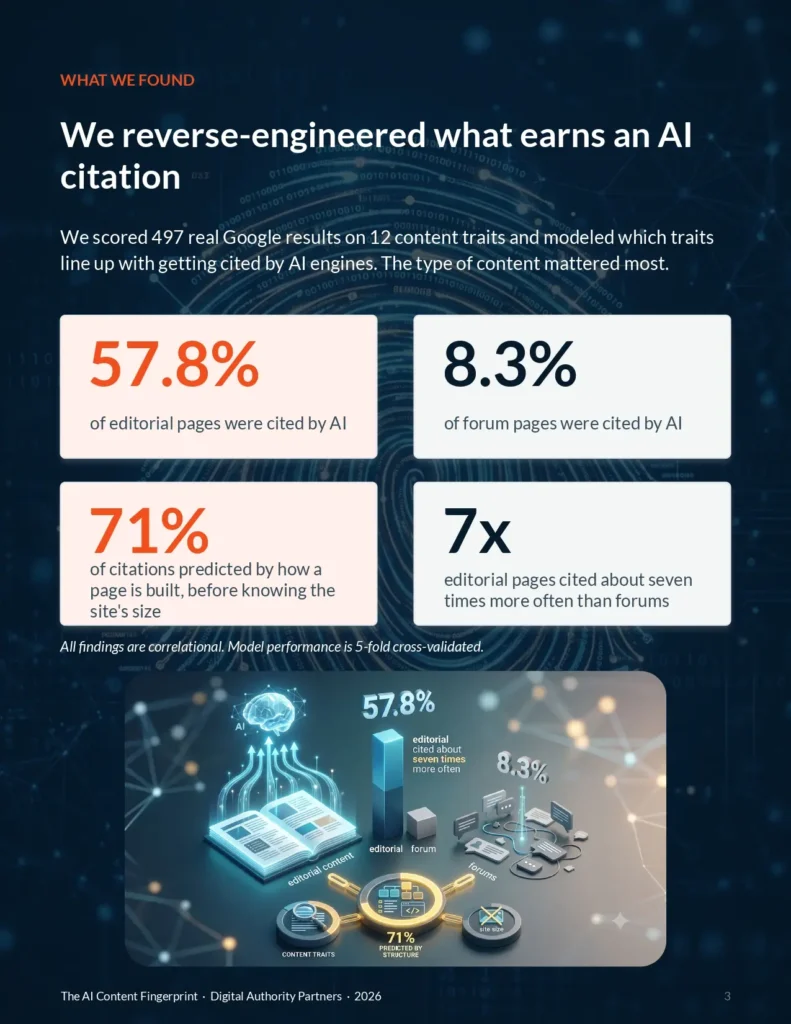
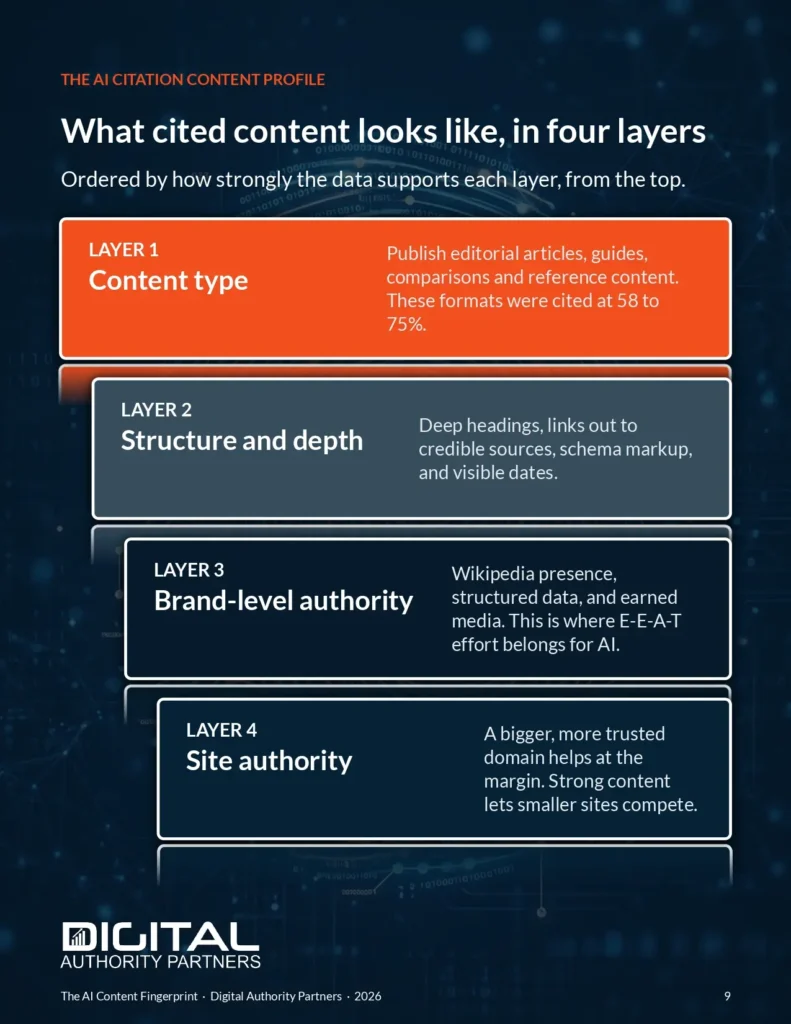
Table of contents
The core question the study answers: what makes a page get cited.
The headline finding that content type carries most of the weight.
Why how a page is built predicts citation almost as well as the size of the website behind it.
The full citation-rate table by content type, from reference and editorial at the top to forums at 8%.
Why landing and service pages are cited at less than half the editorial rate.
What the sevenfold editorial-to-forum gap means for where you invest.
The ranked list of content signals that hold up on their own.
Why page-level bylines and credentials do not register, and where the authority that moves AI engines lives.
The structural bundle (heading depth, outbound links, schema, visible dates) and how to read it as one profile.
The four-layer profile of content AI engines select and return to.
The persistent-content finding: 83% of durable citations are editorial.
The human-authorship signal in the pages AI keeps citing.
Four sequenced plays, from rebalancing your content mix to re-earning citations.
The page-level checklist for building priority pages to the profile.
A 30-60-90 day roadmap and a who-owns-what breakdown for content, SEO, and PR.
Similar white papers

Google treats financial queries differently from every other vertical. The same system that writes confident overviews for recipes and travel applies stricter safety filters to...

The Department of Justice moved the first Title II compliance date to 26 April 2027, which leaves eight months for public entities serving 50,000 people...
Most software evaluations finish somewhere a vendor does not control. 6sense measured 94% of buying groups ranking their vendors before speaking to a seller, with...
Download the Full AI Visibility Gap Study
Free download. No sales call required.