AI Overviews in Financial Search: The “No Specific Advice” Frontier
What You’ll Learn in This Financial Search Whitepaper
Google treats financial queries differently from every other vertical. The same system that writes confident overviews for recipes and travel applies stricter safety filters to investments, taxes, and retirement. Those filters create a clear opening for the firms that understand them.
This whitepaper shows you where that opening sits. It maps which financial queries trigger AI Overviews, what content Google’s model chooses to cite, how to earn those citations while staying inside SEC and FINRA lines, and the credential infrastructure that gives financial firms an E-E-A-T advantage no other industry can match at the same scale.
The content architecture behind these results is the same architecture that earns AI Overview citations today:
- 207% MQL increase and $3.8M marketing-driven revenue: ConnexPay
- $3M new business in year one and 7X return on SEO spend: KYROS
- 6X organic traffic growth and 1,200 keywords ranked: Cove Markets
Results drawn from DAP published financial services case studies. Individual results vary.
Six Things This Guide Will Help Your Financial Firm Do

1. Read the AIO behavior map for finance
AIO coverage runs from 91% on educational queries down to under 10% on individualized-advice queries. The guide charts every query type by its AI Overview coverage and explains the safety logic behind each, so you can see which topics your content is positioned to win.

2. Claim the credential-registry advantage
Financial services is the only vertical with centralized, federally maintained credential registries that Google can cross-reference programmatically: CFP Board, FINRA BrokerCheck, SEC IAPD, and CFA Institute. The guide shows how to link authors to these registries and turn verified credentials into a citation signal.

3. Build content Google’s model chooses to cite
Pages with FAQ schema appear in AI Overviews 3.2x more often, and 54.5% of citations already come from pages ranking in top organic positions. The guide breaks down the four content attributes Google’s model favors and how to build each into your pages.

4. Earn citations while passing compliance review
The guide pairs each AIO technique with the SEC or FINRA rule it satisfies. Educational framing, third-party attribution, FAQ schema with disclaimers, and displayed author credentials all earn visibility while giving your compliance officer a defensible basis to approve.

5. Capture the hybrid local queries
Some financial searches resolve to a map pack, some to an AI Overview, and some to both. The guide identifies the hybrid queries where a strong educational page paired with a verified Google Business Profile captures two visibility layers at once.

6. Run the five-step AIO readiness framework
The guide closes with a five-step framework: audit content for eligibility, implement credential-registry linking, restructure for extractability, align compliance and SEO, and track AIO citations as a KPI. Use it as the action plan for your next two quarters.
Peek Inside the Guide
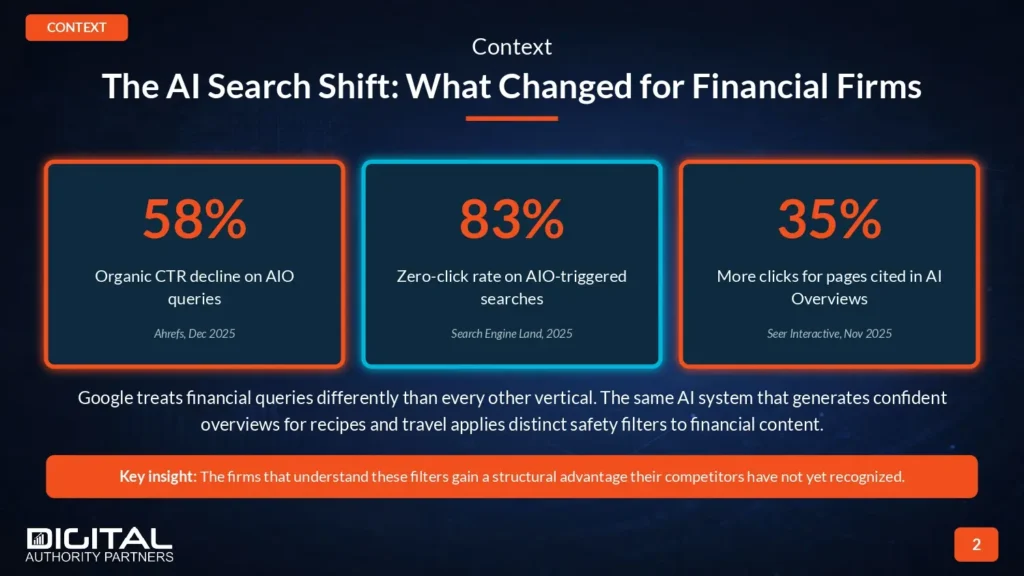
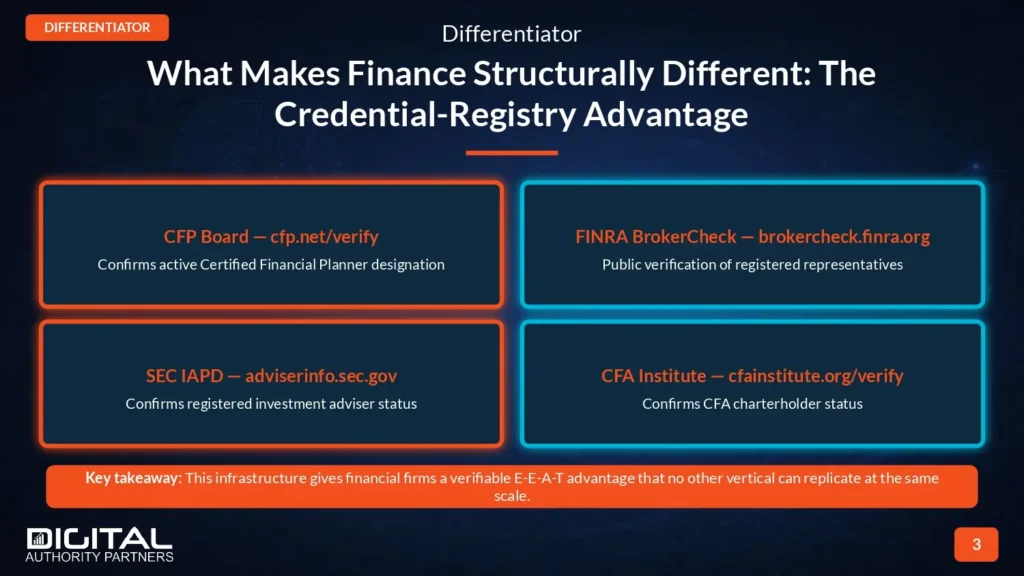
Table of contents
What changed for financial firms, and the three metrics that define the stakes
The credential-registry advantage no other vertical can replicate
Which financial queries trigger AI Overviews, and the safety logic behind each
The four content attributes Google’s model favors
How being cited changes the click economics across the full SERP
Why financial content faces the highest scrutiny, and the four-step author framework
How to pass SEC and FINRA review and earn citations at the same time
How local financial queries resolve, and where the hybrid opportunity sits
Why the advantage widens with every Google update
ConnexPay, KYROS, and Cove Markets
Five steps to position for AI Overview visibility
The financial-services approach, and a 30-minute readiness assessment
Similar white papers

Therapy clients search with clear intent, and a well-run Google Ads account puts your practice in front of them at the moment they look for...

Someone searching “alcohol rehab near me” gets a Local Pack and no AI Overview. Someone searching “what is MAT treatment” gets an AI Overview that...

The Department of Justice moved the first Title II compliance date to 26 April 2027, which leaves eight months for public entities serving 50,000 people...
Have questions about this white paper?
Let’s talk!