ADA Title II Web Accessibility: An Analysis of Government Websites Eight Months From the Deadline
What You’ll Learn in This ADA Title II Web Accessibility Report
The Department of Justice moved the first Title II compliance date to 26 April 2027, which leaves eight months for public entities serving 50,000 people or more. The technical requirement held at WCAG 2.1 Level AA through both extensions, so every hour of work completed so far still counts toward the date. This report sets out the four compliance dates that now apply across ADA Title II and Section 504, then shows what public sector websites look like today.
In August 2026 we ran the same automated scan across 100 US organizations and analyzed 89 of them: 60 county governments, 25 health systems, 15 school districts and public universities. The findings give you a peer baseline for your own homepage, a ranked view of which fixes clear the most ground, a ten question readiness score, and an eight month sequence that fits inside one budget cycle.
- 48% of the 89 public sector homepages we scanned returned zero detected violations, and every site that did carry a violation carried at least one rated serious or critical (DAP Public Sector Accessibility Scan, August 2026)
- 76% (DAP B2B Software AI Engine Test, July 2026)
- 4,928 digital accessibility lawsuits were filed across US federal and state courts in 2025 (UsableNet lawsuit tracker)
Six Things This Report Will Help Your Organization Do

Plan against all four compliance dates.
ADA Title II and Section 504 now carry four separate dates between April 2027 and May 2028, and which one applies to you depends on population served, employee count and funding source. Both rules point at the same technical standard, so one program of work satisfies both.

Compare your homepage against 89 peers.
The scan gives you the full distribution: how many organizations returned zero detected violations, how many sat in the one to five band, and how many carried twenty one or more. You can place your own result inside that spread before you scope anything.

Put the highest volume fixes first.
Four issue types accounted for three quarters of every detected instance. Each one is well understood and each one has a known fix, which makes the first pass of remediation the most productive stretch of the whole program.

Count the document library before it sets your budget.
The rule holds PDFs, Word files and spreadsheets to the same standard as your HTML pages. Agendas, permit forms, board packets, budget books and patient intake packets all sit inside scope, and the count of untested documents is what sets the scale of everything else. The report includes a worksheet for producing that number.

Score your readiness in ten questions.
A ten question self assessment scored out of forty places you in one of four bands, and every band comes with a described route to the April 2027 date. The score tells you which route you are on and where to put the first month.

Answer the accessibility question in procurement.
If you sell digital services to public entities, the rule reaches web content a public entity provides through contractual or licensing arrangements. Public sector buyers now write WCAG 2.1 Level AA into procurement, so a conformant product clears that step of the evaluation.
Peek Inside the Guide
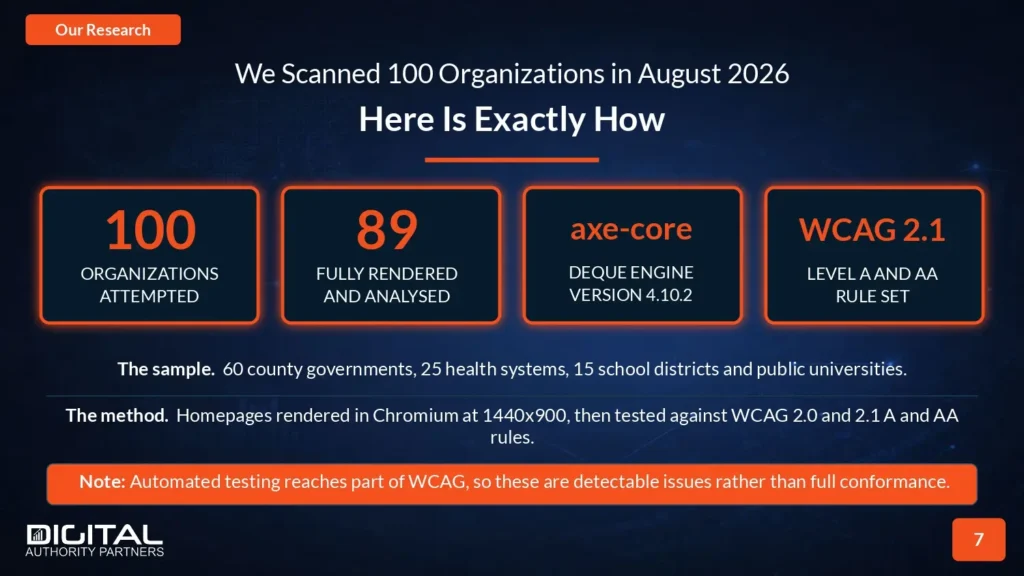
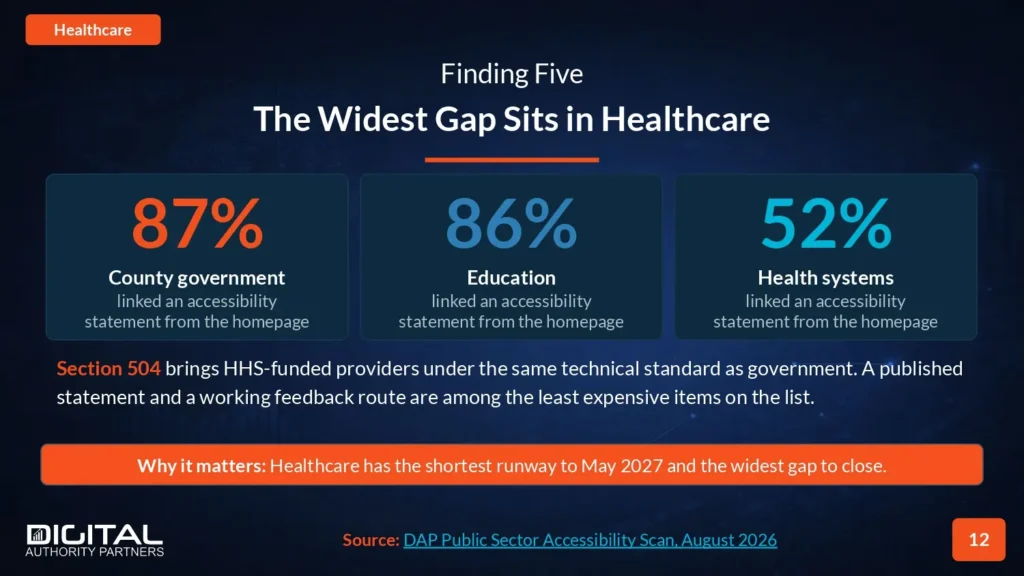
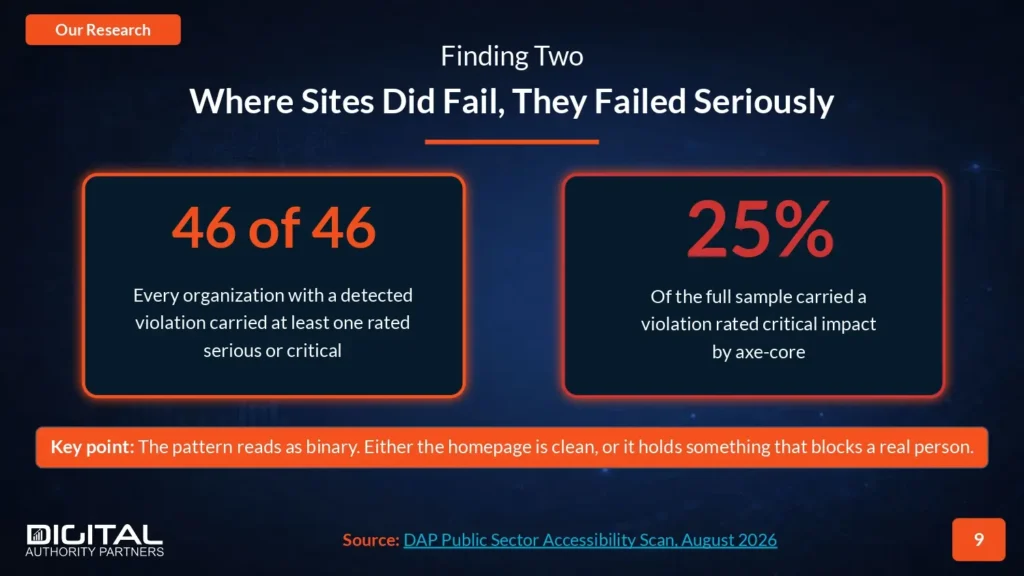
Table of contents
The extended April 2027 date and what remains of it
What a full program covers beyond the website
Why a 1 July fiscal year makes FY27 the deciding budget
The 2024 Title II rule and the April 2026 extension
The May 2026 Section 504 extension for federally funded providers
All four compliance dates in one table
Title II entities: states, counties, cities, schools, courts and libraries
Section 504 recipients: hospitals, health centers, clinics and physician groups
Vendors supplying digital services under contract
How a single Medicare or Medicaid reimbursement brings a provider into scope
The four principles in plain language
Every surface the rule reaches, from mobile apps to third party platforms
Why the document library is usually the largest piece of the list
100 organizations attempted, 89 fully rendered and analyzed
The engine, the rule set and the render conditions
The sample split across county government, health systems and education
What automated testing reaches and what it leaves for people
The pass rate and the full violation distribution
Why the severity pattern reads as binary
The four issues behind three quarters of all instances
The ARIA result and what it says about good intentions
The accessibility statement gap in healthcare
Meaningful alt text, focus order and screen reader journeys
Published PDFs, forms and media
The document inventory worksheet
The ten question scorecard and what each score band means
The eight month path from baseline to evidence
Two ways to start
Similar white papers

Therapy clients search with clear intent, and a well-run Google Ads account puts your practice in front of them at the moment they look for...
Someone searching “alcohol rehab near me” gets a Local Pack and no AI Overview. Someone searching “what is MAT treatment” gets an AI Overview that...

Google treats financial queries differently from every other vertical. The same system that writes confident overviews for recipes and travel applies stricter safety filters to...
Have questions about this white paper?
Let’s talk!