SaaS SEO in 2026: Why Software Buyers Never Reach Your Site
What You’ll Learn in This SaaS SEO Guide
Most software evaluations finish somewhere a vendor does not control. 6sense measured 94% of buying groups ranking their vendors before speaking to a seller, with roughly 80% of deals going to the vendor the group already preferred. By the time a buyer loads your site, the shortlist has usually formed on an AI assistant, a review platform and a peer thread.
This guide maps the four surfaces where that evaluation runs and shows what a software company can win on each. Digital Authority Partners pulled the eight highest-intent category terms in B2B software, plus four alternatives terms, and counted who holds the ground position by position. It sets out the published review-platform thresholds, prices the comparison terms against their paid equivalent, walks one category end to end, and closes with a twelve-check audit and four moves ordered cheapest first. It is written for the marketing leader at a 90 to 350 employee software company who already ranks for a set of terms and still watches deals arrive decided.
- Review platforms and listicles hold 32 of 77 top-ten organic positions across the eight highest-intent B2B software category terms, against 13 for the vendors being evaluated (Digital Authority Partners analysis of Ahrefs data, August 2026)
- Alternatives terms in the category carry a keyword difficulty of five to six, and buying the same visibility through paid search would run to roughly $93,660 a month (Digital Authority Partners analysis of Ahrefs data, August 2026)
- 94% of buying groups ranked their vendors before speaking to a seller, and roughly 80% of deals went to the vendor already preferred (6sense, B2B Buyer Experience Report, November 2025)
Two of the three highlight figures are DAP original research, which is what separates this page from a summary of other people’s survey data.
Six Things This Guide Will Help Your Software Company Do

1. See where the evaluation finishes, and what that opens
Five surfaces, in the order buyers use them: an AI assistant frames the category, a review platform supplies the trust signal, a peer thread supplies the honest read, the shortlist closes at three products or fewer, and the site gets its visit. The guide puts a measured figure on each step, so you can see which surface is deciding your deals before you fund anything.

2. Price the aggregator layer in positions rather than impressions
Across the eight highest-intent category terms, review platforms and listicles hold 32 of 77 top-ten organic positions and vendors hold 13. No organic result holds position one on any of the eight. The guide names the holders term by term, and shows the two domains taking just over a million organic visits a month between them.

3. Clear the review platform thresholds on published criteria
G2 opens Grid inclusion at ten reviews in a category, Capterra Shortlist at twenty inside 24 months, TrustRadius Top Rated at ten plus a rating condition, and Gartner Peer Insights at twenty reviews plus fifteen ratings. Ten requests per platform per quarter clears most volume thresholds inside two quarters, and the guide shows which two platforms read your search performance as an input to your placement.

4. Take the comparison ground while difficulty is still five
Four alternatives terms in the category carry a keyword difficulty of five to six, and one vendor among them has built a purpose-built defensive page. The guide runs the build-versus-buy comparison at current cost per click, and walks the marketing automation category position by position so you can see what a winnable page looks like before you brief one.

5. Turn peer surfaces into a citation asset
Reddit holds the top organic position on three of four alternatives terms and supplies a fifth of the citations in Google AI Overviews. A tracking study of 482 posts found persistence, rather than volume, governs how often a thread gets cited. The guide sets out the participation rule that follows, including how employees disclose affiliation.

6. Score your four surfaces and choose the first move
Twelve checks across review platforms, comparison ground, peer surfaces and your own site, scored out of twelve into three bands, each carrying a different starting point. The four moves that follow are ordered cheapest first, with the effort and the return stated for each.
Peek Inside the Guide
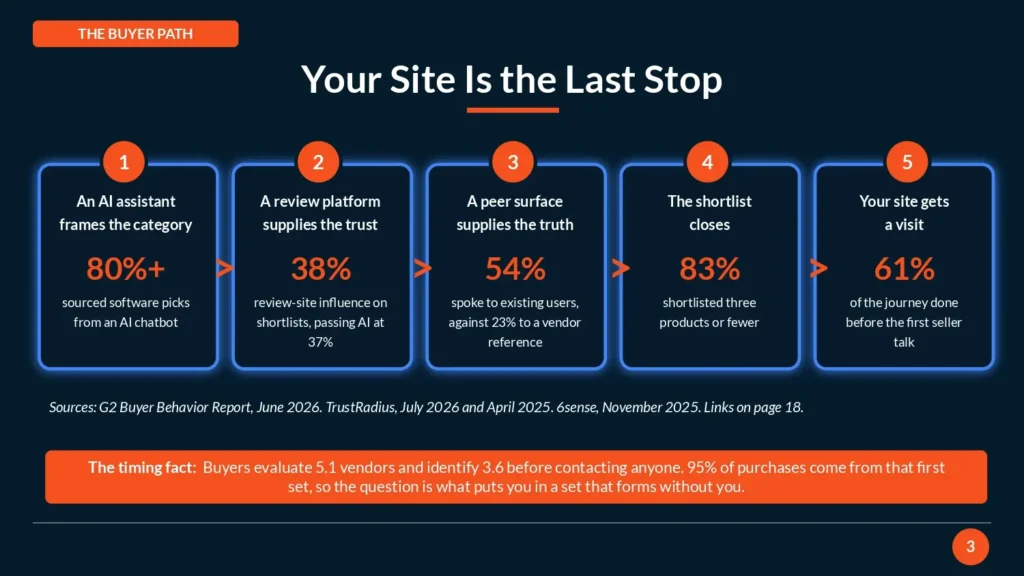
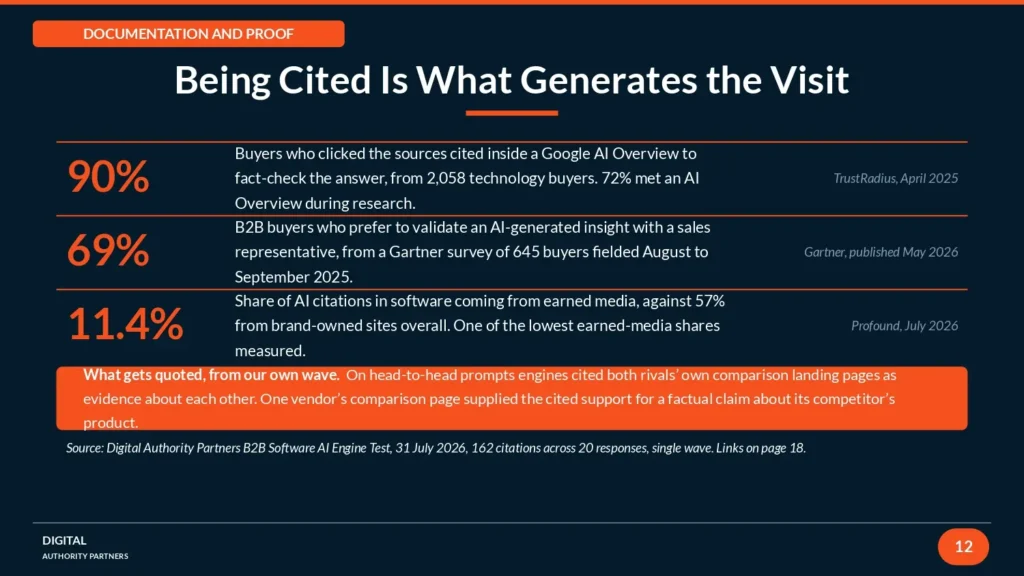
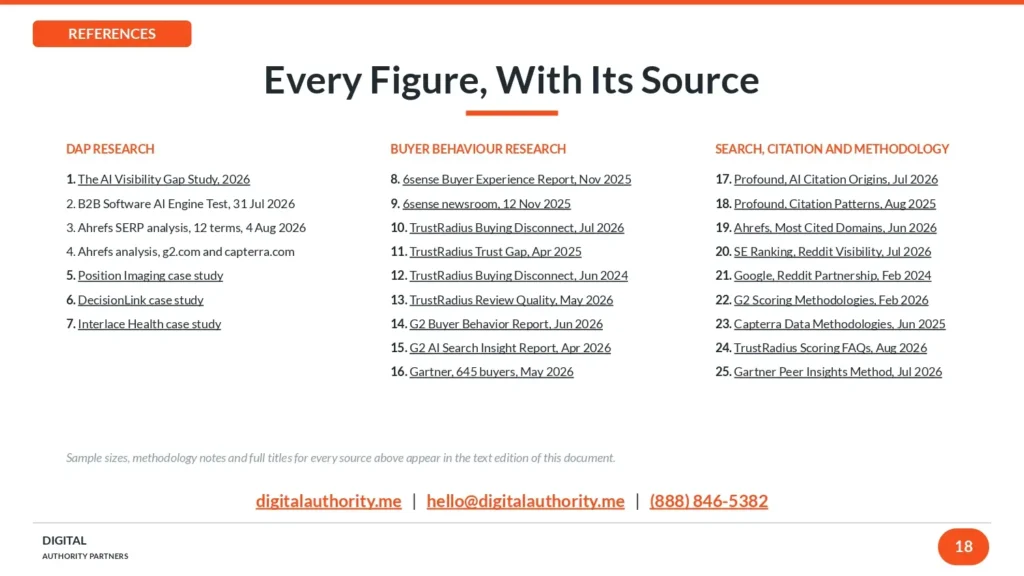
Table of contents
Written for the marketing leader at a 90 to 350 employee software company
94% of buying groups ranked vendors before speaking to a seller, and roughly 80% of deals followed that ranking
An AI assistant frames the category, a review platform supplies the trust, a peer surface supplies the truth
83% shortlist three products or fewer, and 61% of the journey finishes before the first seller conversation
Third parties hold the commercial ground on the classic search result
Brand-owned pages supply 57% of AI citations overall, so your site carries the evidence even when it loses the click
The eight highest-intent category terms, with platform, vendor, press and community holdings counted per term
G2 and Capterra: just over a million estimated monthly organic visits between them, one earned and one paid
The published thresholds and windows for G2, Capterra, TrustRadius and Gartner Peer Insights
The mechanic most vendors miss: two of the four platforms score your search performance as an input to your placement
Four alternatives terms at difficulty five to six, one defensive page between them, and what the paid equivalent costs
A worked example: the marketing automation category read position by position, with the first three moves named
Reddit across classic search, AI Overviews and Perplexity, and why persistence governs citation
Transparent pricing, a demo one click away and unrequested proof: what buyers have ranked first four years running
Twelve checks across four surfaces, scored, with three bands carrying a different first move each
Four moves ordered cheapest first, a forwardable one-page summary, and every figure with its source
Similar white papers

Half of B2B software buyers now open their research with an AI chatbot more often than with Google. G2 put that figure at 51% in...
The wealth transfer everyone still calls “the $84 trillion” event has already grown. Cerulli now projects $124 trillion moving through 2048, with $105 trillion flowing...

Most hospice admissions still begin with a physician or a discharge planner, and that referral remains the foundation of your census. What happens after the...
Have questions about this white paper?
Let’s talk!