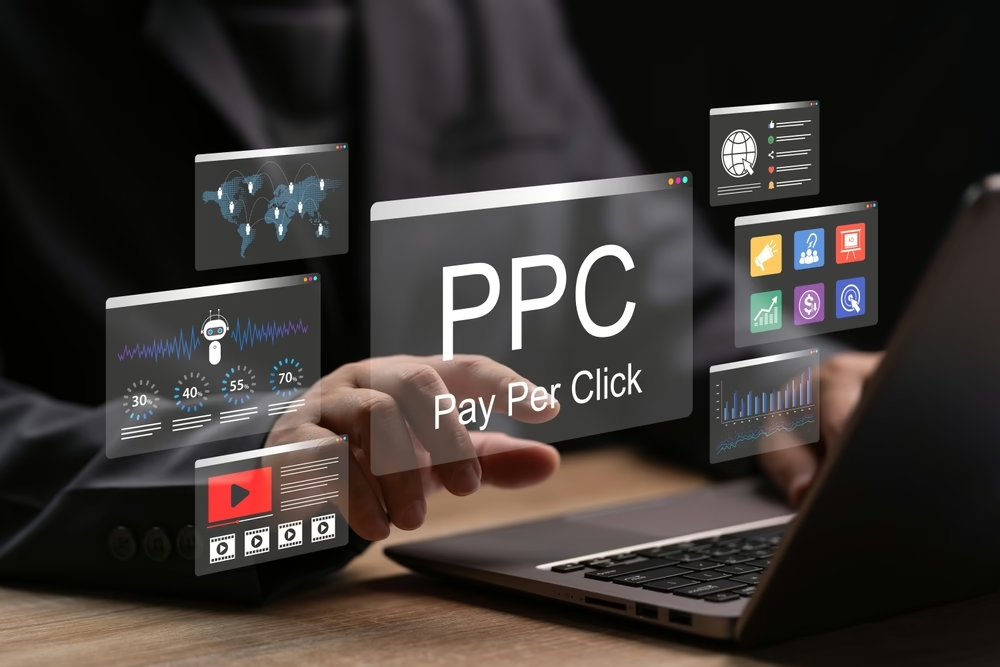
Increase PPC Results For Your SaaS Business With An FCMO

B2B SaaS companies often dedicate significant budgets to Google Ads and LinkedIn campaigns, creating major opportunities to scale pipeline growth. The disconnect between ad spend and revenue is more than an execution issue. It’s a strategic leadership gap.
Marketing teams excel at campaign execution. They can clearly see which accounts become paying customers, keeping customer acquisition cost (CAC) in check and conversions moving upward.
An experienced fractional CMO for B2B SaaS companies can lead your pay-per-click (PPC) advertising, drawing on their experience and expertise to ensure every click connects to revenue.
What Is PPC Advertising for B2B SaaS?
PPC advertising means paying for clicks to drive qualified leads into your pipeline. Remember you are selling complex software to multiple decision-makers, with long sales cycles and high price points.
Research confirms that FCMOs are transforming B2B marketing, enabling predictable growth through strategic campaign execution. Executing your PPC advertising for B2B SaaS with the benefit of fractional CMO leadership changes everything about how you approach paid media.
Core PPC Channels for SaaS
B2B SaaS companies use these channels to reach buyers at different stages:
- Google Ads: Captures people actively searching for solutions like yours
- LinkedIn: Targets the exact job titles of those who sign purchase orders
- Retargeting: Brings back visitors who leave without converting
- Capterra/G2: Gets your business in front of buyers, comparing alternatives
- Reddit/Quora: Builds credibility where technical buyers discuss solutions
Think of each channel as covering a different piece of the buyer’s journey. Google Ads catch the low-hanging fruit — prospects who are already searching for what you offer. LinkedIn sparks new conversations with executives who have yet to realize you exist, but are the ones who will eventually sign off on the deal.
Review sites give buyers confidence when they reach the evaluation stage, showcasing how you compare to competitors. Use these channels together — they reinforce each other and build a smoother path to closed-won deals.
Unique B2B SaaS Challenges
B2B SaaS sales cycles often span months, creating valuable time to educate prospects and build stronger relationships across the buying committee. The end user wants something easy to use. The IT team wants APIs and security documentation. The CFO wants ROI projections and contract flexibility. You need different ads, different landing pages, and different follow-up sequences for each buyer.
Examining industry benchmarks shows that B2B SaaS has higher costs per click than many industries. Your competitors bid up keywords while your conversion rates remain low because decisions take time. Tracking which click led to that enterprise deal six months later might be impossible.
How Strategic PPC Leadership Drives SaaS Success
Most agencies run SaaS campaigns as if they were selling consumer products. They celebrate clicks and form fills while sending you reports showing that the number of impressions increased. Your sales team needs qualified opportunities over vanity metrics.
Marketing celebrates lead volume. Sales complains about lead quality. Finance questions the ROI. When ConnexPay faced these challenges, they turned to fractional CMO expertise to transform their approach, resulting in a 207% increase in marketing-qualified leads.
Without someone who understands MRR, churn, and expansion revenue, you’re making budget decisions with incomplete data. You need strategic leadership that understands the distinction between a product-qualified lead and someone who has downloaded a white paper.
How Does a Fractional CMO Transform B2B SaaS Paid Media?
Harvard Business Review emphasizes that marketing success requires cross-channel orchestration and agile leadership in today’s digital environment. Fractional CMO oversight bridges this gap by connecting PPC advertising for B2B SaaS directly to revenue outcomes.
While agencies focus on driving clicks and impressions, a Fractional CMO complements that work by aligning PPC with revenue goals, turning ad spend into customers, not just traffic. That’s the difference when you implement PPC advertising for B2B SaaS with fractional CMO leadership. You get someone who sees the complete revenue picture, not just campaign metrics.
Building Full-Funnel PPC Architecture
Most SaaS companies run campaigns without coordination. LinkedIn ads aim to do one thing. Google ads chase a different goal. Facebook works alone. Your prospects see different messages at random times.
An FCMO creates campaigns that work in harmony. LinkedIn ads introduce your software to executives unfamiliar with your brand. Content campaigns educate these prospects about their challenges and the solutions available. Google ads catch them when they’re ready to make a purchase. Each step leads naturally to the next.
FCMOs also set up lead scoring to identify sales-ready prospects. They use progressive profiling to learn more about leads over time. They create email sequences that educate instead of push. Every piece works together to move prospects toward a purchase decision.
Unity Communications achieved 18X more qualified leads through this systematic approach. Their fractional CMO built a connected system tailored to their business, generating exponential growth in qualified pipeline opportunities.
Aligning PPC with Revenue Goals, Not Just Clicks
Instead of stopping at vanity metrics like click-through rates or cost per click, agencies often leave revenue impact unclear. A Fractional CMO changes the focus. They track which ads actually bring in paying customers, measure how long it takes to recover acquisition costs, and weigh customer lifetime value against spend. By tying PPC performance directly to business outcomes, the metrics finally tell the whole story.
This shift transforms the way a SaaS business approaches PPC. With PPC advertising for B2B SaaS, budgets are directed toward channels that drive enterprise deals, while spend is reduced on sources delivering unqualified leads. Revenue impact rather than surface-level metrics guides every decision.
Strategic Budget Allocation Across Channels
It’s common for SaaS companies to test multiple platforms at once. The real advantage comes when budgets are focused on the channels that consistently generate a qualified pipeline. FCMOs allocate budgets based on performance data. They identify unprofitable campaigns and redirect that spend to high-performing channels. This disciplined approach transforms wasteful spending into profitable growth.
Smart allocation means knowing when to build awareness versus capturing demand. When to focus on new customers versus expanding current accounts. When to test emerging channels versus improving proven ones. An FCMO runs tests to identify what works, doubles down on winning channels, and reallocates budget away from underperformers. FCMOs pay attention to the numbers, but they also look beyond them.
Does B2B SaaS Demand Special PPC Strategies?
Traditional PPC focuses on immediate conversions. SaaS businesses operate on fundamentally different economics. Your FCMO understands these distinctions and builds campaigns accordingly.
SaaS companies thrive based on their monthly recurring revenue (MRR), not one-time purchases. A customer paying $500 monthly for three years generates a lifetime value of $18,000. This changes everything about how you approach PPC advertising for B2B SaaS with fractional CMO expertise.
The Payback Period Problem
For SaaS businesses, faster payback periods are a key advantage; recovering customer acquisition costs within 12 months or less accelerates growth and reinvestment. An FCMO calculates acceptable CAC based on your specific payback period requirements. They know which channels deliver customers who pay back the fastest.
Enterprise deals tend to take longer to close, but they often result in higher contract values. SMB customers close quickly, but they also churn faster. An experienced FCMO segments campaigns by deal size, optimizing each for the appropriate metrics.
Expansion Revenue Changes Everything
The best SaaS customers expand their contracts over time. They add seats, upgrade plans, and purchase additional products. Your FCMO identifies which keywords and channels bring expandable accounts.
Some channels attract price-sensitive customers who never upgrade. Others bring growth-focused companies that double their spend annually. This insight shapes budget allocation across channels.
Churn Rate by Acquisition Source
Leads and customers vary widely in quality and longevity. A Fractional CMO tracks retention by acquisition source, uncovering patterns that standard PPC reports often miss. Customers acquired through LinkedIn may cost more upfront, but if they retain at a 95% annual rate compared to 70% from Google Ads, LinkedIn ultimately delivers greater long-term profitability.
An FCMO builds these SaaS-specific considerations into every campaign decision. They optimize for net revenue retention, not just new logos. They calculate true unit economics by channel, and understand that SaaS success requires thinking in years, not quarters.
Which PPC Tactics Perform Best Under FCMO Leadership?
You may already be using proven PPC tactics, such as dynamic keyword insertion, dayparting, and negative keyword lists. The real opportunity comes from how those tactics are connected and directed. It’s how you connect them. These five tactics are particularly effective when combined with PPC advertising for B2B SaaS and fractional CMO strategic thinking.
1. Intelligent PPC Automation with Human Strategy
Automation promises to simplify PPC management through algorithmic optimization. Many teams rely entirely on automated bidding without strategic oversight. When supported by strategic oversight, automation turns into a powerful tool for maximizing budget impact.
Successfully using automation comes from the right balance. Teams use automated bidding to optimize campaigns while maintaining strategic oversight. Automation handles bid adjustments. Humans decide which audiences to target and which messages to test.
FCMOs balance automation with human insight. They utilize smart bidding for routine tasks, such as adjusting bids based on the time of day. They automate bid increases for high-converting keywords. They set rules to pause ads that burn the budget without results. Strategic oversight remains critical.
Your FCMO sets up automation rules that scale winners. Keywords that convert automatically receive more budget. Each rule contains human logic, and every automation serves a strategic purpose.
2. Sophisticated Retargeting Beyond Basic Ad Stalking
Basic retargeting shows ads to site visitors across multiple platforms. FCMOs build sophisticated retargeting strategies that drive conversions. They segment audiences based on behavior, not just site visits. They create different messages for different stages.
Start with pixel-based retargeting for anonymous visitors:
- Track which pages they viewed
- Note how long they stayed
- See if they started a trial
- Monitor their engagement level
Add list-based retargeting for known contacts. Upload customer lists to LinkedIn and Google. Create lookalike audiences from your best customers.
The maximum value is achieved by combining both approaches. Someone from a target account visits your pricing page. Your pixel fires. You know three other people from that company are in your CRM. Now you run account-based campaigns to the entire buying committee.
Your FCMO maps retargeting to the buyer journey:
- Early-stage visitors see educational content
- Mid-stage prospects get case studies
- Late-stage buyers receive a demo offer
Effective retargeting delivers results when properly segmented. The key is sending the right message at the right time based on user behavior.
3. LinkedIn Lead Gen Optimization for Enterprise SaaS
While LinkedIn comes at a premium, B2B SaaS companies targeting enterprises often find the return well worth it, thanks to the caliber of leads it generates. FCMOs make LinkedIn work by focusing on quality over quantity.
LinkedIn should be treated as an investment. One enterprise deal can justify hundreds of clicks. An FCMO tracks leads through the entire funnel and proves ROI by connecting campaigns to closed deals months later.
Matching your offer to the audience is key:
- Directors want strategic insights
- Managers need tactical solutions
- Developers seek technical details
- Create distinct lead magnets for each persona
Don’t just target “IT Directors.” Target IT Directors at companies with over 500 employees in specific industries using certain technologies. Add company lists from your CRM. Exclude current customers and competitors. Use lead gen forms to reduce friction. Pre-filled forms increase conversion rates.
The crucial advantage comes from immediate follow-up. Connect leads to your CRM instantly. Trigger personalized email sequences. Alert sales when target accounts engage.
4. Strategic Channel Mix and Message Testing
Most companies select channels without strategic planning. They default to Google based on market share. They overlook specialized platforms due to perceived complexity. FCMOs select channels strategically. They match channels to buyer behavior and test systematically.
They scale what works and eliminate underperformers with structured tests:
- Test one variable at a time
- Test messages, audiences, and landing pages
- Document what works
- Build playbooks for scaling success
This systematic approach identifies winning channels and optimizes budget allocation for maximum impact on qualified pipeline generation.
5. Video Ads for Complex SaaS Solutions
B2B buyers require visual demonstrations of complex software capabilities. Video ads effectively showcase SaaS solutions through dynamic content that static ads cannot match. YouTube in-stream ads reach buyers researching solutions. Embedded videos on landing pages increase conversions.
FCMOs use video strategically across the funnel. Awareness videos introduce the problem your software solves. Explainer videos demonstrate key features. Customer testimonials provide social proof. Demo videos close deals.
Your FCMO measures video performance beyond views. They track engagement rates and calculate the real ROI of production costs against lifetime value. Your team learns how to match content to the platform and keep YouTube ads short and skippable, while maintaining professional and data-driven LinkedIn videos.
How Does an FCMO Build Revenue-Focused PPC Dashboards?
Standard PPC reports typically emphasize impressions, clicks, and CPCs. A fractional CMO ensures those numbers are translated into clear revenue outcomes. You need to track how fast leads move through your funnel to optimize PPC investments. An FCMO, working with a comprehensive digital marketing services team, helps build the infrastructure to accurately track these complex metrics.
Creating Custom Revenue-Focused PPC Dashboards
Traditional dashboards track activity. Revenue-focused dashboards track outcomes and identify which ads attract accounts that stay for years, while also showing how each channel contributes to revenue.
The dashboard structure works in layers:
- Executive layer: Pipeline generated, CAC payback period, marketing-influenced revenue
- Channel layer: Performance breakdown by source and campaign
- Tactical layer: Optimization details for daily management
These dashboards show which campaigns generate a qualified pipeline and which keywords bring customers who expand contracts.
Your FCMO uses dashboards to answer three critical questions:
- Which campaigns generate the most revenue per dollar spent?
- How long does each channel take to pay back?
- Where should we invest next month’s budget?
Proper tracking and optimization enable companies to focus on quality over quantity, resulting in exponential improvements in lead qualification rates.
Connecting Ad Spend to Pipeline Velocity
FCMOs track velocity by channel to determine which sources deliver the most rapid results. Different channels provide different speeds. Google Ads often brings buyers ready to purchase within a matter of weeks. LinkedIn builds awareness that converts months later. Retargeting accelerates deals already in progress.
Your FCMO maps each channel’s velocity pattern. They track average time from first touch to opportunity, how PPC accelerates existing deals, and which campaigns shorten sales cycles.
This data transforms budget allocation. Fast-closing channels might have lower deal values. Slower channels might bring enterprise accounts. The FCMO balances velocity against value to maximize daily revenue, not just revenue per lead. LinkedIn ads may not generate leads, but they can accelerate the close. Retargeting may not create opportunities, but it can prevent deals from stalling.
Optimizing PPC for Customer Lifetime Value
CAC only tells half the story. LTV tells the rest. Effective PPC optimization means balancing both. The key is to track which channels bring customers who stick around, expand revenue by acquisition source, and which keywords attract your best long-term accounts. This analysis reveals surprising patterns.
Enterprise keywords may require higher investment, yet they often bring clients who expand annually and deliver long-term value. Lower-cost sources can provide quick wins, but the most significant momentum comes from customers who stay and grow.
Your FCMO adjusts strategy based on these insights. They increase bids on keywords that attract expanding accounts, reduce spend on sources with high churn rates, and focus on channels that deliver predictable, long-term revenue. Real optimization means knowing unit economics by channel. Each source has its own payback period and retention curve. FCMOs see these patterns and adjust before you waste budget on the wrong targets.
How Does an FCMO Scale PPC Success for B2B SaaS?
With the right roadmap, PPC evolves from short-term wins into a sustainable driver of predictable revenue. FCMOs bring systematic approaches that deliver immediate improvements while building long-term capabilities.
Here’s how PPC advertising for B2B SaaS creates sustainable growth through strategic implementation when combined with fractional CMO leadership.
Phase 1: Discovery and Quick Wins
An FCMO-led PPC transformation begins with comprehensive discovery. Your fractional CMO audits existing campaigns, analyzes historical data, and assesses team capabilities.
This initial phase focuses on capturing immediate value:
- Identify wasted spend
- Reallocate the budget to performing campaigns
- Fix tracking issues preventing accurate measurement
- Pause underperforming initiatives
These early wins build momentum and fund future optimization. You know which campaigns drive the pipeline, giving you clear visibility into performance gaps.
Phase 2: Building Internal Marketing Capabilities
Excellent PPC performance requires skilled teams executing proven processes. The FCMO establishes frameworks for decision-making. Your team learns to analyze performance data, identify opportunities for optimization, and test systematically. They understand the connection between tactics and revenue.
Effective training happens through hands-on validation. Teams work alongside the FCMO on real campaigns. They learn by doing, not just watching. Building these capabilities transforms marketing teams from campaign executors to strategic revenue drivers. Teams learn to optimize campaigns independently while maintaining strategic alignment.
Your FCMO then documents everything for future use by creating playbooks for common scenarios and templates for reporting and analysis. Knowledge stays with your organization even after the FCMO engagement ends.
Phase 3: Technology Infrastructure Optimization
The right technology foundation enables scalable PPC success. Your ad platforms connect to your CRM for closed-loop tracking. Attribution models accurately credit each touchpoint. Dashboards provide real-time performance visibility.
Working with experienced fractional CMO teams ensures proper implementation of analytics platforms, call tracking systems, and reporting tools. Technology serves strategy, not the other way around.
Your optimized stack eliminates blind spots. You know which campaigns generate customers. You understand channel contribution to the pipeline, making decisions based on complete data, not assumptions.
Take PPC to the Next Level With Strategic Leadership From Digital Authority Partners
PPC advertising for B2B SaaS, combined with fractional CMO leadership, delivers measurable revenue growth. We’ve explored how FCMOs build full-funnel architectures, implement sophisticated retargeting strategies, optimize LinkedIn campaigns for enterprise deals, and connect every dollar of ad spend directly to pipeline metrics.
The evidence demonstrates clear ROI: FCMO executives help companies achieve more qualified leads and bigger returns on marketing investment. Reduce customer acquisition costs while increasing overall deal values. These results come from combining strategic oversight with tactical execution.
Take these immediate steps to improve your PPC performance:
- Audit current campaigns to identify wasted spend and tracking gaps
- Align all PPC metrics with revenue goals instead of vanity metrics
- Implement multi-touch attribution across every marketing channel
- Evaluate fractional CMO options to accelerate growth
Ready to transform PPC from a cost center to a growth engine? Discover how our award-winning fractional CMO services can help you achieve similar results. Schedule a consultation to discuss your specific SaaS growth challenges and opportunities.
Want To Meet Our Expert Team?
Book a meeting directly here

Related Articles

You’re ready to hire a fractional CMO in the Los Angeles market. You need senior marketing leadership aligned w...

Business development for professional services has quietly shifted. Buyers research firms and form clear opinions bef...

It’s been another successful quarter for your Raleigh company’s SaaS team, with accelerated customer acquisitio...