Fractional CMO vs Full-Time CMO: What Marketing Leadership Costs in 2026
Marketing leadership is a shape decision before it is a budget decision
Spencer Stuart tracks the marketing leadership of every S&P 500 company by name. In its most recent study, 31% of them have nobody carrying the chief marketing officer title, a share in line with historical averages. Spencer Stuart is specific that most of those companies still run marketing. The capability sits elsewhere on the org chart.
The largest companies in America have built this function several different ways for years. You have precedent for picking the version that fits a company your size.
What has changed is the workload. The Duke Fuqua CMO Survey now records 63% of marketing leaders reporting increased pressure from the CFO, 61% reporting greater CEO scrutiny, and 50% reporting board pressure. All three rose. Moving the other way, training budget sits at 3.8% of marketing spend and headcount growth fell by half year on year. Scrutiny is up while the capacity to answer it is down.
Then there is AI search. Forrester surveyed 18,000 business buyers worldwide and found 94% using AI somewhere in their buying process. Pew Research Center measured what that does on the page: an 8% click rate on traditional results when an AI summary appears, against 15% when it does not. Ahrefs found the share of AI Overview citations drawn from Google’s own top ten fell from 76% to 38% across eight months.
Ranking and being cited are now two scoreboards. Whoever leads your marketing owns both. Fractional CMO vs full-time CMO stops being a budget argument once you price that workload honestly.
What's inside the fractional CMO vs full-time CMO guide

The full-time math, line by line
Published CMO salary data pulled apart. $225,908 average base, self-reported by CMOs. $374,068 on a job-posting basis. A retained search fee of 30% to 35% of first-year compensation on top.

What each number buys
Fractional CMO vs full-time CMO on year one and year two, with a strategy-only engagement and a strategy plus execution engagement priced separately. Read the third row before the first two.

Where each model earns its keep
Six conditions that separate the two: marketing's share of revenue, team size, positioning, channels running at once, measurement maturity, and how fast you need movement.

Two separate scoreboards
94% of business buyers now use AI while buying. What that does to clicks, what it does to citations, and why the leader you hire has to own both scoreboards.

The capability worth hiring for
Gartner surveyed 402 senior marketing leaders. Two thirds expect AI to change the role inside two years. Under a third say the CMO skill set needs significant change to match.

The nine-question scorecard
Three dimensions, 27 points. Score your scope and mandate, your execution capacity, and your economics and timing. Nine questions, three points each.

Your score, read three ways
22 to 27 points, 15 to 21, or 9 to 14. Each band comes with the specific next move, including what to do while the seat is empty.

Ten published client outcomes
Engagements where we supplied the marketing leadership, each with the timeframe the client approved. No averages drawn across them, because the metrics and windows differ.
Peek Inside the Guide
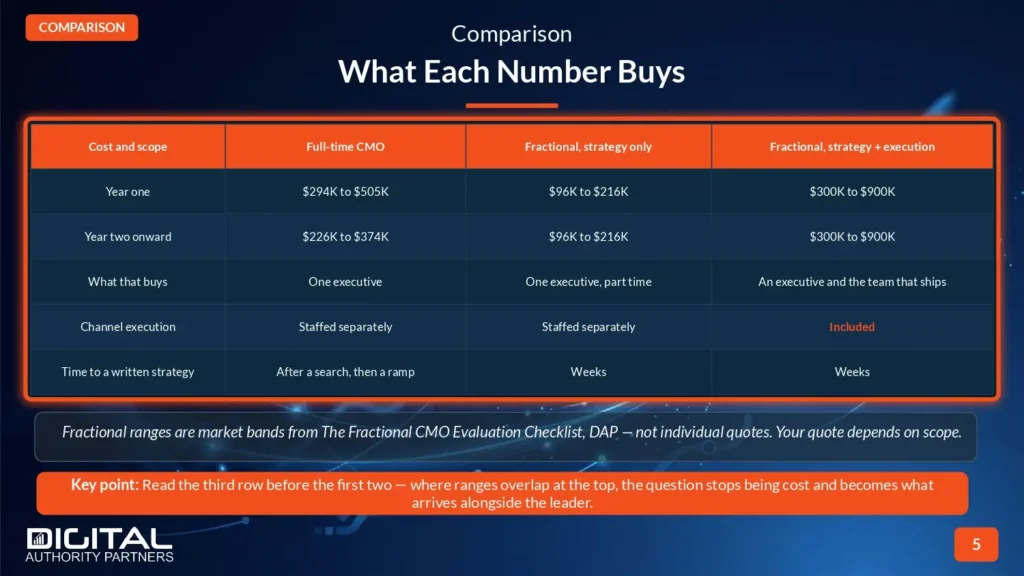
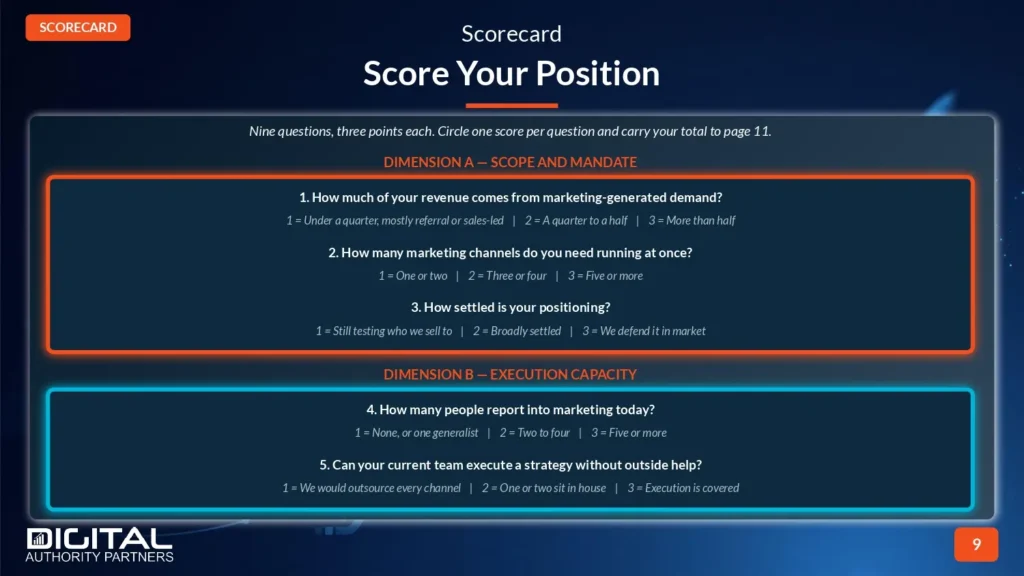
Table of contents
The Evolution of SaaS Marketing Leadership
When NOT to Hire a Fractional CMO
Traditional Marketing Leadership Challenges
5 Competitive Advantages of Fractional CMOs
Why FCMOs Outperform Traditional Hires in SaaS
The Hidden Metrics That Predict FCMO Success
FCMO Implementation Blueprint
ROI Calculation Framework for Marketing Leadership
SaaS Marketing Maturity Model Assessment
The Economic Case: 3-Year Total Cost Analysis
Building Your Internal Marketing Capability
FCMO Selection Framework
Meet Your Growth Architect
Success Stories & Case Studies
Get Started with a Fractional CMO Assessment
Similar white papers

The Department of Justice moved the first Title II compliance date to 26 April 2027, which leaves eight months for public entities serving 50,000 people...
Most software evaluations finish somewhere a vendor does not control. 6sense measured 94% of buying groups ranking their vendors before speaking to a seller, with...
Half of B2B software buyers now open their research with an AI chatbot more often than with Google. G2 put that figure at 51% in...
Have questions about this white paper?
Let’s talk!