Gilead Sciences
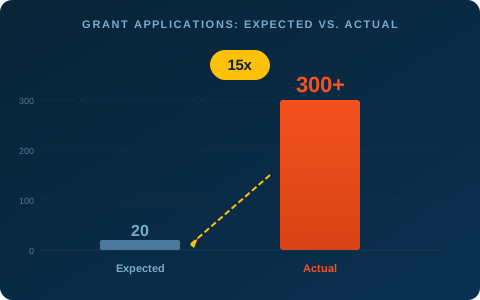
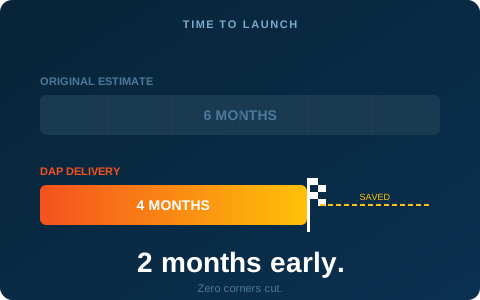
When Gilead Sciences announced the COMPASS Initiative, a 10-year, $100 million commitment to address the HIV/AIDS epidemic in the Southern United States, they had national visibility and major academic partners. But they still needed a digital system to operationalize it. Digital Authority Partners built and launched a fully functional platform in just four months, two months ahead of the original timeline. Within its first six months, the site generated over 300 grant applications, 15 times more than the 20 Gilead had anticipated. The site became the central operating system for one of the largest private commitments to ending the HIV/AIDS epidemic, enabling community organizations to apply, universities to coordinate, and funding to reach the communities it was designed to serve.

Gilead Sciences is a biopharmaceutical company focused on developing medicines for life-threatening diseases. The Community, Partnership, Action, Structural Support (COMPASS) Initiative represented one of the largest private commitments to ending the HIV/AIDS epidemic in the Southern United States, involving partnerships with major academic institutions and community-based organizations. They engaged Digital Authority Partners to build the digital infrastructure that would allow the initiative to function.
How We Helped Gilead Sciences


Project Summary
The COMPASS Initiative existed only in press releases, not in practice. At the time of the public announcement, they lacked the infrastructure to support it. The program needed a website, an eligibility pathway for community organizations, a grant application workflow, a fund distribution system, and coordination tools across multiple stakeholder groups.
The stakes were significant. Without a working platform, participating universities couldn’t distribute funding, and community organizations had no clear entry point into a publicly announced $100M initiative.
Digital Authority Partners built the complete system from the ground up. Through focused prioritization, audience-specific design, and a refusal to build by committee, DAP launched the platform in four months instead of six. The initiative received over 300 grant applications where only 20 were expected.


The Challenge
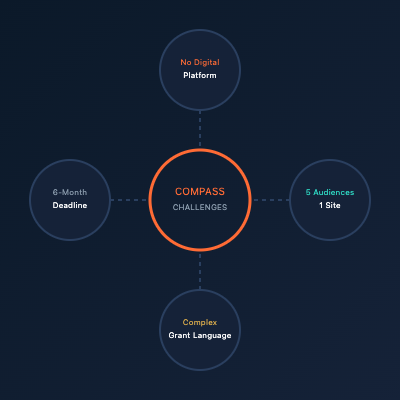
 No Digital Infrastructure
 A $100M Initiative with No Operational Digital Platform
The announcement had national visibility and urgent public health stakes, but the digital presence was a placeholder. The initiative needed a system that could support community-based organizations seeking funding, academic centers managing grants, healthcare professionals, internal Gilead stakeholders, and the general public. Each audience needed clarity, direction, and a clear path forward.
 Complex Stakeholders
 Five Distinct Audiences with Conflicting Needs
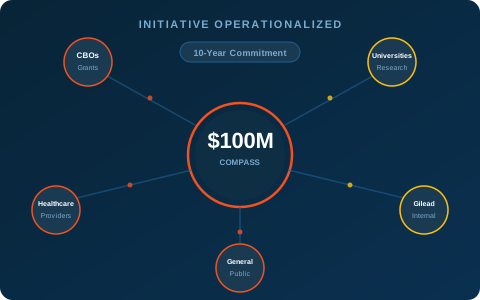
The initiative involved coordinating universities, community organizations of varying sizes and sophistication, healthcare professionals, and internal Gilead teams. Each group had different needs, different questions, and different levels of familiarity with grant processes. It needed more than a one-size-fits-all approach.
 Institutional Complexity
 Grant Language External Audiences Couldn't Navigate
Gilead's internal grant structures, workflows, and approval processes were complex and academically structured. External audiences didn't need that complexity. They needed to quickly understand: Is this relevant to me? Do I qualify? What do I do next?
 Compressed Timeline
 Competing Against Industry Giants
The expected timeline was six months. Given the public visibility of the announcement and the urgency of the public health mission, delays would damage credibility with partner organizations and the communities the initiative aimed to serve.
How we Helped Gilead Sciences
Audience-Specific Messaging and Content Strategy
DAP translated institutional complexity into clear, approachable language for five distinct audiences. We developed all copy for the new website, transforming Gilead’s internal grant language into messaging that felt modern, direct, and actionable.
- Wrote tailored content for five audiences: small community organizations, academic institutions, healthcare professionals, internal stakeholders, and the general public
- Transformed lengthy disclaimers, terms, and institutional language: accessible when needed but never obstructive to the primary experience
- Each audience saw content that spoke directly to them, explained whether they qualified, and told them exactly what to do next
- Prevented users from landing in the wrong workflow and reduced confusion at the top of the funnel
- Earned trust without overwhelming users with complexity
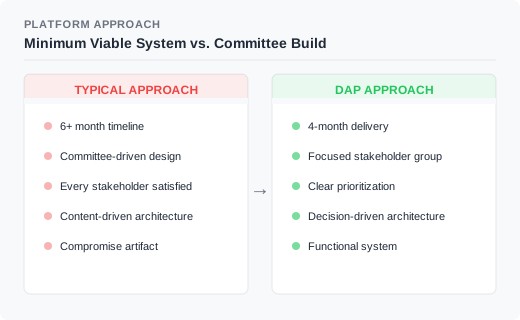
Minimum Viable Website Design on WordPress
We made an explicit decision not to build a massive, committee-driven website attempting to satisfy every stakeholder at once. Instead, we introduced a minimum viable website approach: a small, focused stakeholder group, clear prioritization, and a commitment to iterate based on real usage.
- Structured the site around decisions, not content: users were intentionally routed into distinct paths from the homepage
- Designed the application experience to feel navigable rather than intimidating for organizations of all sizes and sophistication levels
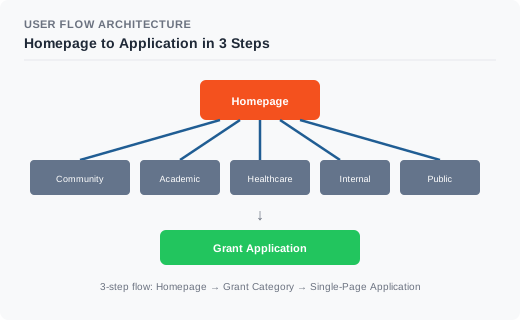
- Organized grants by deadline, funding theme, and audience type with a simple flow from homepage to relevant grant category to single-page application
- Defined the entire information architecture, designed all pages, and built the site on WordPress in partnership with Emory University
- Launched a functional system in 4 months instead of the expected 6, without sacrificing quality or usability
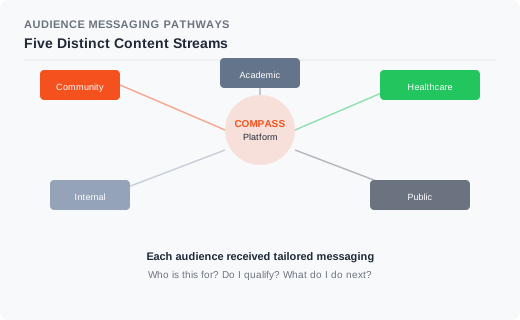
Distinct Audience Pathway Architecture
The homepage guided community organizations, healthcare professionals, and academic partners into dedicated paths built around their specific needs. The application experience was clear and purposeful, designed so applicants always knew where they were and what came next.
- Five distinct audience pathways accessible from a single homepage, each answering: Is this for me? Do I qualify? What do I do next?
- Grant application flow designed as a simple three-step process: homepage to grant category to single-page application
- Collaboration with Emory College and coordinating universities on taxonomy and user flow to ensure institutional buy-in
- Scalable structure that could accommodate new grant programs without redesigning the entire site
- A functional system, not a compromise artifact
Analytics and Measurement Infrastructure
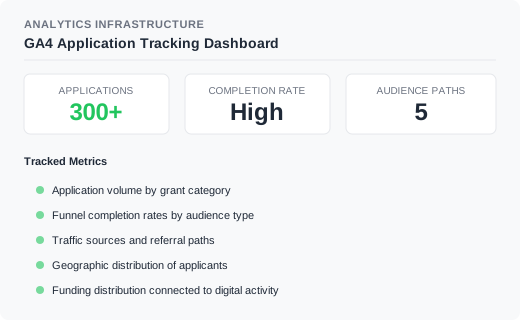
DAP implemented tracking to measure what mattered: applications submitted and funding distributed. We created the web analytics infrastructure and tagging plan to give Gilead real-time visibility into initiative adoption.
- Implemented GA4 to track application volume and funnel performance across all five audience pathways
- Built a tagging plan to measure how organizations engaged with specific grant categories and funding themes
- Tracked where applicants were coming from geographically and whether they successfully completed applications
- Gave Gilead leadership real-time visibility into initiative adoption, turning guesswork into data
- Created a measurement framework connecting digital activity to actual funding distribution outcomes
What we Achieved

Gilead anticipated roughly 20 grant applications. The platform generated over 300 in its first six months. That was the result of an application process that was clear enough for community organizations to complete. The grant portal eliminated jargon, walked applicants through eligibility, and provided a structured workflow that matched how CBOs actually operate. The application surged when we removed the friction.

The expected timeline was six months. DAP launched in four. The difference came down to disciplined prioritization and decisive decision-making. The team identified the minimum viable experience each audience needed at launch and built exactly that. Every design choice mapped directly to a user need, which kept scope tight and progress steady. Stakeholder alignment came through focused, direct conversations that kept the project moving.

The COMPASS Initiative was a $100 million, 10-year operational commitment to addressing the HIV/AIDS epidemic in the Southern United States. The digital platform became the central operating system that allowed universities to coordinate, community organizations to apply for funding, and Gilead to manage the entire grant lifecycle. Without it, the initiative existed only as a press release. With it, funds could actually reach the communities they were designed to serve.

A 15x overperformance on application volume does not happen by accident. It happens when the people you are trying to reach can actually understand what you are offering. By replacing institutional grant language with audience-specific messaging, by designing separate pathways for each stakeholder group, and by building an application workflow that matched how community organizations actually work, DAP turned a complex public health initiative into something organizations could navigate, trust, and act on.