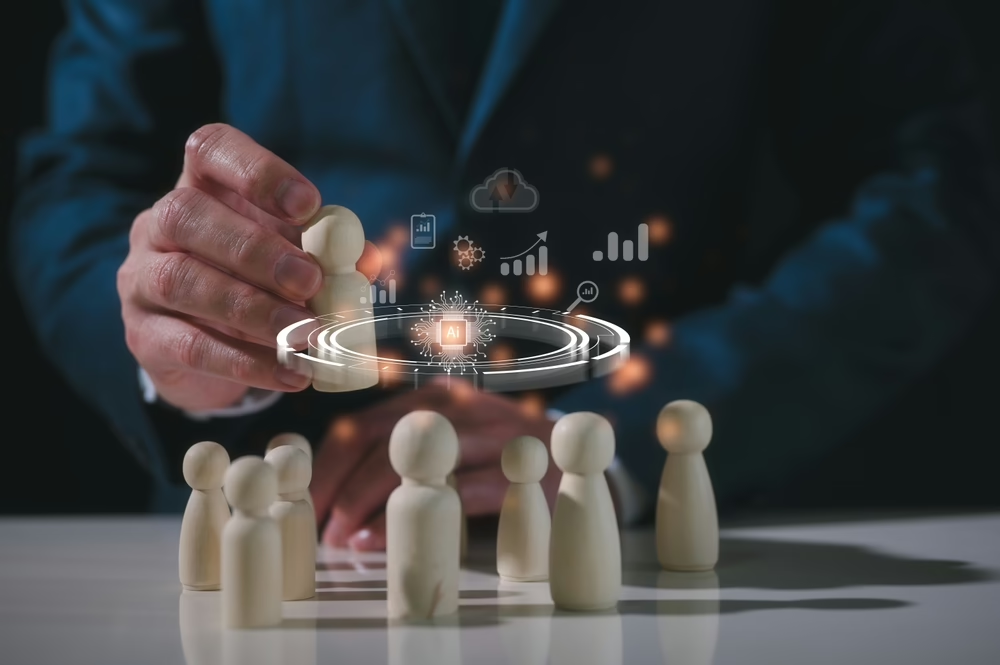
From Dashboards to Human Dynamics: Connecting Marketing Performance and Team Performance with AI

Marketers don’t need more data — they need workflows that make data valuable and useful. Dashboards provide masses of data that include spend, marketing qualified leads (MQLs), pipelines, and client acquisition cost (CAC). Ask yourself: If you already have the data, what’s keeping your team from turning it into measurable performance gains?
Information is helpful when it’s analyzed correctly and used to steer campaigns in the right direction. To make quick work of all this data, AI adoption is moving from pilot projects to a must-have practice through AI performance management for marketing teams.
The U.S. Census Bureau’s Business Trends and Outlook Survey now tracks AI use across U.S. businesses, showing that adoption has been climbing steadily since late 2023 for industries such as marketing, customer service, and analytics.
How AI Connects Dashboard Data to Human Performance Insights
Traditional reporting tells you which channels are generating pipeline, where your client acquisition costs (CAC) creep up, and which campaigns are performing at the desired levels. Traditional information is useful, but it still leaves you without the full picture. Insights that lead to better marketing results should show you:
- Which customer success managers (CSMs) or account executives (AEs) consistently convert your highest-quality leads
- Which campaign owners need additional support to deliver expected outcomes
- Where targeted upskilling can remove process bottlenecks and improve return on investment (ROI)
AI performance intelligence can turn your biggest asset, your human workforce, into a collaborative partner that gets the most value from data-driven programs. An example of this is when your team fully supports running full-funnel digital marketing services, which are excellent for end-to-end visibility. Ownership of processes means that team performance analytics can drive marketing ROI.
How AI Is Rewriting Marketing Work and Expectations
Harvard’s Division of Continuing Education notes that AI is already reshaping marketing roles from content creation and media planning to strategic decision-making. Marketers who can use AI performance management to deliver more relevant, customized experiences will have a decisive edge. That shift shows up on your team in a few ways:
- Workloads fragment: One marketer may juggle prompt engineering, analytics, and stakeholder management in the same afternoon.
- Skill profiles change fast: Curiosity, experimentation, and comfort with AI tools matter as much as channel-specific expertise.
- The “impact per person” gap widens: A handful of AI-fluent marketers suddenly drives a disproportionate share of the pipeline.
A narrow view of campaign metrics misses the operational realities behind them, including how work is structured and how individual behaviors shape outcomes. That’s where AI performance management becomes indispensable.
What AI Performance Management Actually Looks Like
An AI performance intelligence platform sits on top of your existing tech stack to connect all of them together into one cohesive flow. Tools you’re already using — customer relationship management (CRM), marketing automation, project management platforms, call logs, and meeting notes — become part of a centralized data layer. By connecting your tech, you’ll have a singular data point between:
- Channel and campaign data: Your spend, leads, opportunities, and revenue.
- Operational data: Your SLAs, response times, cycle times, and possible backlog.
- People data: Who owns what, their capacity, activity patterns, and coaching history.
Centralizing the data allows marketers to apply people analytics effectively and see, in real time, how team dynamics influence results. Where static dashboards only surface fragments, dynamic AI performance management for marketing reveals the full picture.
AI performance software is built to do exactly this: gathering multi-source marketing and sales data, then applying AI to spot the patterns that humans miss. The data reveals workload imbalances and underutilized top performers. Marketers have access to specific, actionable levers:
- Identifying where work gets stuck in the process
- Revealing which channels, campaigns, or segments actually drive profitable outcomes
- Highlighting top performers and replicating their behaviors
- Detecting workload or capacity imbalances
- Finding hidden inefficiencies in communication and collaboration
- Showing quality issues before they turn into performance problems
- Recommending adjustments based on forecasted demand
In complex B2B environments with multi-stakeholder journeys, organizations often rely on expert partners — such as a specialized SaaS marketing agency — to orchestrate many touchpoints. In those settings, the connection between human behavior and funnel performance is where much of the hidden ROI sits.
Practical Ways AI Can Connect Performance and People
AI in marketing operations allows you to move from dashboards to human performance intelligence. Here’s what that shift looks like:
Capacity and Workload You Can Finally Trust
AI can aggregate tickets, campaigns, meetings, and tasks to estimate true capacity per person, and not just who has the fewest tasks in their queue. You see when:
- A campaign manager is consistently at 130% capacity
- Certain team members are stuck in low-value work
- Handoffs between marketing and sales create recurring bottlenecks
AI performance for marketing is fuel for smarter hiring, better resourcing, and more sustainable targets.
Coaching Based on Patterns
By connecting outcomes through pipeline, revenue, and renewals to activity patterns such as follow-ups and meeting quality, AI can highlight coachable gaps:
- Why does one marketer’s “average” campaign consistently outperform?
- Which reps convert “bad” leads anyway, and how do they do it?
- Where do specific individuals struggle with a certain motion, for example, following up nurture leads within SLAs?
Instead of generic training, you design precision coaching for individuals and roles.
Campaign Retros That go Beyond Creativity
Classic post-mortems fixate on the offer, the landing page, or the audience. When you layer in team performance analytics, you can ask different questions:
- Did we staff this initiative with the right mix of skills?
- Were approval cycles or internal misalignment the real cause of delays?
- Did bandwidth constraints force us to cut corners where it mattered?
AI can summarize these patterns across many campaigns, giving you playbooks for how to staff and manage future initiatives.
See the System and Control the Outcome
Growth goes to the businesses that can replace guesswork with insight, using AI performance tools built for marketers. When you can see where work slows down, where impact originates, and how your team truly performs, decisions get sharper and outcomes become more predictable. AI just makes the truth visible — and once you can see the whole system, you can’t go back.
Want To Meet Our Expert Team?
Book a meeting directly here

Related Articles

The best health apps turn your phone into a daily tool for tracking habits, managing health conditions, and building ...

A healthcare chatbot gives your patients an always-open front door. It answers a question at midnight, books an appoi...
The latest US digital ad spending forecast projects the market will grow from $317 to $490 billion between 2024 and 2...