AI Visibility in 2026: 4 Findings From a 6-Week Study of 1,127 URLs Across 5 AI Engines

AI visibility is how often AI engines cite your pages and recommend your brand in their answers, and how durably those citations hold over time. To put real numbers on it, the Digital Authority Partners AI Visibility Gap study tracked 1,127 unique URLs that ChatGPT, Perplexity, Gemini, Copilot, and Google AI Overviews cited in response to 30 queries.
Six weeks and three collection waves later, only 119 of those URLs were still being cited. The rest had been replaced. The study captured 630 data points across five AI platforms and six industries, with Google and Bing organic top 20 results captured alongside as SERP benchmarks. The findings push back on most of what marketing teams currently report about AI search performance.
Working with a generative engine optimization agency that specializes in AI SEO is becoming more important for companies wanting to look beyond traditional search. This article walks through the four findings with the largest budget and reporting implications: the dark matter invisibility rate, the new Citation Retention Rate metric we developed to track AI source stability, the unique behavior of ChatGPT’s recommendation engine, and the platform fragmentation that breaks every cross-platform optimization shortcut.
Finding 1: Dark Matter. Why 60% of AI Citations Live Outside Your SEO Dashboard
The data shows 60% of the URLs AI engines cite do not rank in the top 20 organic results on Google or Bing for the same query. Across three measurement waves spaced 14 days apart, the dark matter rate held at 62%, then 57%, then 60%. The rate is steady because the structure underneath it is steady. This is how AI citation works.
The implication is operational. If 60% of the sources answering your category’s questions sit outside the top 20 organic results, your current SEO dashboard cannot see them. Ahrefs, Semrush, and Search Console pull rank data from the SERP. AI engines reach beyond it. The two views describe different populations of pages competing for the same audience, which sits at the heart of what generative engine optimization is today.
The structural read matters more than the number itself. Some assumed dark matter is a temporary AI growing pain, an artifact of platforms still calibrating their retrieval models. Three measurement waves across six weeks held the rate inside a three-point band, with no visible drift in any direction.
AI engines reach past the visible SERP because they are designed to. Perplexity surfaced an average of 5.9 citations per query, many from domains with low Domain Rating that would never make the first page of Google. Copilot pulled from Etsy, DealFuel, and Bing-only domains that no other engine touched. The pattern is the system at rest.
For marketing teams, three reporting shifts follow:
- AI visibility belongs in monthly KPI decks as its own line, with citation counts and source-share by platform. Mixing it into organic rankings hides 60% of the signal.
- Catalogue the citation universe before optimizing. Run your top 10 queries across all five major AI engines, capture which domains are cited, and compare that list to your rank tracker. The delta shows where to measure AI search visibility.
- Treat third-party placements as measurable inventory. Third-party media took 89% of AI recommendation citations in our dataset. Forbes, NerdWallet, Zapier, and PCMag dominated, so a slot in those roundups now produces AI visibility that no on-site change can match.
For most categories, PR, partnerships, and digital placement work should sit alongside on-page SEO inside the AI visibility budget, with their own retention tracking attached.
Finding 2: Citation Retention Rate (CRR). AI Citations Decay 67% Per Month
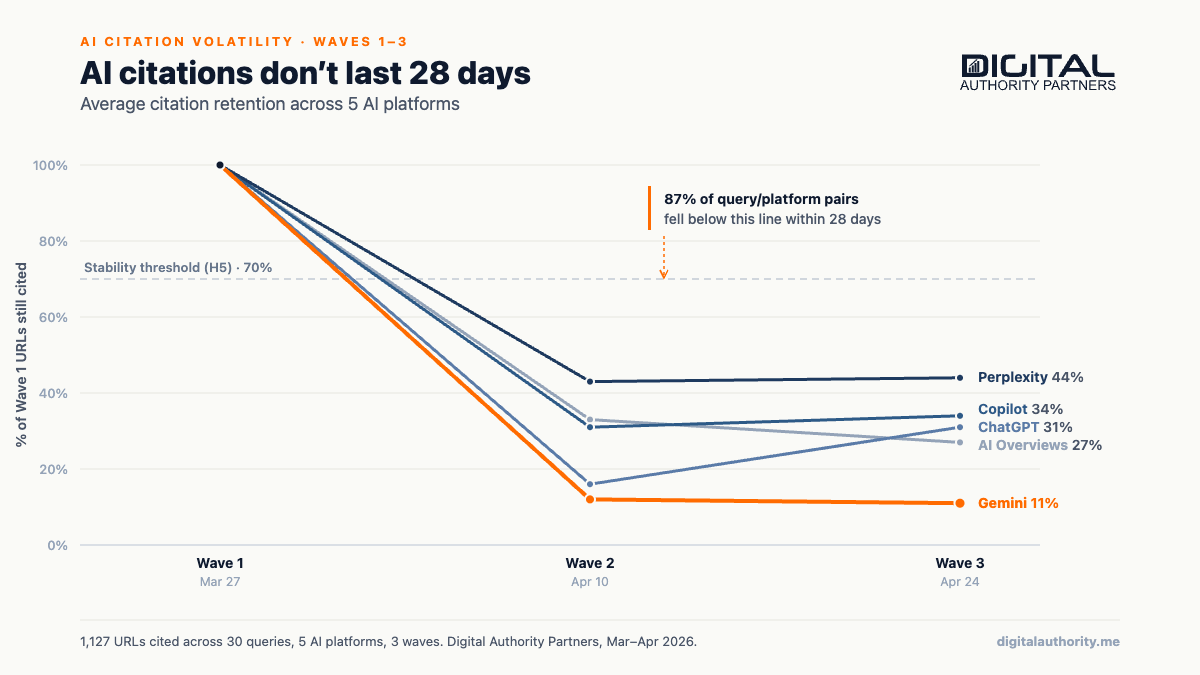
AI citations move. The same query that surfaces your brand on Tuesday may surface a competitor’s the following week, and a third source the week after. To put a number on the movement, we built Citation Retention Rate, abbreviated CRR: the share of cited URLs that hold their position across measurement waves.
CRR over 28 days averaged 33% across five AI platforms. Across the study, 87% of all query and platform pairs fell below a 70% stability threshold. Nearly a quarter, 24%, saw complete citation turnover, with zero overlap between Wave 1 and Wave 3.
The platform breakout tells the deeper story:
- Gemini retained 11% of its citations over four weeks, the lowest of any engine.
- AI Overviews held 27%, ChatGPT 31%, and Copilot 34%.
- Perplexity led at 44%, still well below the stability threshold most marketers would assume.
- Gemini and AI Overviews hit 100% volatility: every query and platform pair on those two engines fell below 70% stability.
The headline survival number is the one to memorize. Of 1,127 unique URLs cited across the full six-week study, 119 appeared in all three waves. That is 10.6% persistence at the URL level across 28 days. Wave 1 produced 530 unique URLs and Wave 3 produced 546, with only 20% overlap between them.
This is why LLM citations need ongoing generative search measurement rather than a quarterly glance.
The investment implication reshapes how content cycles get planned. AI and LLM citation slots get built, lost, and rebuilt on a roughly four-week cycle. A URL that wins a slot today carries a high probability of being replaced within four weeks on at least one platform.
Editorial calendars that account for this cycle hold their citation positions over time. Maintenance work moves onto the same priority footing as new publication. The roadmap shift is concrete:
- Quarterly performance reviews replace annual ones.
- Editorial calendars include a refresh schedule alongside a publish schedule.
- Monthly AI citation tracking sits in the same dashboard as keyword movement.
Teams treating AI visibility as a maintenance-heavy channel rather than a set-and-forget asset will compound advantages quickly. Strong GEO content structure and visibility makes those refreshes easier to win. CRR makes the maintenance work measurable.
Finding 3: ChatGPT Recommends From Memory. Why 74% of Responses Cite Nothing
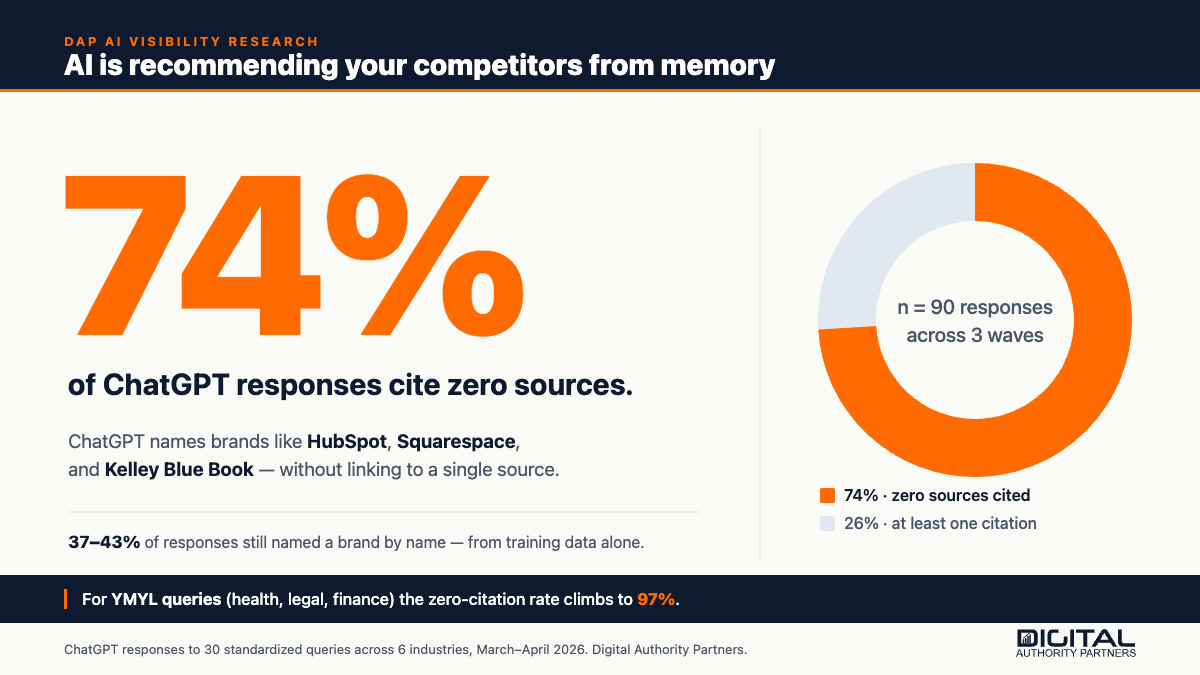
ChatGPT recommends brands without citing sources. Across 90 ChatGPT data points spread over three waves, the citation rate was 26%. The other 74% of responses contained no source links at all, even when the response named specific brands, products, and competitive comparisons. AI brand mention rates across the same waves ranged from 37% to 43%. ChatGPT is making recommendations from its training memory.
This is a different mechanism than every other AI engine in the study. Perplexity, Copilot, AI Overviews, and Gemini perform retrieval against an indexed web at inference time, then cite the documents they pull. ChatGPT mostly pulls from a model that has already absorbed the brands, the comparisons, and the reputational signals during training.
By Wave 3, our collection team documented a behavior change: interactive side panels appeared when brand names were clicked inside ChatGPT responses, similar in structure to Google Knowledge Panels. ChatGPT is moving toward a brand-entity surface, with sourceless responses sitting on top.
The optimization playbook diverges sharply here. SEO, even AI-search SEO, depends on producing crawlable, citable content that retrieval systems can find and reference. ChatGPT surfaces brand associations from patterns it learned during training, with live retrieval playing a minor role across our sample. The target shifts from page authority to entity optimization for AI search.
Three workstreams matter here:
- Wikipedia presence and accuracy become higher-leverage than blog post production, because Wikipedia is one of the densest sources in language model training corpora. In our companion AI brand mentions study, 36 of 49 brands had a Wikipedia page, and the signal that moved naming on all five AI assistants was each brand’s own homepage.
- Structured data on the brand itself, including Organization, Product, and Service schema, gives the next generation of training corpora cleaner entity signals. This is where LLM search optimization content structure pays off.
- Earned media coverage in the publications language models train on, including major business press, trade press, and analyst reports, builds reputational signal that survives training cycles.
The budget implication is direct. ChatGPT optimization is a brand authority program, a form of LLM SEO that runs on a longer time horizon than search SEO, with PR and earned media doing the heaviest lifting. Teams ready to build an AI SEO strategy should give it its own budget line and measurement frame.
Finding 4: Platform Fragmentation. Why 78 to 85% of Cited Domains Are Unique to One Engine
AI engines do not share a citation universe. The highest domain overlap we measured between any two platforms was 17%, between Perplexity and AI Overviews. Every other pair sat lower:
- ChatGPT and Copilot at 14%.
- Perplexity and Copilot at 10%.
- Copilot and AI Overviews at 9%.
- Gemini and Copilot at 2%.
Between 78% and 85% of cited domains across the dataset were unique to a single platform. Each engine is drawing from its own corner of the web. The patterns underneath that fragmentation are specific and useful:
- AI Overviews cited YouTube videos in 47% to 63% of its responses; the other four engines almost never did.
- Copilot cited Reddit zero times across 90 data points, while AI Overviews cited Reddit 20 times and ChatGPT cited it 10 times.
- Copilot pulled from Bing-only domains including Etsy listings, DealFuel pages, and niche sites that no other platform touched.
- Perplexity averaged 5.9 citations per query and rewarded comparison content, with Zapier, NerdWallet, Reddit, Forbes, and Experian at the top.
Cross-platform optimization leaves value on the table for a measurable reason. The content that earns a Perplexity citation lives in comparison and listicle formats. The content that earns an AI Overviews citation often lives on YouTube. The content that earns a ChatGPT brand mention lives in training memory and Wikipedia.
A single piece of content cannot serve all five engines, and the assumption that ranking on Google produces AI visibility across the board breaks against this data.
The strategic move is platform prioritization by vertical, and the tactical ways to win visibility differ by engine:
- Healthcare, legal, and financial brands should index toward Perplexity and AI Overviews, where YMYL suppression is lowest.
- B2B SaaS should weight Perplexity, where comparison content over-indexes, alongside ChatGPT entity authority.
- Local-dependent businesses should accept lower base retention and lean into YouTube and Reddit for AI Overviews.
- Home services and consumer brands get the most out of YouTube, given how heavily AI Overviews uses it.
Picking two platforms and going deep is where the compounding returns live for most marketing teams. Grounding that choice in generative engine optimization best practices keeps the effort focused.
Build an AI Visibility Program That Compounds
AI visibility is fast becoming a revenue channel in its own right. The brands that treat it as a measured, maintained program will own the citations their competitors never see.
Think back to the opening number. Of the 1,127 URLs AI engines cited in our study, only 119 were still cited six weeks later, and that turnover is your opening. The slots reopen every month, and a disciplined program keeps your brand in them across ChatGPT, Perplexity, Gemini, Copilot, and AI Overviews.
Download the AI Visibility Gap Study to get a head start on your modern search strategy, You can also schedule a GEO strategy consultation with our team, and you get a clear map of your dark matter exposure, a two-platform priority plan for your vertical, and the citation tracking that proves the work.
Frequently Asked Questions
What is the AI Visibility Gap?
The AI Visibility Gap describes the share of content cited by AI engines that traditional SEO tools cannot track. In our study, 60% of AI-cited URLs did not rank in the top 20 organic results on Google or Bing for the same query, putting them outside the visible SERP that rank-tracking dashboards monitor.
What is Citation Retention Rate (CRR)?
Citation Retention Rate, abbreviated CRR, is a metric we developed to measure the share of AI-cited URLs that remain in citation across measurement waves. Across five AI platforms over 28 days, the average CRR was 33%. Gemini posted 11%, AI Overviews 27%, ChatGPT 31%, Copilot 34%, and Perplexity 44%.
How is optimizing for ChatGPT different from SEO?
ChatGPT cited a source in only 26% of responses across our 90-data-point sample. The other 74% of responses recommended brands without retrieval, drawing from training memory. ChatGPT optimization therefore favors brand entity work such as Wikipedia presence, structured data, and earned media inside language-model training corpora, over the page-level content production that drives SEO.
Why do AI platforms share so little overlap in their citations?
Each engine has its own preferred sources, formats, and indexing partnerships. AI Overviews leans heavily on YouTube. Copilot pulls from Bing-only domains and avoids Reddit. ChatGPT cites from a training-influenced memory layer. Perplexity rewards long-form comparison content. The highest domain overlap between any two platforms in our study was 17%, with most pairs below 10%.
How was the study conducted?
Digital Authority Partners ran 30 queries across five intent types and six industries on ChatGPT, Perplexity, Gemini, Copilot, and Google AI Overviews, with Google and Bing organic top 20 as SERP benchmarks. Collection occurred in three waves spaced 14 days apart, generating 630 data points and 1,127 unique cited URLs over six weeks.
Want To Meet Our Expert Team?
Book a meeting directly here
Related Articles
IN SHORT Digital Authority Partners audited 150 US ABA and autism therapy clinic websites in July 2026, scoring each ...

Your phone can walk you through a panic attack faster than most clinics can return a call. More than one billion peop...

United States shoppers spent $326.7 billion online in the first quarter of 2026, according to the U.S. Census Bureau....