The GLP-1 Marketing Playbook for Medical Weight Loss Clinics and Telehealth Platforms
What You Will Learn in This GLP-1 Marketing Playbook
Every GLP-1 patient chooses a provider before they ever call your office. They check whether insurance covers the medication, many learn it does not, and they arrive ready to pay cash and ready to compare providers. That comparison now happens in local search, in telehealth listings, and increasingly inside AI answers. The first appointment happens where the patient searches, and it happens without you in the room.
The clinics and telehealth platforms winning right now treat that search moment as patient acquisition. They show up for the drug-class and “near me” terms that carry booking intent, they earn the AI recommendations patients ask for, and they build the retention that turns one patient into a 12-month relationship. This playbook maps the exact system behind that growth, the compliance guardrails that keep it clean, and the economics that decide who leads consolidation.
- 0 to 30 new patients a month: OK Pain Treatment Centers
- #1 in ChatGPT across 8 of 9 neighborhoods: Chicago Pediatric Therapy
- 11,400% organic traffic growth: imaware
Results drawn from DAP published healthcare case studies.
Seven Things This Playbook Will Help You Do

Read your market’s GLP-1 search demand
Live search data shows which GLP-1 terms carry ready-to-book intent in your market and which ones the big brands already own. The playbook shows you how to read your own demand before you spend a dollar.

Win the drug-class and "near me" terms that book patients
Ozempic draws more than a million searches a month at a ranking difficulty of 81, while the "near me" and drug-class cluster sits at difficulty 6 to 14 with booking intent. The playbook maps the keyword mix that fills appointments fastest.

Earn AI recommendations with proprietary research
Patients now ask AI which provider to choose. DAP’s original AI Visibility Study, tracking 1,127 cited URLs across five engines, shows how healthcare brands earn those recommendations and which two platforms to prioritize this quarter.

Build the paid, organic, and AI channel mix
The strongest clinics invest across three channels at once. The playbook breaks down the $20K to $50K monthly range that wins competitive markets and the split that brings blended cost per patient down as the program grows.

Market compounded GLP-1 within the guardrails
The playbook translates FDA and FTC guidance into what you can say about outcomes, maps the compounded-medication advertising rules, and lays out the state-by-state telehealth considerations that keep every channel clean.

Turn retention into your highest-margin growth
One GLP-1 patient is a 12-month relationship. The playbook shows the onboarding, cancellation-trigger, and win-back workflows that protect the lifetime value acquisition paid for.

Run the CAC, LTV, and payback math
The playbook models CAC, LTV, payback, and margin for a cash-pay GLP-1 program, with the LTV:CAC threshold investors look for, so you can run the numbers for your own market.
Peek Inside the Guide
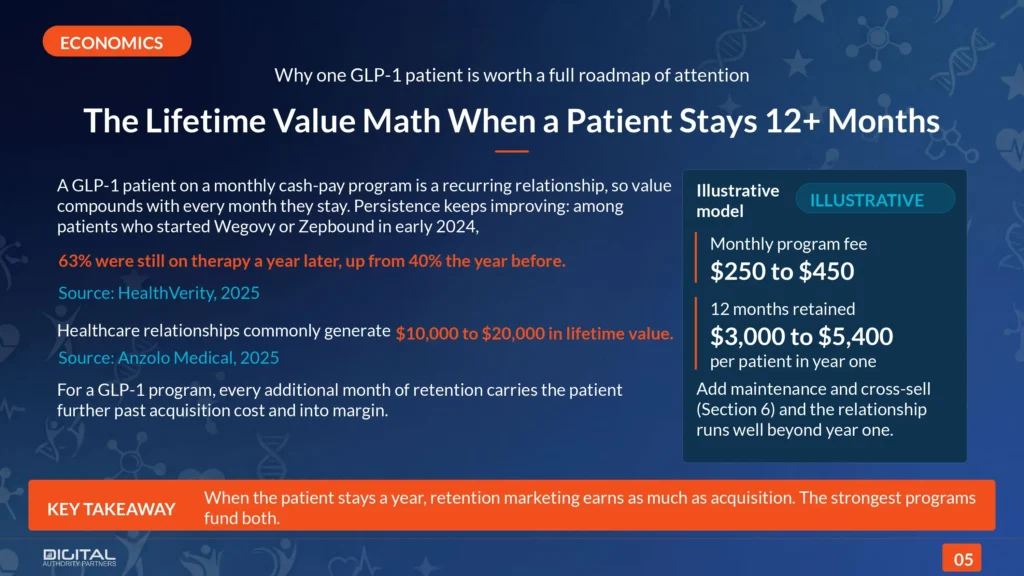
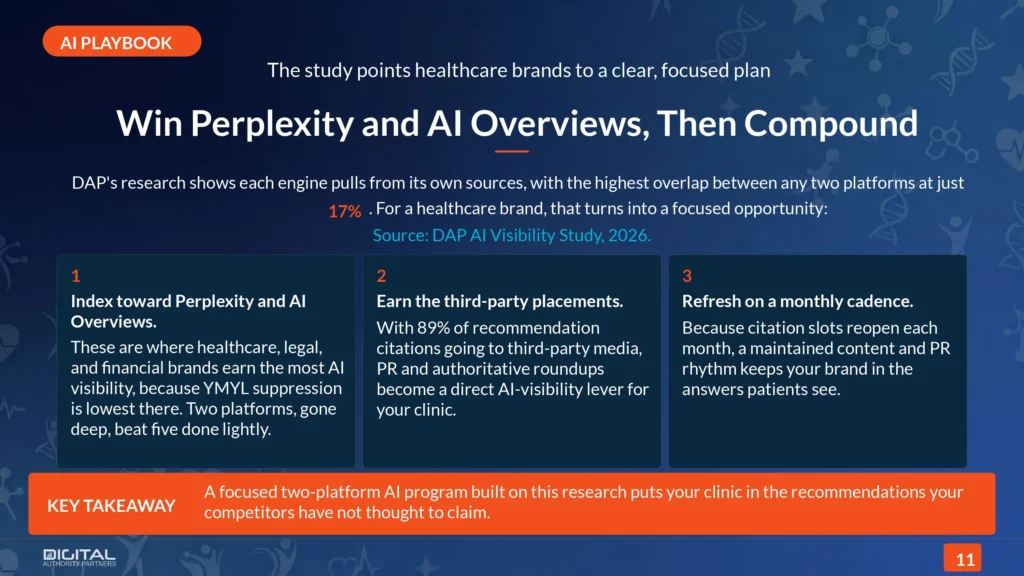
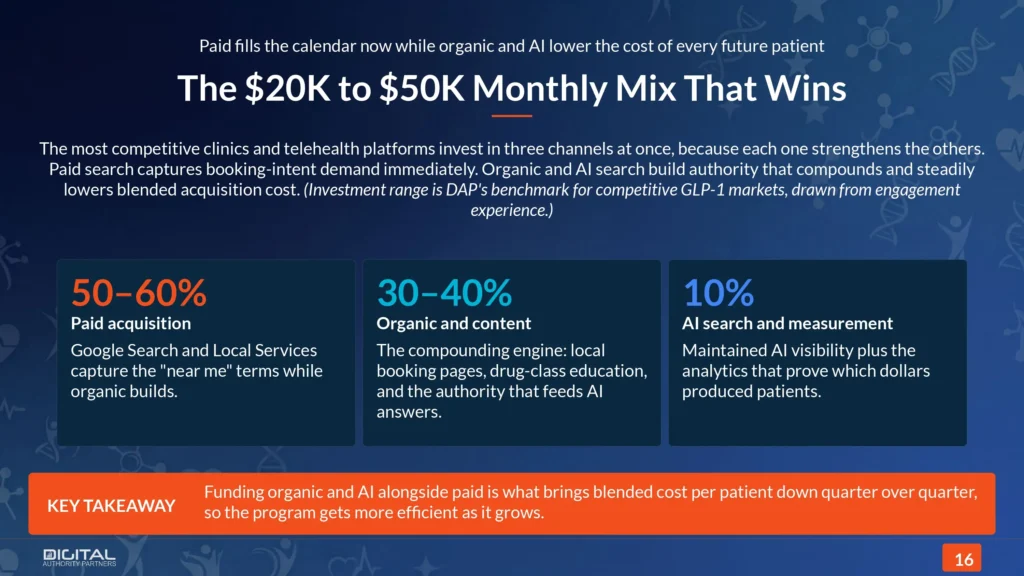
Table of contents
How patients search, how AI recommends providers, and how your economics compound
The category momentum: $48B market, 1 in 8 adults, cash-pay demand
Where the advantage goes in a market adding providers every month
Insurance research and the cash-pay decision
Hub-and-spoke telehealth versus the in-clinic provider
Compounded GLP-1 in the consideration set
The 12-month lifetime value math
Brand head terms versus drug-class and “near me” intent
The low-difficulty cluster that books patients fastest
The keyword mix: local booking, drug-class education, brand-adjacent capture
What the DAP AI Visibility Study measured across five engines
Why 60% of AI citations sit outside the standard SEO dashboard
The two-platform plan for healthcare brands
FDA and FTC rules on outcomes and weight-loss claims
Compounded GLP-1 advertising guardrails
State-by-state telehealth considerations
The $20K to $50K monthly range that wins competitive markets
The starting split across paid, organic, and AI search
How blended cost per patient falls as the program compounds
The 12-month lifecycle and the month-two onboarding moment
The cancellation triggers and the support that meets them
Win-back flows and cross-sell into adjacent services
CAC, LTV, payback, and margin for cash-pay programs
The LTV:CAC threshold investors look for
The economics that decide who leads consolidation
OK Pain Treatment Centers: 0 to 30 new patients a month
imaware: 11,400% organic traffic growth, 20x sales
Chicago Pediatric Therapy: #1 in ChatGPT across 8 of 9 neighborhoods
Similar white papers

The Department of Justice moved the first Title II compliance date to 26 April 2027, which leaves eight months for public entities serving 50,000 people...
Most software evaluations finish somewhere a vendor does not control. 6sense measured 94% of buying groups ranking their vendors before speaking to a seller, with...
Half of B2B software buyers now open their research with an AI chatbot more often than with Google. G2 put that figure at 51% in...
Have questions about this white paper?
Let’s talk!