The B2B Software AI Visibility Report: What AI Engines Cite When They Build a Shortlist
What You’ll Learn in This B2B Software AI Visibility Report
Half of B2B software buyers now open their research with an AI chatbot more often than with Google. G2 put that figure at 51% in March 2026, up from 29% eleven months earlier, and 69% of the buyers surveyed chose a different vendor than the one they had planned on because of what an engine told them. A third bought from a company they had never heard of before the answer named it. With 83% of buyers shortlisting three products or fewer, the answer an engine returns is close to the whole consideration set.
This report shows you which sources those engines reach for and how a software vendor earns a place among them. Digital Authority Partners ran fifteen buyer-style prompts across CRM, project management and cybersecurity through Perplexity and ChatGPT, then classified all 162 citations across 115 domains, and set that wave against two larger DAP studies: a longitudinal measurement of 1,127 cited URLs across five engines, and a content study scoring 497 organic results on twelve characteristics. Inside you get the flywheel linking your search performance to your review platform placement, the published placement criteria and review thresholds for G2, Capterra, TrustRadius and Gartner Peer Insights, a twelve-signal self-assessment scored out of 48, four score bands with a different first move each, and a ninety-day sequence with a named owner per phase. It is written for the marketing lead who has to put a plan in front of a founder, and for the founder who signs it.
- 51% of B2B software buyers open their research with an AI chatbot more often than with Google, up from 29% eleven months earlier (G2, The Answer Economy, April 2026, 1,076 B2B decision makers)
- Vendor-owned pages supplied 72 of the 162 citations we captured, more than trade press, review platforms, documentation and forums combined (DAP B2B Software AI Engine Test, July 2026)
- Citation retention averaged 33% across 28 days on five engines, so roughly two thirds of cited sources turn over inside a month (DAP, The AI Visibility Gap, May 2026)
Six Things This Report Will Help Your Software Company Do

1. Read where software buyers start, and what the shift opens
Three figures set the frame: 51% of buyers open with an AI chatbot, 83% shortlist three products or fewer, and buyers draw on seven sources per purchase on average. The report names those source types and shows which of them a vendor can earn, so the shift arrives as a list of surfaces you can work rather than a headline you react to.

2. Connect the flywheel between search, reviews and AI citation
Capterra Popularity and G2 Market Presence both score branded search volume and SERP position as inputs to placement. Review platforms hold three of the five most-cited domains on commercial queries, and 85% of buyers think more highly of a vendor an AI chatbot mentions. The report follows that loop all the way round and shows what changes when the three budgets funding it work from one roadmap and one measurement view.

3. See what a live engine test captured this July
Fifteen prompts, three categories, two engines, twenty responses, 162 citations, 115 domains, with the method and the limits of the wave published ahead of the findings. Three of those findings travel: paid placement now sits inside AI answers, including on a competitor’s brand query; vendor-owned pages were the largest single evidence source; and an alternatives question opens a shortlist three times wider than a head-to-head comparison.

4. Publish in the formats that earn citation
Across 497 scored organic results, reference and encyclopedia content earned citation 75% of the time, editorial 58%, landing and service pages 25%, and forum threads 8%. Author bylines showed no measurable citation lift once content type and domain authority were accounted for. Rebuilding pages you already own is the fastest gain available this quarter, because format moves inside one publishing cycle while domain authority takes years of accumulated links.

5. Work the aggregator layer against published criteria
G2 agreed to acquire Capterra, Software Advice and GetApp in January 2026, leaving three networks holding the ground in software, and every one publishes its scoring in full. The report sets out what determines position on each platform and the review thresholds that open recognition, which run from ten reviews in a category up to twenty. Ten reviews per network per quarter clears every published threshold in the report inside two quarters and then holds it.

6. Score your twelve signals and run the ninety days
A twelve-signal self-assessment scores your owned, third-party and product surfaces out of 48 and lands you in one of four bands, each with a different first move. The ninety-day sequence that follows names the owner, the work and the output for each of three phases, and bookends with measurement, so the comparison against your day-one baseline becomes the input for quarter two.
Peek Inside the Guide
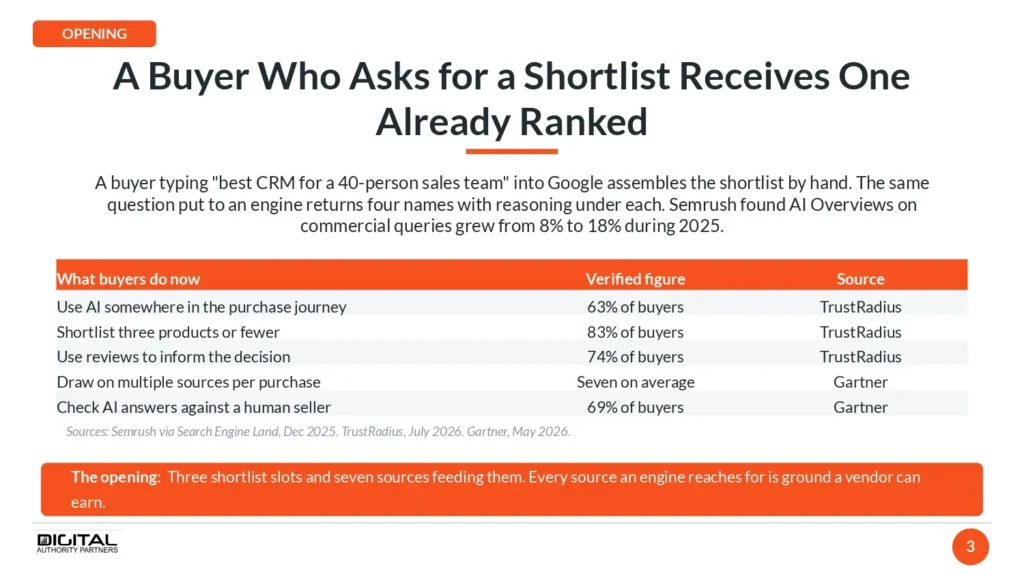
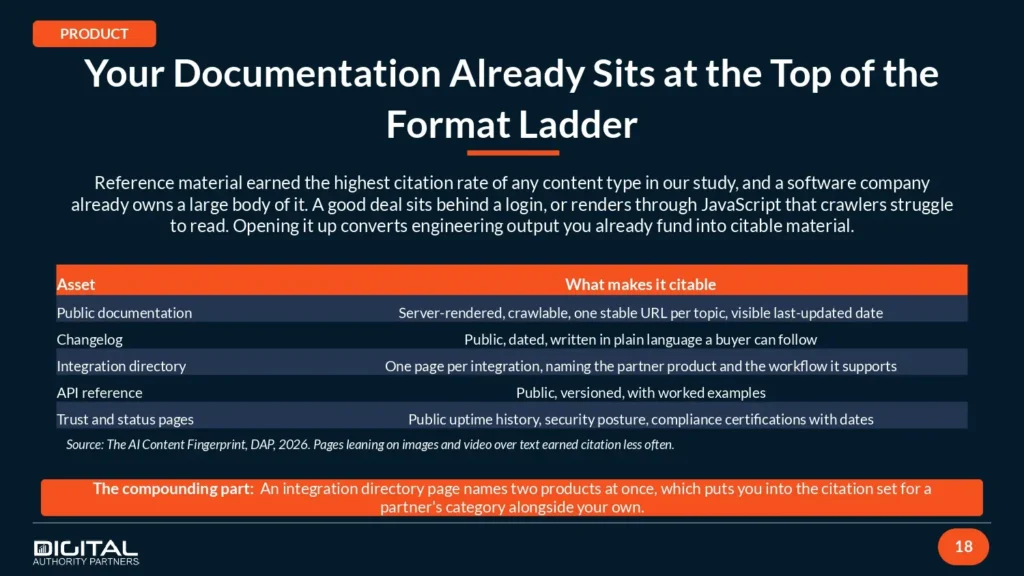
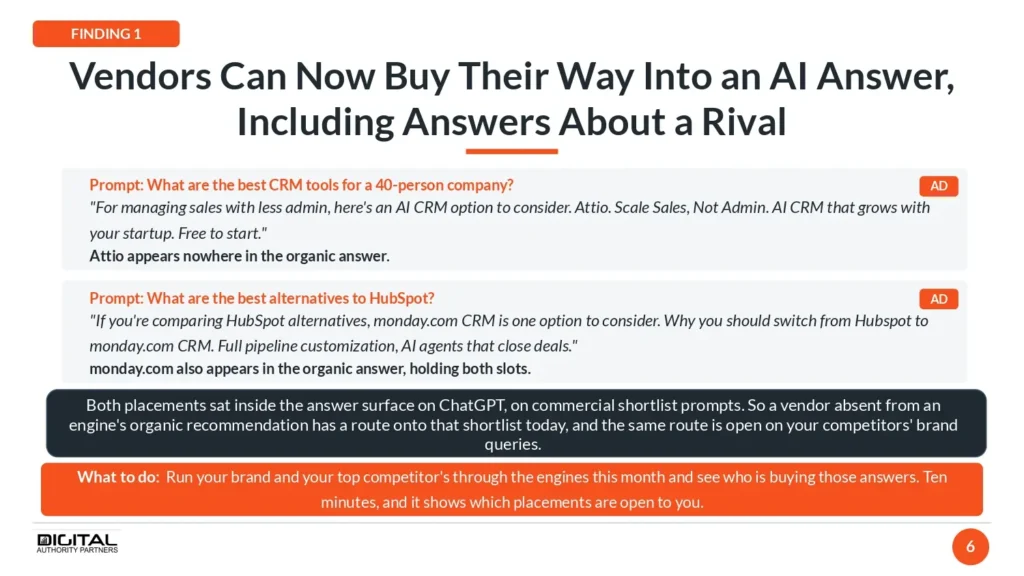
Table of contents
Half of software buyers open their research with an AI chatbot, and what the 1,076-buyer G2 survey found
Three shortlist slots, seven sources per purchase, and the ground a vendor can earn on each
The four-step loop from search visibility to platform placement to AI citation to branded search
Why reviews, search and product documentation form one system funded across three budgets
Fifteen prompts, three categories, two engines, one wave, 162 citations across 115 domains
What the wave supports and what it does not, stated in full before the findings
Paid placement inside an AI answer, including on a competitor’s brand query, captured with its labels
Vendor-owned pages as the largest single evidence source, at 72 of 162 citations
Alternatives questions opening a shortlist three times wider than a head-to-head
The content type ladder: reference at 75%, editorial at 58%, landing and service at 25%, forums at 8%
Author bylines and credentials, and why content format carries the result
Citation retention at 33% over 28 days, and the 60% of cited domains outside the Google and Bing top twenty
The G2, Capterra, Software Advice and GetApp consolidation, and the three networks that now hold the ground
Four measurements of review platform influence set side by side, from 34.5% down to 4.9%
Published placement criteria per platform, and the ten-to-twenty review thresholds that open recognition
Owned: comparison, alternatives and category definition pages, which move inside one publishing cycle
Third-party: review cadence, category roundups and named-expert placement, on a one to two quarter clock
Product: documentation, changelog, integration directory and API reference, on your release cycle
Twelve signals scored out of 48, and four bands carrying a different first move each
A three-phase ninety-day sequence with a named owner and a stated output per phase
The five prompt shapes to rerun on your own category, and every source behind every figure
Similar white papers
Therapy clients search with clear intent, and a well-run Google Ads account puts your practice in front of them at the moment they look for...

Someone searching “alcohol rehab near me” gets a Local Pack and no AI Overview. Someone searching “what is MAT treatment” gets an AI Overview that...

Google treats financial queries differently from every other vertical. The same system that writes confident overviews for recipes and travel applies stricter safety filters to...
Have questions about this white paper?
Let’s talk!