
Best Artificial Intelligence Books to Read in 2026

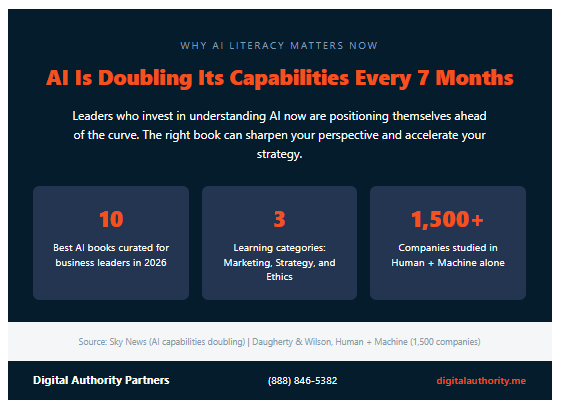
Artificial intelligence is reshaping how you market, sell, and operate. AI is doubling its capabilities every seven months, and the leaders who invest in understanding the technology now are positioning themselves ahead of the curve.
For digital marketers, AI is central to how content and search engine optimization work together. Agencies offer generative engine optimization (GEO) to build on your existing SEO practices and feature your brand in AI overviews. Strategists are integrating agentic AI into their tech stacks to deliver more comprehensive, data-informed strategies.
Whether you are exploring AI for the first time or already using it across your workflows, the right book can sharpen your perspective and accelerate your strategy. These are the best artificial intelligence books for every stage of your journey in 2026.
What Are the Best AI Books for Marketing Teams?
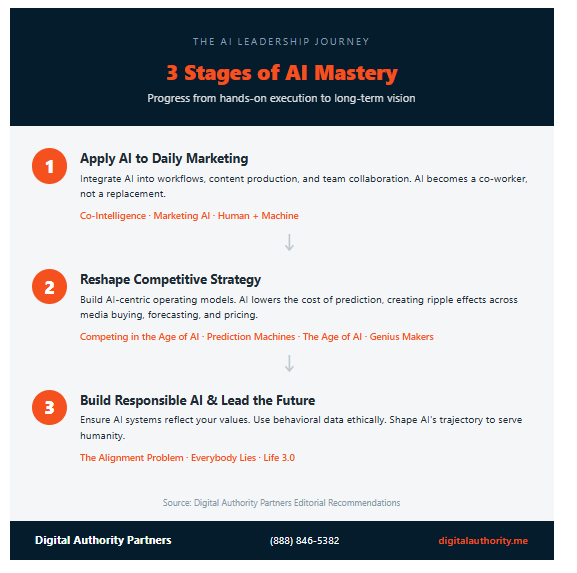
AI is automating campaign optimization, accelerating content production, and reshaping how your team collaborates on creative work. The books in this section focus on applying AI directly to your daily operations, from strategic planning to hands-on execution.
Co-Intelligence: Living and Working with AI by Ethan Mollick
Ethan Mollick reframes AI as a collaborative partner rather than a replacement for human work. Co-Intelligence is one of the best artificial intelligence books for professionals ready to bring AI into their daily routines. Mollick positions AI as a new kind of co-worker, one capable of brainstorming and accelerating knowledge work when used with intention.
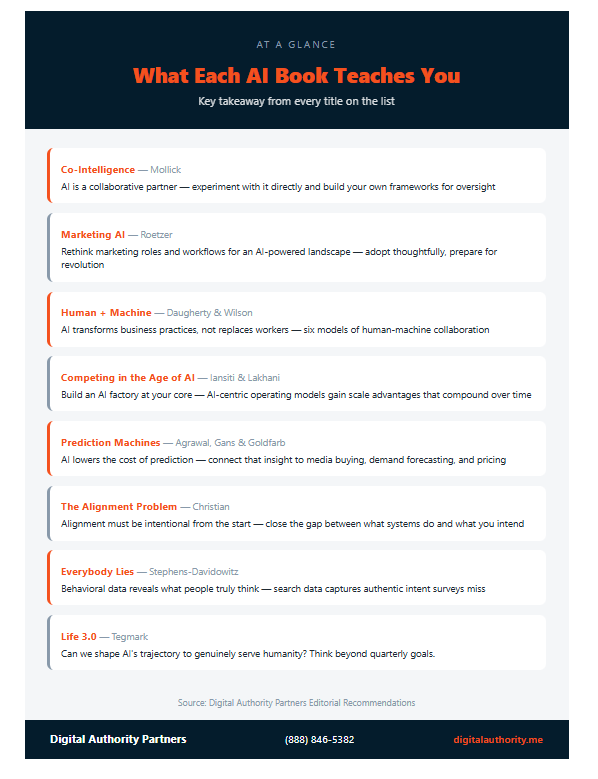
What sets this book apart is Mollick’s emphasis on experimentation. He encourages you to engage directly with AI systems, learn their strengths firsthand, and develop your own frameworks for oversight. The central argument is clear: organizations and individuals who learn to partner with AI will outperform those who resist it.
Mollick also provides practical frameworks for integrating AI into everyday workflows, including how AI reshapes productivity and professional development. For you, this means actionable guidance on building AI collaboration into your team’s processes.
Co-Intelligence offers a forward-looking but pragmatic guide to thriving in an AI-augmented workplace. It rewards curiosity and strategic integration.
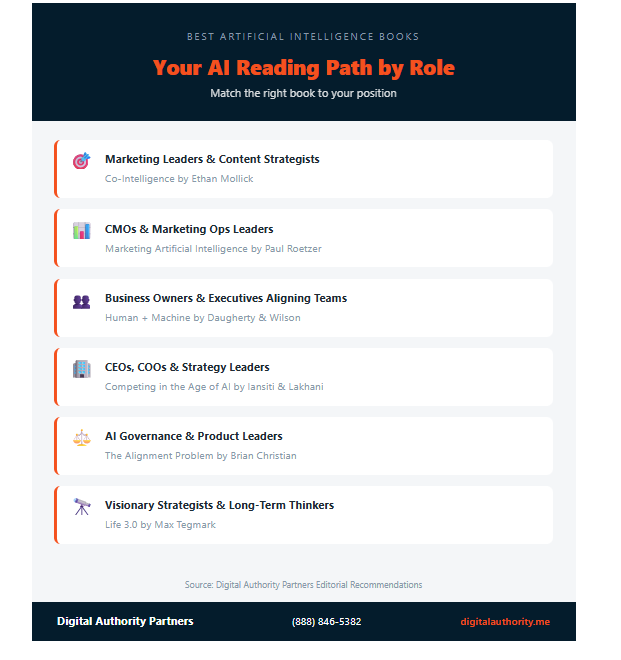
Best suited for: Marketing leaders, content strategists, and knowledge workers exploring AI as a collaborative partner
Where to find it: You can find Co-Intelligence with publisher Penguin Random House and through leading retailers
Marketing Artificial Intelligence by Paul Roetzer
While Co-Intelligence focuses on individual collaboration, Paul Roetzer zooms out to the full marketing function. The founder of the Marketing AI Institute, Roetzer, positions Marketing Artificial Intelligence as your guide to adopting AI proactively across your entire team.
Roetzer explains how AI enhances core marketing functions, without overwhelming you with technical detail. Marketing AI is one of the best generative AI books for marketers ready to lead adoption. He covers where AI is advancing fastest, from content creation and personalization to predictive analytics and performance forecasting, and outlines how intelligent automation can streamline repetitive tasks and unlock data-driven decision-making.
A major strength of the book is its emphasis on transformation. Roetzer addresses how marketing teams should rethink roles and workflows in an AI-powered landscape. He also provides guidance on assessing your team’s AI readiness and building stronger implementation foundations.
Marketing Artificial Intelligence serves as both a strategic guide and an operational blueprint for marketing leaders. It balances opportunity with realism and encourages you to adopt AI thoughtfully while preparing for long-term industry revolution.
Best suited for: CMOs and marketing operations leaders building AI-ready teams
Where to find it: You can find Marketing AI on the author’s website.
Human + Machine: Reimagining Work in the Age of AI by Paul R. Daugherty and H. James Wilson
Daugherty and Wilson take a pragmatic approach to what AI means for the modern workplace. To the authors, AI is more likely to transform business practices than to replace human workers, and their research supports that perspective with depth.
The authors draw on their experience with 1,500 different companies to describe six evolving mergers of human and machine collaboration that enable organizations to adopt AI and advance profitability.
One of the best, most AI-accessible books for beginners on this list, the book includes a “Leader’s Guide” to help you align your company for success with AI. Machine learning is opening powerful new opportunities in the workplace, and leaders who lean in now will be best positioned to benefit.
If you are a business owner or executive focused on building AI-ready teams through proper training, this book provides the framework you need to align your goals and prepare your organization for what comes next.
Best suited for: Business owners, operational leaders, and executives aligning their teams for AI adoption.
Where to find it: You can find Human + Machine with publisher Harvard Business Review Press.
How Does AI Reshape Your Competitive Strategy?
The books above help you apply AI to your marketing workflows. The titles in this section move beyond daily execution into how AI transforms your competitive position and organizational architecture. If you are thinking at the business model level, these reads will sharpen your strategic lens.
Competing in the Age of AI by Marco Iansiti & Karim R. Lakhani
Marco Iansiti and Karim R. Lakhani make the case that AI is not another technology layer. It reshapes how your organization operates and competes. Competing in the Age of AI is one of the best books on artificial intelligence adoption, drawing on case studies and research to introduce the concept of the “AI factory,” a centralized operating model where data pipelines, algorithms, and software infrastructure work together in a continuous feedback loop.
The book encourages you to put AI at the core of your business model rather than treat it as an add-on. AI-driven firms can replace traditional hierarchical structures with digital, network-based systems that enable rapid experimentation and real-time optimization. The authors explore how algorithms generate competitive advantage through scalability and digital amplification.
The central takeaway is strategic. Companies that build AI-centric operating models gain scale advantages that compound over time. Competing in the Age of AI offers a clear framework for navigating transformation in a world increasingly shaped by algorithms and networks.
Best suited for: CEOs, COOs, and strategy leaders redesigning their operating models around AI.
Where to find it: You can find the ebook and hard copy through major online retailers.
The Age of AI by Henry Kissinger, Eric Schmidt & Daniel Huttenlocher
Where Competing in the Age of AI focuses on organizational models, The Age of AI takes you into the geopolitical and regulatory dimensions that shape how businesses adopt artificial intelligence. It is one of the best AI books for understanding how policy, governance, and global competition influence your strategic planning.
The authors argue that AI represents a transformative shift comparable to the Industrial Revolution, a moment that will redefine how societies generate knowledge and exercise power. Kissinger, Schmidt, and Huttenlocher examine how AI systems operate differently from human reasoning and how their outputs can be powerful yet opaque. The book considers the implications for global competition, particularly as nations invest aggressively in AI capabilities, and explores what governance frameworks you should be tracking.
Rather than offering technical instruction, The Age of AI focuses on philosophical and strategic dimensions.
For you as a leader in marketing or technology, this is one of the best books for learning AI at a high level. AI is more than a productivity tool. It is reshaping the global balance of influence and the rules of competition.
Best suited for: Executives, policy-minded leaders, and technologists interested in AI’s geopolitical and regulatory implications
Where to find it: You can find The Age of AI on Goodreads or other major retailers.
Genius Makers by Cade Metz
Strategy is easier to set when you understand where the technology came from. Genius Makers traces the rise of modern artificial intelligence through the researchers and rivalries that pushed deep learning from academic labs into global dominance, marking it one of the best books for those wanting a historical context on the field.
The book centers on pioneers like Geoffrey Hinton, whose breakthroughs in neural networks earned him the 2018 Turing Award alongside Yann LeCun and Yoshua Bengio. Cade Metz blends biography and technological history to show how AI moved from university research into companies like Google and Facebook. The narrative captures the interplay between open academic collaboration and corporate investment, revealing how talent acquisitions and the rise of massive computing power accelerated progress.
A key theme is the shift from symbolic AI to data-driven neural networks and how that transition reshaped fields from speech recognition to natural language processing. Metz also examines the growing conversation around responsible AI development, including how organizations are addressing questions of transparency and accountability at scale.
For you as a business or marketing leader, Genius Makers offers valuable context. Today’s AI tools are the result of decades of experimentation and corporate strategy. Understanding that evolution helps you anticipate where the technology may go next.
Best suited for: Leaders and technologists who want historical context on how AI reached its current capabilities
Where to find it: You can find Genius Makers through online publishers and retail stores.
Prediction Machines by Ajay Agrawal, Joshua Gans, and Avi Goldfarb
While Genius Makers gives you the history, Prediction Machines gives you the economics. This book plots the path between what business leaders know and what they should know about AI’s financial impact. AI lowers the cost of prediction, which creates a ripple effect across media buying, audience modeling, demand forecasting, and pricing strategy. Marketing executives already use predictive analysis as a foundation for economic forecasting, and AI enables you to do it faster and at lower cost.
This is not a technical deep dive. It is a book about how AI affects decision-making and how you can use your skills more effectively alongside predictive tools. The authors offer some of the best strategic insights into the value AI creates within your organization. Areas like marketing analysis and demand forecasting benefit from high-value, low-cost predictive outputs that were previously out of reach.
If you are a CMO, product leader, or strategy executive, Prediction Machines provides a clear mental model for AI’s business impact, presented without technical jargon. It is a focused, practical read that helps you connect AI capabilities to your bottom line.
Best suited for: CMOs, founders, product leaders, strategy teams, and executives
Where to find it: You can find Prediction Machines on the book’s website or through participating retailers.
How Can You Build Ethical AI and Prepare for What Comes Next?
From strategy and execution, the conversation naturally moves to responsibility. As AI-driven personalization and automation scale within your organization, ethical and regulatory considerations become central to how you build brand trust and sustain long-term growth. The best books on AI in this space also look ahead, exploring where the technology is going and what that means for the decisions you make today.
The Alignment Problem by Brian Christian
Brian Christian delivers a deeply researched exploration of one of the most important questions in artificial intelligence: how do you ensure the systems you build reflect your values rather than drift from them? Through vivid case studies, Christian illustrates how machine-learning systems can produce outcomes that diverge from their intended purpose, from biased word embeddings to automated tools that reflect the data they were trained on rather than the goals they were designed to serve.
Christian opens with accessible explanations of core machine-learning concepts, moving from unsupervised learning to supervised learning and finally to reinforcement learning. He then explores real-world examples that reveal the alignment gap: the distance between what you intend a system to do and what it actually optimizes for. These examples make abstract technical concepts concrete and immediately relevant to your work.
What makes this book valuable for leaders is its balance of technical clarity and philosophical depth. Christian connects computer science to ethics and provides a roadmap for building AI systems that reflect your organizational values. The Alignment Problem is one of the best books on responsible AI use. The core message is direct: if you want AI to serve your organization responsibly, alignment must be intentional from the start.
Best suited for: Technologists, product leaders, and executives responsible for AI governance and implementation standards
Where to find it: You can find The Alignment Problem through various leading retailers
Everybody Lies by Seth Stephens-Davidowitz
Christian’s book examines how systems drift from intended values. Seth Stephens-Davidowitz examines something equally important: the gap between what people say and what their data reveals. Everybody Lies explores the idea that people are not always forthcoming, but their search behavior is. Drawing from anonymized Google searches, social media activity, and other large-scale datasets, Stephens-Davidowitz shows how digital traces reveal what people truly think and want.
The book argues that traditional surveys and focus groups often miss insights because respondents filter their answers through social expectations. Search data, by contrast, captures unfiltered curiosity and authentic intent. Through compelling examples, Stephens-Davidowitz demonstrates how big data can uncover hidden patterns in consumer behavior and market demand that you would not find through conventional research methods.
For you as a marketer or business leader, the key takeaway is powerful. Behavioral data can expose demand signals that customers will not articulate openly. Understanding real search behavior encourages smarter audience targeting and product positioning. Everybody Lies is one of the best books that raises important ethical questions about AI, privacy, and data use, encouraging you to think critically about how insights are gathered and applied.
Best suited for: Marketers, audience researchers, and business leaders who want to understand real consumer behavior through data
Where to find it: You can find Everybody Lies on the book’s website and through major retailers.
Life 3.0: Being Human in the Age of Artificial Intelligence by Max Tegmark
The final book on this list takes the longest view. Swedish-American cosmologist Max Tegmark traces the arc of intelligence itself, from biological origins to cultural evolution to technological enhancement, what he calls Life 1.0, Life 2.0, and Life 3.0.
Tegmark explores what AI means for governance, economics, human purpose, and the workforce as he maps the possible futures the technology could create. His perspective is expansive, covering both the extraordinary potential of AI to elevate human capability and the responsibility that comes with building systems of this magnitude.
For you as a leader thinking beyond quarterly goals, this book offers a broader lens. It encourages you to consider how AI will shape not just your business model but the entire structure of your industry and society. The author’s central question is one every executive should sit with: can we shape AI’s trajectory into one that genuinely serves humanity?
Best suited for: Visionary leaders and strategists thinking about AI’s long-term trajectory and societal impact
Where to find it: You can find Life 3.0… with publisher Penguin Random House.
Which AI Book Should You Read First?
Your reading path depends on where you are in your AI journey. If you lead a marketing team and want to integrate AI into your workflows tomorrow, start with Co-Intelligence or Marketing Artificial Intelligence. If you are rethinking how AI fits into your overall business strategy, Competing in the Age of AI and Prediction Machines provide the frameworks you need. If you want to build responsible AI practices into your organization, The Alignment Problem offers the clearest roadmap. And if you want the broadest perspective on where the technology is heading, Life 3.0 will expand your thinking.
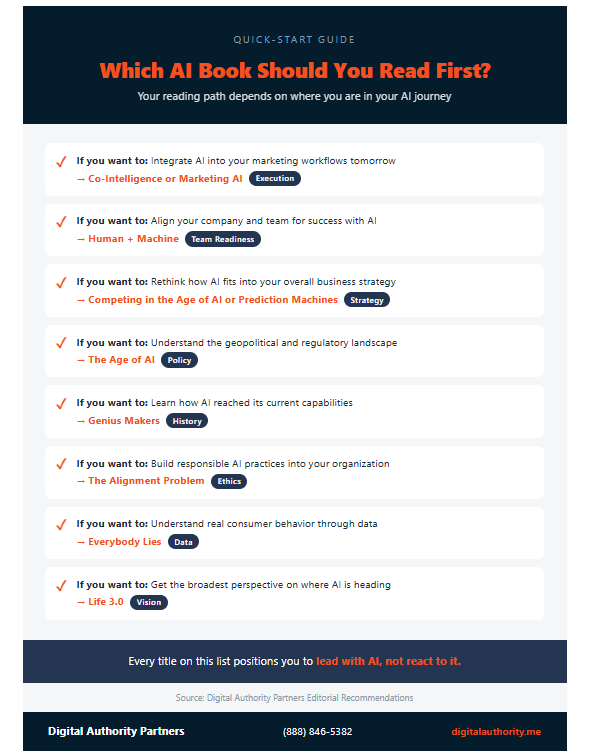
Every title on this list positions you to lead with AI, not react to it. The organizations that invest in AI literacy now will be the ones setting the pace in their industries.
Digital Authority Partners specializes in artificial intelligence and emerging technologies, helping companies build intelligent strategies that drive measurable business performance. Set up a time to talk with our team about integrating AI into your business and accelerating your growth.
Want To Meet Our Expert Team?
Book a meeting directly here