
Generative Search Optimization Tactics: How To Win Visibility in AI-Powered Search

Search results now offer more than a simple list of links. Generative search optimization tactics help brands appear inside AI-generated answers by making content clear, credible, and easy for AI systems to understand and reuse.
You must combine SEO and generative engine optimization (GEO) practices to win visibility. Making content usable for AI systems rather than relying on ranking is imperative, and a generative engine optimization agency understands this shift.
How Your SEO Foundation Supports AI Visibility
When your site is technically sound and well-structured, it makes it easier for AI systems to access and understand your content. Google has indicated that its AI-powered search relies on content, transparent structure, and consistency when generating responses.
SEO lays the groundwork for GEO. Crawlability, indexation, internal linking, and clean on-page structure make it easier for AI systems to evaluate content accurately and consistently.
What Makes Generative Search Optimization Different From Search Engine Optimization?
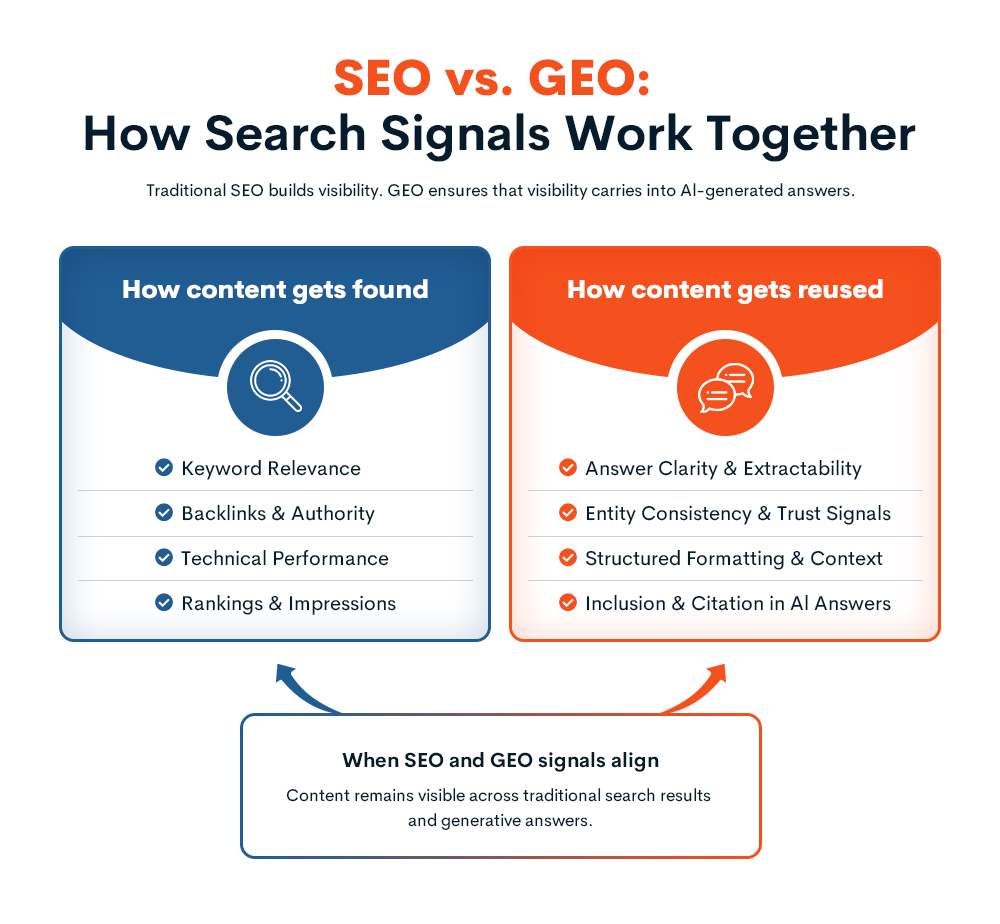
Generative search optimization differs from traditional SEO by prioritizing answer-worthiness and factual alignment over ranking position alone. SEO focuses on helping search engines discover and rank pages. GEO focuses on whether your content is suitable for extraction, summarization, or reference. Both rely on clarity and relevance, but GEO emphasizes how brands structure and explain information for AI reuse. It helps to look at how generative engines produce answers to fully understand this difference.
How Generative Engines Produce Answers
Generative engines assemble responses by synthesizing information from multiple trusted sources. A study shows that 8% of users are less likely to click through to websites when an AI overview appears in search results than when no snippet is present. While click-through rates are lower, it increases high-intent searches, as site visitors already know what they’re clicking through to.
Why Rankings and Traffic Are No Longer Reliable Proxies
Ranking well still matters, but AI visibility comes down more to how clearly your content is structured and how deeply it covers a topic than to position alone. SEO best practices already align with many of Google’s Helpful Content Guidelines, which also serve as a strong foundation for AI visibility.
Technical SEO supports higher discovery, but generative engines apply additional criteria beyond traditional AI ranking factors when deciding what information to surface in their responses. Content must go beyond high ranking and address other elements that make pages easier to parse. These include:
- Organizing information clearly
- Defining concepts directly
- Demonstrating sustained topical focus
Knowing how GEO improves visibility in AI-driven experiences clarifies how SEO efforts extend beyond rankings. When pages are well organized, concepts are defined clearly, and the topic is kept focused, AI systems can extract accurate answers more easily.
How Generative Systems Judge Confidence, Not Just Content
AI favors content that defines concepts directly, explains reasoning step by step, and uses consistent language throughout. When content explains what something is, why it matters, and how it works, it reduces risk during synthesis and increases the likelihood of citation.
Generative engines compare explanations across multiple sources before assembling an answer. When your content reflects established understanding while adding original structure or perspective, it becomes easier to validate.
Why Consistency Across Pages Matters
Consistency across related pages helps generative systems understand your focus and recognize your expertise. Inconsistent definitions, conflicting phrasing, or uneven topic coverage introduce uncertainty, even when individual pages are well written.
Core Generative Search Optimization Tactics That Drive Inclusion
Effective generative search optimization tactics create content that is easy for AI systems to evaluate and use in AI overviews. These tactics help brands surface more reliably across large language model-driven search experiences.
1. Structure Your Content for Direct Answer Extraction
Generative systems favor content that presents definitions and explanations in clear, predictable, scannable formats. There are several ways to increase the parsability of the content:
- Use question-based H2s and H3s: Framing headers in question format mirrors how users search, which signals to generative engines that there is a direct answer.
- Lead with summaries before depth: Open each section with a concise explanation so AI systems capture the core idea before processing supporting details.
- Keep paragraphs under four lines: Short, focused paragraphs improve clarity and help generative systems isolate complete thoughts without pulling in unrelated context.
2. Strengthen Entity Signals Across Your Entire Site
Consistent entity signals help generative engines understand who you are, what you cover, and when to reference your content. When your language and topic focus stay consistent, AI systems can more easily understand your expertise and what your site represents. Site-wide consistency is reinforced by strengthening your entity signals. Some guidelines to consider are:
- Align language across about, services, blog, and schema: Use consistent descriptions and terminology across key pages to reinforce your entity’s recognition.
- Reinforce topical focus through strategic internal linking: It helps search engines understand how individual pages relate to broader subject areas and authority clusters.
These practices increase the likelihood that generative systems will select your content to synthesize answers.
3. Optimize Separately for Inclusion vs. Citation
Generative engines silently draw on many sources but cite only those with the strongest authority and clarity signals. Clear structure makes it easier for AI systems to understand your content, which is why it plays such an important role in generative answer optimization. Key considerations include:
- Inclusion signals: Emphasize structure and relevance through clear, comprehensive coverage, enabling generative engines to absorb and reuse information.
- Citation signals: Emphasize the authority and originality by introducing distinct frameworks and demonstrating firsthand expertise that generative systems can confidently reference.
Citation relies on a narrower set of LLM citation signals, including authority, originality, corroboration, and clear attribution pathways. Fewer sources earn citations because the trust threshold is higher, but cited content benefits from stronger brand visibility and greater durability of authority across AI-driven search experiences.
4. Create Citation-Worthy Content Assets
Citation-worthy content introduces original frameworks and transparent processes that AI systems cannot easily paraphrase from competitors. These assets go beyond surface-level advice and represent advanced generative search tactics. They show how you make decisions and what differentiates one approach from another. This level of specificity increases confidence in the source and improves the likelihood of attribution. Ways to create citation-worthy content include:
- Publish proprietary models, checklists, or methodologies: Clearly name frameworks or repeatable processes to give generative systems unique material to reference.
- Avoid generic best-practice summaries: Adding original structure or insight helps distinguish your content and increases the likelihood of citation.
- Support claims with authoritative external sources: Referencing respected research or academic studies reinforces accuracy and helps generative engines validate the information before citing it.
Consistently publishing citation-worthy assets strengthens both visibility and credibility across generative search environments.
How to Audit Existing Content for Generative Search Readiness
Before creating new GEO-focused content, start by reviewing what you already have. Many pages are closer to generative-ready than they appear and only need clearer structure and sharper focus.
Identify Pages AI Is Most Likely to Reuse
Begin with pages that already show search traction. These include content that ranks consistently, earns steady impressions, or supports key services, even if clicks have declined as AI overviews appear.
Generative systems tend to reuse information they already recognize as relevant. Improving these pages often delivers faster gains than starting from scratch.
Check Whether the Core Idea Is Easy to Extract
Next, assess how clearly each page communicates its central point. Generative systems favor content that gets to the answer quickly and explains it cleanly.
Ask whether the page:
- Defines the topic early
- Uses headings that clearly signal what the section explains
- Separates summary insights from deeper detail
If the page requires interpretation to understand its purpose, it is harder for AI systems to reuse accurately. Tightening structure usually matters more than adding content.
Look for Topic Overlap That Dilutes Clarity
Generative engines compare explanations across related pages. When multiple pages cover the same topic using different language or framing, it can weaken clarity. During your audit, flag pages that overlap or compete. In many cases, consolidating content into a single, stronger resource improves focus and increases reuse.
Evaluate Whether the Page Shows Real Expertise
Pages that demonstrate firsthand experience stand out in generative results. Look for content that explains how decisions are made, not just what the best practices are. Clear processes, original frameworks, and practitioner insight help AI systems validate the information and reuse it with confidence.
Prioritize Updates That Support Business Goals
Finally, prioritize updates based on impact. Focus first on core service pages, high-impression content tied to revenue-driving topics, and pages that already anchor internal links. A generative readiness audit is not about rewriting everything. It’s about sharpening the pages that matter most so AI systems can confidently extract and reuse your best content.
How to Decide Which Content Deserves GEO Investment
GEO delivers the most value when applied to content that shapes understanding, not just visibility. Service pages, process explanations, comparison guides, and educational resources perform well because they reduce uncertainty and clarify complex topics. Generative systems are more likely to reuse content that helps users understand something clearly, rather than content designed only to promote.
Content that supports evaluation and comparison often carries more weight in generative answers than early awareness material. When AI systems assemble responses, they favor sources that explain trade-offs, context, and reasoning, because this information helps users move forward.
GEO investment works best on content with a long shelf life. Pages tied to evergreen processes, industry fundamentals, or core services are more likely to be reused over time than short-term campaigns. Stable content gives generative systems a reliable reference point.
Align GEO priorities with business impact. Focus on pages that support revenue-driving services, address common objections, or appear frequently in sales conversations. These pages often become trusted reference material because they reflect real questions your audience already asks.
GEO is not about optimizing everything. It’s about choosing the content that carries meaning, earns trust, and continues to matter as AI-powered search evolves. Once these priorities are clear, the next step is applying GEO tactics that consistently position your most valuable content for reuse and citation.
Technical and On-Page SEO Tactics That Enable GEO
When your technical foundation is solid, AI systems can more easily access and evaluate your content, keeping on-page SEO central to GEO. This technical readiness ensures your content can be discovered, interpreted, and reused consistently across AI-powered search experiences.
Crawlability, Indexation, and Content Hygiene
Your content becomes eligible for inclusion in AI-generated answers if generative engines can easily access and interpret it. Crawlability and indexation ensure AI systems can reach your pages, while content hygiene supports accurate, consistent information processing.
Reducing technical friction makes it easier for AI systems to find and understand your content. Crawlability determines whether AI and search bots can access your pages. In contrast, indexing determines whether content is stored and eligible for reuse in search and AI-generated answers. Some common ways to reduce friction include:
- Maintain clean, readable URLs
- Use logical, hierarchical site architecture
- Configure indexing signals correctly
Strong content hygiene allows generative engines to retrieve content without confusion. Ways to maintain content hygiene are:
- Remove outdated or inaccurate pages
- Consolidate overlapping or competing topics
- Fix broken internal and external links
Content hygiene establishes the baseline conditions that enable higher-level GEO tactics, such as structured formatting and entity signals, to work as intended.
Schema and Structured Data as Context Reinforcement
Additional context makes it easier for the schema to support accurate interpretation across both traditional and generative search. Schema works best with strong on-page content and clear site architecture. Before implementing the schema, here are some guidelines:
- Set realistic expectations for schema outcomes: Structured data improves clarity and consistency alongside other inclusion and citation signals.
- Keep recommendations practical: Focus on widely supported schema types that align with the page’s purpose, prioritizing accuracy over complexity.
Schema and structured data strengthen context, helping generative systems evaluate and reuse your content with greater confidence.
Trust and Experience Signals That Influence AI Reuse
Trust signals become more visible when expertise is consistently demonstrated in how content is written and connected across your site.
Demonstrating Firsthand Experience for AI Trust
Firsthand expertise shows in how clearly you explain processes and justify decisions. Examples of experience-driven signals include:
- Use proprietary terminology. Clearly defined terms or labels signal original thinking and consistent use across content.
- Document original workflows. Step-by-step processes that reflect how you work provide specificity that generic explanations lack.
- Share practitioner-level insight. Details drawn from real-world applications show depth that generative systems recognize as expertise.
Internal Linking as Authority and Context Mapping
Internal links help generative systems understand topic relationships and site-level authority. These contextual maps show where your site focuses its expertise and which topics it covers in depth. Tactics you can use to create topical maps for generative search include:
- Include a minimum of three internal links. Linking related content reinforces topical clusters and supports contextual understanding.
- Use entity-reinforcing anchor text. Anchors should consistently reflect key topics or concepts.
- Avoid generic anchors. Descriptive anchor text improves clarity and more accurately interprets page relationships for GEO.
How Content Freshness and Updates Affect Generative Visibility
Visible content upkeep helps generative systems recognize which sources remain accurate and reliable. Here’s what content updates should look like in practice:
| Content Type | Recommended Update Cadence | Purpose for GEO |
| Core service or pillar pages | Every 6-12 months | Reinforce accuracy and topical authority |
| Tactical guides or frameworks | Every 3-6 months | Reflect evolving best practices |
| Statistics-heavy content | As new data becomes available | Maintain factual reliability |
| Thought leadership articles | Periodic refreshes | Support ongoing topical alignment |
This consistent rhythm helps generative systems recognize which sources continue to reflect content expertise.
What Constitutes a Meaningful Update
Generative engines respond more strongly to substantive updates than to surface-level edits. Meaningful updates may include:
- Revising definitions or frameworks to reflect current usage
- Adding new examples or supporting data
- Expanding sections where user intent has evolved
- Updating internal links to reinforce current topical clusters
Why Static Thought Leadership Loses Relevance Faster in AI Systems
AI systems favor sources that remain accurate and dependable. If you position your content as evergreen thought leadership, it must reflect current language and supporting evidence to stay relevant. Outdated content makes AI systems more likely to favor newer or better-maintained sources with clearer context.
Measuring Success in Generative Search Optimization
Measuring generative search optimization requires tracking visibility and the reuse signals beyond rankings and organic traffic. Traditional performance indicators capture only part of how users encounter and engage with content, as AI-driven search experiences summarize answers directly. With roughly 80% of search users relying on AI summaries, brands need to measure how content influences these responses.
GEO-Specific Metrics To Monitor
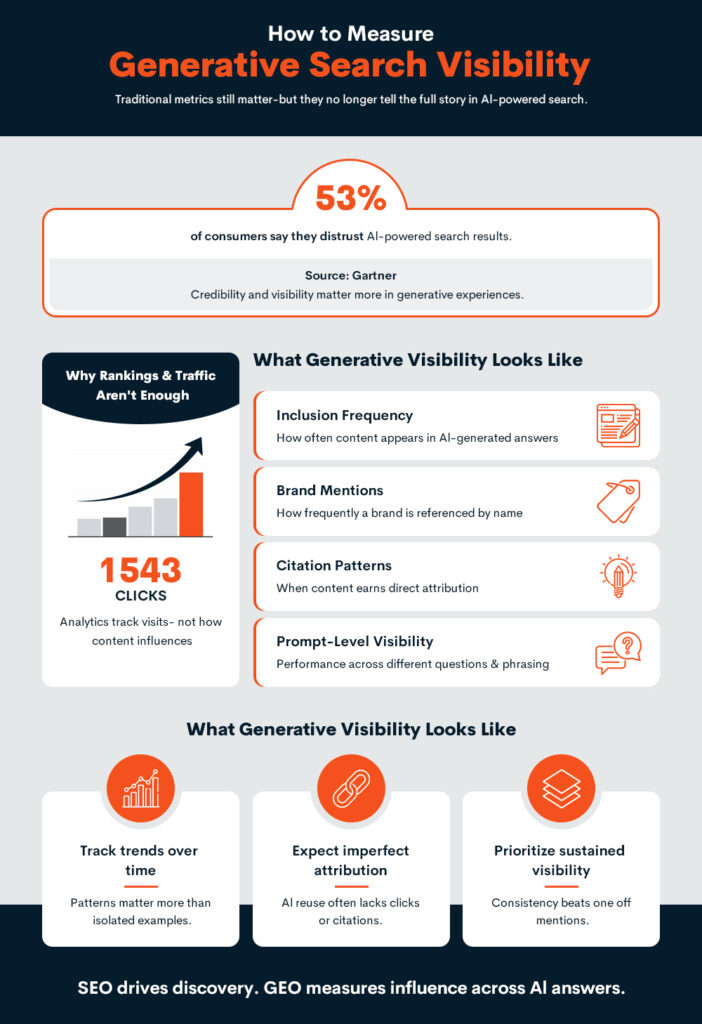
Key indicators include inclusion frequency, brand mentions, citation patterns, and prompt-level visibility. This helps evaluate the effectiveness of LLM visibility strategies across generative platforms. Because generative systems gather answers rather than rank pages, GEO performance shows up in how often and where content influences AI-generated responses.
Here are some core GEO metrics explained:
- Inclusion frequency: Tracks how often your content appears within generative answers, whether cited explicitly or used as a supporting source. Repeated inclusion signals growing relevance and trust.
- Brand mentions: Measures how frequently AI-generated responses reference your brand or entity. Consistent mentions indicate stronger entity recognition and authority within a topic area.
- Citation patterns: Track when and how your content earns direct attribution.
- Prompt-level visibility: Evaluates how content performs across different query types and conversational prompts, revealing alignment with user intent.
Analytics tools offer limited visibility into how generative systems reuse content, as most focus on rankings and traffic. Tracking patterns change, and more frequent inclusions or emerging citation patterns provide stronger insight than isolated examples.
Measuring changes helps avoid overemphasizing vanity metrics such as one-off citations or screenshots. Instead, it reveals where your content consistently appears across prompts and platforms.
How GEO Tactics Apply Across AI Platforms (Not Just Google)
Although AI platforms differ in presentation, generative engines rely on similar extraction and trust signals.
Google AI Overviews
Google’s AI Overviews synthesize answers directly within search results, often pulling from multiple sources without requiring a click. Content that performs well here combines strong SEO fundamentals with clear definitions and corroborated information. Pages that already rank well gain an advantage, but structure and extractability determine whether they are included in the overview.
ChatGPT
ChatGPT generates conversational answers based on patterns learned from a broad range of sources. Content reused typically features clear explanations, consistent terminology, and signals of credibility.
Perplexity
Perplexity emphasizes transparency by surfacing citations alongside generated answers. Content that earns visibility in Perplexity typically presents information in a way that is easy to verify and clearly establishes topical relevance.
Claude
Claude prioritizes accuracy and safety when generating responses. Content that performs well is carefully structured and grounded in reliable information. Clear context and thoughtful explanations help content align with Claude’s emphasis on responsible, well-supported answers.
Key Takeaway Across Platforms
While each platform presents generative answers differently, the underlying signals remain consistent. Clear, well-structured, authoritative, and actively maintained content is better positioned to perform across Google AI Overviews, ChatGPT, Perplexity, and Claude without requiring separate strategies for each platform.
Common Mistakes Brands Make With Generative Search Tactics
GEO performs best when brands prioritize structural and authority fundamental tactics. Your team will gain lasting visibility across generative search environments by building clear, consistent foundations.
Over-Optimizing for Prompts
Prompt experimentation can help you learn how generative systems respond, but sustainable GEO success comes from strengthening the underlying content. Content built around clear questions and frameworks adapts naturally to a wide range of user inputs without constant adjustment.
Publishing Vague Thought Leadership
Thought leadership performs best when it offers a specific perspective, structure, or experience. When content is created around clear questions and frameworks, it adapts naturally to a wide range of user inputs without constant adjustment.
Overlooking Technical and Entity Alignment
Technical readiness and entity consistency create the foundation for all other GEO efforts. Keeping crawlability, indexing, internal linking, and terminology consistent helps AI systems understand your site’s focus and areas of expertise.
Build Durable Visibility in Generative Search
Generative search optimization tactics succeed when content authority and technical readiness work together to support AI-driven answers at scale. Rather than replacing SEO, GEO extends proven search foundations.
Brands that invest in structure and ongoing content maintenance strengthen visibility as search interfaces change, supporting both generative answers and broader search performance. The path forward is straightforward: audit content for extractability and topical focus.
At Digital Authority Partners, our content specialists understand the importance of building a strong SEO foundation for your GEO strategy. We help brands evaluate their organic search rankings and AI citations across numerous industries. Get a GEO readiness review by contacting us today.
Want To Meet Our Expert Team?
Book a meeting directly here

Related Articles

You need to be visible across multiple marketing channels if you want your campaign to have any impact. Targeting you...


Patients looking for a doctor want convenience and speed, especially in an emergency. Local search is the action a pa...

Los Angeles is home to more than 244,000 businesses, and ranks as the 19th largest economy in the world. That scale m...