How Healthcare Brands Build Compounding SEO Equity
What You Will Learn in This Healthcare SEO Strategy Whitepaper
Healthcare brands that treat search as an owned asset earn patients from the same work month after month, while the value keeps building. This whitepaper lays out the healthcare SEO strategy behind that pattern: how a brand builds compounding SEO equity that holds its value as AI reshapes the results page.
The ground under search is shifting fast. Digital Authority Partners ran one of the first controlled, longitudinal studies of how AI engines cite their sources, tracking 1,127 URLs across ChatGPT, Perplexity, Gemini, Copilot, and Google AI Overviews over six weeks. Two thirds of the sources an engine cited in week one were replaced by week four. A single citation now behaves like a slot a brand re-earns on a weekly cycle. The brands that stay visible are the ones building durable equity underneath.
For healthcare specifically, the opportunity is clear. BrightEdge found that Google moved “near me” and provider-finding searches from 100 percent AI Overview coverage in 2023 to 0 percent in 2025, handing patient-acquisition search back to maps, the local pack, and organic listings. The searches that book patients still reward the brand that owns the organic and local position.
This whitepaper documents the strategy that turns that opportunity into a compounding asset: the two engines that make SEO in healthcare compound, the curve that shows where the returns concentrate, the habits that leave the compounding on the table, and the markers that separate a partner who builds the asset from one who resets it. You will also see how the approach played out across three verified DAP client engagements in mental health, hospice, and medical imaging.
Whether your brand operates in one market or many, the principles apply and scale with your footprint. The brands building compounding SEO equity today are setting a patient-acquisition advantage that widens every quarter. This whitepaper shows exactly how to build it.
Whitepaper Highlights

Build the Asset, Not the Slot
A ranking or an AI citation is a position a brand holds and works to keep. The asset underneath is a store of search equity the brand owns: every optimized page, every top ranking on a high-intent query, and every authority signal that keeps drawing patients from work already done. DAP's 2026 AI Visibility Gap study shows why breadth matters, with 89 percent of brand-recommendation citations pointing to third-party media and 60 percent of AI-cited content sitting outside the top 20 organic results. This whitepaper shows how a healthcare SEO strategy compounds that base over time.

Read the AI Search Shift Before Your Competitors Do
DAP's AI Visibility Gap study tracked 1,127 URLs across five AI engines over six weeks and found a 33 percent average citation retention rate across 28 days, with 66 percent of week-one citations gone by week four. The takeaway reframes visibility: durable presence comes from the equity underneath the citation. This whitepaper turns that finding into a plan for SEO in healthcare.

See Where the Durable Patient-Acquisition Opportunity Sits
Patients open their journey on a search bar, and 56 percent turn to Google first to find a provider (Tebra, 2025). Google now answers most clinical questions with AI Overviews while keeping “near me” provider searches in organic and local results, a reversal from 100 percent AI Overview coverage in 2023 to 0 percent in 2025 (BrightEdge, 2025). Live data shows organic listings earning close to half of every click on local care queries while paid earns a single-digit share (Ahrefs, 2026). The owned position captures the larger, lower-cost stream of patients.

Understand the Two Engines That Make Equity Compound
Healthcare brands build equity two ways. Depth stacks services with one partner, so each engagement starts from a higher base than the last. Reach scales one proven playbook across new cities and practice areas, so expansion moves faster every time. The whitepaper documents both with the DAP healthcare roster, including clients who stacked as many as 12 engagements and a client who reached number one across 11 locations.

Find Where the Returns Concentrate on the Compounding Curve
Search equity follows a recognizable curve. First Page Sage, drawing on campaign data from 2021 through 2025, reports that an SEO investment reaches positive ROI inside the first 6 to 12 months and hits its peak return in the second and third year. The whitepaper shows why the brands that stay through the climb collect the largest share of the value, with DAP client results that track the same curve.

Spot the Two Habits That Leave Compounding on the Table
Two habits keep brands from reaching the steep part of the curve. The first is switching partners at the 6 to 12 month mark, right as the compounding begins (Focus Digital, 2026). The second is chasing one position instead of building a broad base, when AI engines draw from a shifting set of sources with the highest overlap between any two platforms at 17 percent (DAP AI Visibility Gap Study, 2026). Both are easy to act on once a brand sees them.

Use the Markers to Evaluate Any Healthcare SEO Partner
The whitepaper defines the markers of a partner who builds compounding equity, framed as the questions to ask before you sign: How many clients are in their second year or beyond? Will the same team stay on the account? Do you specialize in healthcare, and can you show it? What is your point of view on AI search, and what is it based on? Which KPIs do you own, and how often will I see them? These markers separate a partner who builds the asset from one who resets it.

See What This Looks Like in Practice
The whitepaper closes with three verified DAP healthcare engagements. Geode Health reached number one across 11 locations and attributed more than 40 percent of new appointments to local SEO within three months, at a cost of acquisition 7 times lower than paid. United Hospice owned a new region across 15 or more cities in ten months. Centella earned 90 or more number-one rankings across 8 Florida markets. Each shows citation-ready content, healthcare local SEO, and a reused playbook working as one connected program.
Peek Inside the Guide
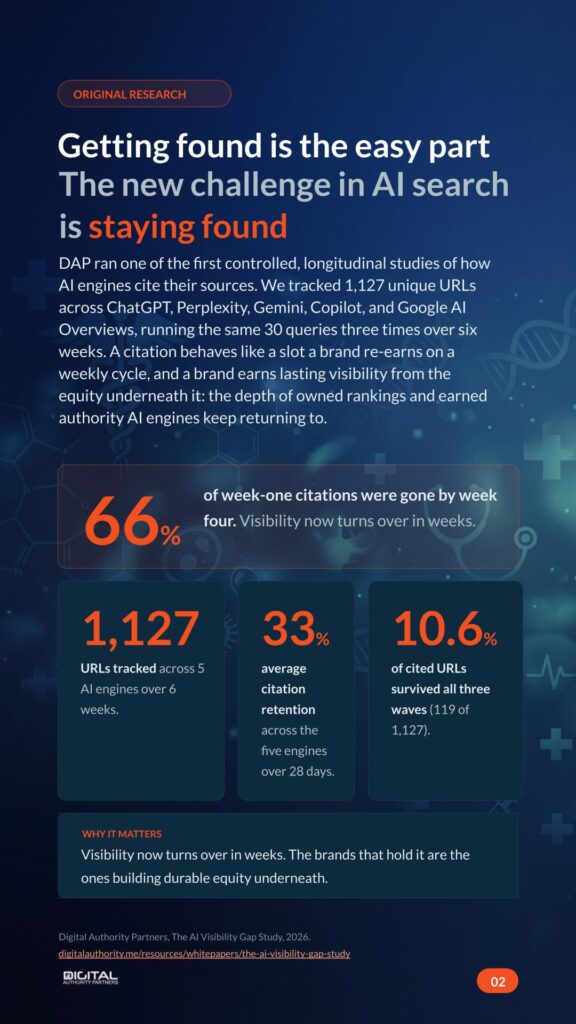
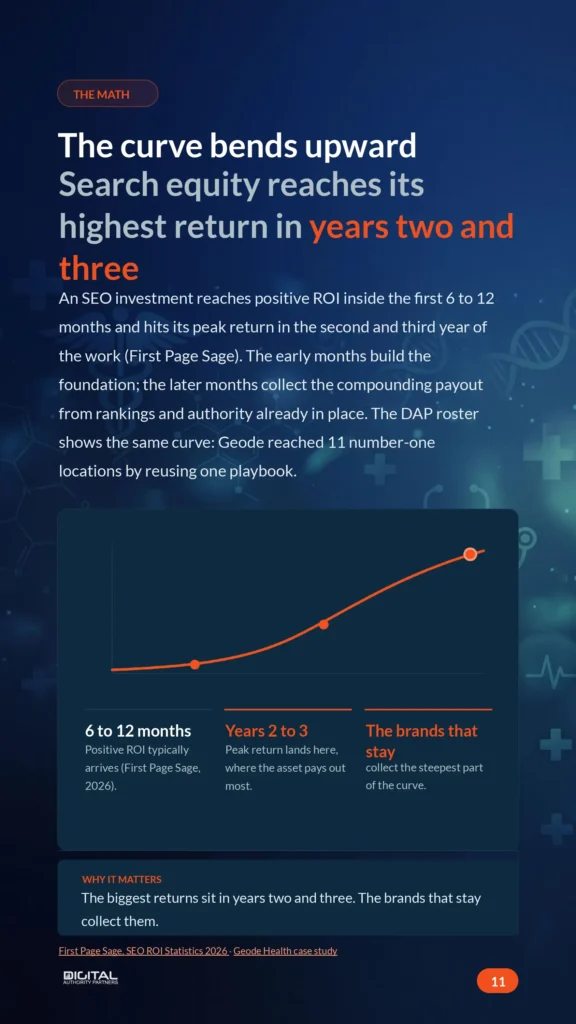
Table of contents
See what DAP’s AI Visibility Gap study found across 1,127 URLs and five AI engines
Understand why durable presence comes from equity, not a single citation
Map patient search behavior and the organic share of clicks on local care queries
See why Google keeps patient-acquisition searches in organic and local results
Define the owned search asset and the breadth that makes it resilient
Connect owned rankings and earned authority into one compounding base
Understand how stacking services deepens the asset
See how one proven playbook widens it across markets
Locate where the returns concentrate across the first three years
Match the curve to verified DAP client results
Recognize the early-switch habit that resets the asset
Build the broad base that holds visibility as AI engines shift sources
Compare a specialist healthcare partner with a generalist SEO agency
Apply the markers and diagnostic questions to your current program
Review three verified DAP outcomes in mental health, hospice, and medical imaging
See how citation readiness, healthcare local SEO, and a reused playbook work as one program
Similar white papers

The Department of Justice moved the first Title II compliance date to 26 April 2027, which leaves eight months for public entities serving 50,000 people...
Most software evaluations finish somewhere a vendor does not control. 6sense measured 94% of buying groups ranking their vendors before speaking to a seller, with...
Half of B2B software buyers now open their research with an AI chatbot more often than with Google. G2 put that figure at 51% in...
Have questions about this white paper?
Let’s talk!