The Fractional CMO Evaluation Checklist
What You Will Learn in This Fractional CMO Hiring Checklist
Growth-stage founders have no shortage of fractional CMO candidates. An afternoon on LinkedIn surfaces more than 30 qualified people, each using the same title and quoting a similar weekly hour count. The opportunity sits in telling them apart. This checklist gives founders a structured way to hire a fractional CMO who compounds revenue for years, with ten questions that separate the operator who delivers from the one who only plans.
The timing favors founders who choose well. North American fractional executive engagements grew roughly 57% year over year in 2024, with growth-stage companies as the largest source of demand (Business Talent Group, 2025). Marketing budgets tightened to 7.7% of revenue in the same window (Gartner CMO Spend Survey, 2024), which makes senior leadership at a fraction of full-time cost one of the highest-leverage moves on the table. Founders who learn how to hire a fractional CMO with discipline capture that leverage, while a hire made on chemistry alone can cost six months and $200K to $500K before the mismatch shows.
One dimension of the hire barely existed three years ago. AI engines now shape how buyers discover and vet brands, and the ground moves weekly. Digital Authority Partners ran one of the first controlled, longitudinal studies of how AI engines cite their sources, tracking 1,127 URLs across ChatGPT, Perplexity, Gemini, Copilot, and Google AI Overviews, and found that two thirds of week-one citations were gone by week four (DAP AI Visibility Gap Study, 2026). A fractional CMO who treats AI search as a future trend is already two years behind, so the checklist devotes two of its ten questions to proof of AI search work.
This whitepaper turns the hire into a scorecard across four dimensions: strategic fit, operating model, AI search readiness, and reporting and exit. Every question carries a detection tip that moves the conversation past logos and into the operational specifics that predict revenue. You score each candidate from one to three, total the result, and read a clear next step from the band the score lands in.
Whether you are building the marketing function from zero or adding senior leadership over an existing team, the checklist scales to your situation. It closes with DAP’s own answers to all ten questions, scored against the same rubric, so you can see what a strong response looks like before you run your first interview.
Whitepaper Highlights

Score the Hire, Skip the Gut Call
The strongest founders score every candidate on every question, including the one they already like. Roughly two thirds of strategic plans stall before producing measurable results, with execution capacity cited as the primary cause (Bain & Company, 2024). A written score exposes the gaps that personal chemistry hides and turns a subjective hire into a decision you can defend to your board.

Know the Two Operating Models Before the First Call
Most fractional CMO pitches collapse into one of two models: strategy-only or strategy plus execution. They carry different benches and different retainers, from $8K to $18K per month for strategy-only up to $25K to $75K for a model that ships every channel (DAP market observations, 2024 to 2026). The checklist helps founders name the model their business needs before a single conversation.

Match the Model to Your Stage
A founder building marketing from zero needs delivery capacity. A founder with a strong in-house team needs direction. Fractional executive demand grew roughly 57% year over year in 2024 as growth-stage companies looked for senior leadership at a fraction of full-time cost (Business Talent Group, 2025). The checklist ties each archetype to the stage it fits.

Test Strategic Fit in the First 60 Seconds
Three questions check whether a candidate has studied your business: can they articulate your growth model, name the single biggest constraint on your growth, and connect a Day 90 deliverable to a line on your revenue plan. A real operator names the constraint and the first lever they would pull. The checklist gives you the detection tips to hear the difference.

Find Out Where the Hours Actually Go
The operating-model questions surface whether the senior person you meet will do the work or hand it to junior contractors. Ask for the exact hour split across senior strategy, junior execution, and project management, and for the name and LinkedIn of the person who would run your paid media. Named people beat categories every time, and the checklist is built to draw the names out.

Check AI Search Readiness With Evidence
Two questions probe whether a candidate operates inside 2026 search. DAP's AI Visibility Gap Study tracked 1,127 URLs across five AI engines and found a 33 percent average citation retention rate over 28 days, with 66 percent of week-one citations gone by week four (DAP AI Visibility Gap Study, 2026). The checklist asks candidates to name the engines they monitor and to show client work where AI search moved a real metric in the last 12 months.

Read the Score and Know the Next Move
Score every answer as vague, narrow, or proven, then total the ten. A 24 to 30 signals a strong fit and a paid two-week pilot. An 18 to 23 signals a strategy-only candidate and a reframed 60-day scope with execution sourced separately. Below 18 signals it is time to keep searching. The rubric turns ten conversations into one comparable number.

See How DAP Scores Against Its Own Checklist
Before asking any founder to score DAP, DAP answered all ten questions with the evidence behind each one, from the vertical-led discovery brief to the named function leads who are live on day one. The whitepaper includes that scorecard, the operator who leads your engagement, and a month-by-month view of what a DAP fractional CMO retainer delivers from diagnosis through documented handoff.
Peek Inside the Guide
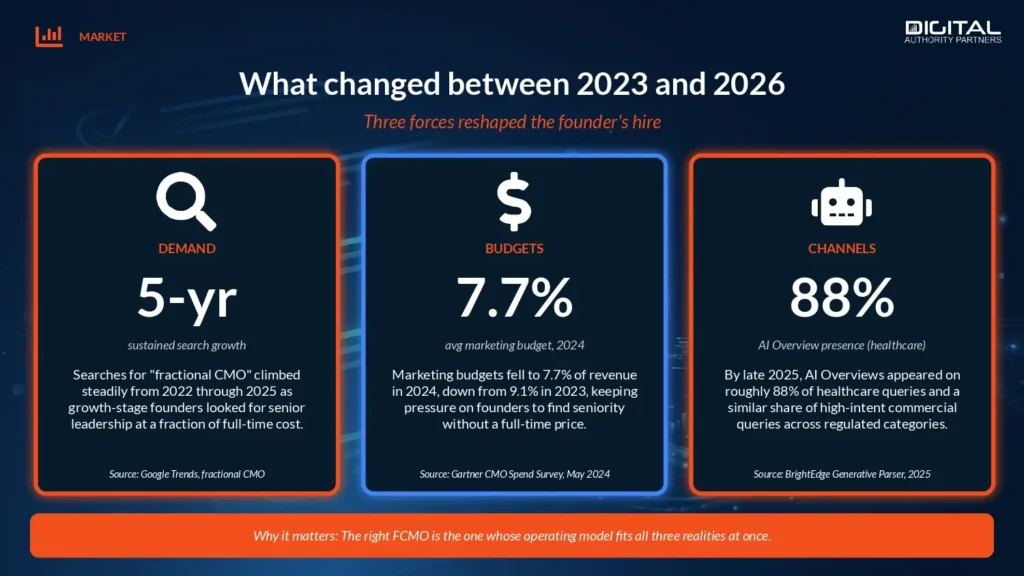
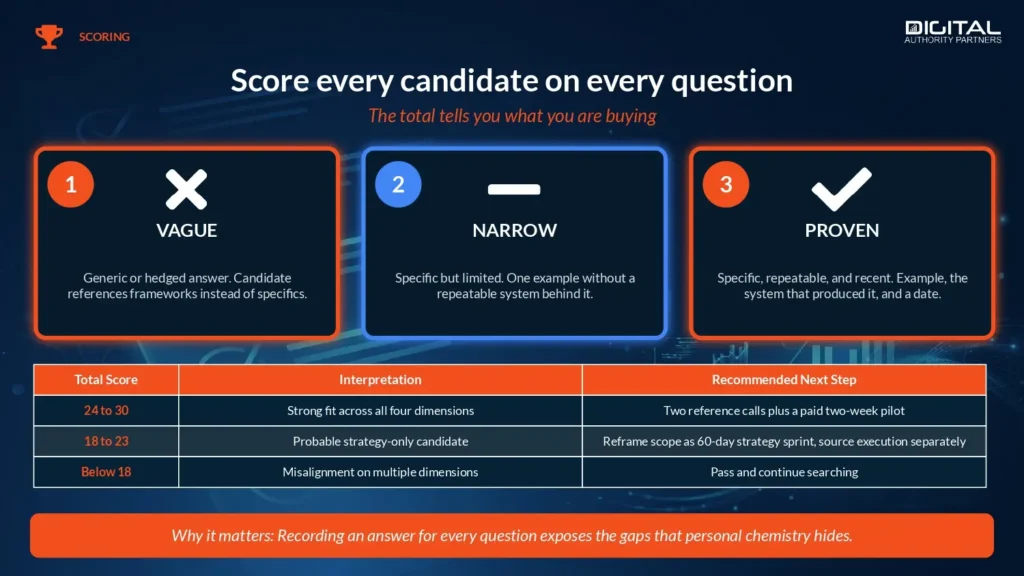
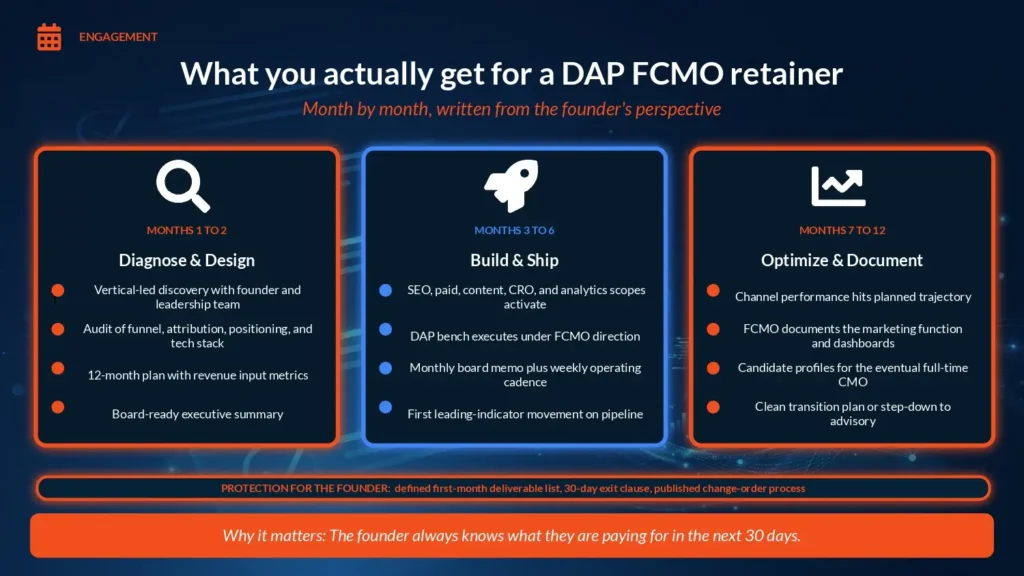
Table of contents
See why the fractional CMO category got crowded fast
Understand what the wrong hire costs in runway and momentum
Map the shift in demand, budgets, and search channels
See why the right model has to fit all three at once
Compare strategy-only against strategy plus execution
Match bench, retainer, and time to first result to your stage
Recognize the chemistry, logos, and strategy traps
Learn how the checklist forces every conversation past them
Test whether the candidate has studied your business
Connect Day 90 deliverables to your 12-month revenue plan
Find out where the hours go and who runs each channel
Check weekly capacity across their client portfolio
Probe their point of view on AI search and your channel mix
Ask for proof that AI search moved a real client metric
Review a redacted board memo from a live engagement
Understand the exit plan and what the handoff includes
Apply the one-to-three rubric across all ten questions
Read the score band and its recommended next step
Walk the engagement from diagnosis to documented handoff
Meet the named operator and the execution bench
See DAP’s answer to all ten questions
Review the evidence behind each one
Similar white papers

Google treats financial queries differently from every other vertical. The same system that writes confident overviews for recipes and travel applies stricter safety filters to...

The Department of Justice moved the first Title II compliance date to 26 April 2027, which leaves eight months for public entities serving 50,000 people...
Most software evaluations finish somewhere a vendor does not control. 6sense measured 94% of buying groups ranking their vendors before speaking to a seller, with...
Have questions about this white paper?
Let’s talk!