AI and Healthcare: An Interview with Codrin Arsene

The FDA had authorized more than 1,400 AI and machine learning medical devices for clinical use by August 2024, up from a small handful when this interview first took place. That jump shows how far artificial intelligence in healthcare has come since Digital Authority Partners (DAP) CEO Codrin Arsene sat down with eHealth Radio Network’s Eric Michaels.
Editor’s note: This interview aired on eHealth Radio Network on April 27, 2018, when Codrin Arsene led DAP as CEO. Today he serves as DAP’s Chief Marketing Officer.
Their conversation covers technology budgets, big data, and the debate over who controls patient records. Those are questions every health system still faces today. Arsene recorded these answers before generative AI tools existed, yet they still hold up as a grounded look at how healthcare adopts new tools. Below, our healthcare marketing agency adds fresh context wherever a specific prediction has since played out.
Listen to the entire interview: eHealth Radio Network, “Artificial Intelligence & Healthcare: A Match Made in Heaven.”
How Healthcare and Technology Can Work Together
Arsene starts with where healthcare technology stood in 2018, a baseline worth revisiting now that AI runs inside hundreds of FDA-cleared devices instead of pilot programs.
![FDA has authorized over 1,400 AI and machine learning medical devices for clinical use as of August 2024]](https://www.digitalauthority.me/wp-content/uploads/2024/10/image-33-1024x802.png "fda-ai-device-growth.png")
Michaels: What are the primary issues in healthcare that technology can help solve in 2018?
Arsene: As we’ve seen in the last couple of years, there’s been a significant shift in how medical and healthcare companies are looking at technology, and how technologies are being rolled out progressively to improve operational efficiencies, communication, customer service, billing and a lot of other practices that are critical to day-to-day operations in healthcare.
When it comes down to technology as a whole, we’re seeing direction and trends that are significantly impacted by what we call in the industry emerging technologies: artificial intelligence, predictive analytics, augmented reality, even VR headsets are now being used by doctors all over the world who are operating on patients. Just a few years ago, we saw the first heart surgery done entirely through a VR headset so that doctors and medical students could actually see it in action.
When it comes down to the primary trends that I see in healthcare this year, there’s definitely a shift towards improving operational efficiency, towards improving the accuracy of procedures and processes so that doctors, hospitals, and care delivery providers can provide better and faster care to patients all over the US.
That efficiency push raises a harder question for the people who control healthcare IT budgets, which is where Michaels takes the conversation next.
On Problems Facing Healthcare Executives
Michaels: What should keep healthcare executives awake at night given the latest tech trends?
Arsene: Ultimately, IT executives [in healthcare] are in a very tough business. IT is a cost center, by definition. You have all of these different needs and processes that need to be in place, often on a shoestring budget. With the rise of artificial intelligence, big data, predictive analytics, IoT, and more, IT executives can actually play a strategic role that goes beyond the current boundaries of their position.
As far as I’m concerned, if I were an IT executive, I would try to look at the current emerging technologies and think of them as being more than simply tools. It’s not just about rolling out a new initiative. It’s not just about creating value or making a process more efficient: it’s about a mindset.
I think the biggest opportunity for the current emerging technologies is that we can look at artificial intelligence or big data as being a mindset change, a completely different philosophy, versus just being a one-time project that is rolled out as part of the day-to-day operations.
The other thing that IT executives should understand is that these emerging technologies are only as smart as the people behind them. The reality is that most healthcare organizations usually do one of the following: they purchase new technologies and simply roll them out and implement them, or they create some product internally. But all of these decisions, the way they’re made, is very tactical.
What I encourage IT executives to think about is how do you holistically prepare for what is coming up in the 5 to 10 years. Because the next 5 to 10 years will be drastically different than the previous 100 years of how care in the United States and all over the world is provided to patients, how value is provided to patients, and how chronic conditions are managed.
We are in an age where a growing number of healthcare services are delivered virtually. The question is: what does this mean for an institution? What does this mean for a hospital? How should a hospital prepare itself structurally in order to really accommodate the emerging technologies they’ll have in place?
It’s not just a question of mindset; it’s a question of getting buy-in across the organization. It’s a question of getting the right infrastructure in place to support what is to come. You have to build a foundation.
And then, in addition to that, there’s a need to engage not only with your own institution but more holistically, even at the government level, with how emerging technologies can be retrofitted within the current paradigm of how healthcare is being delivered in the United States.
For example, many doctors want to provide care virtually; however, Medicare and Medicaid do not make this very easy.
Two different conversations need to occur. One is internal, within the hospital, the care facility, and the software companies that provide the medical solutions. The other is within our own government to ensure that we can continue providing medical care, regardless of the channel.
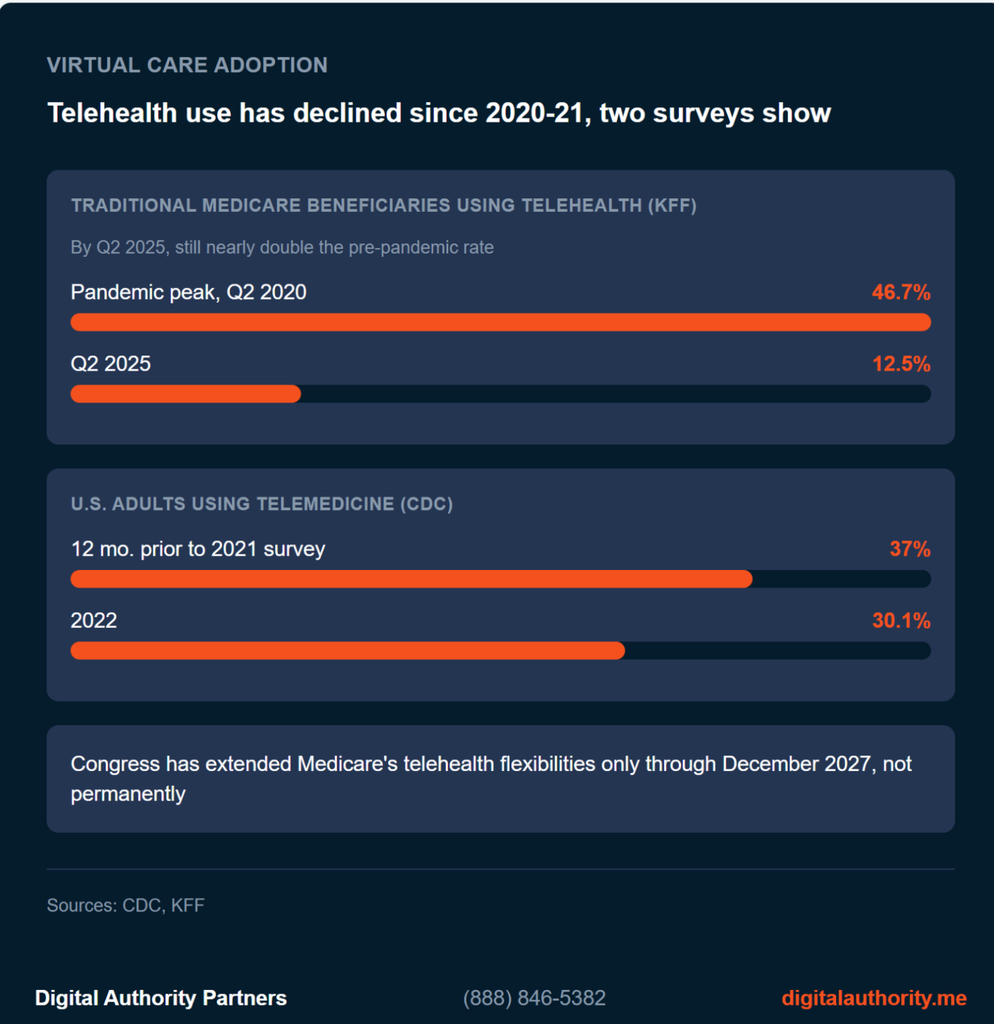
Arsene’s virtual care prediction proved directionally correct, even if adoption did not climb in a straight line. CDC survey data shows that 37% of U.S. adults used telemedicine in the 12 months before the 2021 National Health Interview Survey, a rate that fell to 30.1% by 2022 as pandemic-era flexibilities wound down. The policy gap Arsene describes between hospitals and government regulators around virtual care access remains active today.
Telehealth use spiked once the pandemic hit and then leveled off well above pre-pandemic levels. The most recent national data from KFF show that 12.5% of traditional Medicare beneficiaries used a telehealth service in the second quarter of 2025, nearly double the pre-pandemic rate, even after falling from a pandemic peak of 46.7% in the second quarter of 2020.
Congress has only extended Medicare’s telehealth flexibilities through December 2027 rather than making them permanent. Beyond policy, information itself is the bigger lever for artificial intelligence in healthcare, and that is where Arsene turns next.
How the Rise of Big Data and Artificial Intelligence Will Impact Healthcare
Michaels: What’s the importance of big data and artificial intelligence in healthcare?
Arsene: We all know that data, any type of data, is power. When it comes down to healthcare, data is more than just a tool. Data means accuracy.
Let’s say someone, we’ll call her Mary, goes to the hospital for an infection. The reality is that Mary may have the same set of physical characteristics as thousands of other “Marys” dealing with the exact same condition.
What if you were able to use statistical data of patients from all over the world with the same condition? It would provide better care, more accurate care, and provide doctors with the insight they need at any particular given time.
A machine doesn’t get tired; big data will always work around the clock. Big data has the potential to aggregate different information from all available sources and present that to a doctor, who can then deal with a patient in ways that were never possible in the past.
Think of rare conditions. Rare conditions are just that: rare. Meaning, there is not a lot of information on them. Once you use big data, combined with the algorithms that power artificial intelligence, the information problem will no longer be the same. You will be able to make better decisions, faster, when it comes to patient care.
Of course, some skeptics have negative things to say about AI. But over the long term, it is amazing what big data and artificial intelligence can do together, when paired correctly with human intelligence behind it, to provide the insightful information that healthcare professionals need at the point of care.
The same information gap Arsene describes for rare conditions shows up again the moment a patient switches doctors, which brings the conversation to one of healthcare’s oldest logistical problems.
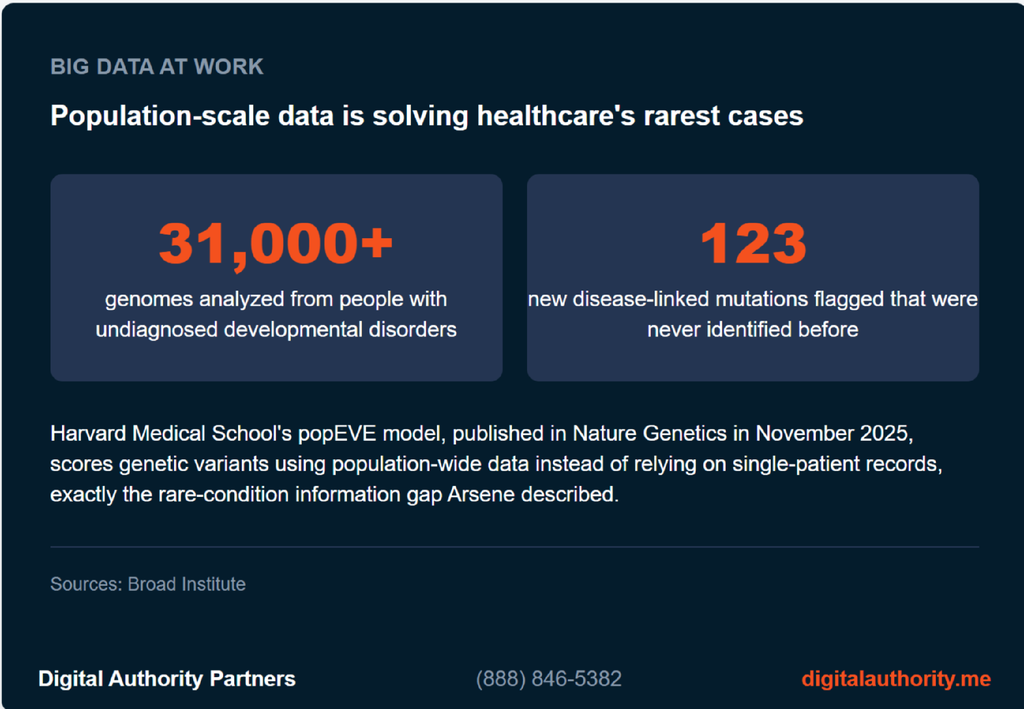
Arsene’s rare-conditions example has a concrete answer now. In November 2025, Harvard Medical School researchers published popEVE in Nature Genetics, a model that scores genetic variants for disease risk using population-scale data instead of single-patient records. Applied to genome data from more than 31,000 people with undiagnosed developmental disorders, the model flagged 123 mutations never before linked to those conditions, several dozen of which were identifiable from single patients alone. This is exactly the kind of rare, sparse-data case Arsene describes.
On the Democratization of Data
Michaels: What does the democratization of data mean for the healthcare industry as a whole?
Arsene: Data in the United States has, frankly, been held hostage by antiquated processes and by government regulations.
Think about it. Let’s say you have a condition and need a second opinion from another doctor. What’s the current process in place? You get your folder, with your results, with everything that has ever been collected by a doctor at any moment in time, and then you’re going to another doctor’s office.
That’s unacceptable. It’s not just unacceptable in the context of a patient doing these tasks; it is unacceptable even when it comes down to communication between doctors. See, doctors ask for referrals or consultations on a day-to-day basis. Doctors from all over the US are paging each other to get a second opinion regarding the difficult patient cases they’re working on.
As it stands, this is a very cumbersome process that involves manual paging and faxing. It’s very antiquated. And the reason why we’re still dealing with these processes, which ultimately make healthcare more expensive for us all and doctors’ lives worse because they’re losing so much time in these bureaucratic activities, is because we don’t have a democratization of data.
Data should be passed freely in between hospitals and care professionals. But more importantly, a patient should have ownership of their data. They should be able to go from Doctor A to Doctor B, and with the push of a button or an electronic signature, get all their info passed to the new doctor.
Ultimately, it’s very simple. The democratization of data means better care across providers. It means faster care. It means saving more lives. It means freeing us from how we manage and share our own personal data.
Arsene’s central argument, that healthcare improves when data moves freely and technology supports human judgment instead of replacing it, has only gained ground since this interview. Our future of AI and digital health resource follows how artificial intelligence in healthcare has evolved through generative AI, expanded virtual care, and the data ownership questions Arsene could only point toward in 2018.
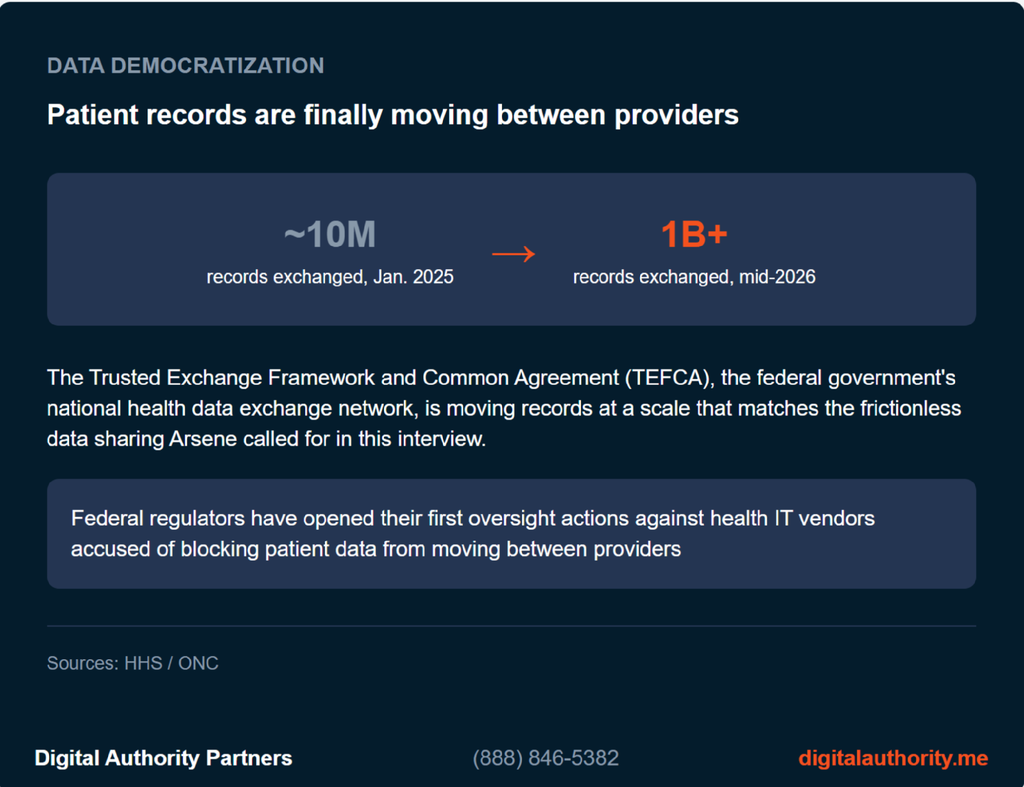
That democratization has measurable traction. As of mid-2026, more than 1 billion health records have moved through the Trusted Exchange Framework and Common Agreement, the federal government’s national health data exchange network, up from roughly 10 million records in January 2025. The same federal office running that network has opened its first oversight actions against health IT vendors accused of blocking patient data from moving between providers, the exact antiquated gatekeeping Arsene describes.
Build a Healthcare Marketing Strategy Around Where AI Is Headed
AI’s move from a talking point to a regulated, ordinary part of care delivery confirms the argument Arsene made years earlier: technology creates value only when an organization treats it as a way of operating, not a single rollout. More than 1,400 FDA-authorized AI devices now active are a direct result of the infrastructure-first approach he described, proof that his framework pointed the right direction before the tools existed to fill it in.
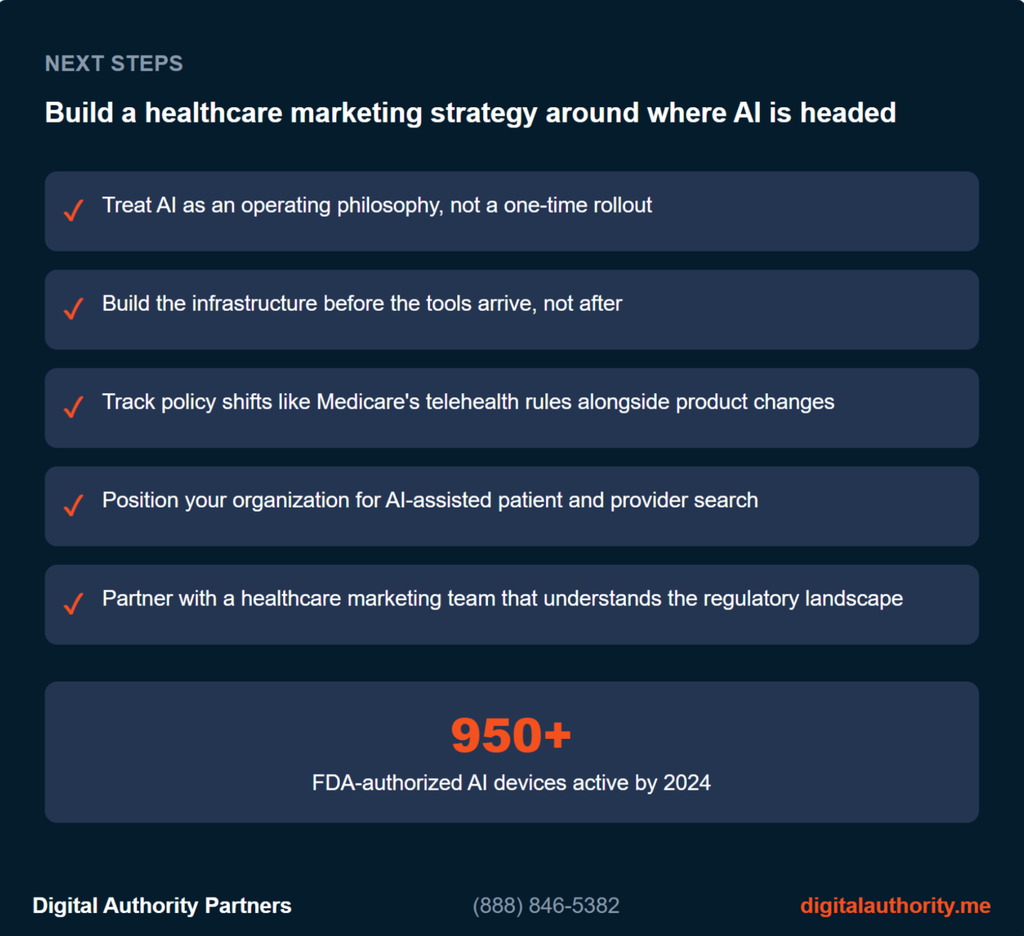
Healthcare organizations that plan for this shift now, rather than reacting once competitors gain visibility, put themselves ahead of both patients and referring providers who increasingly turn to AI-assisted search. Contact our healthcare marketing team to build a strategy that keeps your organization visible as AI changes how people find and choose care.
Want To Meet Our Expert Team?
Book a meeting directly here