
The Future of AI in Digital Health

AI in digital health has moved from research labs into daily care. A phone camera can now screen for diseases that once required a lab visit, thanks to artificial intelligence across the healthcare industry reaching hospitals faster than most executives expected.
Digital health covers every tool that manages the health of the body and mind through technology. AI is the layer that makes those tools smarter: it studies data, finds patterns, and turns them into decisions a clinician can act on. Digital health is the matter, and AI is the mind.
This guide covers four types of AI, the tools already running inside hospitals today, why healthcare executives are adopting them now, and where AI in digital health market is headed next.
Different Types of AI “Intelligence”
Researchers point to two capabilities that separate real intelligence from simple automation. The first is learning: taking in new information and adjusting to situations the system has not seen before. The second is application: using that learning to make a decision or solve an unfamiliar problem rather than repeating a memorized answer.
The University of Illinois Chicago engineering program frames this as the line between weak AI, built for one narrow task, and general intelligence, which can learn and apply knowledge across many tasks the way a person does. AI in digital health only earns the name when it does both.
One trait does set AI apart from ordinary software. On a narrow, well-defined task, it can match or exceed individual specialists. A 2026 study of AI-assisted breast cancer screening in the NHS found that AI, used as a second reader alongside a radiologist, caught more cancers and produced fewer false positives than a second human reader alone.
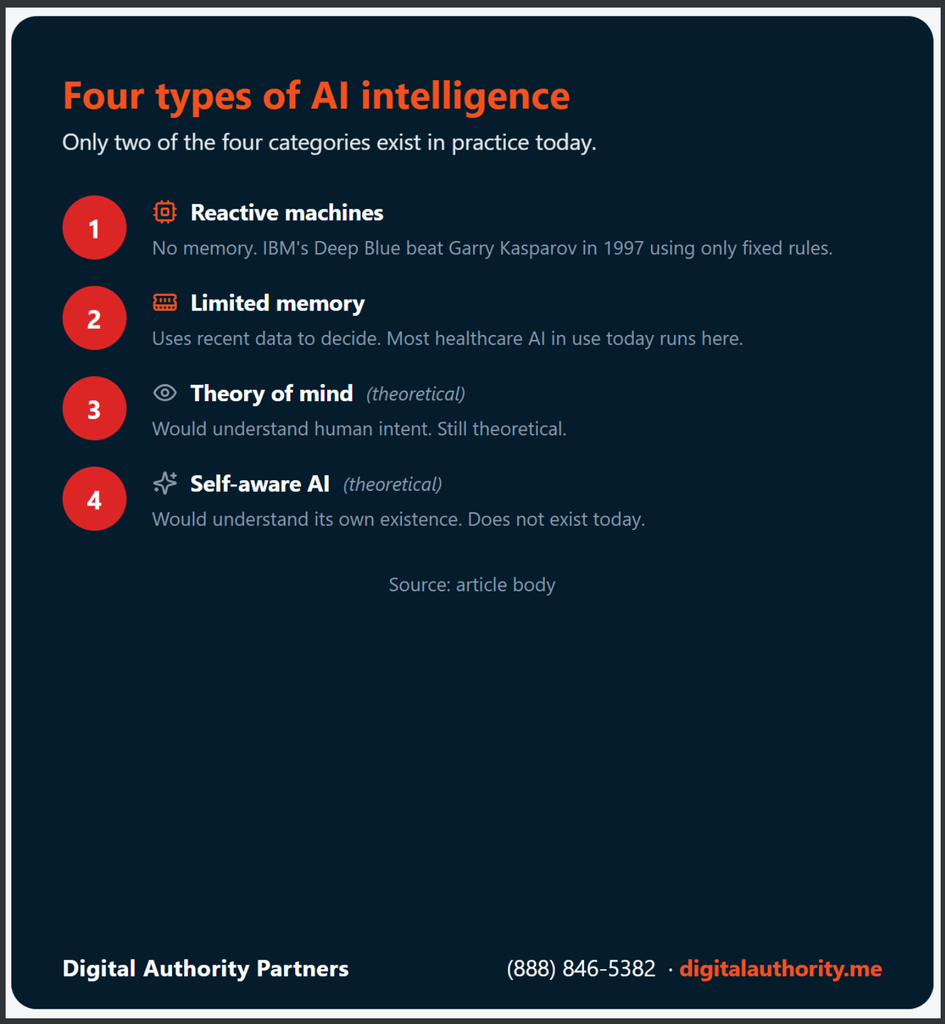
That kind of task-specific strength does not make AI intelligent the way a person is. Researchers group AI into four types based on how much a system can remember, understand, and reflect on: reactive machines, limited memory, theory of mind, and self-aware AI. Only the first two exist today. The other two remain theoretical.
Reactive Machines
Reactive machines are the simplest type of AI. They have no memory and cannot learn from experience. Given the same input, they always produce the same output. In 1997, IBM’s Deep Blue supercomputer defeated reigning world chess champion Garry Kasparov, the first time a computer beat a sitting champion under standard tournament conditions.
Deep Blue evaluated up to 200 million positions per second and picked the move most likely to win, but it could not learn from a loss or apply what it knew to a different game. It only reacted to the rules it was given.
Limited Memory
Today’s AI lives here. Limited memory systems look into the recent past in a narrow way, then use what they find to make a decision. A self-driving car judges where nearby objects will be next based on where they are now and where they were a moment ago. Most healthcare AI, from imaging tools to virtual assistants, runs on limited memory.
Theory of Mind
Theory of mind is the next step up, and it is still theoretical. A theory-of-mind machine would understand the needs and expectations of the people it works with. DeepMind’s ToMnet research has trained models to predict another agent’s beliefs and intentions from behavior alone, an early step in that direction, though nothing close to real theory of mind exists yet.
Self-aware AI
Self-aware AI sits at the top of this scale. It describes machines that understand their own existence and decide on their own. Nothing close to this exists today, and for now it remains a subject of science fiction rather than engineering.
Most healthcare AI in use today falls into the second category. That distinction matters, because it sets realistic expectations for what these tools can and cannot do before you invest in them.
Examples of AI at Work in Healthcare Today
You do not have to wait for future stages of AI’s development to see results. Limited memory AI already carries real weight across the healthcare industry, and its accuracy keeps improving. Four categories show where that impact is concentrated right now: machine learning, natural language processing, diagnostic imaging, and robotics.
Machine Learning
Machine learning improves through experience, the way you learn from repetition. It studies training data, then builds a model for future decisions. Your email spam filter uses it. So does the Kinsa Smart Thermometer, a consumer device that tracks temperature history and flags illness trends inside a household.
Natural Language Processing
Natural language processing lets you talk to a machine and get an answer. It powers voice assistants, and it now drives ambient documentation tools that listen during a visit and draft the clinical note. That single application is reshaping how clinicians spend their day, as the data later in this article shows.
Diagnostics and Machine Vision
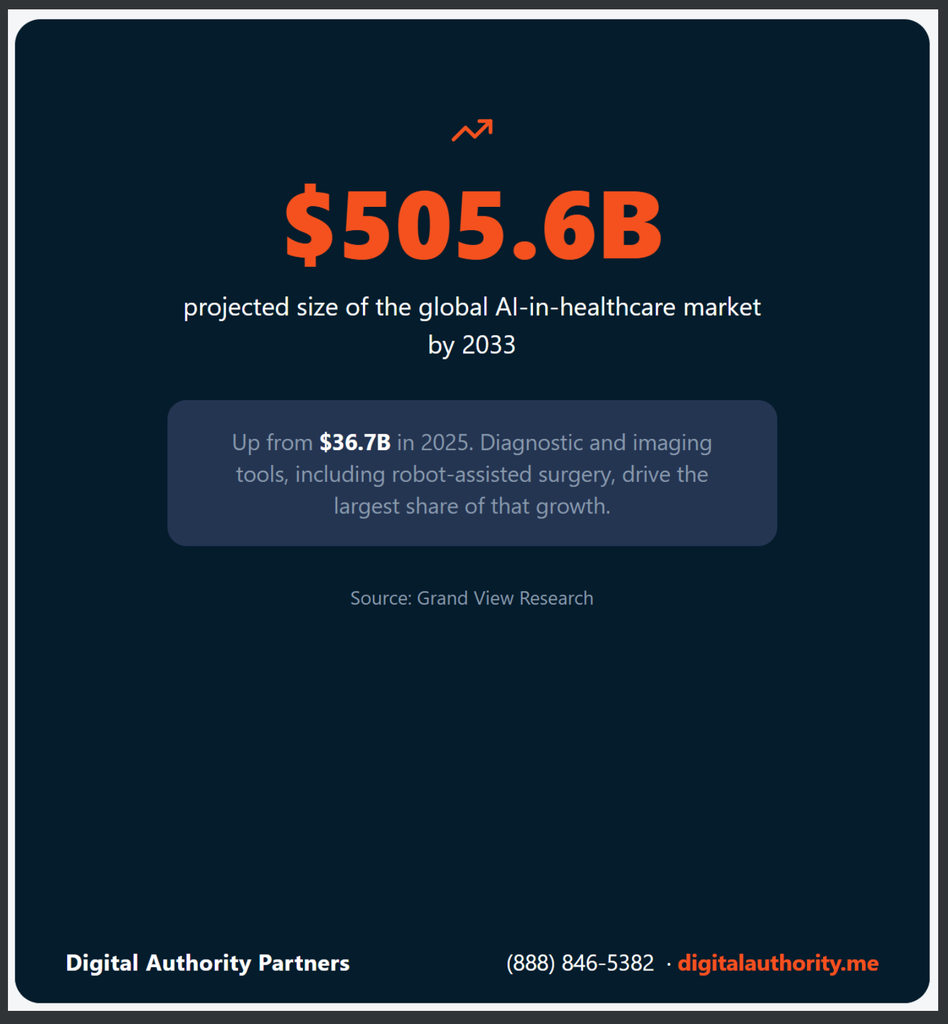
Machine vision reads images the way earlier software read text. In healthcare, it reviews scans for markers a human eye can miss. Grand View Research valued the global AI in healthcare market at $36.7 billion in 2025 and projects it to reach $505.6 billion by 2033. Diagnostic and imaging tools, including robot-assisted surgery, make up the largest share of that growth.
Robotics
Robotics in medicine is about precision and consistency. The Da Vinci surgical robotic system holds cameras and instruments so surgeons can operate through tiny incisions. A robotic dentist in China fitted implants without direct human control. Robots do not tire, and that consistency lowers a whole class of errors.
Together, these four categories show that AI is not a future promise in healthcare. It is already doing measurable work, and the next section shows why that has changed how healthcare leaders plan their budgets.
Why Healthcare Leaders Are Embracing AI
AI Adoption is no longer the open question. Most health systems already use AI somewhere in their operations. The remaining question is how fast an organization moves from a single pilot to a system-wide program, because the health systems that scale first capture the savings before the technology becomes table stakes.
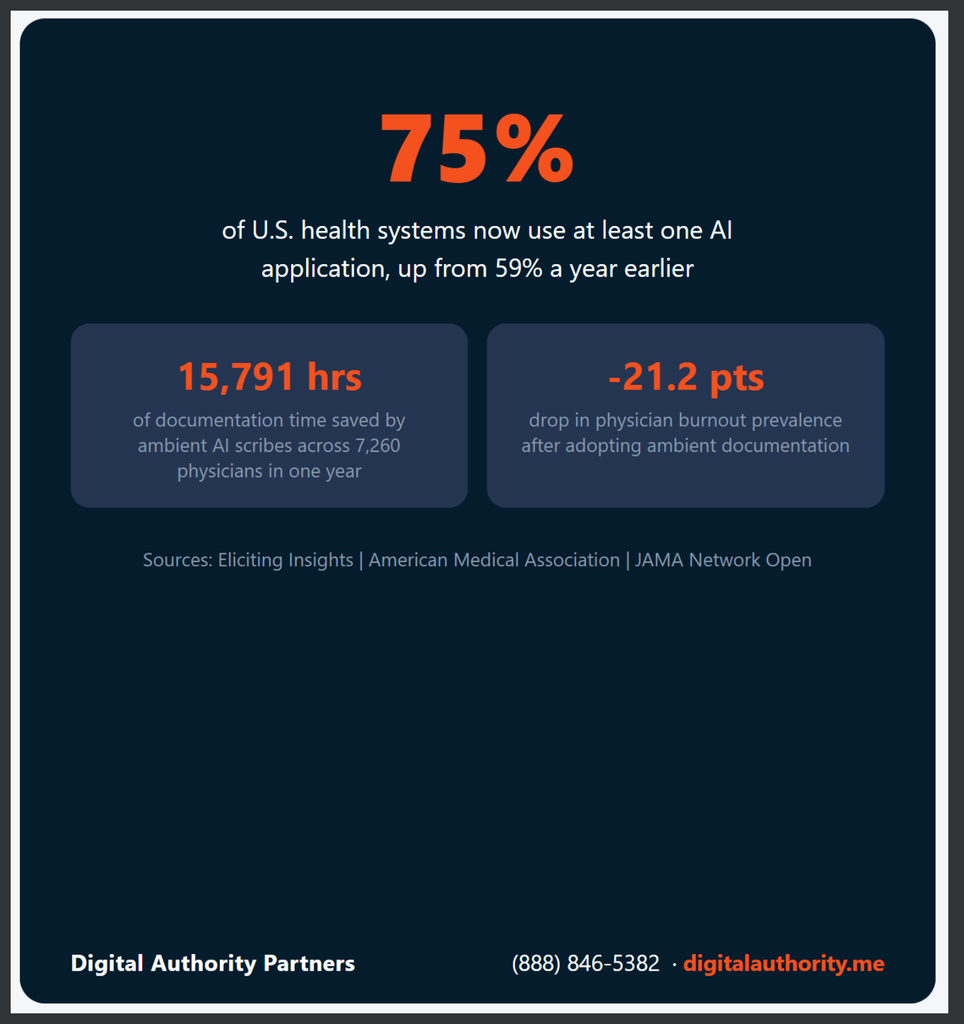
A 2026 Eliciting Insights adoption survey found that 75% of U.S. health systems now use at least one AI application, up from 59% a year earlier, and half of respondents run three or more AI tools at once. That pace means organizations that wait even one more budget cycle are competing against health systems that already have a year of efficiency gains banked. As a healthcare leader, that value shows up in five places:
- Lighter administrative load: AI drafts notes, processes claims, and flags coding gaps so your teams spend more time on patients.
- Smarter clinical support: Machine learning surfaces at-risk patients and predicts complications in intensive care before they escalate.
- More efficient operations: AI command centers read hospital-wide data to route beds, staff, and equipment where they are needed.
- Stronger security: Behavioral analytics help IT teams spot threats to patient data faster than manual review.
- Faster discovery: AI shortens drug research and remote monitoring, so care reaches patients sooner and at lower cost.
When The Permanente Medical Group rolled out ambient AI scribes across its physician workforce, the results were strong enough that the American Medical Association featured them in 2025. Across 7,260 physicians and more than 2.5 million patient visits over one year, the tools saved an estimated 15,791 hours of documentation time, the equivalent of nearly 1,800 eight-hour workdays.
Physicians used that recovered time to spend more of the visit with patients instead of typing notes afterward, and the effect shows up directly in burnout data. A Mass General Brigham study published in JAMA Network Open found that ambient documentation technology was associated with a 21.2 percentage-point drop in burnout prevalence among Mass General Brigham physicians within 84 days. When you reduce burnout, you protect the workforce you already have.
Privacy, HIPAA, and Patient Trust
AI in digital health only works if you can trust it with sensitive information. If patients do not feel safe sharing their data, they will not use the tool, no matter how accurate it is. That means privacy cannot be an afterthought. It has to be part of the product from the first line of code.
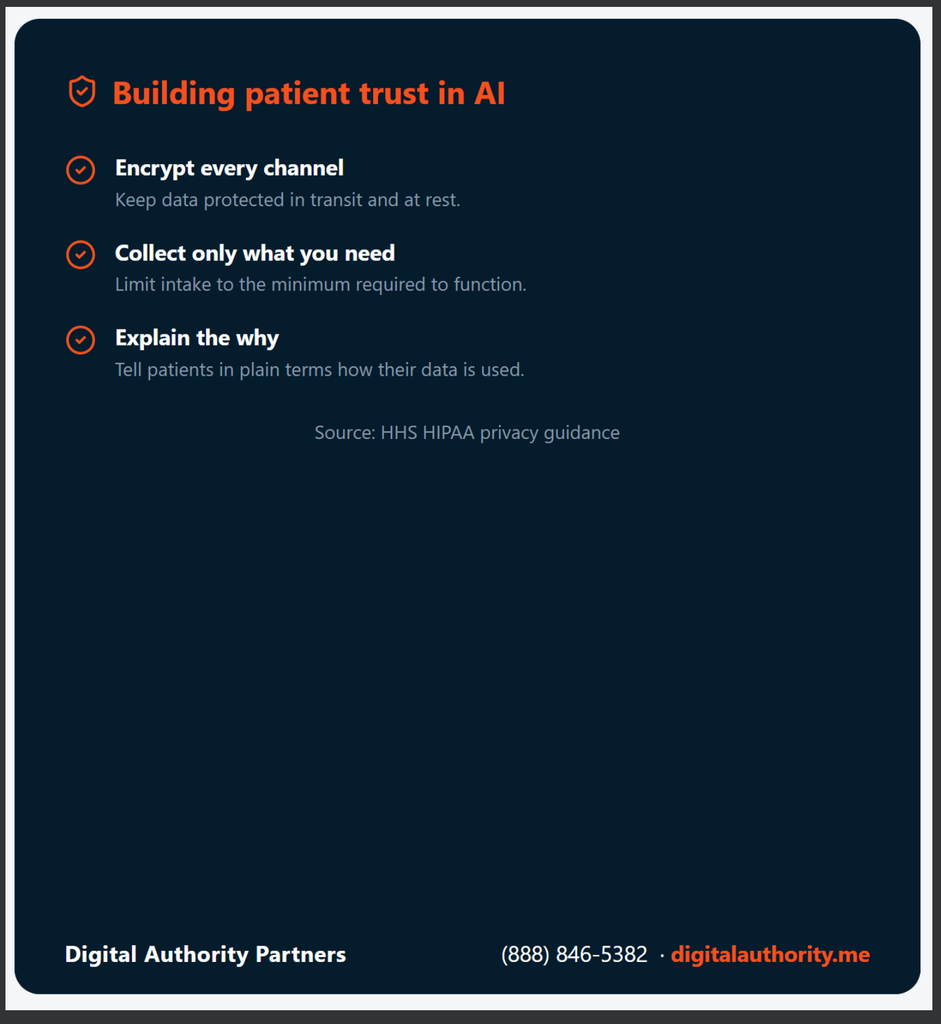
The HHS guidance on HIPAA privacy rules establish the minimum standard for how protected health information is handled. A few practices help your AI tools meet that standard and earn patient trust at the same time:
- Encrypt every channel, so data between the patient and the tool stays protected in transit and at rest.
- Collect only what you need, limiting intake to the minimum information the tool requires to function.
- Explain the why, telling patients in plain terms how their data is used and safeguarded.
Get this right and you earn something no feature can buy on its own: patients share more, follow through on care, and come back. That trust is what makes the rest of the technology worth using.
Technology and Digital Health?
In a 2011 interview shortly before his death, Apple co-founder Steve Jobs predicted that the biggest innovations of the century would happen where biology and technology meet. Digital health is that intersection, and it is still early.
The Healthcare Information Management Systems Society defines digital health as connecting and empowering people to manage health and wellness, supported by integrated, digitally enabled care. Under that definition, digital health takes many forms:
- Telehealth, giving you access to consultations, diagnoses, and prescriptions without a clinic visit.
- Wearable tech, measuring heart rate, glucose, and sleep between appointments.
- Big data, processing information to sharpen diagnoses and treatment plans.
- Imaging and diagnostics, producing clearer scans and faster reads.
- Genomics, mapping genomes to spot risk factors and guide treatment.
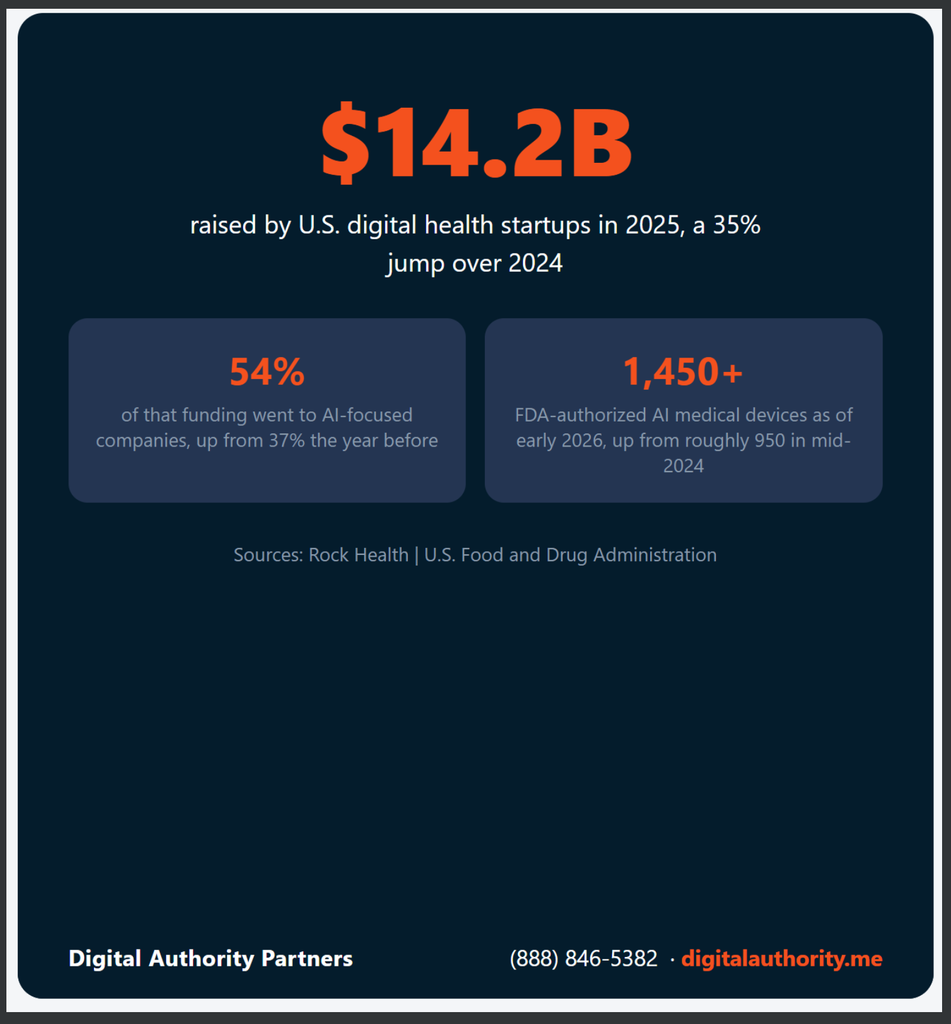
Investors have noticed the shift toward AI-driven care. Rock Health’s 2025 year-end market overview found that U.S. digital health startups raised $14.2 billion, a 35% jump over 2024. AI-focused companies captured 54% of that funding, up from 37% the year before.
The Rise of Digital Health
A big driver of the surge in digital health is the smartphone. When Apple launched HealthKit in June 2014, developers built health apps on top of it by the hundreds of thousands.
Phones quickly became health hubs. You can record breathing patterns through the microphone or track motor disorders through the built-in accelerometer. Everyday hardware quietly turned into medical hardware.
The FDA list of AI-enabled medical devices now holds more than 1,450 authorizations as of early 2026, up from roughly 950 in mid-2024. Most cluster around cancer detection, chronic condition treatment, and disease prediction. Doctors are on board too. Digital health serves everyone in the chain of care:
- Patients gain access to their own data, personalized treatment, and a better overall experience.
- Providers deliver more targeted care and shift focus from treating disease to preventing it.
- Payers cut costs by improving outcomes and simplifying a complex system.
Every stakeholder in that chain benefits from the same underlying shift: better data, used faster.
How AI Keeps Pushing Digital Health Forward
AI is what turns raw digital tools into results. Four areas show the pattern clearly:
Mobile Health
The World Health Organization defines mobile health as public health practice supported by phones and wireless devices. Machine learning reads the data these devices collect, then detects, tracks, and manages disease. Your phone becomes a monitor, a coach, and an early warning system at once.
At-home Testing
The idea that you must visit a clinic for every diagnosis is fading. Home kits now handle screening for a growing list of conditions, and AI helps return accurate results quickly. Convenience and privacy are pulling this market upward year after year.
Chronic Condition Management
Chronic conditions do not pause when you leave the office. Apps paired with devices like glucose monitors and portable EKGs let you manage a condition daily and share the data with your care team. Machine learning turns that stream into treatment adjustments that fit your life.
Software as a Medical Device
Sometimes the software itself is the medical device, regardless of what hardware it runs on. Instead of supporting a diagnosis, the program performs the medical function directly. FDA-cleared examples track symptoms of ADHD, epilepsy, and skin changes, using machine learning and machine vision to catch problems early.
What the Future of Digital Health Looks Like
The tools you have seen have only scratched the surface. Connected devices are multiplying, and each one adds data that makes the next diagnosis sharper. The trajectory points toward constant, low-friction monitoring.
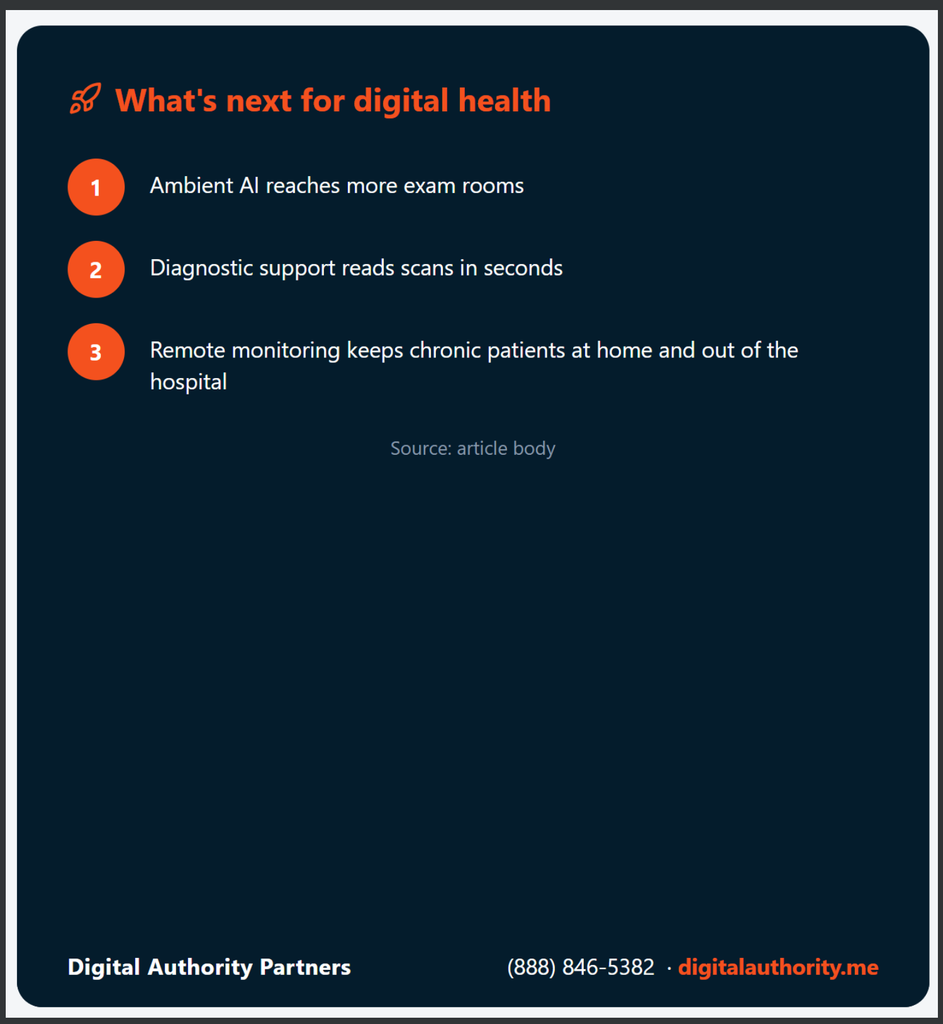
More data means earlier detection, faster diagnosis, and better tracking of how conditions spread. Care shifts from reacting to disease toward preventing it. Expect three moves over the next few years. Ambient AI reaches more exam rooms. Diagnostic support reads scans in seconds, and remote monitoring keeps chronic patients at home and out of the hospital.
Frequently Asked Questions on the Future of AI in Digital Health
You’ve seen how AI is reshaping digital health today and where it’s headed next. Here are direct answers to the questions people ask most:
How is AI used in healthcare right now?
AI handles imaging analysis, clinical decision support, administrative documentation, and remote monitoring. It also speeds drug discovery and predicts complications in intensive care. Most of these tools run on limited memory AI, the stage that is feasible today.
Is AI in digital health safe and regulated?
Yes. The FDA reviews and authorizes AI-enabled medical devices, and the list passed 1,450 authorizations in 2025. Providers still keep clinicians in the loop, and AI serves as decision support while physicians make the final call.
Does AI in digital health reduce clinician burnout?
It can. Ambient documentation tools draft notes automatically, and one health system saved nearly 15,791 hours of documentation time. Mass General Brigham measured a 21.2% drop in burnout prevalence after adoption.
How does AI improve diagnostics?
Machine vision reviews scans for subtle markers, and machine learning refines its reads over time. These tools can flag findings a busy clinician might miss. They work best as a second set of eyes alongside a physician.
What is the difference between AI and digital health?
Digital health is the broad field of digital tools for managing health. AI is the intelligence layer that makes many of those tools smarter. Digital health is the matter, and AI is the mind.
How can a healthcare organization start adopting AI?
Start with one high-friction workflow, like documentation or scheduling, and measure the result. From there, expand into clinical support and operations. A healthcare marketing and SEO team can help you position those investments so patients and referrers find you.
Put AI in Digital Health to Work for Your Business
AI in digital health has moved from promise to practice. The organizations pulling ahead run it as an ongoing program and measure the return in time, accuracy, and trust. Here is what to remember:
- Adoption is the baseline, since three in four U.S. health systems already run at least one AI application.
- Administrative wins come first, because documentation and scheduling deliver measurable time savings fast.
- Data compounds, as every connected device sharpens the next diagnosis and prediction.
- Judgment stays human, with AI supporting the clinicians who make the final call.
Ready to turn AI in digital health into growth for your organization? Partner with an award-winning healthcare marketing and development team. Talk with the Digital Authority team to build a strategy that reaches the patients and partners who need you.
Want To Meet Our Expert Team?
Book a meeting directly here

Related Articles
Nearly all HITRUST-certified environments stayed breach-free last year, which is why HITRUST certification has become...
Digital transformation in healthcare is the integration of digital technologies, data, and connected systems across c...

Health systems hold more data than ever, and big data in healthcare is the competitive advantage waiting to be used. ...