
How to Write SEO Medical Content That Ranks in 2026

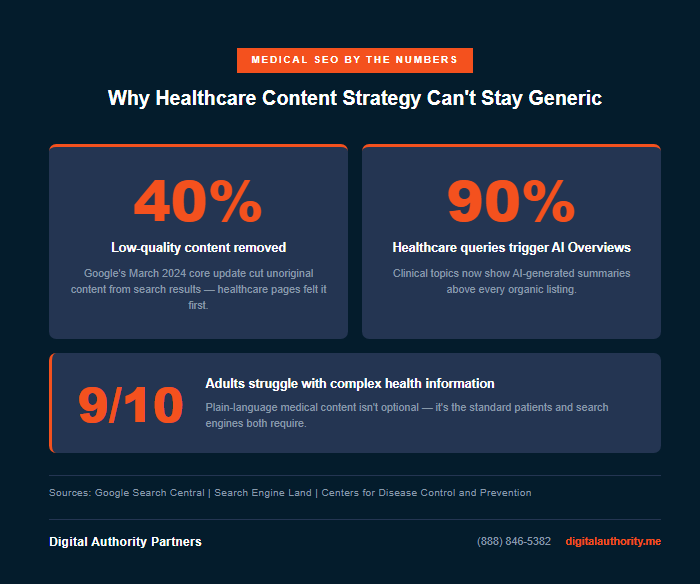
Google’s March 2024 update cut low-quality, unoriginal content from search results by 40%, and healthcare pages felt the impact immediately. Earning organic visibility now requires you to target specific clinical queries and structure every page around patient intent.
A strong medical SEO content strategy, built on accuracy and trust, separates pages that rank from those that stagnate. Our Medical SEO Agency helps you build that. This guide walks you through how to write SEO medical content, from mapping search intent and building evidence-first research workflows to structuring pages that earn placement in AI Overviews, providing a repeatable system for medical content that ranks and converts.
What Is Medical SEO Writing and Why Does It Matter?
Medical SEO writing combines clinical accuracy with search optimization to help healthcare organizations earn visibility. It goes beyond inserting keywords into your blog posts. Every page must answer a real health question with evidence-backed information structured for search engines and the people who depend on your answers.
Healthcare is one of the highest-stakes search categories online. Understanding how to write SEO medical content helps you build pages that outperform generic, unverified health information at every level of search.
Google triggers AI Overviews for 90% of healthcare queries. Clinical topics such as symptoms, treatments, and conditions now show AI-generated summaries above almost every organic listing. This is your opportunity to work with Google and help your medical content get cited by AI Overviews.
The patients you want to reach are already searching. They type questions about symptoms, compare treatment options, and look for providers they can trust, all before they ever contact a clinic. Medical SEO writing puts your answers in front of them at exactly that moment.
Start With Search Intent Before Keywords
Search intent defines what patients want and how your content should respond. When you write SEO medical content with intent, your readers find it easier to understand and more engaging. Nine out of 10 adults struggle to understand health information when it includes complex language. Ensure your medical content supports real patient needs, meeting your readers at their level of understanding.
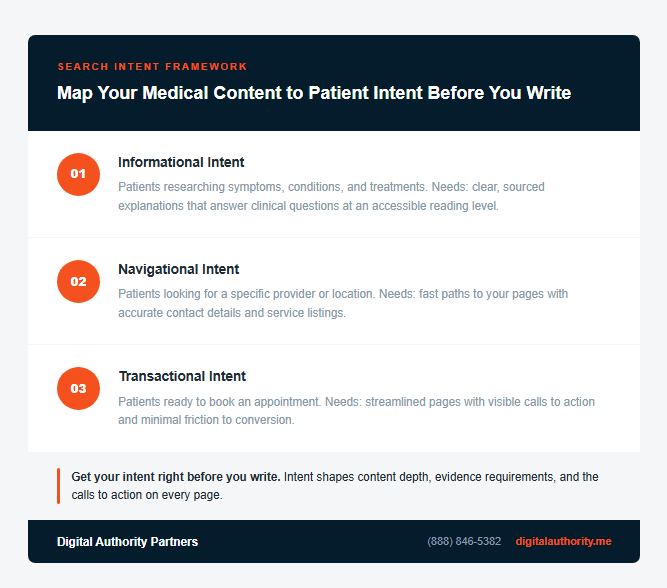
Map your content plan around three core intent categories:
- Informational intent: Symptoms, conditions, and treatments need clear explanations backed by sourced evidence for your patients.
- Navigational intent: Searchers looking for a specific provider or treatments need fast paths to your pages with accurate locations and contact details.
- Transactional intent: Patients who are ready to schedule appointments with you need streamlined pages with visible calls to action.
Your content’s intent shapes everything downstream. The depth of your content, the evidence you include, and the calls to action on each page. Get your intent correct before you write to prevent rework and build pages that convert visitors into patients.
With your intent categories mapped, you have a focused set of SEO healthcare topics to research and develop. That clarity makes it straightforward to build a sourcing process that backs every claim you publish. It also helps you avoid writing for a broad audience when your patients are searching with very specific questions. Intent-mapped content answers the question being asked, not a generalized version of it.
Build an Evidence-First Research Workflow
Ensure a verifiable source backs every medical claim. A structured research workflow gives your writers a clear, repeatable process. Standardize this process in your SEO for medical websites strategy and evaluate your sources to improve your trust and long-term performance.
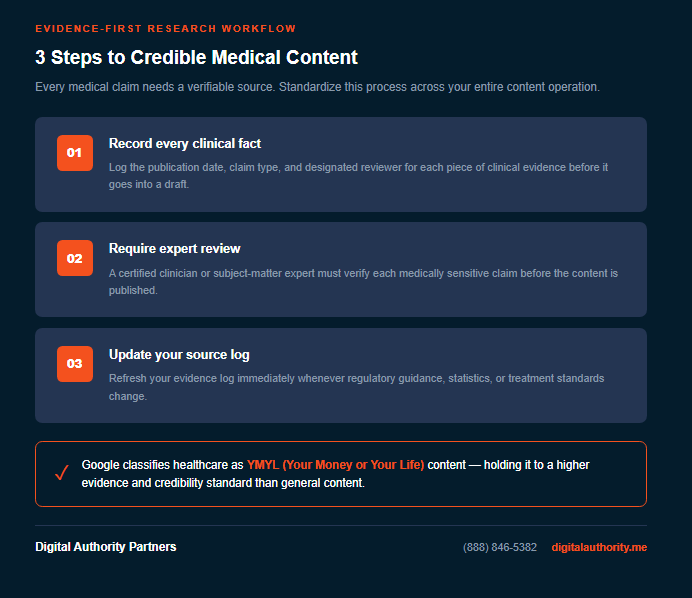
- Record the publication date, specific claim type, and the designated reviewer for every clinical fact.
- Require a certified clinician or subject-matter expert to review each medically sensitive claim.
- Update your source log immediately whenever regulatory guidance, statistics, or accepted treatment standards change.
This evidence foundation keeps your claims credible. Credibility alone, however, won’t move patients to act. Once your sourcing is solid, the next layer is making sure the people you wrote it for can actually understand it.
Write for Health Literacy Without Flattening the Science
You need to bridge the gap between clinical accuracy and patient comprehension. Replace jargon with clear, concrete language while preserving the substance behind every claim. Restructure your complex ideas so a wider audience can make informed health decisions based on your medical content.
The U.S. Department of Health and Human Services highlights the importance of plain language in healthcare. Clear writing benefits your patients and search engines. A sound medical SEO marketing approach makes content easier to interpret, rank, and act on.
Start by identifying the terms your clinical team uses. Replace them with patient-first phrasing and short definitions that clarify without condescension. The focus is on reducing your readers’ cognitive load. Active voice, paired with concrete verbs and short paragraphs, is a powerful tool for achieving that.
Keep risk statements, treatment limitations, and next-step guidance visible rather than buried in footnotes. Pair each complex concept with a plain-language equivalent. The same clarity that makes your content readable is also what makes it structurally eligible for featured snippets and AI Overviews, where direct, plain-language answers are exactly what Google surfaces.
Structure Pages for Featured Snippets and AI Overviews
Google emphasizes creating unique content that fully satisfies user needs. Modern search results prioritize direct answers. Writing your content for featured snippets and AI Overviews is a critical part of medical content SEO. With snippet-friendly formatting, both algorithms and readers have a faster path to the answers they need.
To structure your content effectively:
- Lead with the answer: Address the main question in the first sentence.
- Use question-based headings: Match how users search for information.
- Add structured elements: Include lists, FAQs, and comparisons.
Pages structured this way serve double duty. They give your patients fast access to the answers they need and give AI systems extractable content to display in overviews. Pair this approach with generative engine optimization to align your page formatting with AI search citation patterns.
Getting cited by AI is one measure of visibility. Earning a patient’s trust is another, and it requires clear proof that real, qualified people stand behind your content.
Add E-E-A-T Signals Readers Can Verify
Readers need to trust the people behind your content, and adding E-E-A-T (Experience, Expertise, Authoritativeness, and Trustworthiness) signals demonstrates real expertise and shows exactly who created your content. A healthcare SEO expert knows you cannot establish trust with a simple tagline. Build trust through visible, verifiable details on every page you publish. Your medical SEO marketing strategy must embed trust signals into your healthcare content workflows from the first draft.
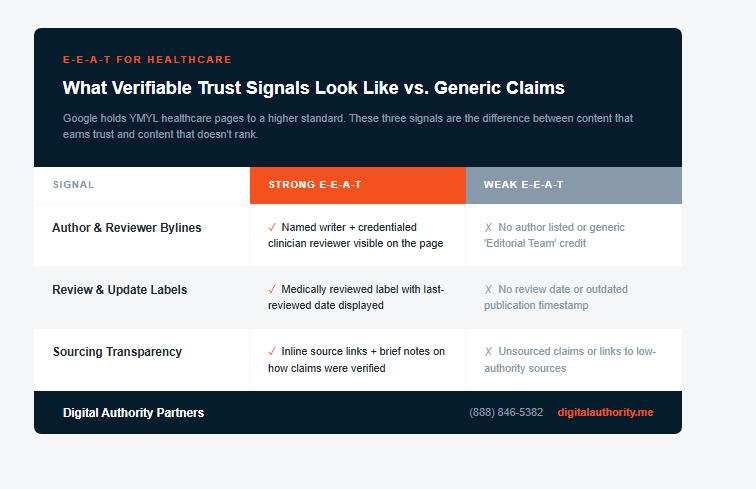
Every signal you add answers a core question Google asks about your pages. Who created this, and can readers verify their qualifications? Show why your page exists and how you help them make better health decisions.
Build these E-E-A-T signals into every piece:
- Author and reviewer bylines: Name the writer and the clinician who reviewed the content, with credentials and relevant healthcare experience visible on the page.
- Review and update labels: Add a medically reviewed label and last reviewed dates where appropriate.
- Sourcing transparency: Include brief notes explaining how key claims were verified, with links to primary sources for readers to verify the evidence.
These signals matter more in healthcare than in almost any other vertical. Google classifies medical content as Your Money or Your Life (YMYL), meaning it holds pages to a higher evidence and credibility standard than general interest content.
Use medical language carefully and only where real expertise is easy to demonstrate. The goal is to make your expertise easy to verify, which is much more persuasive in healthcare than generic claims.
These signals give your readers a reason to stay, read, and return. Healthcare audiences notice when your content feels reviewed and maintained with care. E-E-A-T signals do more than satisfy Google’s quality criteria. They build online authority that earns consistent visibility, and pairing that authority with efficient on-page execution turns credibility into rankings.
Optimize On-Page Healthcare SEO
Strong medical content needs clean on-page signals to reach its full ranking potential. SEO healthcare performance depends on technical execution as much as writing quality. Start with the fundamentals. Title tags, H1s, and URLs each need alignment to a single primary topic. Trying to rank for multiple keywords on one page dilutes your focus and weakens every signal you send to Google.
These details compound. A well-structured title tag sets accurate expectations before a patient clicks. A meta description that mirrors the intent behind a search query, not just the keyword, improves both click-through rates and on-page engagement.
Alignment across your site builds domain authority far faster than isolated page-level improvements. Small technical decisions, made consistently, strengthen your topical clarity across your entire website over time.
Schema markup is one of the most underused on-page tools in healthcare SEO. Adding MedicalWebPage or Physician schema helps search engines classify your content correctly and improves your eligibility for rich results, including knowledge panels and AI Overview citations.
Internal links are a direct extension of that on-page work. They guide patients through related content and tell Google how your topics connect. Pages that earn strong engagement pass that authority to connected pages, which means a well-linked content structure amplifies the performance of every individual piece you publish.
A dedicated medical SEO company goes beyond typical solutions with mobile-friendly layouts and purposeful calls to action on every page, making sure every link leads somewhere worth clicking. The biggest ranking gains come when written medical content works as part of a larger, well-maintained content structure, which is exactly what a topic cluster architecture provides.
How to Build Topic Clusters and Content Pillars
Patients move from broad education to service comparison to local provider selection, and your content architecture should mirror that journey. Healthcare search rarely ends with a single article. A pillar-and-cluster structure built around your conditions and services captures search demand at every stage.
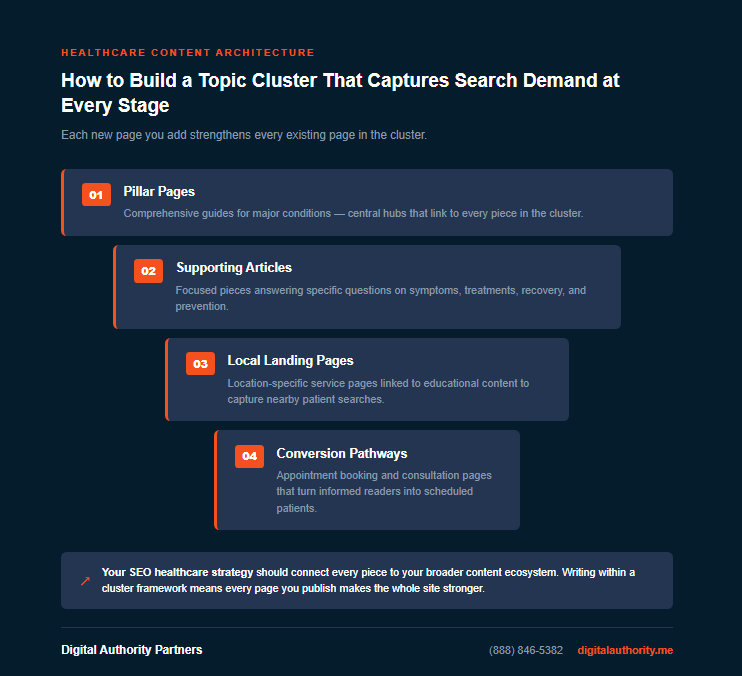
A well-designed cluster reinforces your authority across an entire subject area:
- Pillar pages: Comprehensive guides for major conditions serve as central hubs linking to all related content across the cluster.
- Supporting articles: Focused pieces answer specific patient questions about symptoms, treatments, recovery, and prevention within each topic area.
- Local landing pages: Educational content linked to location-specific service pages, using local SEO strategies for doctors, captures nearby patient search traffic.
- Conversion pathways: Cluster content linked to appointment booking and consultation pages turns informed, engaged readers into scheduled patients.
Your SEO healthcare strategy connects every piece of content to a broader content ecosystem, where writing SEO medical content within a cluster framework means each new page strengthens every existing one.
Building and maintaining a cluster at this scale takes consistent output, technical oversight, and deep familiarity with healthcare search. For many organizations, that reach is precisely where a medical SEO company becomes the smarter investment.
The question is not whether your content strategy needs that level of structure. At a certain stage of growth, it always does. The real question is whether your current team has the bandwidth and the healthcare SEO expertise to build and sustain it.
When Should You Hire a Medical SEO Specialist?
Creating pages that meet SEO, compliance, and marketing goals simultaneously takes coordinated expertise. Working with a dedicated medical SEO company gives you the experience, expertise, and technical depth to execute each page with precision and confidence.
What Signs Show Your Team Is Ready to Scale?
Bringing in a medical SEO specialist is a proactive decision that builds on the work you’ve already done. These indicators suggest the timing is right:
- Key topics have strong ranking potential that your current strategy is positioned to capture.
- Your sourcing and clinical review process is established and ready to scale alongside content volume.
- Production capacity is growing, and your workflows need structure to support the output.
- Traffic is building, and a specialist can convert more of those visits into patient appointments.
A specialist works alongside your existing team. They bring the focused workflows and deep expertise that help your marketing strategy perform at the level your content quality deserves.
What Does a Medical SEO Content Specialist Do?
A specialist aligns clinical accuracy and search performance across your full content operation. They know how to write SEO medical content that meets both patient needs and Google’s standards. Their core responsibilities span four areas:
- Map nuanced patient search journeys to build intent-driven content strategies tailored to your services.
- Apply rigorous medical sourcing standards and maintain an evidence-first research workflow across every piece.
- Structure pages for AI Overviews, featured snippets, and strategic internal linking across your content architecture.
- Coordinate the clinician review process and compliance requirements with ongoing factual updates.
Delegate these responsibilities to a specialist and allow your internal teams to focus on patient care. The right external expertise transforms your medical SEO marketing and drives the long-term success of your patient acquisition efforts.
Medical SEO Content That Builds Authority
Every step in this framework connects to the next. Intent mapping shapes your research process. Rigorous sourcing strengthens your health literacy writing. Clean page structure feeds your E-E-A-T signals. Topic clusters amplify every individual piece you publish. Apply this system consistently, and your medical content becomes one of your most durable patient acquisition channels.
Contact Digital Authority Partners to build your authority with curated medical content tailored to your services and audience. Get a free consultation to learn how we help you write medical content that meets every standard you set.
Want To Meet Our Expert Team?
Book a meeting directly here

Related Articles

Demand for therapy is at an all-time high, yet nearly half of the 62 million U.S. adults with a mental illness receiv...

AI in digital health has moved from research labs into daily care. A phone camera can now screen for diseases that on...

The best health apps turn your phone into a daily tool for tracking habits, managing health conditions, and building ...