HVAC Google Ads That Actually Work + BluePrint

You’ve probably been there. You set up a Google Ads campaign, watch the clicks to your HVAC website, and waited for your phone to ring. Except it didn’t. Or when it did, it was someone three counties away asking for a quote you couldn’t fulfill.
It sucked right?
Here’s the thing. HVAC Google Ads can work incredibly well. I’ve seen contractors pull in 25+ qualified leads a month with the right setup. But most HVAC companies make the same handful of mistakes that drain their budget before they ever see results.
This guide is going to fix that. You’ll learn how to structure campaigns that actually convert, pick keywords that attract buyers instead of browsers, and stop hemorrhaging money on clicks that go nowhere. Whether you’re brand new to HVAC PPC or you’ve been running ads for years with disappointing results, this HVAC Marketing Company guide covers what you need.
By the end, you’ll know:
· Which campaign types make sense for your budget
· The keywords that bring in real jobs, not tire-kickers
· How much you should actually spend (and what to expect)
· How to track everything so you know what’s working
Why HVAC Google Ads Beat Every Other Channel
Picture this. A homeowner’s AC stops working on a Saturday afternoon in July. It’s 95 degrees. Kids are cranky. What do they do? They grab their phone and Google “AC repair near me.”
That’s your moment.
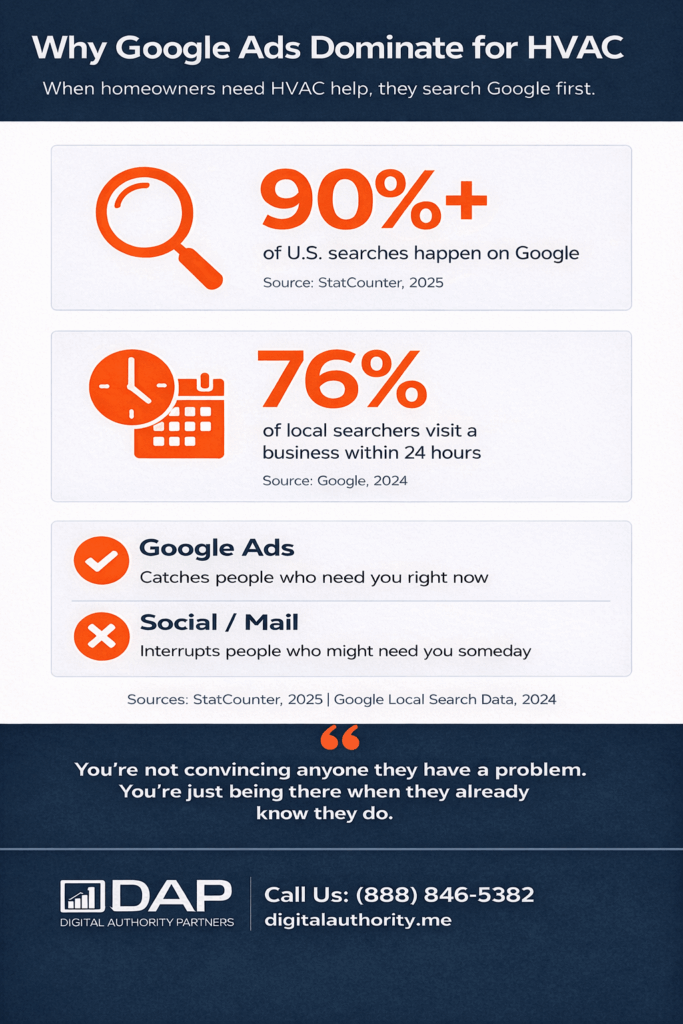
According to Statcounter, Google handles over 90% of searches in America. And Google’s own data shows 76% of people who search for something local visit a business within 24 hours. For emergency services like HVAC? That number’s probably even higher.
Compare that to running Facebook ads or sending postcards. Those interrupt people who might need you someday. Maybe. HVAC Google Ads catch people who need you right now. They’re sweating, they’re stressed, and they’re ready to book whoever shows up first with a credible ad.
That’s the difference. You’re not convincing anyone they have a problem. You’re just being there when they already know they do.
Three Campaign Types You Need to Know
Not every Google Ads campaign works the same way. Picking the wrong type for your goals is an easy way to waste money fast.
Search Ads: The Bread and Butter
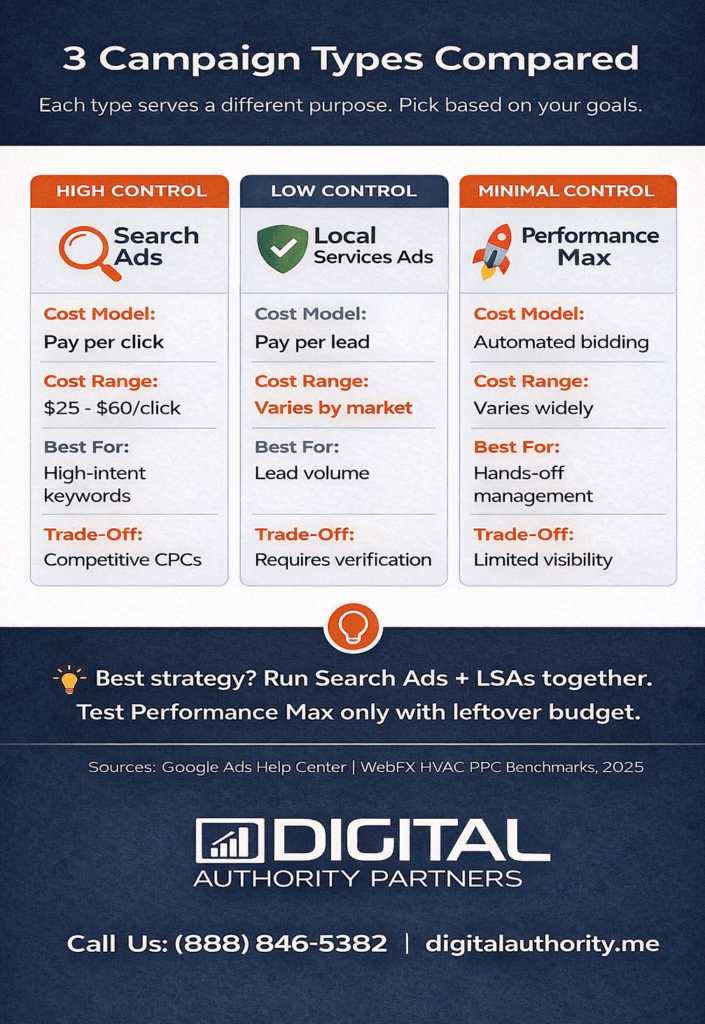
These are the text ads that show up when someone types “furnace repair near me” into Google. You pick the keywords, write the ads, and pay when someone clicks.
For most HVAC contractors, search campaigns deliver the best bang for your buck. You’re targeting people actively looking for help. The intent is already there.
Downside? Competition’s fierce. Depending on your market, you might pay $25 to $60 per click for popular terms. Ouch. But when one repair job brings in $400 and a new install brings $8,000? The math can still work out.
Local Services Ads: Pay for Leads, Not Clicks
LSAs are those ads with the green “Google Guaranteed” checkmark that appear above everything else. Different model here. You pay per lead, not per click.
So if someone clicks but doesn’t call? You don’t pay. Only actual contacts cost you money.
The catch is you need to pass Google’s verification process. Background checks, license verification, insurance docs. Takes a few weeks. But once you’re in, you’ve got a trust badge competitors without it don’t have. In my experience, LSAs often outperform regular search ads for pure lead volume.
Performance Max: The “Let Google Figure It Out” Option
Performance Max uses Google’s AI to run your ads across Search, YouTube, Display, Maps, and Gmail automatically. You feed it headlines, images, and videos. It decides where to show them.
Honestly? Mixed feelings on this one. It can work well if you don’t have time to manage multiple campaigns. But you lose visibility into what’s actually performing. Some HVAC advertisers love it. Others find it burns the budget on Display placements that never convert. Worth testing, but don’t bet everything on it.
HVAC Google Ads Keywords That Actually Convert
Keywords are where most campaigns go wrong. Pick the wrong ones and you’ll blow through your budget on people who were never going to hire you.
Emergency Keywords: Where the Money Is
When someone’s furnace dies at 2 AM in January, they’re not comparison shopping. They need someone now. These searches convert like crazy.
Target stuff like:
· AC stopped working in [your city]
· No heat emergency
· Furnace won’t turn on
· AC blowing hot air
· Emergency HVAC repair in [your city]
Bid aggressively on these. Yes, they’re expensive. But the lifetime value of an emergency customer is huge. They’ll call you for maintenance, they’ll refer neighbors, they might buy a new system in a few years. One midnight furnace call can turn into thousands in revenue over time.
Service + Location Keywords
These combine what someone needs with where they are. Super effective for Google Ads for HVAC contractors because they signal clear intent.
Think:
· AC installation Austin
· Furnace repair near me
· Heat pump service 85001
· Duct cleaning Scottsdale
Pro tip: build separate ad groups for each service. Your AC repair ad shouldn’t show up when someone searches for furnace installation. Relevance matters. Google rewards it with lower costs and better positions.
Negative Keywords: Your Budget’s Best Friend
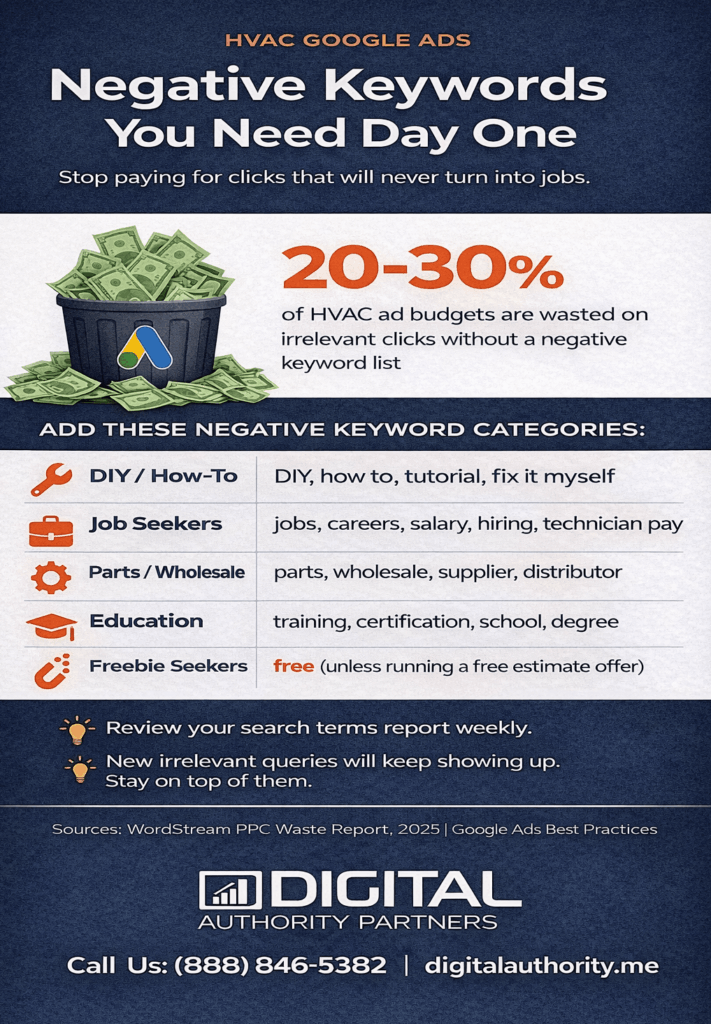
Here’s something most HVAC advertisers skip. Negative keywords tell Google what searches to ignore. Without them, you’ll pay for clicks from people looking for DIY tutorials, HVAC jobs, or equipment parts.
Add these immediately:
· DIY, how to, tutorial
· Jobs, careers, salary, hiring
· Parts, wholesale, supplier
· Training, certification, school
· Free (unless you’re offering something free)
Check your search terms report every week. You’ll find weird queries triggering your ads. Add them to your negative list. I’ve seen accounts waste 20-30% of their budget on irrelevant clicks before someone finally cleaned this up.
Structuring Your Account So It Actually Makes Sense
Throwing all your keywords into one campaign is a recipe for terrible results. Structure matters more than most people realize.
Split Campaigns by Customer Intent
Emergency repairs, installations, and maintenance attract completely different customers. They need different ads, different landing pages, and different bidding strategies.
Emergency campaigns should run 24/7 with aggressive bids. Someone Googling at 3 AM will pay premium prices and won’t shop around much.
Installation campaigns? Run these during business hours. These folks are researching. They want estimates, financing options, maybe a few quotes. Your messaging needs to reflect that.
Maintenance campaigns target the budget-conscious planners. Lower bids, seasonal specials, tune-up packages. Different animal entirely.
Keep Ad Groups Tight
Within each campaign, group keywords by specific service. One ad group for AC repair. Another for furnace repair. Another for heat pump work.
Why bother? Because when someone searches “AC repair,” you want them to see an ad that says “AC Repair” in the headline. Not “HVAC Services” or “Heating and Cooling.” Specificity wins clicks. And Google rewards relevance with better Quality Scores, which means you pay less per click.
Writing Ads People Actually Click
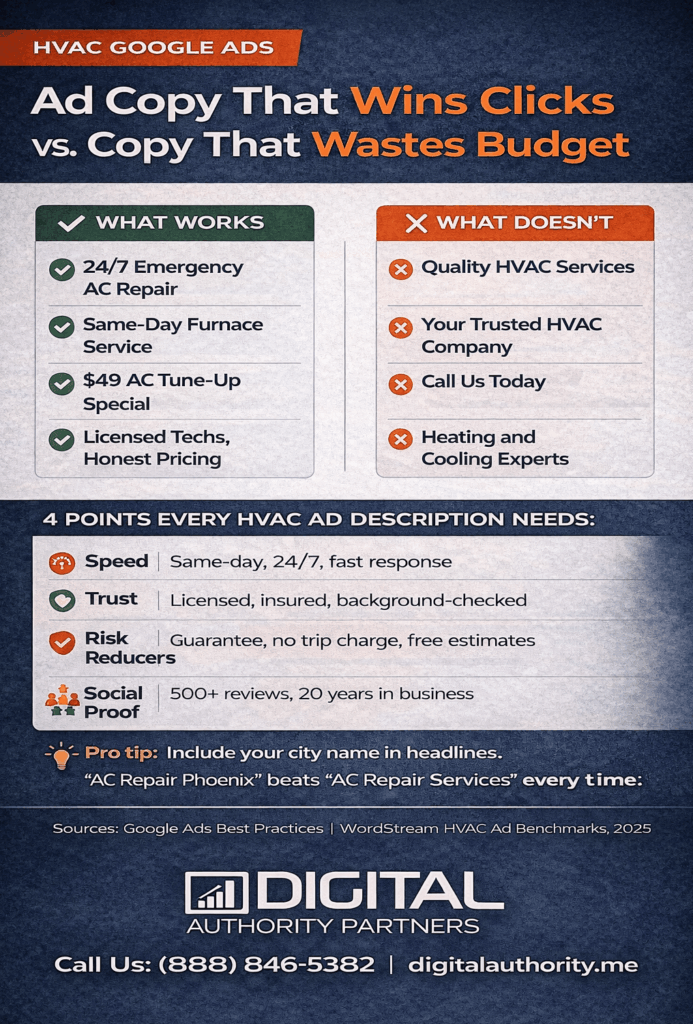
Most HVAC ads are painfully generic. “Quality Service.” “Trusted Professionals.” “Call Today.” Boring. Forgettable. Lost in a sea of identical competitors.
Headlines That Grab Attention
Your headline’s the first thing people see. Make it count.
What works:
· 24/7 Emergency AC Repair
· Same-Day Furnace Service
· $49 AC Tune-Up Special
· Licensed Techs, Honest Pricing
What doesn’t work:
· Quality HVAC Services (yawn)
· Your Trusted HVAC Company (who says that about themselves?)
· Call Us Today (for what exactly?)
Include your city when you can. “AC Repair Phoenix” beats “AC Repair Services” for someone searching in Phoenix. It just feels more relevant.
Descriptions That Seal the Deal
You’ve got a few lines to convince someone you’re worth calling. Focus on what matters to them, not what matters to you.
Hit these points:
· Speed (same-day, 24/7, fast response)
· Trust signals (licensed, insured, background-checked)
· Risk reducers (satisfaction guarantee, no trip charge, free estimates)
· Social proof (500+ five-star reviews, 20 years in business)
End with a clear action. “Call now for same-day service” beats “Contact us to learn more.” Be direct.
Call-Only Ads for Emergencies
Here’s a trick that works great for HVAC advertising. Call-only ads skip the website entirely. Someone clicks, their phone dials your number. Done.
Perfect for emergency keywords. When someone’s AC just died, they don’t want to browse your site and fill out a form. They want to talk to a human. Call-only ads make that one tap away.
Run these during business hours when you can actually answer. After hours, switch to regular ads with a landing page.
Landing Pages: Where Most Campaigns Fall Apart
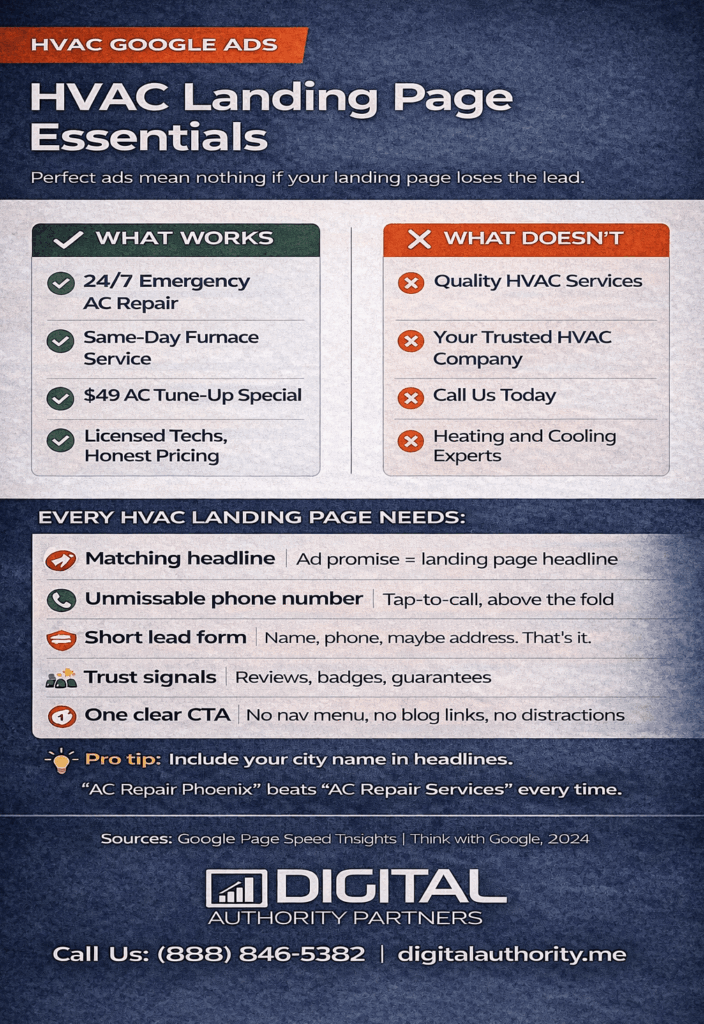
You could have perfect keywords, perfect ads, and perfect targeting. But if your landing page sucks? You’re lighting money on fire.
Stop Sending Traffic to Your Homepage
This is the most common mistake I see. Your homepage is designed to do twenty things. A landing page should do one thing: get them to call or fill out a form.
Build dedicated pages for each service you advertise. AC repair ads go to an AC repair page. Furnace installation ads go to a furnace installation page. Match the message throughout.
Note: if you operate in just one city, you should localize the page with qualifiers like “in Chicago,” “in Denver,” “in San Francisco,” and so on and so forth.
Every landing page needs:
· Headline that matches the ad they clicked
· Phone number that’s impossible to miss
· Short form (name, phone, maybe address)
· Trust badges, reviews, guarantees
· One clear call-to-action
That’s it. No navigation menu tempting them to wander off. No distracting links to your blog. Just the info they need to make a decision and a clear way to contact you.
Mobile or Bust
Over 95% of people searching for HVAC help are on their phones. If your landing page loads slowly or looks janky on mobile, they’re gone. Three seconds of load time is the max before people bail.
Make phone numbers tap-to-call. Keep forms short because nobody wants to type a novel on their phone. Test everything on actual devices, not just your desktop preview.
HVAC Google Ads Budget: Real Numbers, Real Expectations
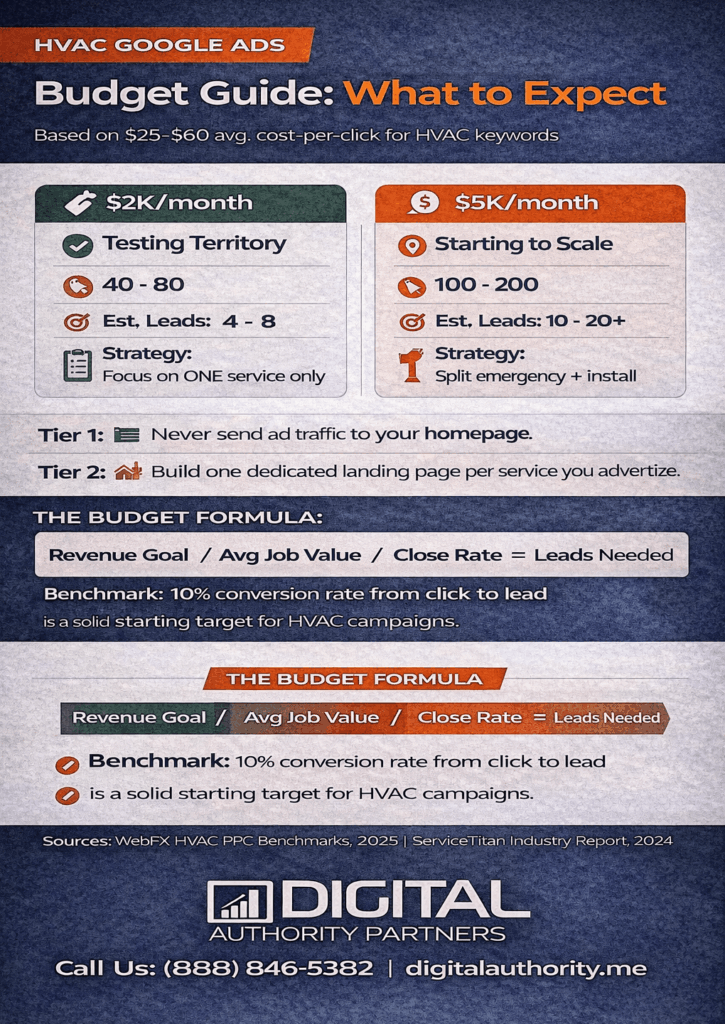
“How much should I spend?” Probably the most common question. And the honest answer is: it depends. But I can give you some realistic benchmarks.
$2,000 Per Month: Testing Territory
At this level, you’re looking at maybe 40-80 clicks depending on competition in your area. With a decent 10% conversion rate, that’s 4-8 leads.
It’s enough to learn what works. You’ll see which keywords convert and which are expensive dead weight. But you’ll probably run out of daily budget before capturing all the demand in your market.
Real talk: if you’re at $2,000/month, focus on ONE thing. Either emergency repairs or installations. Not both. Spreading this budget too thin means neither campaign gets enough data to optimize properly.
$5,000 Per Month: Starting to Scale
Now we’re talking. At $5K, expect 100-200 clicks and 10-20+ leads if your campaigns are dialed in.
This is where optimization gets interesting. You’ve got enough volume to test different ads, adjust bids by time of day, and actually see patterns in your data. Most HVAC companies start seeing real positive ROI at this level.
You can run separate campaigns for emergency and installation without starving either one. You’ve got room to experiment.
$10,000+ Per Month: Market Domination
At this budget, you’re capturing most of the high-intent searches in your service area. Big operations in competitive metros often spend here.
But fair warning. Bigger budgets need tighter management. A 10% efficiency improvement at $10K/month saves $1,000. Small optimizations matter way more at this scale.
The Budget Formula
Don’t pick a number randomly. Work backwards from your goals.
Say your average job is $500 and you want 20 new customers this month. That’s $10,000 in revenue. If half your leads convert (50% close rate), you need 40 leads. If leads cost $50 each, budget $2,000.
Obviously these numbers vary wildly by market. But having a framework beats guessing.
For the full picture on growing your HVAC business beyond just ads, grab our HVAC marketing guide.
Tracking: If You’re Not Measuring, You’re Guessing
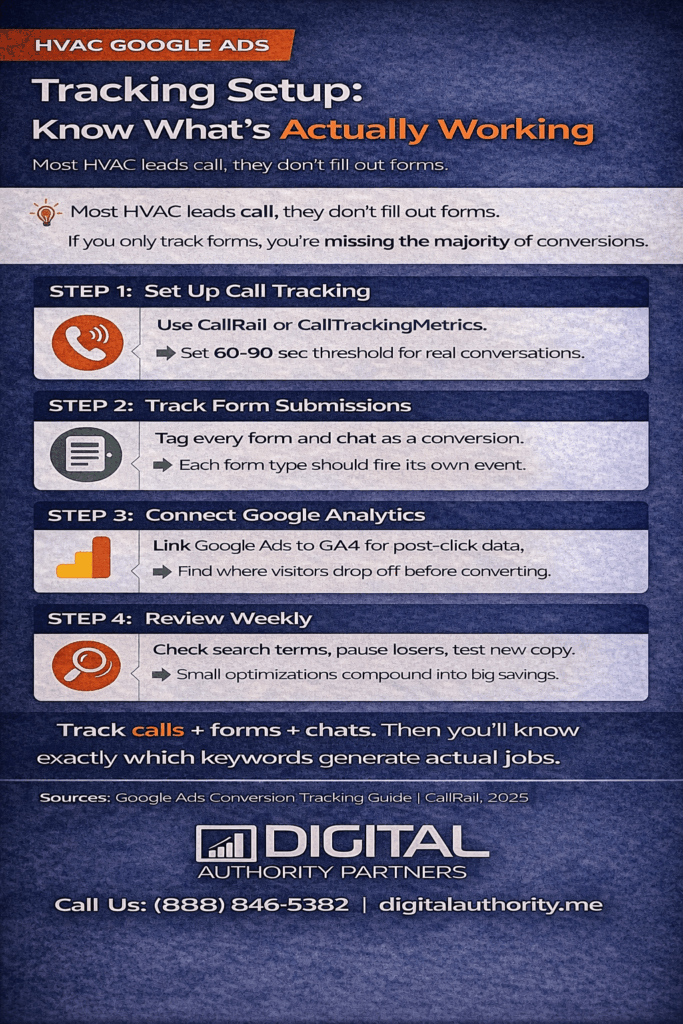
Running HVAC Google Ads without proper tracking is like driving blindfolded. You might get somewhere, but probably not where you wanted.
Call Tracking Is Non-Negotiable
Here’s the thing about HVAC leads. Most of them call. They don’t fill out forms. If you’re only tracking form submissions, you’re missing the majority of your conversions.
Set up call tracking with a tool like CallRail or CallTrackingMetrics. These assign unique phone numbers to each campaign. When someone calls, you know exactly which ad brought them in.
Set your conversion threshold at 60-90 seconds. Anything shorter is usually a wrong number or someone immediately realizing they called the wrong place. You want to count real conversations.
Track Forms and Chats Too
If you’ve got contact forms or chat widgets on your landing pages or email marketing assets, track those as separate conversion actions. Connect your HVAC Google Ads to Google Analytics to see how people move through your site after clicking.
Where are they dropping off? Which pages do they visit before converting? This stuff matters if you want to improve over time.
For more on turning leads into actual booked jobs, check out our HVAC lead conversion ebook.
Local Services Ads: Worth a Deeper Look
I mentioned LSAs earlier, but they deserve more attention. For a lot of HVAC contractors, these end up outperforming regular search ads.
Getting Google Guaranteed
That green checkmark isn’t just for show. Google actually verifies your business. License checks, insurance verification, background checks on employees. Takes 2-4 weeks usually.
Once you’re approved, your ads show at the absolute top. Above regular paid ads. Above organic results. Prime real estate.
How the Bidding Works
LSAs charge per lead, not per click. You set a weekly budget and a max cost-per-lead. Google uses your budget, your bid, and your profile quality to decide how often you show up.
What affects your ranking? Reviews are huge. Response time matters too. Google tracks how fast you answer leads and rewards quick responders with better placement.
LSAs vs Regular Search Ads
Both have their place. LSAs give you less control but often cheaper leads. Search ads let you target specific keywords and craft exact messaging.
The best HVAC Google Ads strategy? Run both. Use LSAs for broad lead generation. Use search campaigns for high-value keywords where you want tight control over what shows up.
Don’t Ignore AI Search Results
Search is changing. More people now, than ever, search on ChatGPT, Google’s Gemini, Grok or Claude. More people are getting answers directly from AI instead of clicking through to websites.
What’s this mean for HVAC advertising? Brand visibility matters more than ever. If someone sees your company mentioned in a ChatGPT response about “best HVAC contractors in Dallas,” they’re way more likely to click your ad later.
This is still early days, but it’s worth paying attention to. Creating helpful, authoritative content on your site increases your chances of getting cited by AI tools.
Want to dive deeper? Our HVAC ChatGPT whitepaper covers this emerging channel in detail.
Mistakes That’ll Drain Your Budget Fast
Let’s talk about what NOT to do. These errors are painfully common and painfully expensive.
Targeting Too Wide
You serve a 20-mile radius around your shop. So why are your ads showing to people 50 miles away? They’re not gonna hire you. They’ll find someone closer.
Set tight geographic targeting. Use radius targeting or specific ZIP codes. Check your location reports regularly because Google’s defaults are often too broad.
Ignoring Quality Score
Google grades every keyword on relevance, landing page experience, and expected click-through rate. Higher scores mean lower costs and better positions. Lower scores mean you’re overpaying.
Fix it by matching your ads to your keywords closely. Send clicks to relevant landing pages, not your generic homepage. Write compelling ads that people actually want to click.
Never Testing Anything
Running one ad per ad group forever? You’re leaving money on the table. Always test multiple headlines and descriptions. Let them run until you have meaningful data, then cut the losers and iterate on the winners.
Your Action Plan
You’ve got enough info now to actually do something. Here’s the short version:
First, audit what you have. Check your geographic targeting, negative keywords, and conversion tracking. These basics trip up most accounts.
Second, structure by intent. Emergency, installation, maintenance. Separate campaigns. Different strategies for each.
Third, build real landing pages. One per service. No homepage sends. Ever.
Fourth, set up tracking properly. Call tracking especially. You need to know which keywords generate actual jobs, not just clicks.
Fifth, pick a realistic budget. Give it enough fuel to actually learn what works.
Sixth, review weekly. Check search terms. Pause what isn’t converting. Test new ad copy. Small tweaks compound over time.
If this feels like a lot to manage on top of running an HVAC business, you’re not wrong. Working with a Home Services Marketing Agency that knows this space can fast-track your results significantly.
Get Started Today
HVAC Google Ads work. Not magic, but math. The right keywords, the right structure, the right tracking. Put those pieces in place and you’ve got a predictable system for generating leads.
Your competitors are already running ads. The only question is whether you’ll show up when customers are searching, or let them capture that demand instead.
Ready to stop guessing and start scaling? Get in touch with our HVAC marketing experts to build campaigns that actually fill your schedule.
Want To Meet Our Expert Team?
Book a meeting directly here

Related Articles

About 10% of products and businesses online carry some form of review manipulation, by the Federal Trade Commission&#...


IN SHORT Digital Authority Partners audited 150 US ABA and autism therapy clinic websites in July 2026, scoring each ...

United States shoppers spent $326.7 billion online in the first quarter of 2026, according to the U.S. Census Bureau....