
HITRUST Certification: The Complete Guide for Healthcare Organizations

Nearly all HITRUST-certified environments stayed breach-free last year, which is why HITRUST certification has become the most trusted way to prove your security program works. If your company handles protected health information, a payer or partner has probably already asked whether you hold it. This guide walks you through what HITRUST is, how the e1, i1, and r2 assessments differ, what the process looks like, and what it costs in 2025. You will finish knowing where to start and what to budget. For organizations that also want to grow, the team behind our healthcare digital marketing services sees firsthand how certification builds patient and partner trust.
HITRUST is the organization behind the HITRUST CSF, a security and privacy framework built for industries that protect sensitive data. Earning HIPAA compliance in website development is one thing HITRUST certification helps you demonstrate, because the framework folds HIPAA into a single, certifiable standard. HITRUST harmonizes more than 40 authoritative sources, including HIPAA, ISO 27001, NIST, and PCI DSS, so you can satisfy many requirements at once.
What HITRUST Certification Is
HITRUST certification is independent proof that your organization meets the controls in the HITRUST Common Security Framework, known as the CSF. The CSF is a prescriptive framework that maps to dozens of standards and regulations in one place, as the HITRUST CSF framework documentation sets out.
The mechanics are straightforward. A third-party assessor reviews your environment, validates your scores, and submits the results to HITRUST. HITRUST then runs its own quality review before it issues the certification. That independent layer is what makes the certification credible to the payers and partners who depend on it, as well as regulators.
The framework began in healthcare and earned its reputation protecting electronic protected health information. HITRUST made the CSF industry-agnostic in 2019, so fintech, SaaS, and other regulated sectors now use it too. Healthcare roots still matter most here, because patient data carries the highest stakes.
Who Needs to Be HITRUST Certified
If your company creates, accesses, stores, or exchanges personal health information, HITRUST certification belongs on your roadmap. Hospitals, insurers, pharmacies, physician practices, and the vendors that serve them all fall in scope.
Major healthcare payers and health systems increasingly require their business associates to be HITRUST certified before they share data. HITRUST compliance has become a condition of doing business, so earning it opens doors that stay open to certified vendors and closed to everyone else.
Technology vendors feel this pressure most. A health system asks a SaaS provider for a HITRUST report the way it asks for a signed contract. For example, a digital health startup selling to a hospital network can replace a 200-question security review with one trusted document, which is exactly what certification is built to do.
Why HITRUST Certification Matters Now
Healthcare breaches cost more than those in any other industry, which is exactly why provable security has become a financial priority. The numbers make the case on their own.
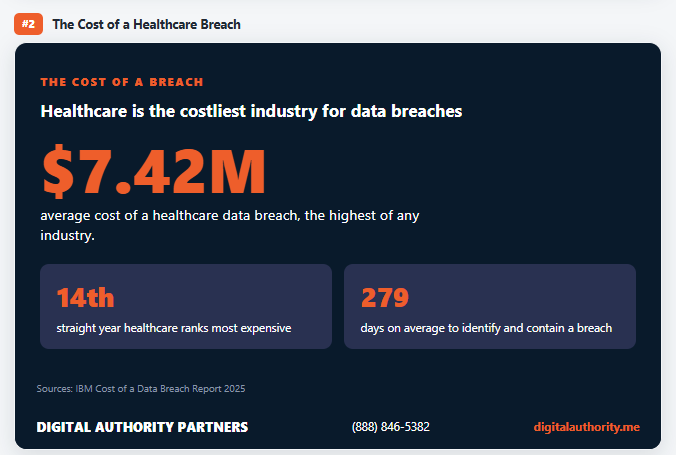
A 2025 IBM study, the Cost of a Data Breach report, found that healthcare breaches cost an average of $7.42 million, the highest of any industry for the 14th year running. The same report found healthcare organizations took 279 days on average to identify and contain a breach.
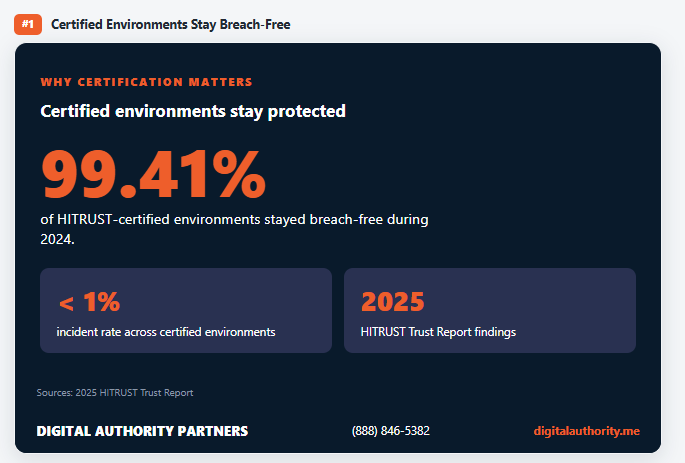
Certification measurably changes those odds. A 2025 HITRUST study, the 2025 HITRUST Trust Report, found that 99.41% of HITRUST-certified environments stayed breach-free during 2024. That is an incident rate of well under 1%. The distance between certified and uncertified organizations is the strongest argument for starting the process.
What You Gain Beyond Compliance
Compliance is the obvious reason to get HITRUST certified, and the business payoff reaches well past a regulatory checkbox. Certified organizations turn their security work into a competitive asset. You can expect four returns:
- One framework, many standards: HITRUST maps to HIPAA, ISO, NIST, PCI DSS, and more, so one assessment supports many obligations at once.
- Faster sales cycles: A HITRUST report answers a partner’s security questionnaire in a single trusted document, which shortens vendor reviews.
- Lower breach risk: The Trust Report data shows certified environments stay breach-free at far higher rates than the broader market.
- Stronger market position: Certification signals to patients and payers that your organization takes data protection seriously.
These benefits compound over time. Each renewal cycle gets smoother as your team builds the documentation and habits the framework rewards.
The Three HITRUST Assessment Types: e1, i1, and r2
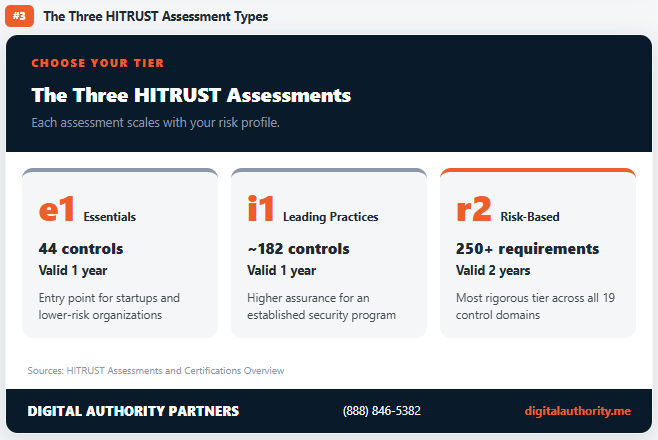
This is the part of HITRUST certification that changed most in recent years, so getting the current picture matters. HITRUST now offers three validated assessments that scale with your risk profile, so you choose the level that fits your organization.
HITRUST e1: The One-Year Essentials Assessment
The e1 assessment covers 44 foundational controls and suits startups and lower-risk organizations that want to prove solid cybersecurity hygiene. The HITRUST assessments and certifications overview positions the e1 as an accessible entry point, and the certification is valid for one year. Many companies use the e1 as a stepping stone toward the more advanced tiers.
HITRUST i1: The One-Year Leading-Practices Assessment
The i1 assessment raises the bar to roughly 182 controls and fits organizations with an established security program ready to show leading practices. It delivers a higher level of assurance than the e1 and stays valid for one year. HITRUST also offers a rapid recertification path that lets qualified organizations recertify against a reduced set of requirements.
HITRUST r2: The Two-Year Risk-Based Assessment
The r2 assessment is the most rigorous tier and the one most associated with full HITRUST certification. It is risk-based, so the number of requirements scales with your environment. Most r2 assessments include 250 or more requirement statements across the 19 domains. The r2 evaluates up to five maturity levels for each control, moving from policy and procedure through implemented, measured, and managed. Certification lasts two years, with an interim assessment at the one-year mark to confirm you have stayed on track.
HITRUST AI: The Artificial-Intelligence Assessments
HITRUST expanded the framework to cover artificial intelligence, which matters as healthcare organizations adopt AI tools quickly and want their security programs to keep pace. Two newer assessments address this directly.
The HITRUST AI Risk Management Assessment uses 51 controls drawn from the NIST AI Risk Management Framework and ISO 23894, and any organization can take it without being HITRUST certified first. The HITRUST AI Security Assessment adds prescriptive controls for securing AI systems and pairs with an e1, i1, or r2 to produce a formal AI security certification. For organizations weighing how AI reshapes compliance, our team tracks these shifts through our work in AI and emerging technologies.
What the HITRUST CSF Covers
Now that you know how the tiers scale, the control domains they draw from come into focus. The HITRUST CSF organizes its requirements around 19 control domains that span your entire security program. HITRUST maintains and updates the framework regularly, with CSF version 11 as the current generation. Version 11 spans these 19 control domains, each covering one slice of your security program:
- Information protection program
- Endpoint protection
- Portable media security
- Mobile device security
- Wireless security
- Configuration management
- Vulnerability management
- Network protection
- Transmission protection
- Password management
- Access control
- Audit logging and monitoring
- Education, training, and awareness
- Third-party assurance
- Incident management
- Business continuity and disaster recovery
- Risk management
- Physical and environmental security
- Data protection and privacy
You adopt the framework in full, then your assessment type determines how many requirements you implement and how deeply each one gets tested. A startup taking the e1 touches a focused subset, while an established vendor on the r2 works across all 19 domains in depth.
How HITRUST Differs From HIPAA
People often treat HIPAA and HITRUST as interchangeable, so this distinction is worth getting right. HIPAA is a federal law that sets standards for protecting patient health information, and it relies on self-attestation, with no official body that certifies you as HIPAA compliant.
HITRUST exists to close that gap, giving you the independent, third-party validation HIPAA leaves to self-attestation. When a partner asks whether you are HIPAA compliant, your HITRUST certification is the closest thing to a verifiable yes.
The framework also reaches beyond HIPAA. HITRUST maps to ISO, NIST, PCI DSS, and the other standards listed above, so a single assessment supports compliance across multiple obligations. Healthcare marketers navigating these rules can dig deeper into our guide to healthcare digital marketing and HIPAA, which stays useful alongside certification.
How to Get HITRUST Certified: The Step-by-Step Process
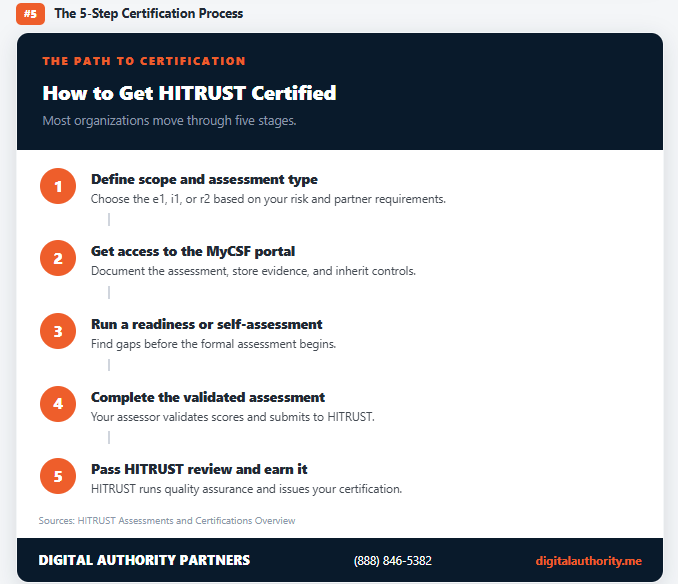
Getting HITRUST certified follows a clear path, and knowing the sequence helps you plan resources and timeline. HITRUST structures the process around a consistent methodology, and most organizations move through these five stages.
Step 1: Define Your Scope and Assessment Type
Scope first. You decide which systems and data fall inside the assessment, then choose the e1, i1, or r2 based on your risk and your partners’ requirements. Scoping well at the start saves time and money later.
Step 2: Get Access to the MyCSF Portal
You contact HITRUST for access to MyCSF, the platform where you document your assessment, store evidence, and request inherited controls from certified cloud providers. MyCSF is where the assessment lives.
Step 3: Run a Readiness or Self-Assessment
Next, you evaluate your current controls against the framework to find gaps before the formal assessment begins. A readiness assessment run by an external assessor gives you the most realistic view of where you stand.
Step 4: Complete the Validated Assessment
Your authorized external assessor reviews and validates your scores, tests your evidence, and submits the finished assessment to HITRUST. This phase typically runs four to six weeks for an r2 and less for an e1 or i1.
Step 5: Pass HITRUST Review and Earn Certification
Finally, HITRUST runs its quality assurance review, requests any clarifications, and issues your certification once you meet the criteria. That final review is what gives the certification its weight.
How Long Does HITRUST Certification Take
Timeline depends heavily on your readiness and the assessment tier you choose. First-time organizations should plan for a longer runway than the assessment window suggests.
For a first r2 certification, most organizations spend six to nine months preparing, a window that includes the readiness assessment and remediation work. The validated assessment and certification add about three more months. The e1 and i1 move faster, often comparable to a SOC 2 timeline of two to six months of prep plus a four-to-six-week assessment.
How Much Does HITRUST Certification Cost in 2025
Cost is usually the first question, and the answer depends on your size, readiness, and assessment type. The total HITRUST certification cost generally falls between $70,000 and $160,000 in 2025, according to the HITRUST Alliance pricing guidance and industry estimates.
Three investments drive that total. MyCSF access and assessment-object fees run roughly $20,000 to $50,000 or more per year. External assessor fees range from about $40,000 to $250,000 or more, depending on assessment type and scope. Internal costs for people, tools, and remediation vary widely and often carry the largest hidden weight.
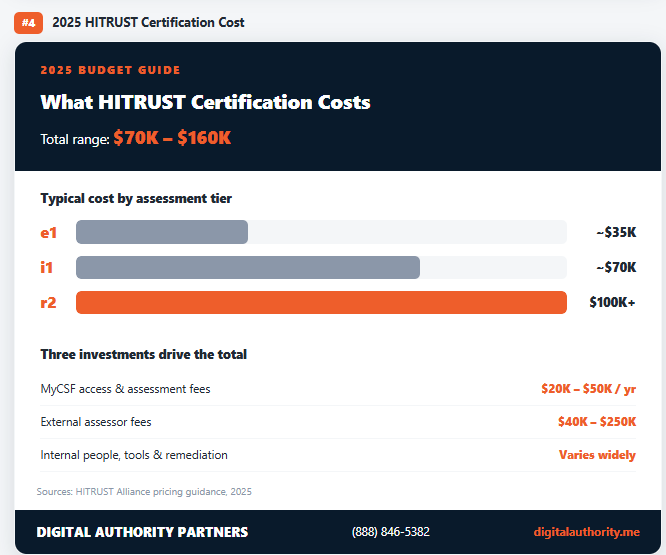
As a rough planning guide, an e1 commonly lands near $35,000, an i1 near $70,000, and an r2 at $100,000 or more. First-year costs run highest because they include readiness work and the initial validated assessment, then drop as you move into interim and renewal cycles. If your organization also builds patient-facing technology, our guide to building healthcare apps covers the security decisions that make certification smoother.
Frequently Asked Questions
What Is HITRUST Certification?
It is independent, third-party proof that your organization meets the controls in the HITRUST CSF, the framework that maps to HIPAA, ISO, NIST, PCI DSS, and dozens of other standards. An authorized assessor validates your environment, and HITRUST issues the certification after its own quality review.
How Much Does HITRUST Certification Cost?
Plan for $70,000 to $160,000 in 2025, covering MyCSF and assessment fees of roughly $20,000 to $50,000 a year, assessor fees of $40,000 to $250,000, and internal remediation. By tier, expect about $35,000 for an e1, $70,000 for an i1, and $100,000 or more for an r2.
How Long Does It Take to Get HITRUST Certified?
A first r2 usually takes six to nine months of preparation, plus about three months for the validated assessment. The e1 and i1 move faster, roughly two to six months of prep plus a four-to-six-week assessment, similar to a SOC 2 timeline.
What Is the Difference Between e1, i1, and r2 Assessments?
The e1 covers 44 controls and certifies you for one year. The i1 covers about 182 controls with higher assurance, also for one year. The r2 is risk-based with 250 or more requirements and certifies you for two years, with an interim check at the one-year mark.
What Is the Difference Between HIPAA and HITRUST?
HIPAA is a self-attested federal law with no certifying body. HITRUST supplies the independent validation HIPAA leaves out, and because the CSF incorporates HIPAA, a HITRUST certification is the most credible way to show partners and regulators you are compliant.
Who Needs to Be HITRUST Certified?
Any organization that creates, accesses, stores, or exchanges protected health information should consider it, from hospitals and insurers to pharmacies, physician practices, and their vendors. Technology vendors face the strongest pull, since health systems often require a HITRUST report before sharing data.
Is HITRUST Certification Mandatory?
No law requires it directly. In practice, many payers and health systems require their business associates to hold it as a condition of partnership, which makes certification effectively necessary for vendors serving large healthcare organizations.
How Long Is a HITRUST Certification Valid?
An e1 lasts one year, and an i1 lasts one year with a rapid recertification option. An r2 lasts two years, with a required interim assessment at the one-year mark. HITRUST treats certification as continuous improvement rather than a one-time event.
What Is the HITRUST CSF?
The Common Security Framework is the certifiable framework at the heart of HITRUST. It organizes requirements into 19 control domains and harmonizes more than 40 authoritative standards. Version 11 is current, and HITRUST updates it regularly to address new threats and regulations.
Does HITRUST Cover Artificial Intelligence?
Yes. The AI Risk Management Assessment uses 51 controls from the NIST AI Risk Management Framework and ISO 23894, open to any organization. The AI Security Assessment pairs with an e1, i1, or r2 to produce a formal AI security certification.
Key Takeaways
HITRUST certification gives healthcare organizations a single, independently verified way to prove their security program works, and the 2025 data makes the investment easier to justify. Choosing the right assessment tier and scoping it well are the decisions that shape your timeline and budget.
Keep these fundamentals in mind:
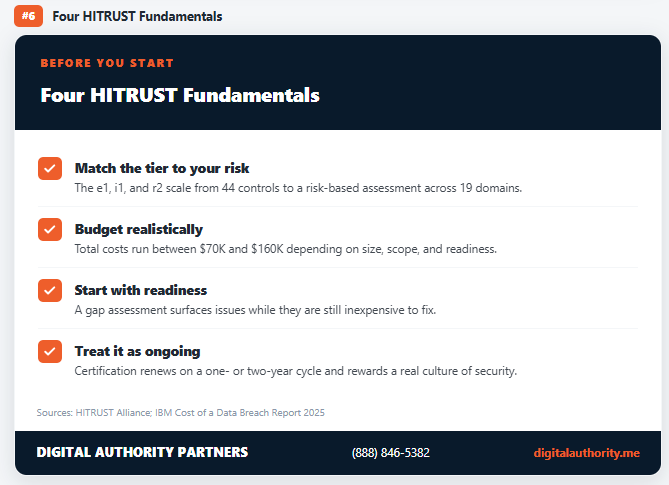
- Match the tier to your risk. The e1, i1, and r2 scale from 44 controls to a two-year risk-based assessment across 19 domains.
- Budget realistically. Total costs run between $70,000 and $160,000, depending on size, scope, and readiness.
- Start with readiness. A gap assessment surfaces issues while they are still inexpensive to fix.
- Treat it as ongoing. Certification renews on a one- or two-year cycle and rewards a real culture of security.
Talk to a Healthcare Growth Partner
Earning HITRUST certification proves your organization protects sensitive data, and that trust becomes a powerful growth asset when patients and partners choose who to work with. Digital Authority Partners (DAP) helps healthcare organizations turn compliance and credibility into measurable growth. Schedule a free consultation today to map out your HITRUST certification strategy.
Want To Meet Our Expert Team?
Book a meeting directly here

Related Articles

AI in digital health has moved from research labs into daily care. A phone camera can now screen for diseases that on...

Digital transformation in healthcare is the integration of digital technologies, data, and connected systems across c...


Health systems hold more data than ever, and big data in healthcare is the competitive advantage waiting to be used. ...