
HVAC Social Media Marketing: 50+ Ideas That Actually Book Jobs

You’re great at fixing furnaces. Diagnosing strange AC noises at 2am? No problem. But posting on Instagram? That’s where things get uncomfortable.
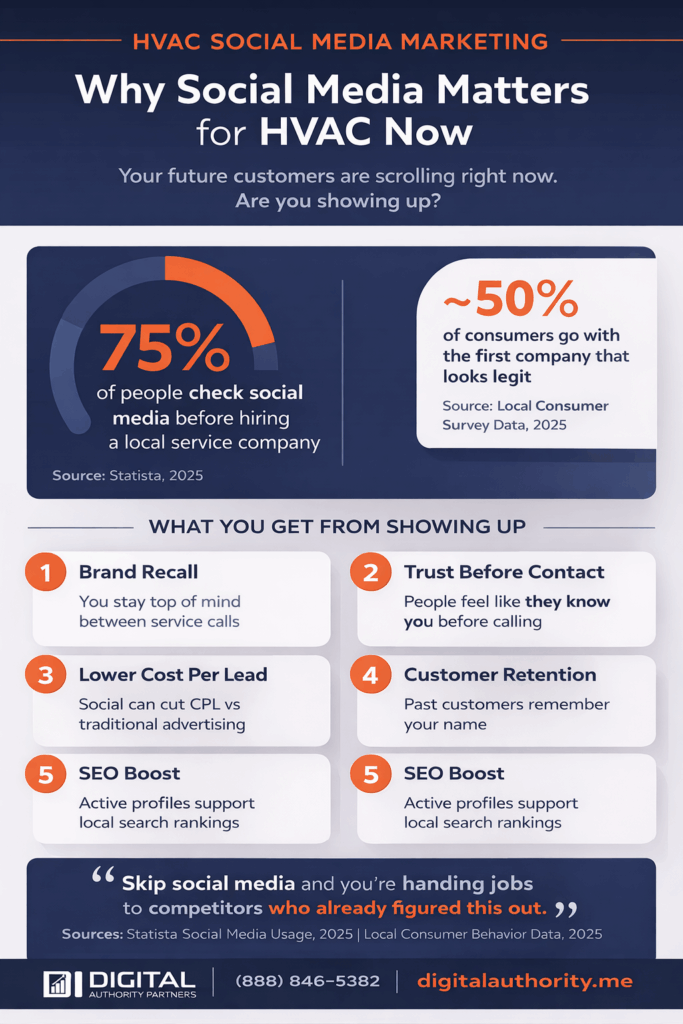
Here’s the thing: HVAC social media marketing is no longer optional. It’s how Mrs. Patterson in Glenview finds someone to fix her heat pump before Thanksgiving dinner, and how the property manager with 47 units decides who gets the maintenance contract. Skip it, and you’re handing jobs to competitors who already figured this out.
But we at digital Authority Partners get it. You didn’t become an HVAC tech to write captions and chase likes.
This in-depth guide breaks down everything: which platforms actually matter, what to post when you’re drawing a blank, how to run ads without wasting money, and how to know if any of this is working. Whether you have zero social presence or you’re posting sporadically and getting nowhere, you’ll finish with practical strategies you can use immediately.
One quick note: working with an HVAC Marketing Company speeds things up considerably. But even when handling it yourself, these strategies will help you punch above your weight against bigger competitors with dedicated marketing teams.
Let’s get into it.
Why HVAC Social Media Marketing Actually Matters Now
I’ll be honest. Five years ago, you could ignore social media and do fine. Word of mouth, truck wraps, maybe some Google Ads. That worked.
Not anymore.
The Numbers Are Hard to Argue With
Something like three-quarters of people now check social media before hiring local service companies. That stat comes from Statista’s research on social media usage, and while the exact percentage varies by study, the direction is clear. Your future customers are scrolling through Facebook while their AC makes that grinding noise, looking for someone who seems trustworthy.
HVAC social media marketing has shifted from “nice to have” to “how people actually find contractors.” Your competition figured this out. Some of them are booking jobs right now because a homeowner saw their post about furnace maintenance tips yesterday.
Here’s what really sucks for your HVAC business: nearly half of consumers go with the first company that shows up and looks legit. Speed matters. Visibility matters.
What You Actually Get From Showing Up in Social Media Feeds
People remember you exist. Even if someone doesn’t need you today, seeing your posts means you’re the name that pops into their head when their thermostat dies in February.
Trust before the first phone call. Weird as it sounds, seeing your team’s faces and “work in action” makes strangers feel like they already know you. That’s huge when you’re asking to come into their home.
Leads that cost less. We’ve seen HVAC companies cut their cost-per-lead in half compared to traditional advertising. Social media for HVAC contractors can be absurdly efficient when done right. (When done wrong, it’s just time you’ll never get back. More on that below.)
Past customers stick around. That family whose furnace you replaced three years ago? They probably forgot your name. But if they’ve been seeing your posts pop up occasionally, you’re still their HVAC guy.
Google notices. Active social profiles send signals that help your local search rankings. It’s not the biggest factor, but it’s not nothing either.
Picking Platforms Without Losing Your Mind
Real talk: you cannot be everywhere.
We’ve watched HVAC company owners try to maintain Facebook, Instagram, TikTok, YouTube, LinkedIn, Twitter, and Pinterest all at the same time. Know what happens? They post twice on each, get overwhelmed, and quit everything.
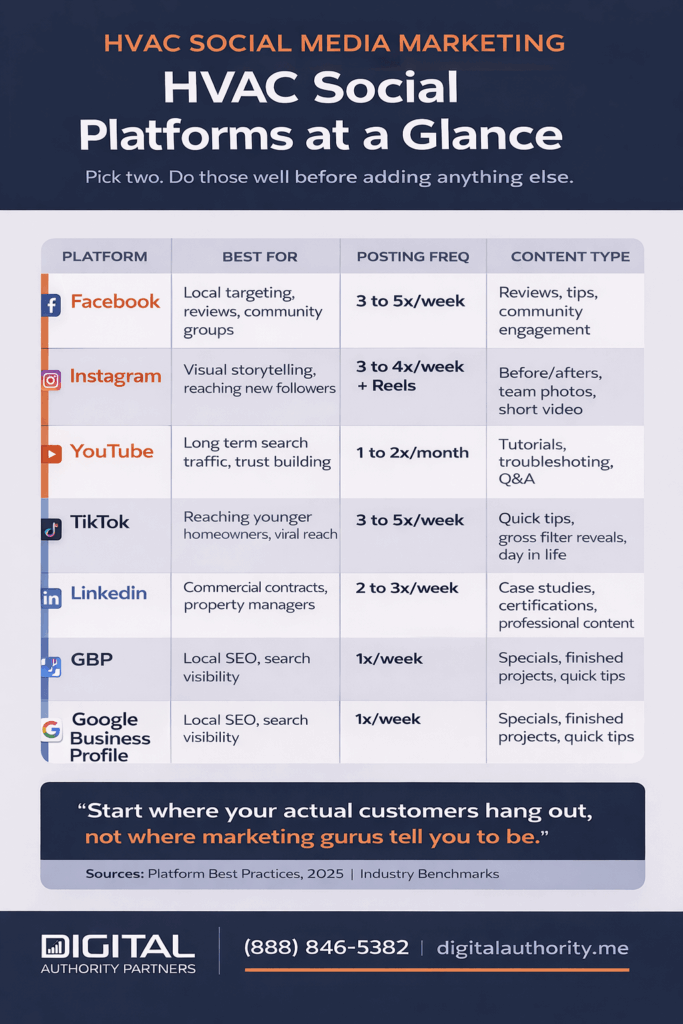
Pick two. Maybe three social media platforms if you’re ambitious. Do those well before adding more.
Your HVAC social media strategy should start with where your actual customers hang out, not where marketing gurus tell you to be.
Facebook: Still the Workhorse (Yes, Really)
Look, we know Facebook feels old. Your nephew thinks it’s for boomers. But here’s the thing: boomers own houses. So do Gen Xers. These are the people who need HVAC work and have the money to pay for it.
HVAC Facebook marketing works because the platform is built around local connections. You can target zip codes with extreme accuracy. You can join neighborhood groups where people ask “Does anyone know a good AC repair company?” You can build an audience of people who actually live in your service area.
Use it for customer reviews (screenshot those five-star Google reviews and post them), maintenance reminders that actually help people, and connecting with your community. Messenger works great for fielding quick questions, too.
Post around three to five times weekly. Not a rigid rule. Just enough to stay visible without being annoying.
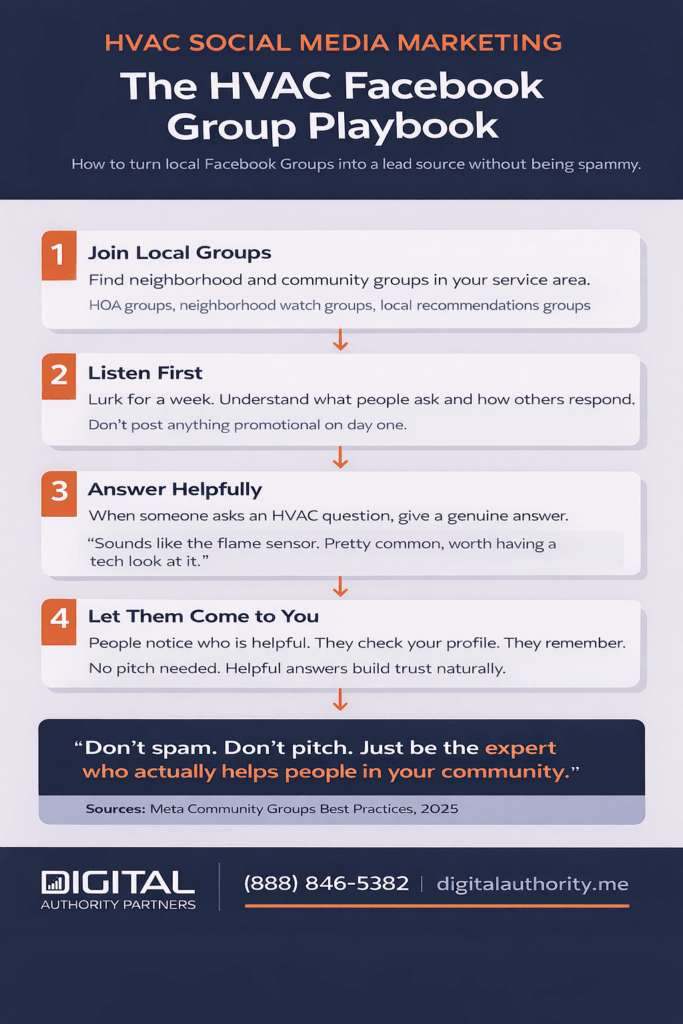
Pro tip that actually works: join local Facebook Groups, but don’t spam them. Seriously. When someone asks about weird furnace behavior, answer helpfully without pitching yourself. “Sounds like it could be the flame sensor, a pretty common issue, worth having a tech look at it.” That’s it. People notice who’s helpful. They check your profile. They remember.
Instagram: Show Don’t Tell
Instagram rewards visual businesses. And despite what you might think, HVAC absolutely counts.
That pristine ductwork you installed last Tuesday? Photograph it. The before-and-after of a furnace replacement, where the old unit looked like it survived a war? Perfect content. Is your team actually smiling after a tough job? People love that stuff.
HVAC Instagram marketing requires less explaining and more showing. The platform isn’t built for paragraphs of text. It’s built for scroll-stopping visuals and quick videos.
Reels matter here. A lot. The algorithm pushes Reels to people who don’t follow you yet, which is exactly what you want. A 30-second video of you explaining why that weird smell comes from the vents when you first turn on the heat? That can reach thousands of local homeowners.
Hashtags work differently on Instagram than they do on other platforms. Mix broad ones (#HVAClife is surprisingly popular) with hyper-local ones. #ScottsdaleACRepair gets you in front of your actual market. #ACRepair gets you lost in a sea of millions of posts.
YouTube: Playing the Long Game
Here’s something most HVAC companies miss: YouTube is a search engine. The second biggest one after Google itself.
When someone at 11pm types “why is my AC freezing up” into their phone, there’s a decent chance they land on YouTube. Does your video answer that question? You just earned trust with someone who probably needs professional help.
HVAC social media marketing on YouTube requires patience. Videos take months to rank and accumulate views. But once they do, they keep working indefinitely. I’ve seen tutorial videos generate leads three years after posting.
Start with questions your customers actually ask. You hear the same ones repeatedly during service calls. What does that noise mean? How often should I really change my filter? Why is one room always hotter than the others?
Record yourself answering. Phone camera, decent lighting, just talk like you’re explaining to a homeowner. That’s it.
The production quality matters less than you think. Authenticity matters more.
TikTok: Not Just for Kids Anymore
I’ll admit here at DAP we were skeptical about TikTok for HVAC. Dancing teenagers didn’t seem like future customers.
But here’s what changed: millennials are homeowners now. Gen Z is buying houses. These people grew up on YouTube and TikTok. They’ll watch a 45-second video about why their air filter matters but won’t read a blog post about it.
TikTok rewards authenticity over polished perfect social media posts. That gross clogged filter you pulled out today? Film it. The ductwork that looked like a science experiment? Content gold. People are fascinated by the stuff you see every day and take for granted.
HVAC social media marketing on TikTok doesn’t require fancy editing. It requires showing people something interesting and explaining it simply. The algorithm does the rest.
Bonus: everything you create for TikTok works on Instagram Reels and YouTube Shorts too. One video, three platforms.
LinkedIn: When Commercial Work Matters
If you’re strictly residential, skip LinkedIn. But if you want commercial contracts, property management relationships, or connections with builders and developers? Different story.
Property managers live on LinkedIn. So do facility directors who control maintenance budgets for office buildings, schools, and retail spaces. One commercial client can be worth fifty residential jobs.
Share case studies from commercial projects. Post about certifications your team earned. Connect with real estate professionals in your area. This tone is more professional here, less casual than Facebook or Instagram.
Social media for HVAC contractors doing commercial work should definitely include LinkedIn in the mix.
Google Business Profile: The One Everyone Forgets
Most people don’t think of Google Business Profile as social media. But you can post updates, share photos, respond to reviews, and engage with customers. Sounds like social media to me.
The killer advantage: GBP posts show up in search results. When someone searches “HVAC near me,” your recent posts can appear right alongside your listing. That’s visibility at the exact moment someone needs you.
Post weekly. Seasonal specials, finished projects, quick tips. Takes ten minutes and directly supports your local search rankings.
Building an HVAC Social Media Strategy That Doesn’t Fall Apart
Posting randomly whenever you remember isn’t a strategy. It’s a hobby that eats your time without producing results.
Let us walk you through building something that actually works.
Get Clear on What You’re Trying to Accomplish
This sounds obvious but most people skip it. What do you actually want from social media?
More phone calls? Brand recognition so people remember you exist? Staying connected with past customers so they call you again instead of Googling “HVAC repair”? Each goal shapes different tactics.
Here’s why this matters: marketers who set goals are 376% more likely to report success than those who don’t. And 70% of goal-setting marketers actually achieve what they set out to do. And since you’re your own marketing team, you can too!
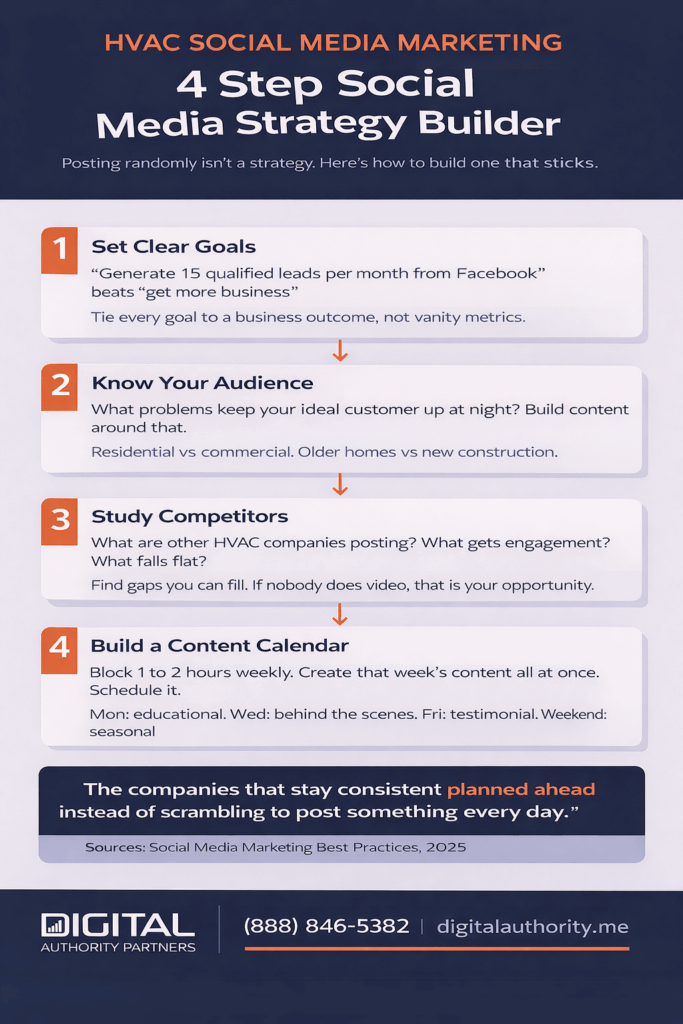
Write it down. Make it specific. “Get more business” is too vague. “Generate 15 qualified leads per month from Facebook” gives you something to measure against and see if you’re on track or not.
Your HVAC social media strategy should tie directly to business outcomes you care about, not vanity metrics like follower counts.
Figure Out Who You’re Talking To
Residential customers in older neighborhoods have different concerns than those in new construction. Commercial property managers care about different things than homeowners.
What problems keep your ideal customer up at night? What questions do they ask during service calls? What do they complain about? Build content around that.
Timing matters too. When are these people scrolling? Homeowners often check social media in the evening and on weekends. Test different posting times and see what works for your audience.
Spy on Your Competition (Ethically)
What are other HVAC companies in your area posting? What gets engagement? What falls flat?
You’re not copying them. You’re learning what resonates with your shared audience and finding gaps you can fill.
If everyone in your market posts only promotional content, you can stand out with educational stuff. If nobody’s doing video, that’s your opportunity to be the only HVAC company people actually see in action.
Working with a Home Services Marketing Agency can accelerate this competitive analysis, but you can do basic research yourself by just looking at your competitor’s pages.
Build a Content Calendar You’ll Actually Follow
Planning beats improvising. Every. Single. Time.
Block out an hour or two once a week. Create that week’s content all at once. Schedule it using free tools like Meta Business Suite. Then you’re done until next week.
A simple rotation works well. Monday: something educational. Wednesday: behind-the-scenes team stuff. Friday: customer testimonial or review. Weekend: seasonal or promotional. Adjust based on what your audience responds to.
HVAC social media marketing gets easier once you systematize it. The companies that stay consistent are the ones who planned ahead instead of scrambling to post something every day.
Content Ideas That Don’t Sound Like Everyone Else
Here’s where most HVAC social media guides hand you a list of 50 generic ideas. “Post before-and-after photos! Share customer reviews! Give seasonal tips!”
Yeah, no kidding. Everyone does that. That’s why it all blurs together.
Here’s the problem: according to SproutSocial, authenticity tops the list of what consumers don’t see enough of from brands on social media. Generic content doesn’t cut it anymore. People scroll past the same tired posts they’ve seen from a hundred other companies.
Let me give you something more useful: categories of content with specific angles that make yours stand out. These HVAC social media post ideas go beyond the obvious.
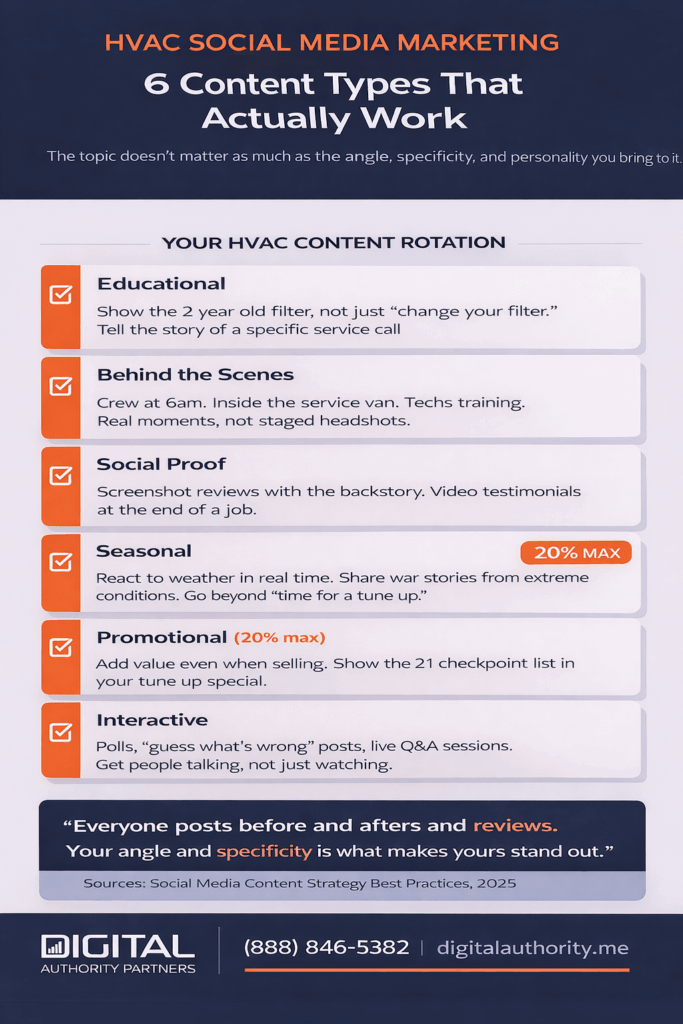
The key to great HVAC social media marketing content isn’t the topic itself – it’s the angle, the specificity, and the character you bring to it.
Educational Content That Actually Teaches Something
The goal isn’t just “be educational.” It’s to answer questions in ways your competitors don’t.
Don’t just say “change your filter regularly.” Show the filter you pulled out of a system that hadn’t been changed in two years and explain what that does to energy bills. Make it visual and specific.
Instead of generic “signs your AC needs service,” tell the story of a specific call. “Got called out to a house in Riverside last week. Homeowner said the AC was running constantly but the house stayed warm. Turns out…” That’s interesting. That’s memorable.
You should also explain concepts people wonder about but feel dumb asking. What do SEER ratings actually mean in dollars? Why does closing vents not save energy the way people think? How do heat pumps work when it’s freezing outside?
Get specific. A post about “a 1970s ranch house we worked on in Oak Park, Illinois, that had the original ductwork” is infinitely more interesting than “ductwork matters.”
Backstage Content That Humanizes Your Team
People hire people, not logos. Show yours.
But skip the corporate headshot approach. Those are boring. Show your crew at 6am before a long day of installations. Show the inside of a service van organized like a surgeon’s kit (or hilariously disorganized, if that’s more honest). Show a tech explaining something technical to a new apprentice.
Company celebrations work well too, but make them real. The awkward office birthday party is more relatable than staged photos of everyone smiling perfectly.
Training content performs surprisingly well. People like seeing professionals learning and improving. A quick clip of your team doing certification training shows you take the work seriously.
Social Proof That Doesn’t Feel Like Bragging
Yes, share reviews and testimonials. But add context.
Screenshot a Google review, but write a caption that tells the backstory. “This was the emergency call on Christmas Eve. The Hendersons had family coming and no heat. We got there by 9pm and had them running by 11. This review made my month.”
Before-and-after photos work better with specificity. “Left side: the furnace original to this 1985 colonial. Right side: the new high-efficiency unit that’s going to cut their heating bills by about 30%.”
Video testimonials crush written ones, but they’re awkward to ask for. Try this: at the end of a job where the customer is clearly happy, just ask “Hey, would you mind saying a quick word about your experience? I’m trying to build up my social media.” Most people will say yes in the moment when they’re feeling grateful.
Seasonal Content That Isn’t Just “Time for a Tune-Up!”
Every HVAC company posts “spring is here, schedule your AC tune-up!” That’s table stakes. It’s also forgettable because there’s no urgency for a homeowner.
Try angles nobody else uses. “The 3 things I check on every spring tune-up that most homeowners never think about.” Now I’m curious what those three things are.
React to weather in real-time. When an unexpected cold snap hits, post about it. “Woke up to 15 degrees this morning and my phone’s already blowing up. If your heat went out overnight, we’re squeezing in emergency calls until 9pm tonight. Hang in there.”
Share war stories from extreme weather. “Last summer’s heat wave was brutal. We ran through 47 capacitors in one week. Here’s what that kind of heat does to your outdoor unit…” Now you’re teaching while telling a story while being timely.
Promotional Content That Doesn’t Feel Sleazy
You can absolutely promote your services. Just don’t make every post an ad.
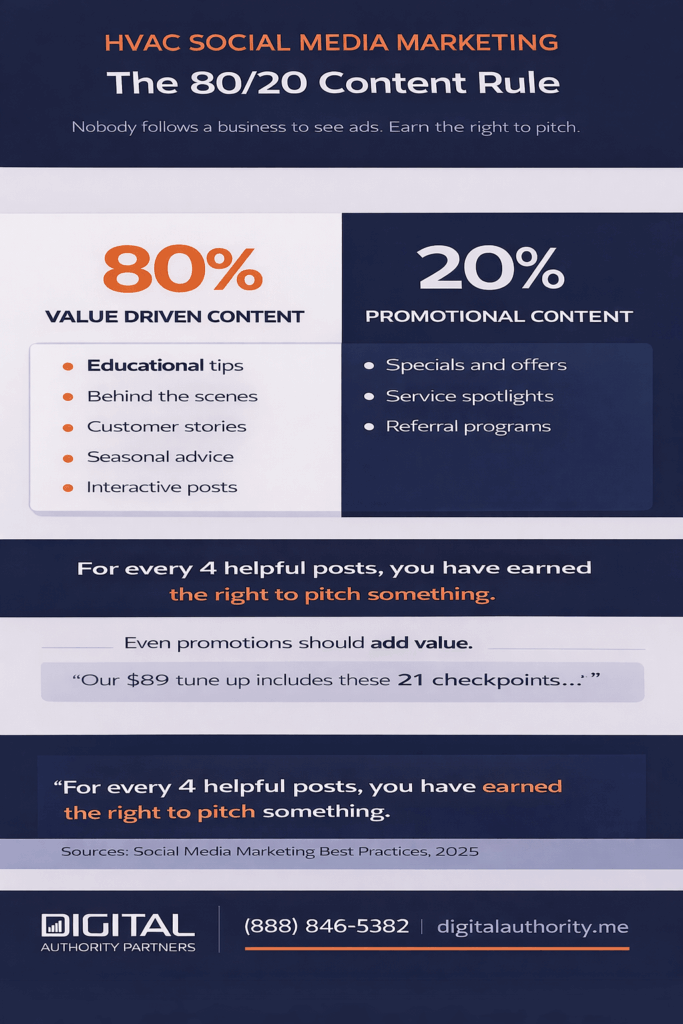
The general wisdom is 80% value, 20% promotion. That means for every four helpful posts, you’ve earned the right to pitch something.
When you do promote, add value anyway. “Running our spring tune-up special through April. $89 includes these 21 checkpoints (list them). Here’s why the evaporator coil inspection matters most…”
Referral programs work great on social media. “Quick shout-out to the Martinez family who referred three neighbors to us last month. That’s three families staying cool this summer. We appreciate you.”
Interactive Content That Gets People Talking
Ask questions. Run polls. Get people participating instead of just consuming.
“Thermostat wars: what temperature does your household fight about?” People love sharing their opinions. And engagement signals tell the algorithm to show your posts to more people.
“Guess what’s wrong” posts work surprisingly well. Show something unusual you encountered on a job. Let people guess in the comments. Then reveal the answer a day later. This is one of those HVAC social media post ideas that practically runs itself once you get in the habit.
Q&A sessions are gold. “I’ll be answering HVAC questions for the next hour. What’s been bugging you about your system?” You’ll get questions you can turn into future content too.
These interactive HVAC social media post ideas tend to outperform polished promotional content because people want to participate, not just watch.
Adapting Ideas to Your Brand Voice
Here’s the thing about HVAC social media post ideas: they’re starting points, not scripts. A company in Phoenix serving retirees sounds different than one in Chicago working with young families.
Take any idea and filter it through your personality. Are you the no-nonsense technical experts? The friendly neighborhood HVAC guys? The premium service providers? Let that come through.
The same basic concept – showing a filter change – looks totally different when a serious technical company explains it versus when a more casual brand jokes about what they found living in someone’s ductwork. Both work. Just be consistent with who you are.
Video Content: Where HVAC Social Media Marketing Is Heading
I’ll be blunt: if you’re not doing video, you’re leaving money on the table. 85% of people have been convinced to buy a product or service by watching a video.
Platforms prioritize video. Users watch videos longer. Trust builds faster through video. It’s just how social media works now. And with Facebook, Youtube, Tiktok and Instagram all pushing videos on their primary feeds, it has become the primary method of communicating online on social networks.
HVAC social media marketing increasingly means video marketing. That might feel uncomfortable if you’re used to staying behind the scenes. But the companies willing to show up on camera are building trust at a rate text and images can’t match.
YouTube Strategy for Your Homeowners
YouTube content is an investment. It takes months to see real results. But those results compound.
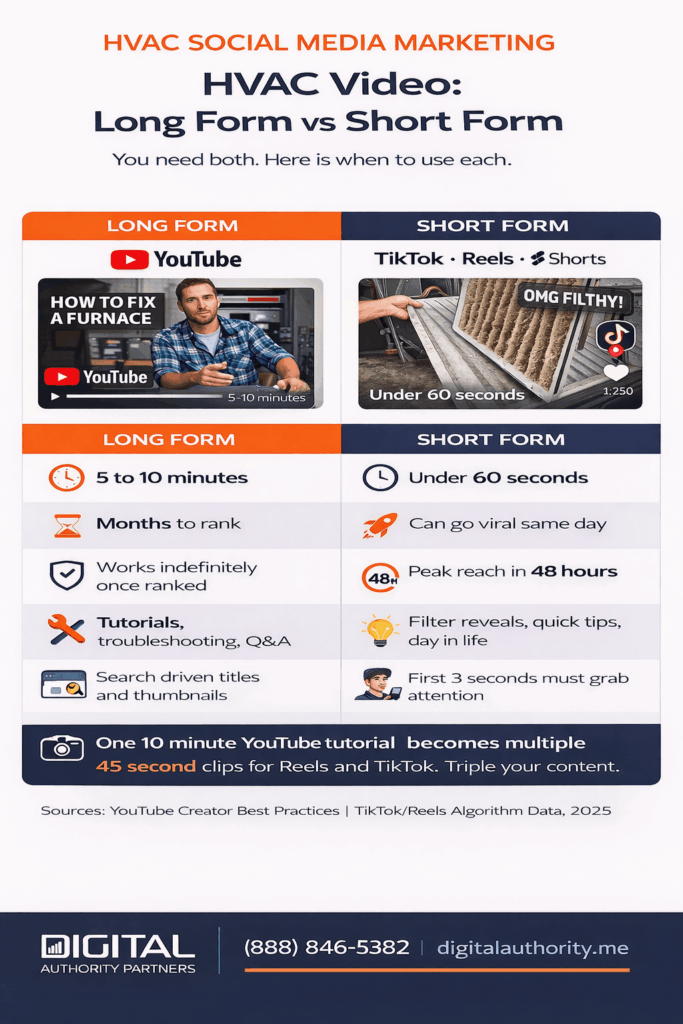
Think about search intent. What are people typing into YouTube looking for help with? “AC not cooling house,” “furnace won’t ignite,” “weird noise from HVAC” – these get searched constantly.
Create videos that answer those searches. Keep most between 2-3 minutes. Get to the point quickly because YouTube tracks how long people watch, and if everyone clicks away after 30 seconds, that video dies.
Optimize your titles and descriptions with keywords people actually search. “How to Fix a Furnace That Won’t Stay Lit” beats “Furnace Video #3.”
HVAC social media marketing through YouTube is a long game, but it’s one where the work accumulates instead of disappearing.
Short-Form Video: TikTok, Reels, Shorts
Different ball game entirely. You have maybe three seconds to hook someone before they scroll past.
Start with the interesting part. Show the disgusting filter first, then explain why it matters. Show the frozen evaporator coil, then explain what caused it. Hook, then context.
Keep videos under 60 seconds. Add text overlays because most people watch without sound. Use trending audio when it fits naturally (forcing it looks weird).
HVAC Instagram marketing through Reels specifically is probably the fastest way to reach new local followers right now. The algorithm aggressively pushes Reels to non-followers.
Video Ideas That Actually Perform
Troubleshooting walkthroughs work great. Walk through how you diagnose a common problem. People eat this up.
“What’s that noise?” content is endlessly repeatable. Different noises, different causes, different videos.
Tool content has a surprising audience. People are curious about the equipment professionals use.
Day-in-the-life stuff humanizes your brand. Not a polished production, just authentic clips from an actual workday stitched together.
One solid long video can become multiple short videos. Film a 10-minute YouTube tutorial, then cut out the best 45-second segments for Reels and Instagram. Triple your content from one shoot.
Paid Advertising Without Burning Cash
Organic reach has limits. Paid ads let you appear in front of exactly who you want, when you want.
Here’s where HVAC social media marketing gets really interesting. Organic content builds your reputation over months. Paid advertising can put you in front of your ideal customer this afternoon.
Most HVAC companies either ignore paid social entirely or throw money at it without strategy. Both approaches waste potential.
When Paid Makes Sense
Organic builds credibility over time. Paid delivers immediate visibility.
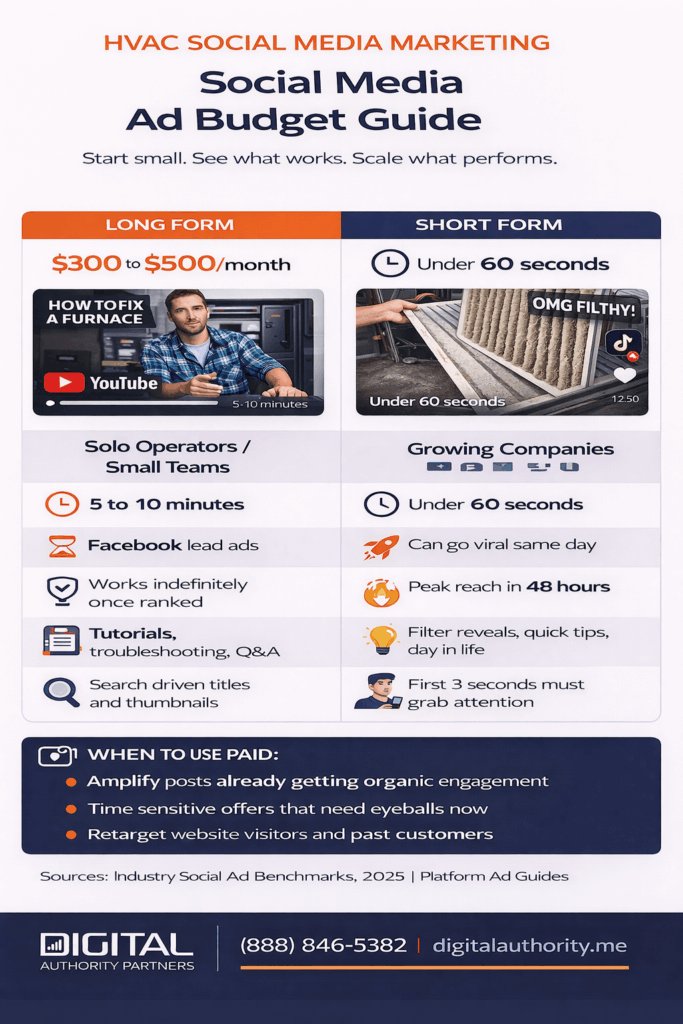
Use paid search to amplify content that’s already working organically. If a post is getting good engagement, put some money behind it to reach more people.
Use paid for time-sensitive offers. That spring tune-up special needs eyeballs now, not three months from now after you’ve built organic reach.
Use paid to reach people who’ve shown interest. Website visitors, video watchers, past customers – these warm audiences convert at much higher rates than cold ones.
HVAC Google Ads captures people actively searching for services. Social media ads build awareness and stay top-of-mind. The best HVAC social media marketing combines both.
Budget Reality Check
How much should you spend? Depends on your size and goals.
Solo operators or small teams can start with $300-500 monthly. Focus on Facebook lead ads targeting your immediate service area. Test different offers and messages to see what resonates.
Growing companies with several technicians might run $750-1,500 monthly. Add retargeting campaigns for website visitors. Test video ads against static images. Expand geographic targeting carefully.
Larger operations can go $2,000 or more. Run brand awareness alongside lead generation. Test multiple platforms and audiences simultaneously.
Start small. See what works. Scale what performs.
Creative That Converts
Before-and-after images grab attention. Video typically outperforms static images for both engagement and recall.
Include urgency when it’s real. “Spots filling up fast for pre-summer tune-ups” works if it’s true. Fake urgency damages trust.
Every ad needs a clear call-to-action. Tell people exactly what to do. “Call now for a free estimate” beats “Learn more” almost every time.
Test multiple versions. Small changes to headlines or images can dramatically impact results. Let the data tell you what works instead of guessing.
Actually Measuring If This Is Working
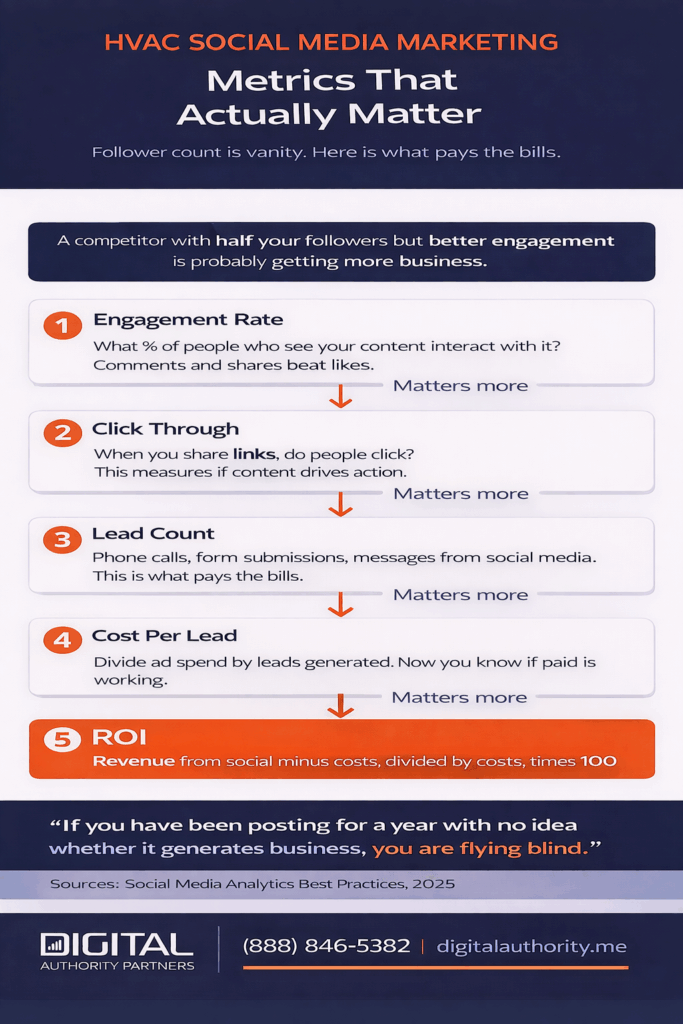
Here’s where most HVAC companies mess up: they don’t track anything meaningful.
I’ve talked to HVAC owners who’ve been posting for a year without any idea whether it’s generating business. That’s like running service calls without invoicing anyone. You’re doing the work but not capturing the value.
Good HVAC social media marketing requires knowing what’s working so you can do more of it. Otherwise you’re just guessing.
Metrics That Actually Matter
Follower count is mostly vanity. A competitor with half your followers but better engagement is probably getting more business. 64% of small businesses have worked with micro-influencers, and 47% experienced the most success with them, proving smaller, more engaged audiences outperform large but passive ones.
Track engagement rate: what percentage of people who see your content actually interact with it? Comments and shares matter more than likes.
Track click-through: when you share links, do people click? This measures whether your content drives action.
Track leads: how many phone calls, form submissions, or messages come from social media? This is what actually pays the bills.
Track cost per lead on paid campaigns: divide your spend by leads generated. Now you know if it’s working.
Figuring Out Where Leads Come From
Ask your new customers. Seriously. Train whoever answers the phone to ask “how’d you hear about us?” and actually record the answers. Old school, but it works.
Use UTM parameters on links. They tell your website analytics exactly which posts drove traffic.
Create dedicated landing pages for specific campaigns. Send your Facebook ads to a different page than your Instagram ads. Now you can track conversions by source.
Check out the HVAC Lead Conversion eBook for more strategies on turning the leads you generate into actual booked jobs.
Calculating Real ROI
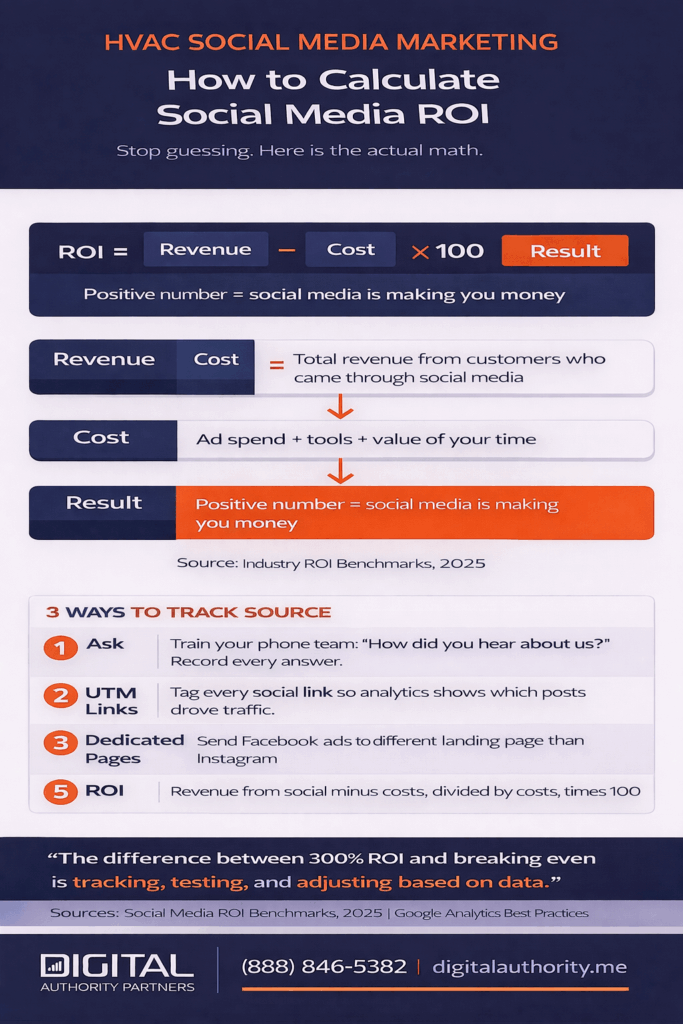
Add up revenue from customers who came through social media. Subtract your costs: ad spend, tools, the value of your time.
ROI = (Revenue – Cost) / Cost × 100
Positive ROI means HVAC social media marketing is making you money. Even a modest return justifies continuing, especially since brand awareness effects are real but harder to quantify.
Some companies see 300% ROI on social media marketing. Others struggle to break even. The difference is usually tracking, testing, and adjusting based on data instead of guessing.
Using AI and Automation Without Being Lazy
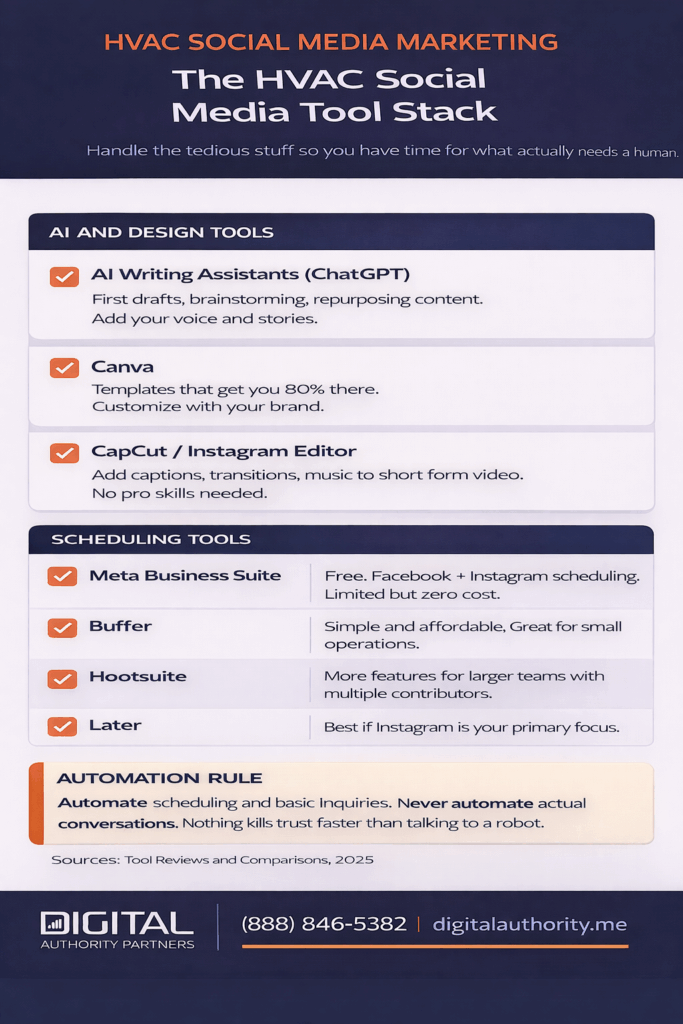
Technology can save serious time. But it can also make your content feel robotic if you lean on it too hard.
The goal of automation isn’t to remove the human element. It’s to handle the tedious stuff so you have more time for the parts that actually require a human brain. That includes responding thoughtfully to comments or filming a quick video explaining something technical.
AI Tools That Actually Help
AI writing assistants like ChatGPT can help with first drafts, brainstorming ideas, and repurposing content into different formats. But – and this is important – you still need to add your voice, your stories, your expertise. AI gives you raw material. You make it yours.
The HVAC ChatGPT whitepaper dives deeper into using AI specifically for HVAC marketing if you want to explore that.
Canva makes decent graphics accessible to non-designers. Beats trying to figure out Photoshop. Templates get you 80% there, and you just customize.
Video editing apps like CapCut or the built-in Instagram editor make short-form content surprisingly easy. Add captions, transitions, music without professional skills.
Scheduling Tools Worth Using
Scheduling posts in advance means you can batch your content creation. Spend two hours once a week instead of scrambling daily.
Buffer is simple and affordable for small operations. Hootsuite offers more features for larger teams with multiple contributors. Meta Business Suite is completely free for Facebook and Instagram – limited compared to paid options, but hard to argue with zero cost.
Later works well if Instagram is your primary focus. Sprout Social is premium-priced but excellent for larger operations that need in-depth analytics.
Any of these beats posting manually every day while you’re supposed to be running service calls.
The key is picking one and actually using it. The best scheduling tool is the one you’ll consistently use. Most HVAC companies don’t need enterprise-level features. They need something simple that removes the daily scramble.
Automation Cautions
Chatbots can handle basic inquiries after hours. Auto-replies can set expectations. That’s fine.
But don’t automate actual conversations. Nothing kills trust faster than feeling like you’re talking to a robot when you have a genuine question.
Only automate the boring stuff. Relationships still need the personal element.
Seasonal Campaign Quick Playbooks
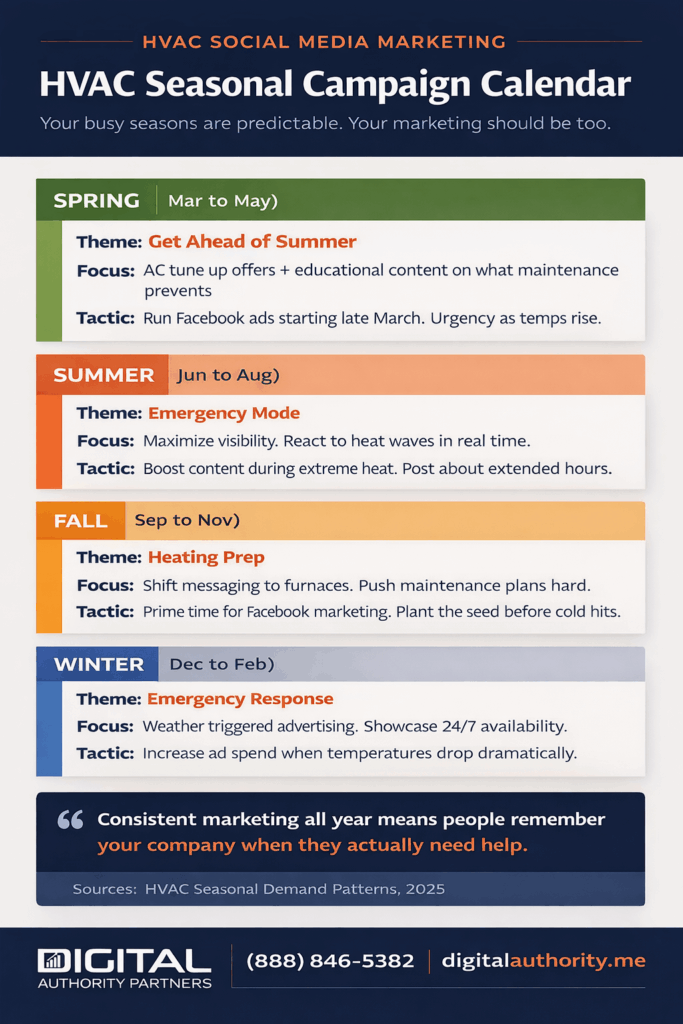
HVAC demand is seasonal. Your marketing should be too.
One of the biggest advantages in HVAC social media marketing is that your busy seasons are predictable. You know when phones will ring off the hook. You know when things slow down. Smart marketers use that knowledge to prepare.
These aren’t rigid formulas. Modify based on your market, your climate, and what you’re seeing in your actual business.
Spring: Get Ahead of Summer
Launch early. By the time it’s hot, you want tune-ups already booked.
Mix educational content (what spring maintenance prevents), testimonials of previous years, and your tune-up offer. Run Facebook ads starting late March in most markets.
Urgency messaging as temperatures rise: “Already hitting 80s this week. AC tune-up slots going fast.”
Summer: Emergency Mode
When heat waves hit, people need help immediately. Be visible. Be available.
React to the weather in real-time. Post about extended hours. Boost content during extreme heat.
This is where consistent HVAC social media marketing all year pays off. People remember the company they’ve seen.
Fall: Heating Prep
Shift messaging to furnaces and heating systems. Most homeowners forget about heat until they need it. Your job is reminding them.
“Your furnace sat unused for six months. Here’s what we check to make sure it’s ready for the cold…” Educational content performs well here because people genuinely don’t know what could go wrong.
This is prime time for HVAC Facebook marketing in particular. Homeowners scrolling Facebook in October aren’t thinking about heating yet. Your posts plant the seed.
Push maintenance plans hard during fall. Lock in recurring revenue before the winter rush hits. Frame it as peace of mind: “Sign up now and never worry about whether your furnace is ready for winter again.”
Winter: Emergency Response
Similar to summer AC emergencies but for heating.
Weather-triggered advertising works. When temperatures drop dramatically, increase visibility and ad spend.
Showcase 24/7 availability. Peace of mind matters when it’s freezing and the furnace won’t start.
Mistakes DAP Sees Constantly
Learn from others so you don’t repeat this stuff.
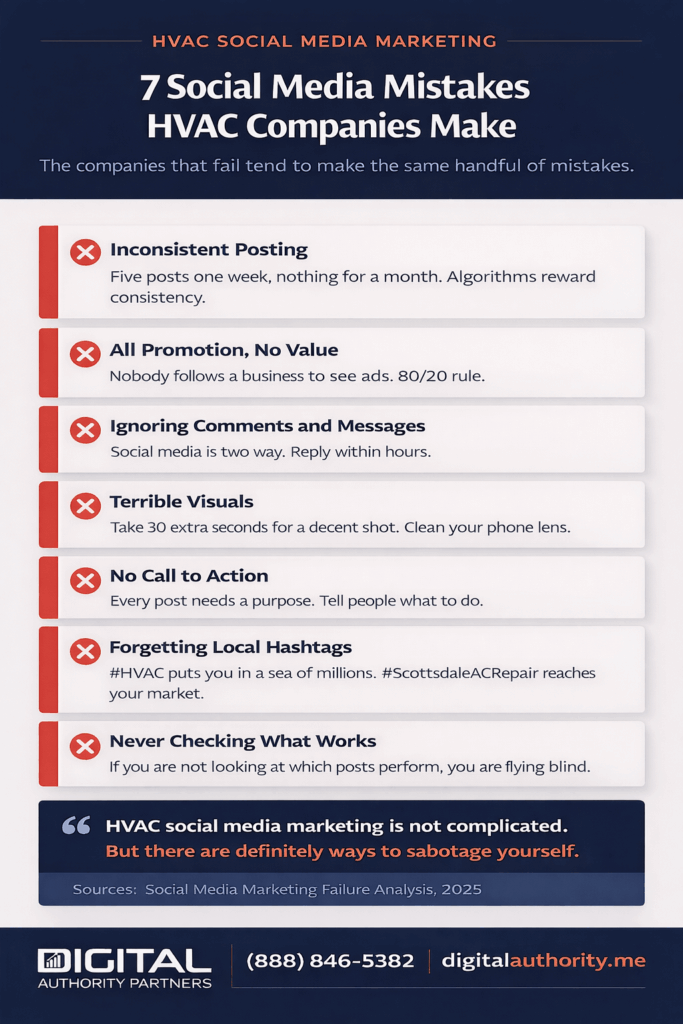
After seeing hundreds of HVAC companies attempt social media with varying degrees of success, patterns emerge. The ones that fail tend to make the same handful of mistakes. The ones that succeed avoid these traps.
HVAC social media marketing isn’t complicated. But there are definitely ways to sabotage yourself.
Inconsistent posting. Posting five times one week, nothing for a month, then two posts, then silence. Algorithms reward consistency. Sporadic activity gets you nowhere.
All promotion, no value. Nobody follows a business to see ads. The 80/20 rule exists for a reason. Provide value first.
Ignoring comments and messages. Social media is two-way. Someone comments, you respond. Someone messages, you reply within hours. 32% of consumers stopped buying from a business after a single bad customer service experience, and ignoring people on social counts.
Terrible visuals. Blurry photos and shaky video look unprofessional. Take thirty extra seconds to get a decent shot. Clean the lens on your phone.
No call-to-action. Every post should have a purpose. Even if it’s just “double tap if you agree” or “tag someone who needs to see this.” Tell people what to do.
Forgetting local hashtags. Generic hashtags like #HVAC puts you in a sea of millions of posts. Location-specific hashtags reach your actual market.
Never checking what works. If you’re not looking at which posts perform and adjusting accordingly, you’re flying blind.
The HVAC Marketing Guide covers marketing channels beyond social media if you want a broader view.
Getting Your Team Involved
You can’t do this alone forever. Getting your team to contribute multiplies your content and distributes the work.
The best HVAC social media marketing often comes from technicians in the field, not marketing people in an office. Your techs see the interesting stuff. They have the stories. They just need a system for capturing and sharing it.
Technicians Are Content Machines (They Just Don’t Know It)
Your techs see interesting stuff every day. Unusual problems, impressive installations, satisfied customers. Train them to capture it.
Simple guidelines: horizontal video usually works better (except for Reels/TikTok). Good lighting helps. A quick note about what they’re filming gives context.
Create a shared folder or group chat for submissions. Review weekly and pick the best material.
Some techs will embrace this. Others won’t care. That’s fine. Even one or two contributing makes a difference.
Someone Needs to Own This
Clear ownership prevents “I thought you were doing it” syndrome.
For smaller companies, maybe the owner or office manager handles social. Bigger operations might have a marketing coordinator or work with an agency.
Whoever it is, they’re responsible for posting, responding, and tracking results. No ambiguity.
Putting It Together
HVAC social media marketing isn’t rocket science. But it does require showing up consistently over time. There’s no hack that replaces consistency.
Pick your platforms, probably Facebook plus one other that matches your style. Build a realistic content calendar you’ll actually follow. Post regularly without obsessing over perfection. Engage when people respond because that’s where relationships form. Track what works so you can do more of it. Adjust when something isn’t performing.
The strategies here work. HVAC companies across the country use them to book more jobs and grow revenue. Social media for HVAC contractors has become genuinely essential for staying competitive in markets where customers research everything online before making a call.
The compound effect is real. Six months of consistent HVAC social media marketing builds an audience. A year of it builds real trust. Two years and you’re the HVAC company people in your area actually recognize and recommend.
But implementing all of this takes time you might not have while running service calls, managing employees, handling billing, dealing with suppliers, and everything else that comes with running a business. Something always needs your attention.
If you’d rather have experts handle your HVAC social media marketing while you focus on what you do best, we can help. Digital Authority Partners builds social media strategies for HVAC companies that actually generate results – not vanity metrics, but phone calls and booked jobs.
Contact us to talk about growing your HVAC business through strategic social media marketing.
Want To Meet Our Expert Team?
Book a meeting directly here

Related Articles
You’ve probably been there. You set up a Google Ads campaign, watch the clicks to your HVAC website, and waited for y...


Noticed a drop in SEO traffic? This pattern reflects a fundamental shift in how search works. Traffic dips signal the...


People trust people more than brands. SaaS buyers want confidence that you’ll follow through on your promises. SaaS i...