
Marketing Strategies for Doctors: A 2026 Growth Playbook

Patients rarely choose a doctor the way they did 10 years ago. Before they call your office, they search, read reviews, and compare practices online. That shift is why marketing strategies for doctors now decide which practices fill their schedules.
You can compete without a hospital-sized budget. A focused plan built around how patients search brings a steady stream of new appointments, whether you run it in-house or with a healthcare marketing agency. This guide walks through nine marketing strategies for doctors that work in 2026, then shows you how to turn them into a repeatable plan and measure your results. Whether you run a solo clinic or a multi-provider group, you will find tactics to start this quarter.
How Patients Find Doctors Online in 2026
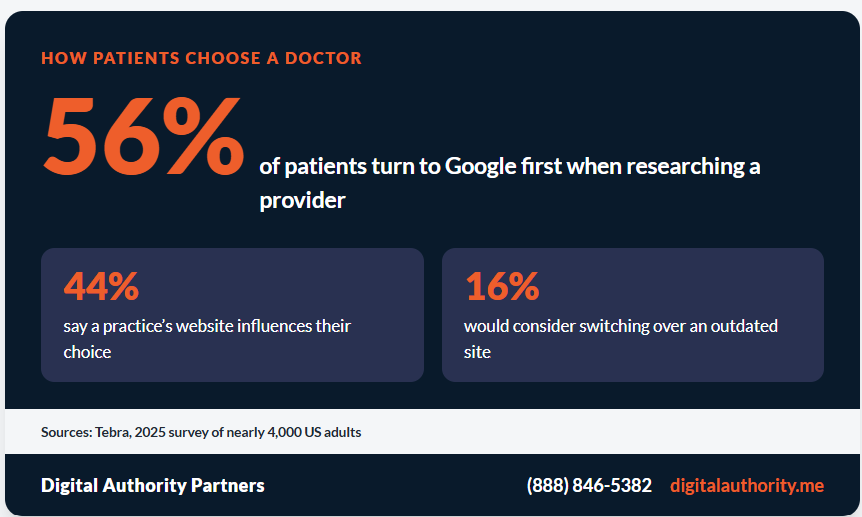
Most patient journeys now begin on a search engine. In fact, 56% of patients turn to Google first when researching a provider, according to a 2025 Tebra survey of nearly 4,000 US adults on what patients want in 2025.
From that first search, patients form a quick impression within seconds, scanning your reviews, your website, and your listing details. When those signals appear strong, they reach out; therefore, it pays to keep each one current and consistent.
Your website carries significant weight here, as 44% of patients say it influences their decision. A current, polished site also reassures the 16% who might otherwise weigh a switch, per the same Tebra survey.
Search habits keep shifting, too. Patients now blend Google, maps, review sites, and AI tools in a single decision. They might ask an AI assistant for a recommendation, then verify it on your profile and reviews. The marketing strategies for doctors that win in 2026 account for every one of those stops.
Your job, then, is to be easy to find, easy to trust, and easy to book. The nine strategies below do exactly that, and you can put most of them in motion without a large team or a big agency retainer.
9 Marketing Strategies for Doctors That Work in 2026
When people search for a doctor or specialist, they usually start with a local online search, and a strong digital presence turns that search into a booked visit. The nine strategies below, the core of effective digital marketing for doctors, appear in rough order of impact for a growing practice.
1. Build a Fast, Mobile-First Website
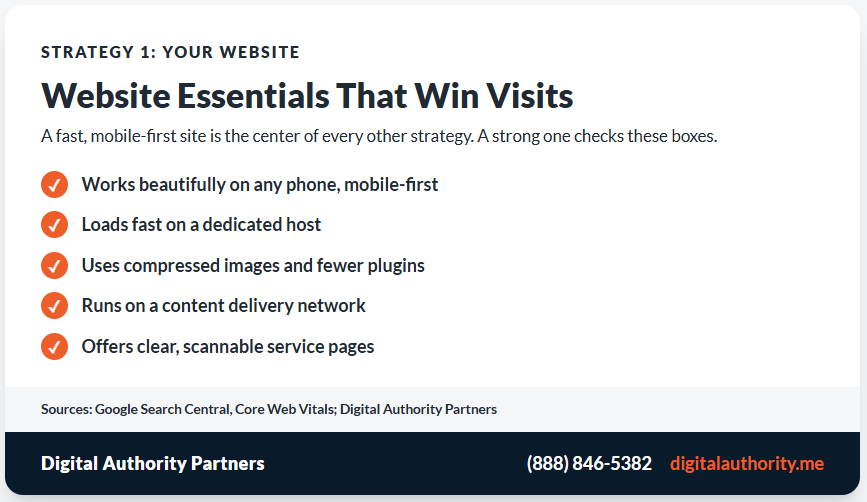
Your website is the center of every other strategy on this list. Patients use their phones to find care on the go, so your site should work beautifully on a small screen first.
Every component should be usable from a phone. That includes appointment tools, service pages, calculators, and forms. Patients should move from page to page without pinching, zooming, or guessing where to tap.
Speed matters just as much. Most people expect a page to load within a few seconds, so a fast site keeps them moving toward booking. A dedicated host, compressed images, fewer plugins, and a content delivery network all help your pages load quickly.
Make your services easy to find, too. Visitors want to see your treatments right away, the same way a patient would ask the front desk. Clear service pages, supported by SEO built for medical practices, help both patients and search engines understand what you offer.
Google counts page speed and stability among its ranking signals through Core Web Vitals. A site that loads fast and stays stable tends to rank higher and convert more visitors, so test your pages a few times a year and improve the slowest ones first.
2. Win Local Search and Your Google Business Profile
Most patients search with local intent, so local search is where you win new visits. Use keywords that name your location and specialty rather than broad terms.
A broad search for “doctor” or “psychiatrist” returns millions of results, so specific terms serve you better. Phrases like “pediatrician in San Diego” or “San Diego stress relief specialist” connect you with patients nearby, and “near me” phrasing helps as well.
Your Google Business Profile does much of the work here. Keep your hours, address, phone number, services, and photos accurate and current, since this listing is often the first thing a patient sees.
Treat your Google Business Profile as a live channel that you update often. Post news, add fresh photos, and answer the questions patients leave there. Encourage reviews on the profile, since they feed your local ranking and your reputation at once.
Beyond Google, claim your profiles on high-authority directories like WebMD, Healthgrades, and Vitals. Patients use them to compare providers, so complete listings there widen your reach.
When your local listings are complete and consistent, you show up more often. You also look more credible the moment a patient finds you.
3. Manage Your Reviews and Online Reputation
Reviews now carry as much weight as a personal referral, and 79% of patients read them before choosing a provider. Another 53% look for a rating of four stars or higher, per the 2025 Tebra survey.
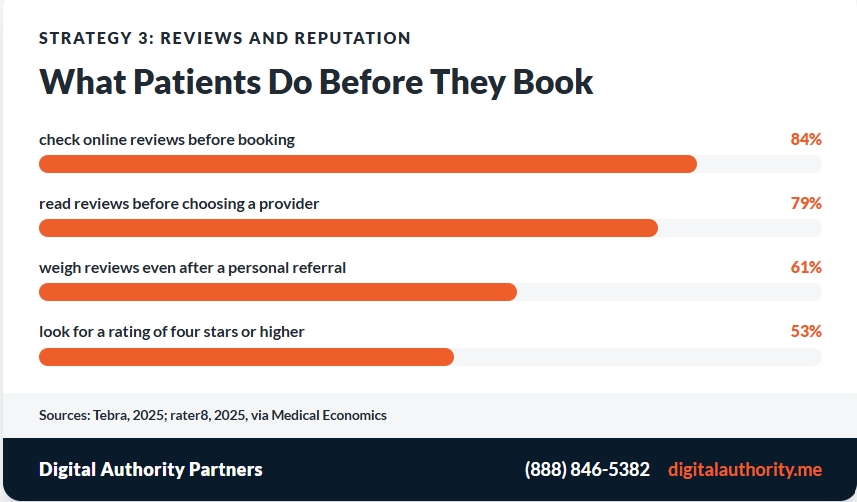
The pattern holds elsewhere. Online reviews reach 84% of patients before they book, and strong recent feedback reassures the 61% who weigh reviews even after a personal recommendation, according to a 2025 rater8 report on patients turning to AI tools published in Medical Economics.
You can shape this. Ask happy patients soon after the visit with a quick text or email, since most are willing when prompted. Respond to every review, positive or constructive, in a calm and professional voice that protects patient privacy.
This works because patients read your replies as a signal of how you will treat them. A thoughtful response to a tough review often earns more trust than a wall of five-star ratings.
Timing and volume matter as much as the words. A steady stream of recent reviews tells patients your practice is active and well-run. Build the review request into your checkout or follow-up text, make it a habit across your team, and your rating climbs on its own.
4. Show Up in AI Search and Answer Engines
A growing share of patients now ask AI tools for provider recommendations. Roughly 70% are open to or already using AI tools to research physicians, and 26% say an AI recommendation directly influenced their choice, per the 2025 rater8 report.
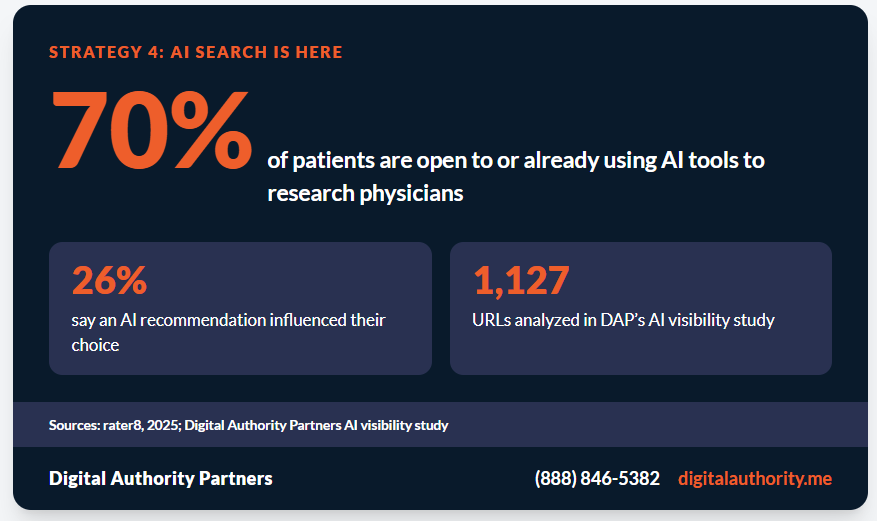
That makes AI visibility a channel you can win today. Our team at Digital Authority Partners (DAP) studied this directly, analyzing our AI visibility research study of 1,127 URLs to see how often AI engines cite and recommend pages like yours.
To earn those citations, structure your content so machines can read it. Answer common patient questions in clear language. Add FAQ and medical schema, and keep your service and location pages factual. The same clarity that helps a patient skim your page helps an AI engine quote it.
Reviews and authority signals matter here as well. AI tools lean on the same trust cues patients do, so strong ratings and credible content both raise your odds of being recommended. Treat AI visibility as an extension of the SEO and reputation work you already do.
5. Use Social Media to Build Trust
Social media is where patients get a feel for your practice before they visit. A consistent presence helps you build your brand and stay top of mind in your community.
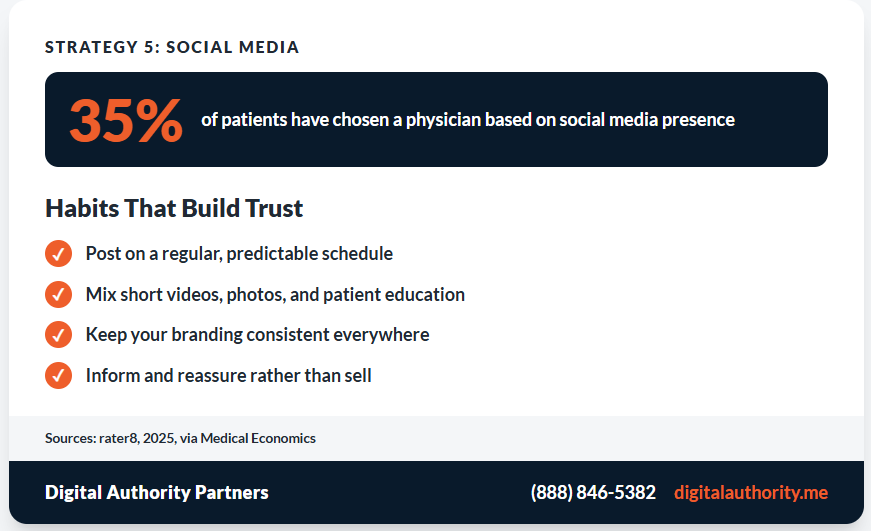
Social media can tip a decision, since 35% of patients have chosen a physician based on that practice’s social media presence, per the 2025 rater8 report. A few habits keep your accounts working for you:
- Post on a regular, predictable schedule.
- Mix formats such as short videos, photos, patient education, and team highlights.
- Keep your logo, colors, and tone consistent across every platform.
- Share content that informs and reassures rather than sells.
Pick one or two platforms your patients already use and do them well. A focused presence beats a thin spread across five networks.
Show the people behind the practice, since patients connect with faces more than logos. Brief team introductions, behind-the-scenes clips, and answers to common questions all build familiarity. That familiarity is what turns a scroll into a booked appointment.
6. Invest in Video Marketing
Video is one of the most persuasive ways to introduce your practice. Short clips about your services, your team, and your approach to care help patients feel comfortable before they book.
Many people would rather watch a 60-second explainer than read a long page of text. A simple welcome video on your homepage works well, and so do a few procedure overviews and patient-friendly answers to common questions. You can film most of these on a phone with good lighting.
Add captions to every clip, since most social video plays on mute. Then reuse those videos on your website, your profiles, and your Google Business Profile.
You do not need a studio to start. One clear video that answers your most common patient questions can run for years. Post it where patients already look, then build your library a clip at a time as you see what resonates.
7. Run Targeted Paid Search Ads
SEO builds momentum over months, while paid ads put you at the top of results today. The two work best together.
Google Ads and Local Services Ads reach patients at the moment they search for your specialty. You control the budget, the locations, and the services you promote, which lets you focus spending on your highest-value visits. Well-managed paid search ads for doctors fill schedule gaps while your organic rankings grow.
Start small and track which keywords produce calls and bookings, then shift budget toward what converts. Send every ad to a focused landing page that matches the search, since a dedicated page turns more clicks into appointments.
Local Services Ads deserve special attention for many practices. They appear above standard ads and show your reviews and a Google Screened badge. Patients click them because they signal trust before the visit. Pair them with strong reviews, and your paid presence reinforces everything else on this list.
8. Publish Procedure-Based and Patient-Education Content
Doctors have a duty to share accurate information, and that duty doubles as one of the strongest forms of medical marketing. Helpful content earns search traffic, builds trust, and feeds the AI engines patients now consult.
Explain your procedures, treatments, and what patients can expect. Use text, images, video, or infographics to match how people prefer to learn. Content that shows real expertise and trustworthiness performs best in both search and AI results.
Over time, a library of patient-education pages becomes a quiet, compounding asset. Each page can rank for the questions your future patients are already typing.
Build your content around topics rather than one-off posts. Group related pages so they support each other and signal real depth in your specialty. A well-linked cluster on a single condition or treatment outranks a scattered set of articles. It also gives AI engines a clear, authoritative source to cite.
9. Keep Patients With Email and Text Follow-Up
New patients matter, and so do the ones you already have. Keeping an existing patient costs far less than winning a new one and often returns more over time. Email and text follow-up keep your practice close for when patients need care again.
Send appointment reminders, recall notices for annual visits, and seasonal health tips. Keep every message useful and easy to act on. Always use HIPAA-compliant tools and clear opt-in consent for these channels.
A short, well-timed reminder fills more chairs than most one-off campaigns. It also gives loyal patients an easy reason to refer friends and family.
Turn These Marketing Strategies for Doctors Into a Plan
Tactics work best inside a plan. You do not need a thick binder, just a clear picture of who you want to reach, what you will spend, and where your physician marketing effort goes.
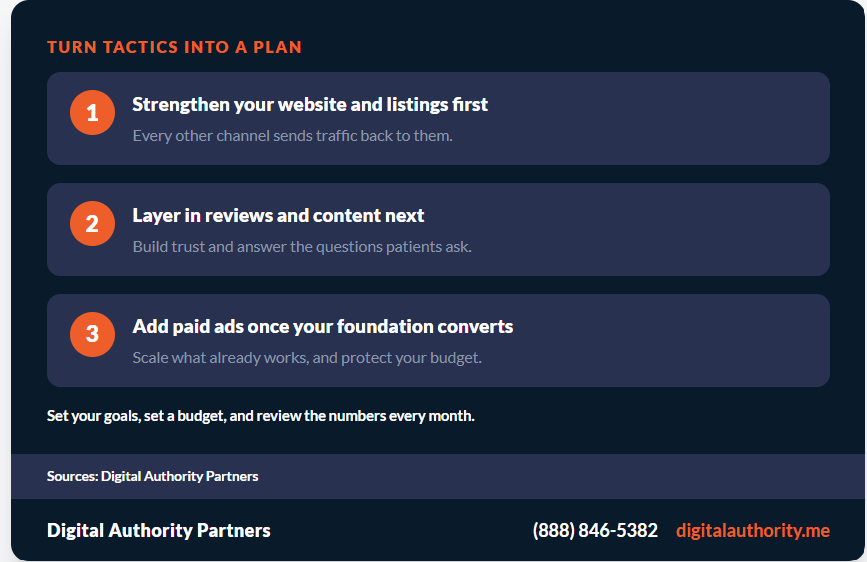
Start with your goals. Decide whether you want more new patients, more high-value procedures, or stronger retention. Each goal points to a different channel mix. Set a realistic budget, too, and adjust it as channels prove themselves.
Then sequence the work. Strengthen your website and listings first, since every other channel sends traffic back to them. Layer in reviews and content next, then add paid ads once your foundation converts. This order protects your budget and compounds your results.
Match the plan to your specialty as well. A dermatology or cosmetic practice leans harder on video, social, and paid search. A primary care or pediatric practice often wins on local search, reviews, and retention. Choose the marketing strategies for doctors that fit how your patients really decide.
A simple quarterly plan keeps everyone aligned. List your top three priorities and assign an owner to each. Review the numbers every month and adjust from there.
How to Measure Your Marketing ROI
Marketing earns more budget when you can show what it returns. That means tracking a few numbers that connect activity to revenue.
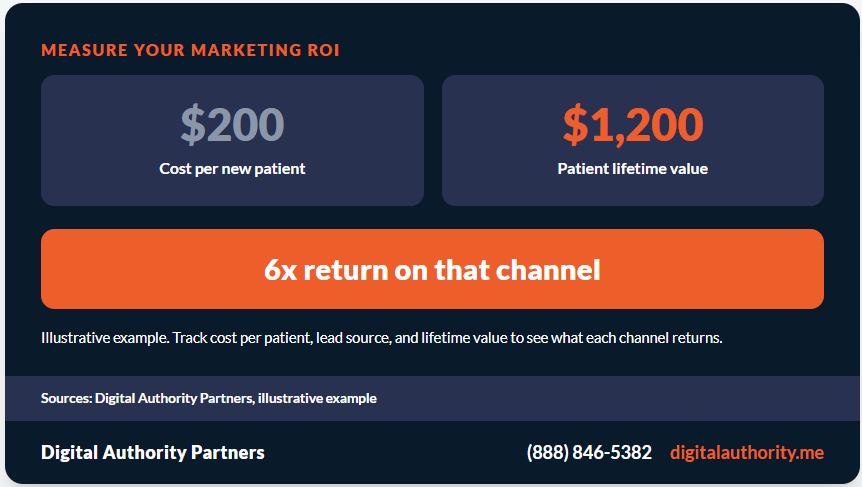
You only need three figures to start. Track your cost per new patient, the channel that produced each lead, and the lifetime value of those patients. Use call tracking and form tracking to tie each lead to its source. Connect those leads back to booked and completed visits whenever your systems allow.
A quick example shows why this matters. Say paid search costs you $200 per new patient, and a new patient is worth $1,200 over time. That channel returns six times its cost, so you fund it with confidence.
When a channel returns more than it costs, the decision to keep investing makes itself. Review these numbers monthly, and move budget toward the channels that deliver the strongest return.
Frequently Asked Questions About Marketing for Doctors
What Are the Best Marketing Strategies for Doctors?
The best marketing strategies for doctors start with a fast, mobile-first website and a complete Google Business Profile. From there, add review management, local SEO, and patient-education content. Paid search and AI visibility help you scale once the foundation converts. The right mix depends on your specialty, your market, and your goals.
How Much Does Marketing for Doctors Cost?
Marketing for doctors costs as much or as little as your goals require. Many practices invest a modest percentage of annual revenue, then adjust based on results. A new or competitive practice often spends more early to build visibility. Track your cost per new patient so you can see what each dollar returns.
How Do Doctors Get More Patients Online?
Doctors get more patients online by being easy to find and easy to trust. That means ranking in local search, earning strong reviews, and keeping listings accurate. Clear content that answers patient questions helps as well. Paid search can add new patients quickly while your organic presence grows.
What Are the 5 P’s of Healthcare Marketing?
The 5 P’s of healthcare marketing are product, price, place, promotion, and people. For a practice, that means your services, your pricing and insurance options, and your locations. It also covers how you promote your practice and the team patients meet. Reviewing each P helps you spot gaps.
Does Social Media Marketing for Doctors Work?
Yes, social media marketing for doctors works when it builds trust rather than chases sales. About 35% of patients have chosen a physician based on social media, per a 2025 rater8 report. Consistent, helpful posts keep your practice visible and familiar to patients nearby.
How Long Does Medical SEO Take to Work?
Medical SEO usually shows early movement in three to six months. Stronger results build over six to 12 months. Competitive specialties and crowded markets take longer. Because SEO compounds, practices that start sooner and stay consistent tend to pull ahead and stay there.
How Can Doctors Show Up in AI Search Results?
Doctors show up in AI search by publishing clear, well-structured content that answer engines can read. Add FAQ and medical schema, and answer common patient questions in plain language. Keep your service and location pages factual. Strong reviews and authoritative content both improve how often AI tools recommend your practice.
Is Digital Marketing for Doctors HIPAA Compliant?
Digital marketing for doctors can be fully HIPAA compliant when you protect patient information at every step. Never share identifiable patient details in reviews, ads, or social posts without written authorization. Use HIPAA-compliant tools for forms and messaging. Train your team on what they can and cannot publish.
What Is the 70-20-10 Rule in Marketing?
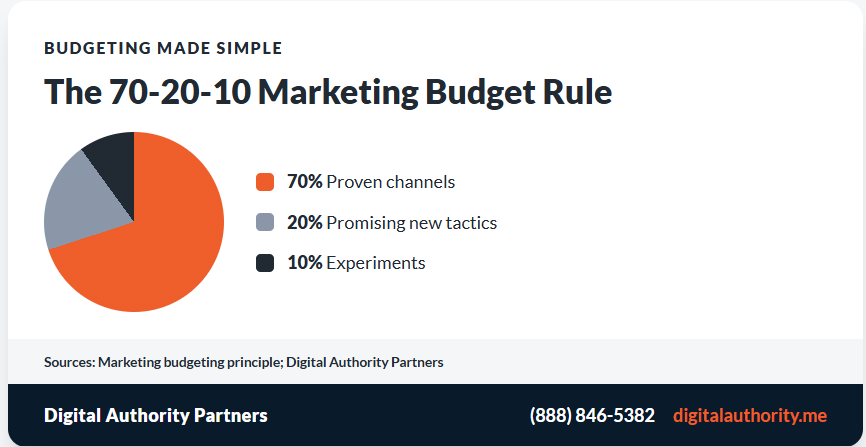
The 70-20-10 rule suggests putting 70% of your budget into proven channels, 20% into promising new tactics, and 10% into experiments. For a practice, that might mean 70% on your website and local search and 20% on paid ads. The last 10% goes to testing a new platform. It keeps you steady while you learn.
How Do You Measure the ROI of Marketing Strategies for Doctors?
You measure the ROI of marketing strategies for doctors with three numbers. Track cost per new patient, the channel behind each lead, and patient lifetime value, then fund the channels that return more than they cost.
Key Takeaways
Marketing strategies for doctors succeed when they make your practice easy to find and easy to trust. They also make it simple to book. Pick a few priorities, build on a strong foundation, and let your results guide where you invest next.
What to take away:
- Foundation first, because your website and listings carry every other channel and shape a patient’s first impression.
- Reviews build trust, since most patients read them before booking and weigh them like a personal referral.
- AI visibility is here, as a growing share of patients now ask AI tools which doctor to choose.
- Measure everything, so you can prove what each channel returns and invest with confidence.
Your next patient is searching right now, and the practices that show up well are the ones that win the visit. If you would like a partner to build and run this plan, talk to our team about a strategy tailored to your specialty and market.
Want To Meet Our Expert Team?
Book a meeting directly here

Related Articles

Demand for therapy is at an all-time high, yet nearly half of the 62 million U.S. adults with a mental illness receiv...

AI in digital health has moved from research labs into daily care. A phone camera can now screen for diseases that on...

Nearly every local search ends in one of three spots. The U.S. has 8.3 million business establishments, and 7.1 milli...