
What Is Local SEO? Everything You Need to Know

Nearly every local search ends in one of three spots. The U.S. has 8.3 million business establishments, and 7.1 million of them employ 19 people or fewer, all competing for the same three results Google shows on a map pack. Local SEO decides which three businesses win those spots.
This guide covers how Google ranks local results, the five building blocks a working strategy needs, how long each one takes to show results, and how AI search is changing the rules. Underneath all of it, Local SEO Services come down to three things: how relevant, close, and well known Google considers your business to be.
What Is Local SEO?
Local SEO is the work of making sure Google shows your business to the customers searching nearby, whether they type a location into the search bar or Google infers it from their phone. It relies on geo-targeted strategies, meaning your website, profile, and content are all built around where your customers actually are, not just what they’re searching for.
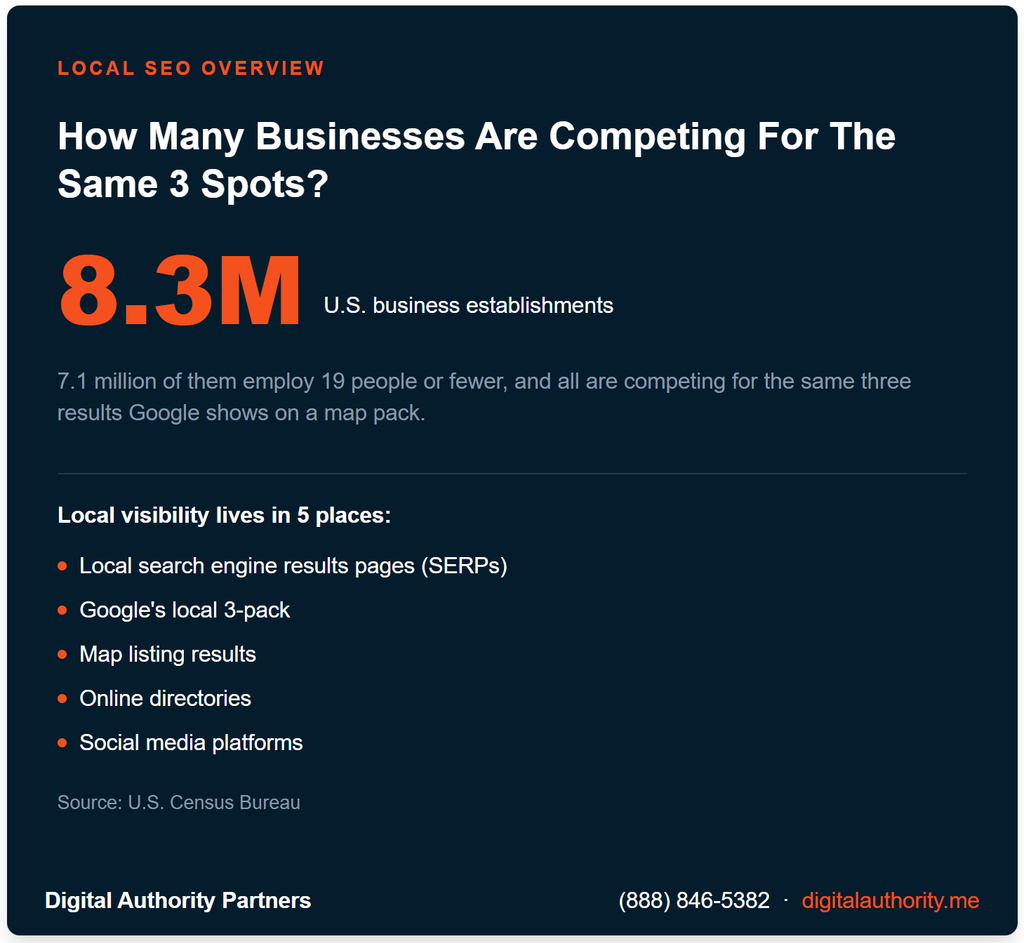
Businesses with strong local rankings reach far more of those nearby searchers than competitors who ignore local signals entirely. That visibility doesn’t live in one place. Local search results, map pack rankings, directory listings, and social platforms all send customers your way, and each one deserves its own attention:
- Local search engine results pages, or SERPs
- Google’s local 3-pack, the top three results displayed on local SERPs
- Map listing results
- Online directories
- Social media platforms
Most of the 7.1 million U.S. businesses with 19 or fewer employees serve a single city, county, or service radius rather than a national market. For a business that size, local search visibility isn’t a growth tactic: it’s how customers find you.
How Is Local Search Different From National Search?
Local and national SEO both aim to put your business in front of the right searcher, but Google treats the two very differently. For a query like “personal injury lawyer near me” or “hospital in Henderson, NV,” Google weighs how close a business sits to the searcher, on top of the usual relevance signals. Google’s own guidance on how Google ranks local results confirms distance and prominence apply to these queries in a way a purely national search never considers.
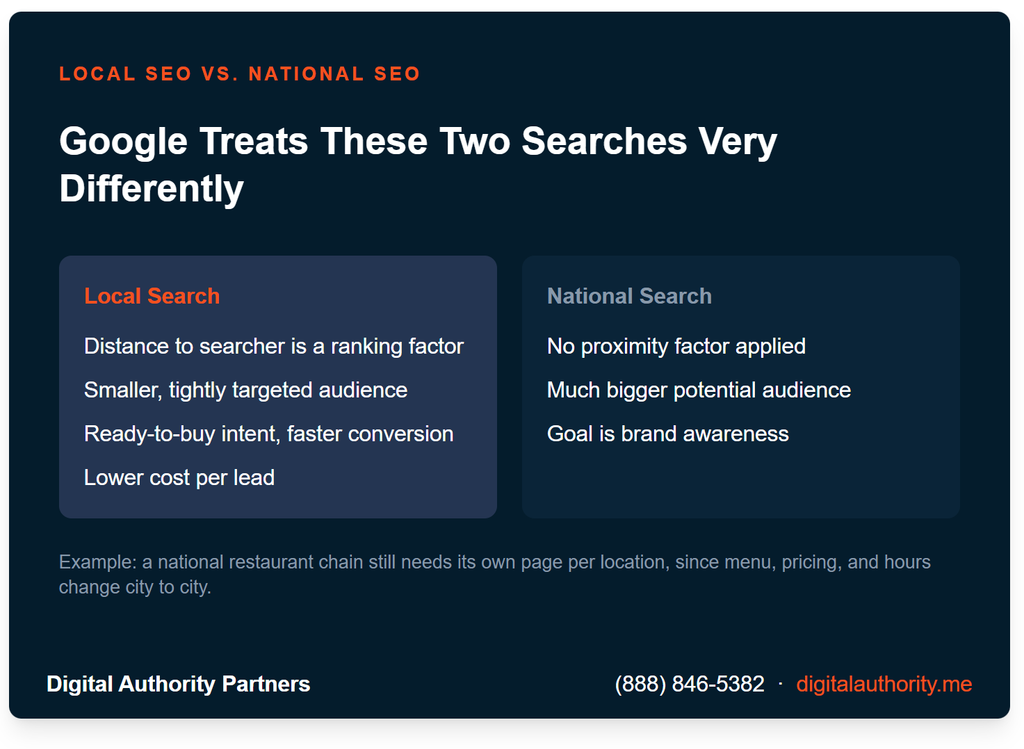
National campaigns can reach a much bigger audience, and that reach has real value when brand awareness, not a nearby customer, is the goal. Local campaigns trade that scale for precision. A local search usually comes from someone ready to buy today, so a smaller, tightly targeted audience often converts faster and costs less per lead than a national one.
Consider a national restaurant chain, for example. It runs one national marketing push, but every location still needs its own page, because the menu, the pricing, and the hours change from city to city. Whether you run a multi-location brand or a single storefront, businesses can produce results quickly. That makes this an effective way to drive ready-to-buy traffic to your site and store.
How Does Local SEO Work?
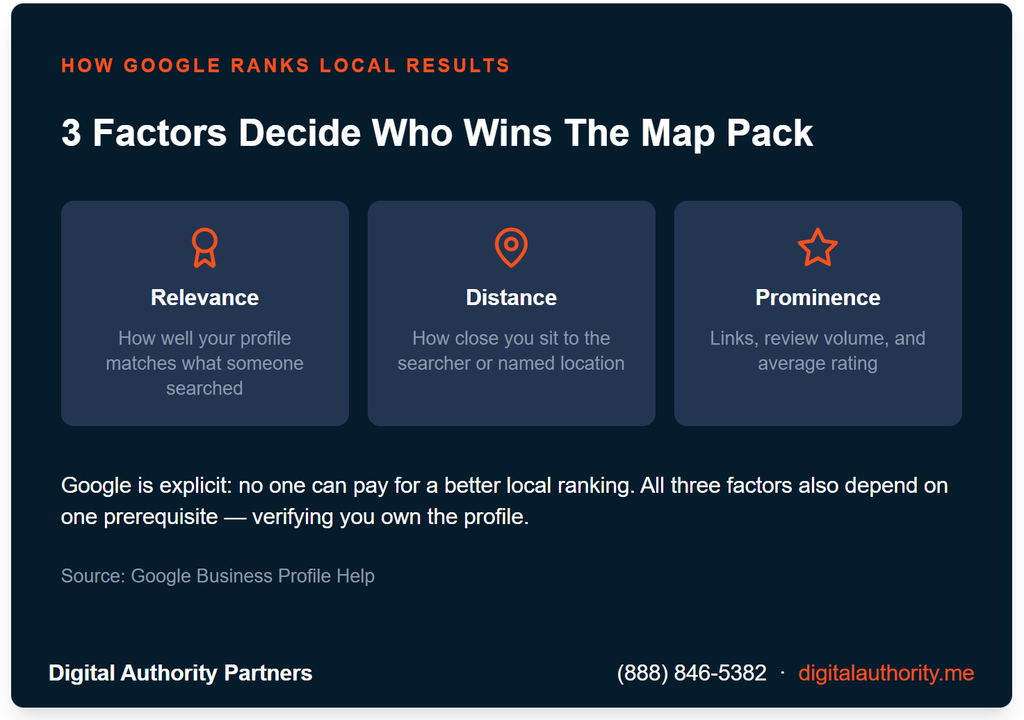
Google is explicit about what drives the map pack. Google also states plainly that no one can pay for a better local ranking. Improving your local ranking on Google comes down to three factors:
1. Relevance
Relevance measures how well your Google Business Profile matches what someone actually typed. Complete, specific, accurate information wins that match. A profile listing one vague category loses to a competitor who lists every service, every hour, the exact service area, and the right attributes. Relevance is the cheapest ranking factor available, because it costs you nothing but the time to fill out every field completely.
2. Distance
Distance measures how far each result sits from the searcher, or from a location named directly in the query. You cannot move your building, but you can control which address Google associates with your profile and how tightly you draw your service area, both of which shape how you show up for nearby searches.
3. Prominence
Prominence measures how well-known your business is beyond your own website. Google counts the links pointing to your site, along with your review volume and your average rating, here. Building prominence is where your sustained local search engine optimization work grows over time, so gains that take longer to show up here are usually gains that last.
All three factors depend on one prerequisite: verifying that you actually own the profile you’re trying to rank. Google’s own guidance on establishing your business details walks through what verification unlocks, starting with eligibility for the map pack and the knowledge panel in the first place.
Once you complete that verification, you control the address, category, hours, and photos Google displays for your business. That accuracy matters more today than it did three years ago, because Google, and increasingly AI search tools, pull directly from your verified profile data to answer “near me” queries without a searcher ever visiting your website.
What Are the Building Blocks of a Winning Local SEO Strategy?
Geo-targeted keywords are the foundation of any local SEO campaign, since almost nothing else in this list works without them. Location-based keywords tied to real searcher intent are what earn you the rankings the rest of this guide is built around, and location landing pages are where those keywords actually live on your site. The five components below build on each other in order. Skip the early ones, and the later ones will underperform no matter how much effort you put into them.
1. Local Keyword Research
Start with how customers describe the problem, then add a geographic marker. A dental practice, for example, targets a term like “emergency dentist” alongside the specific neighborhood names its own patients use, rather than the city name alone. Pull the keywords your competitors already rank for, confirm each one actually triggers a map pack result, and check real search volume before you commit a page to it.
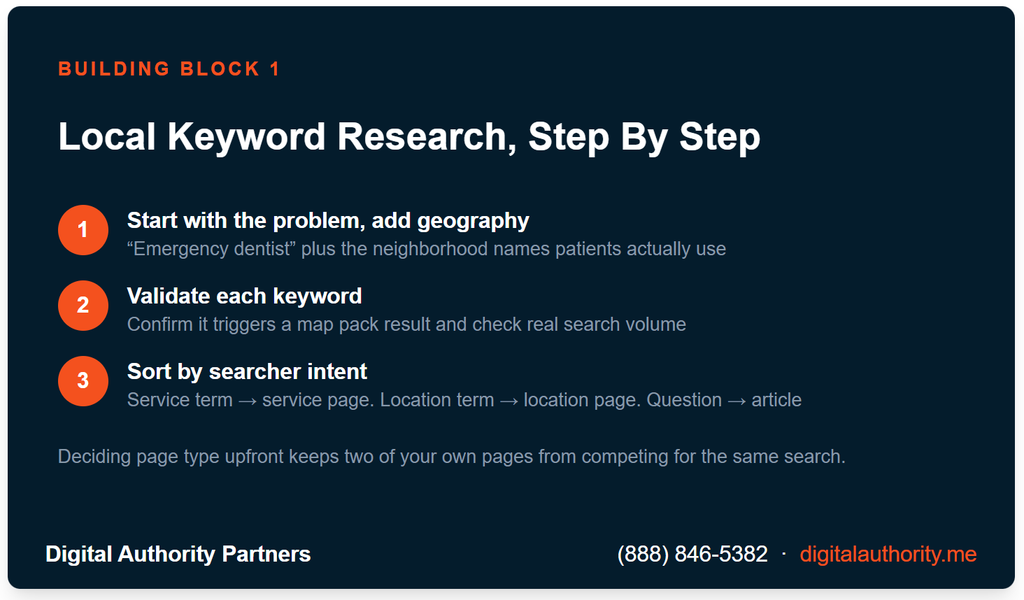
Once you have that keyword list, sort each term by what the searcher wants next. A service term like “emergency dentist” belongs on a service page, a location term like “emergency dentist in [neighborhood]” belongs on its own location page, and a question term like “how much does an emergency dentist visit cost” belongs in an article. Deciding this upfront keeps two of your own pages from competing against each other for the same search, which only weakens both.
2. Google Business Profile Optimization
Your Google Business Profile is the single most valuable asset in local search. Claim it, verify it, then fill every field. That means categories, services, hours, holiday hours, service area, attributes, and photos. The primary category carries more weight than any other choice you make.
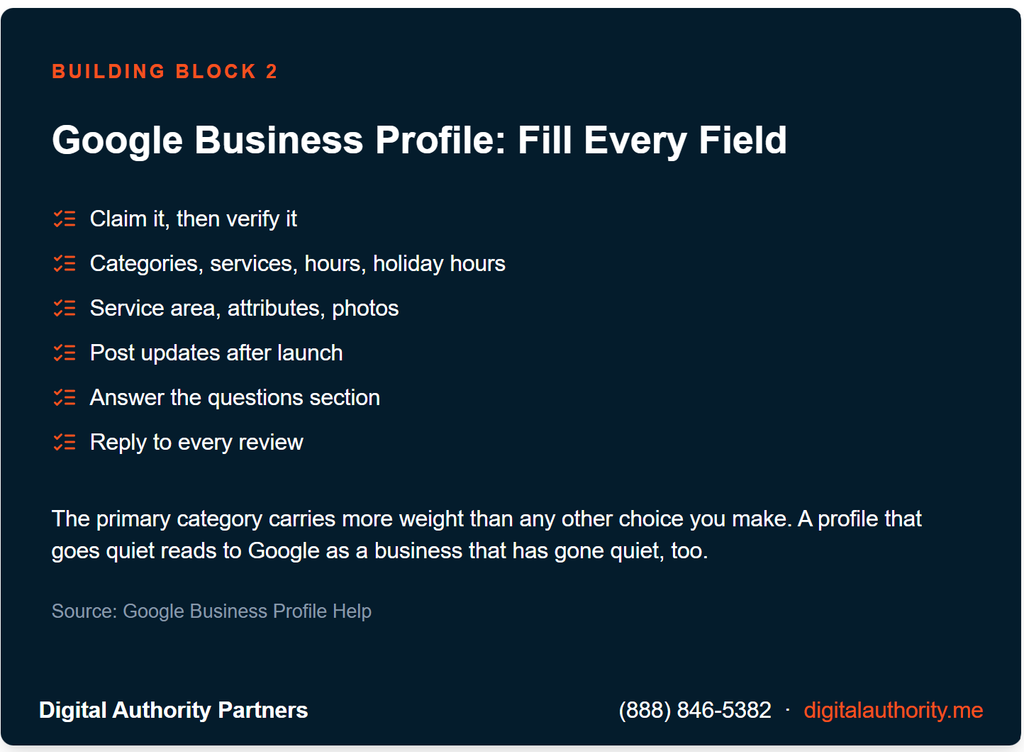
Keep the profile active after launch. Post updates, answer the questions section, add fresh photos, and reply to every review. A profile that goes quiet reads to Google as a business that has gone quiet too, and prominence, one of the three ranking factors covered earlier, rewards the opposite.
3. Location Landing Pages
One page cannot rank in six cities, because Google matches distance and local relevance as tightly as it matches topics. Covering multiple markets takes a dedicated page for each one, and each of those pages needs its own address, embedded map, staff information, hours, testimonials, and copy written for that specific location rather than swapped-in city names. Thin, duplicated pages that only change the city name get filtered out of local results instead of ranked in them.
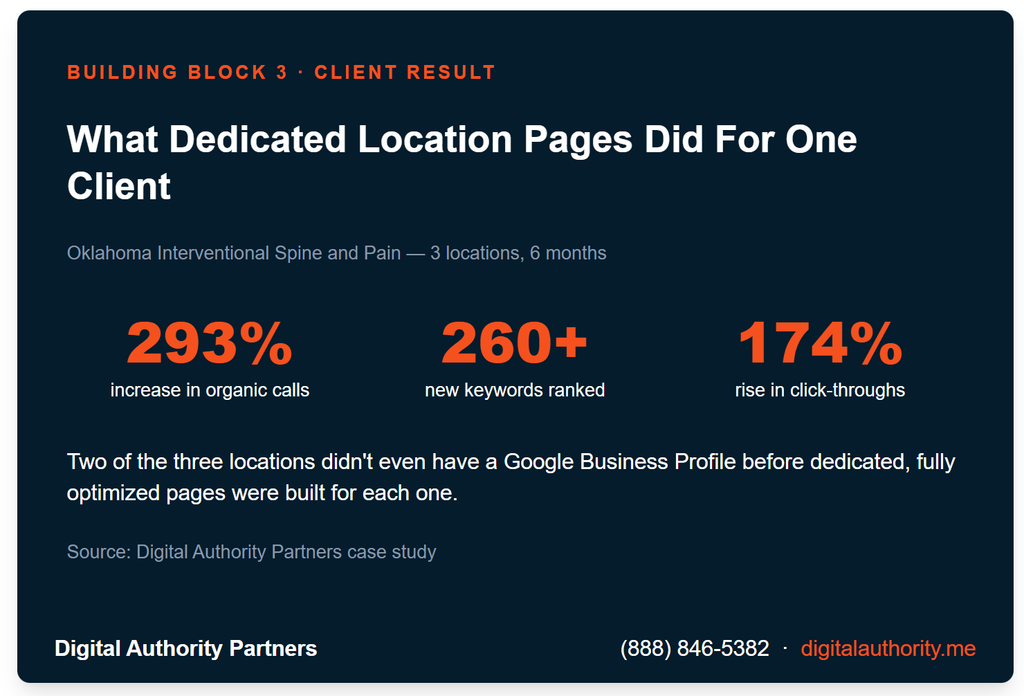
Our work with Oklahoma Interventional Spine and Pain shows what a location page strategy done right can do. The clinic had three locations across Oklahoma with little online presence, and two of them didn’t even have a Google Business Profile.
After building dedicated, fully optimized profiles and pages for each location, the practice saw a 293% increase in organic calls and began ranking for more than 260 new keywords within six months, along with a 174% rise in click-throughs from its profiles. Giving each location its own page and its own optimized profile is what lets all three locations grow together instead of competing with each other for the same searches.
4. Reviews and Reputation
Reviews feed directly into prominence, the ranking factor covered earlier, which is exactly why they belong in your local SEO plan and not just your customer service queue. Once you’re ranking, reviews are also what convince a searcher comparing you against two other results to actually pick up the phone and call you instead.
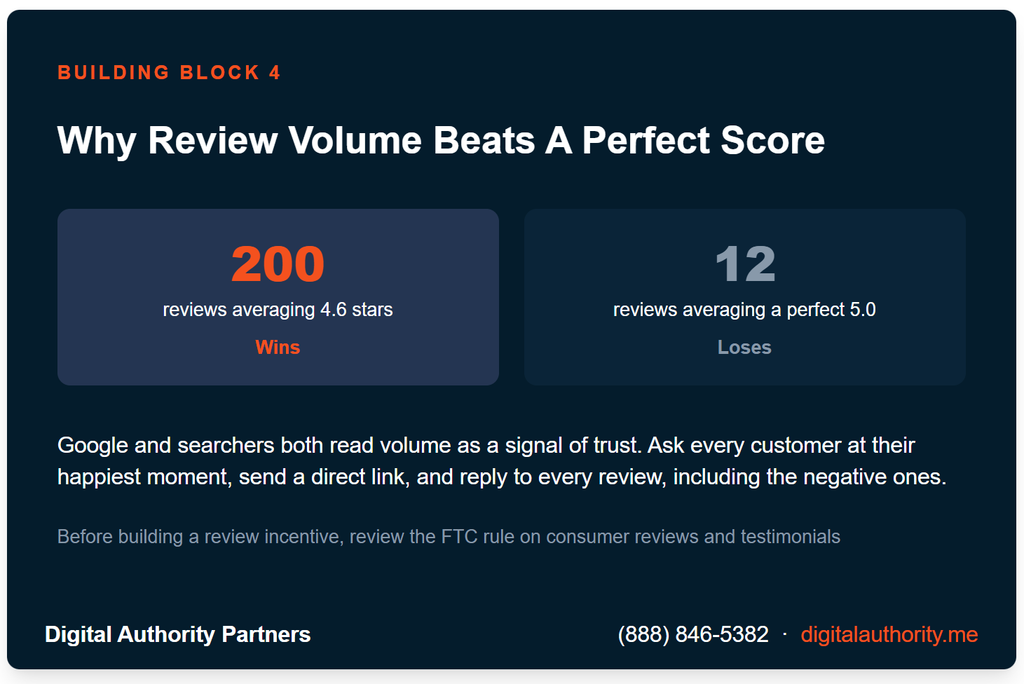
Getting them takes a system, not luck. Ask every customer at the moment they’re happiest with you, send a direct link so leaving a review takes seconds, and reply to every single one you get, including the negative ones.
Before you build any kind of review incentive into that system, read the Federal Trade Commission rule on consumer reviews and testimonials. Beyond compliance, quantity and freshness matter as much as the star rating itself: a profile with 200 reviews averaging 4.6 stars outperforms one with 12 reviews averaging a perfect 5.0, because Google and searchers both read volume as a signal of trust.
5. NAP Consistency and Citations
Thousands of online directories list businesses like yours, and keeping all of them updated one by one simply isn’t realistic. Picture correcting a single address change across 100 different listings by hand. A listing aggregator solves that problem for you. Listing aggregators handle that for you. Platforms like Yext and Localeze let you manage listings in one place, with one update syncing everywhere.
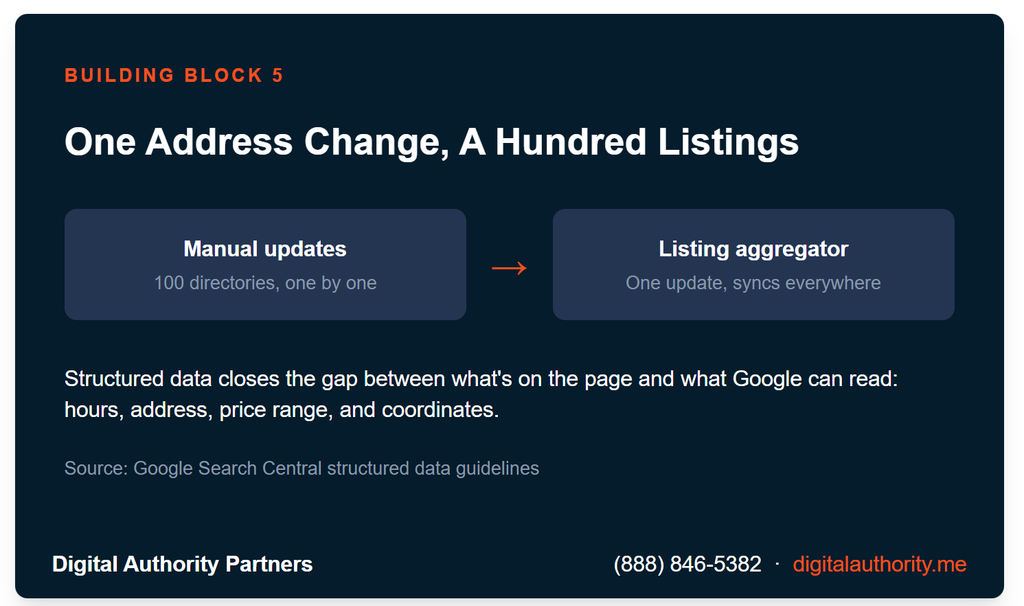
Structured data for local businesses closes the gap between what’s on your page and what Google can actually read. Adding it to your location pages states your hours, address, price range, and coordinates in a format Google can read. Follow Google’s general structured data guidelines so the markup remains eligible for rich results.
How Do You Measure Local SEO Results?
Rankings alone won’t tell you if local SEO is working, because local results are hyperlocal by nature. Two customers standing a mile apart can search the exact same term and see two completely different map packs, so a single rank tracked from one spot only tells part of the story.
What actually matters is what those rankings produce: calls, visits, and revenue. Four key metrics can tell you if a local SEO program is working. Track each one monthly against a fixed baseline:
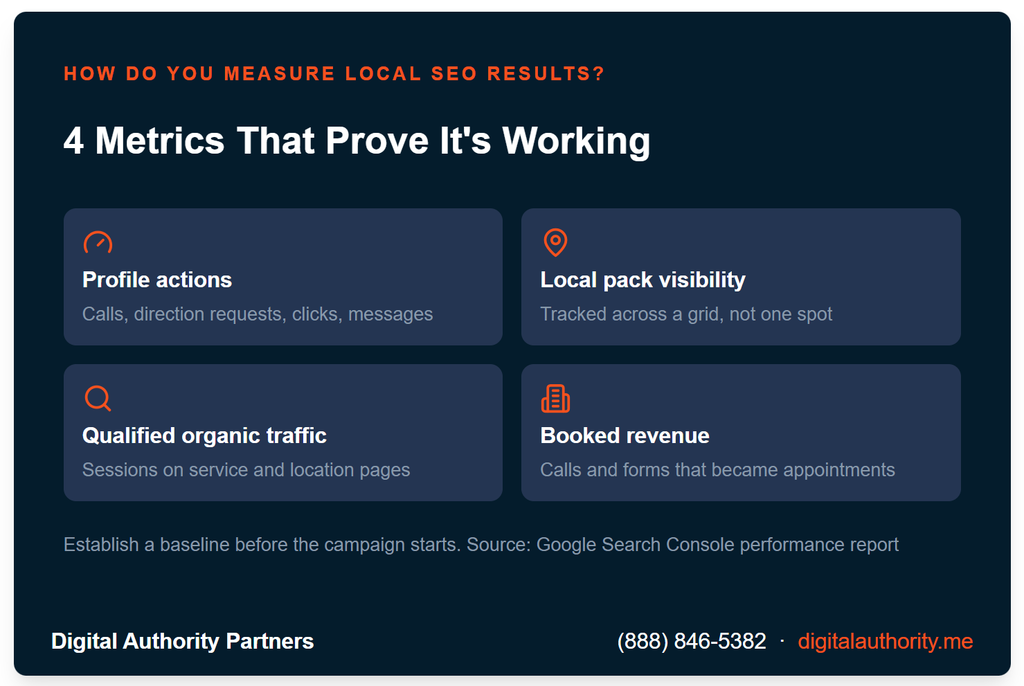
- Profile actions: Calls, direction requests, website clicks, and messages from your Google Business Profile.
- Local pack visibility: Where you appear across a grid of points around each location, not from one spot.
- Qualified organic traffic: Sessions landing on service and location pages from the geographies you serve.
- Booked revenue: Calls and forms that became appointments, tied back to the page and query behind them.
Establish that baseline before your campaign starts, not after, so you have something real to measure against. Google’s Search Console performance report is the free starting point for query and page-level data, and working through a local SEO checklist for a small business is a practical way to document where you began.
How Does AI Search Change the Rules?
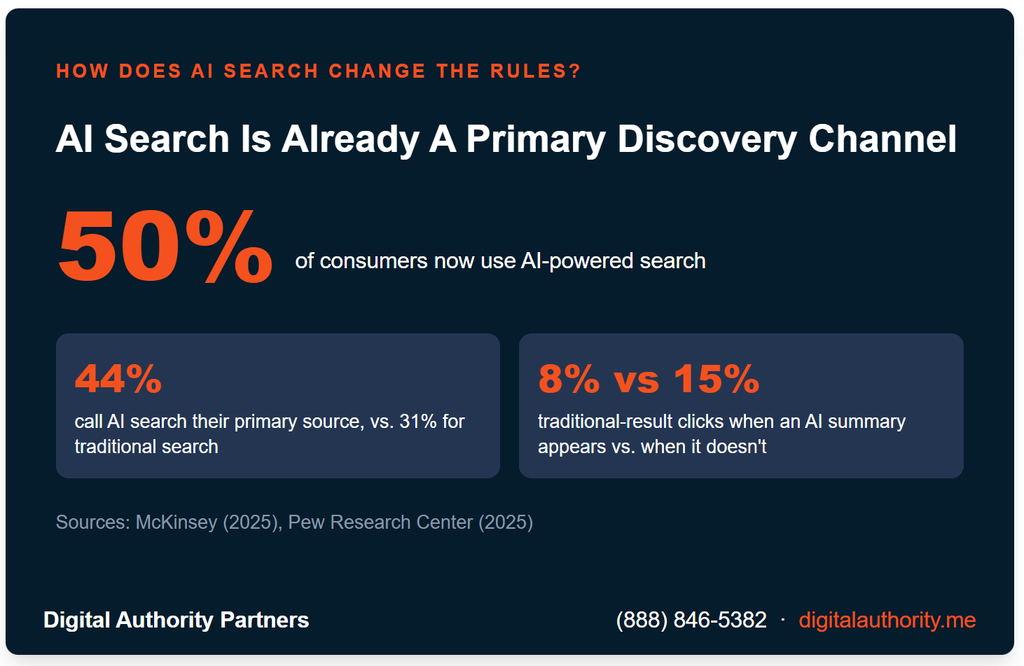
AI-powered search has moved from a novelty to a real discovery channel in a very short time. A 2025 McKinsey report shows that half of consumers now use AI-powered search. Among those users, 44% call it their primary source of insight, ahead of traditional search at 31%.
AI systems assemble answers from the same facts Google uses for the map pack. Your profile, NAP consistency, reviews, and structured data are the inputs. Feed the AI systems clean data, and you could appear in the summary. The way AI uses your business information makes the fundamentals even more valuable, not less. Accurate categories, verified listings, real reviews, and marked-up location pages let AI platforms state your hours with confidence.
Publish content that answers the questions your buyers actually ask, in their language, on pages AI can parse. Working through a local SEO checklist for your business shows you exactly what that looks like for one market, and the same process applies whether you’re optimizing for one city or fifty.
Which Businesses Benefit Most From Going Local?
Local SEO works for nearly any business with a defined service area, but the payoff isn’t identical everywhere. It’s largest in categories where the customer is ready to buy the moment they search and where competitors are fighting hard for the same few map pack spots. Four categories consistently see the strongest returns:
- Healthcare practices win because patients and providers find each other based on proximity. Insurance and location filters then narrow the field fast. Digital Authority Partners covers the specifics in their guide about healthcare local search strategies.
- Legal practices win because one case can justify years of investment. That is why firms compete so hard for terms like “personal injury lawyer near me”. Home services companies win because demand is urgent and unplanned, which is the pattern our home services marketing agency team builds for.
- Multi-location and franchise operations are the fourth case, and the hardest. Every location needs its own page, profile, and review stream. Brand consistency still has to hold across all of them. That tension is why how local SEO works at scale is a different discipline from optimizing one storefront.
Whatever category you fall into, the fundamentals don’t change. Accurate data, an active profile, and a page for every location you serve are still what decide whether you show up first or not at all.
Frequently Asked Questions About Local SEO
These are the answers to some of the questions you and other business owners might be asking about local SEO:
What Is Local SEO in Simple Terms?
Local SEO is the work of making your business visible to people searching nearby. It targets queries with location intent, like “dentist near me” or “bookkeeper in Austin,” and competes for map pack spots, Google Maps results, and location-specific organic listings. The goal is simple: show up when someone close by is ready to act.
What Is the Difference Between Local SEO and Regular SEO?
Regular SEO competes for national or global rankings on a topic. Local SEO competes within a defined geography, where your distance from the searcher becomes a ranking factor in its own right. That difference reshapes your keyword selection, your page structure, and how much weight your Google Business Profile carries. National authority still helps, but it never overrides proximity: a national brand with thousands of links can lose the map pack to a single-location competitor who is simply two blocks closer to the searcher.
How Long Does Local SEO Take to Show Results?
Profile fixes, like completing every field and correcting an inconsistent address, can move rankings within a few weeks, since they touch the relevance and prominence factors most directly. Location pages and consistent citations typically take two to three months to show meaningful traffic. Competitive terms in dense markets, like personal injury law or urgent care, can take six months or longer, because you’re competing against businesses that have been building these same fundamentals for years. The one constant is that work started today keeps compounding, so the sooner you start, the sooner it pays off.
How Do You Do Local SEO for Beginners?
Start by claiming and verifying your Google Business Profile, completing every field, and picking the most accurate primary category available to you. From there, research the location-based terms your customers actually use, build one page per location and one per core service, and get listed consistently across the directories that matter most in your industry. Ask for reviews every week after that. Beginner local SEO is mostly about accuracy and consistency, not clever tactics.
Can I Do Local SEO Myself?
Yes, and most single-location businesses should start there. Claiming your profile, cleaning up your directory listings, and asking customers for reviews can produce most of your early gains on their own. The work becomes more of a specialist territory once you add locations, need technical fixes on the site itself, or start competing in a market where every competitor already has the basics covered.
What Are the Most Common Local SEO Mistakes to Avoid?
The most damaging mistakes are technical, not creative. Google’s introduction to robots.txt explains how a misconfigured file can accidentally block a location page, and a stray noindex tag left over from a staging site can do the same thing invisibly. Duplicate Google Business Profiles for one location are another common trap. Google’s guidance on resolving duplicate profiles walks through merging or removing one before it splits your reviews and rankings across two listings instead of one. Keyword-stuffed business names are a third mistake worth checking, since Google’s policy on prohibited business content treats that as a suspension risk, not just a missed opportunity.
How Does AI Search Affect Local SEO Results?
AI Overviews and AI-powered search assistants pull from the same profile and review data that feeds your map pack ranking, so the fundamentals still matter. What’s changed is the click. A Pew Research Center study found that Google searchers click a traditional result in just 8% of visits when an AI summary appears, compared with 15% of visits when it doesn’t, and people are also more likely to end their search entirely once they see a summary instead of a website. For local businesses, being cited accurately inside the summary is becoming just as important as ranking below it.
Do I Still Need a Website If I Have a Google Business Profile?
Yes. Your profile gets you discovered, but your website is what earns the click, answers questions your profile can’t, and hosts the location and service pages this guide covers. A profile with no website behind it also caps how much local SEO you can do, since structured data, keyword-targeted content, and internal linking all live on the site, not the profile.
Build Local Visibility That Grows
Eight million American businesses compete for the same three map results, and the ones winning are rarely the ones spending the most. They are the ones whose data is accurate, whose profiles stay active, and whose reviews keep coming in. Each of those is a decision you control this quarter. Each one is valuable to your growth, because a profile built today keeps earning results years from now.
Ready to find out where your local visibility needs work? Our team audits your profile, citations, and location pages, then shows you which fixes move rankings first. Talk to our local SEO team or call (888) 846-5382 to get started, and you’ll have a prioritized plan within a week.
Want To Meet Our Expert Team?
Book a meeting directly here

Related Articles

IN SHORT Digital Authority Partners audited 150 US ABA and autism therapy clinic websites in July 2026, scoring each ...


Your phone can walk you through a panic attack faster than most clinics can return a call. More than one billion peop...
United States shoppers spent $326.7 billion online in the first quarter of 2026, according to the U.S. Census Bureau....