5 Differences Between B2B and B2C Marketing You Must Know

The difference between B2B and B2C marketing goes deeper than logic versus emotion or long sales cycles versus short ones. Each model operates as a distinct growth system. The way buyers evaluate risk, the number of people involved in a purchase, the channels that earn their attention, and the metrics that prove ROI all shift depending on whether you sell to businesses or consumers.
When your strategy reflects those structural realities, your digital marketing services perform better across the board. In this guide, we break down five strategic differences that shape real-world B2B and B2C digital marketing performance. You’ll learn how to align your approach with the buying environment you actually operate in.
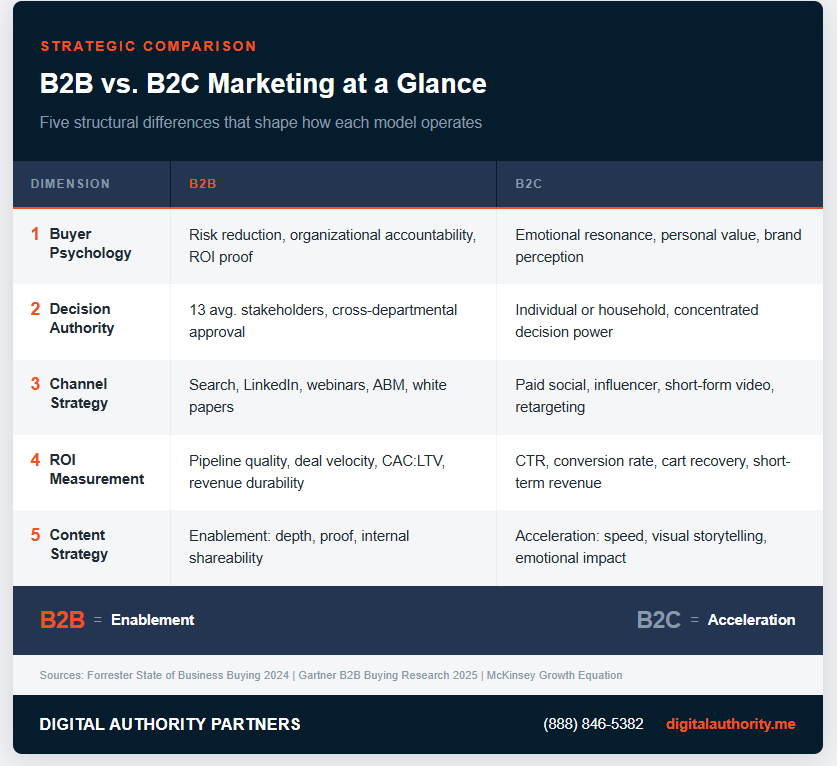
What Does B2B Mean vs B2C in Practice?
In B2B, every purchase connects to revenue, operational efficiency, compliance, or competitive positioning. A software platform, consulting engagement, or logistics contract affects multiple departments and can directly influence quarterly performance. Buying decisions carry organizational weight, and B2B organizations need to understand their buyers at a structural level to market effectively.
In B2C, purchases are personal. You are making choices driven by convenience, desire, lifestyle, or immediate need. Even higher-consideration B2C purchases, like real estate or automobiles, ultimately come down to an individual or household. The evaluation window is shorter, the approval process simpler, and the emotional connection to the brand carries more influence.
These structural foundations shape everything that follows. When you understand the operating model behind each buying environment, you can build a marketing strategy that fits, rather than borrowing tactics from the wrong playbook. The SEO framework for B2B and B2C reflects this same principle: the buyer journey itself is structured differently, so your keyword strategy, content depth, and conversion architecture need to match.
Buyer Psychology: Risk, Motivation, and the Path to Purchase
Buyer psychology is where the difference between B2B and B2C marketing becomes most visible. Both environments involve evaluation and decision-making, but the type of risk driving each process is fundamentally different. Understanding that distinction allows you to craft messaging that resonates with the right motivations.
What Drives B2B Buying Decisions?
If you market to businesses, your buyer is accountable to their organization. A decision-maker evaluating your product or service is considering whether the choice will improve performance metrics, protect operational stability, withstand internal review, and deliver measurable ROI.
The higher the contract value, the more visible the decision becomes within the company. That visibility increases the need for proof. Your marketing needs to provide case studies demonstrating specific outcomes, data supporting implementation timelines, and commercial logic that helps the buyer justify the investment in a leadership meeting. Think of it this way: your content becomes the buyer’s internal presentation material. If your marketing equips them to advocate for you confidently, you accelerate the sale.
For example, a SaaS company selling a $150,000 annual platform license will find that its buyer needs to present a clear business case to their CFO, IT director, and operations lead. Your marketing must speak to each of those stakeholders with relevant proof points. This is why B2B marketing is important: it directly enables the internal buying process that determines whether a deal moves forward.
B2B buyers are not just persuaded. They are professionally accountable for every vendor decision they make.
How Do B2C Buyers Evaluate Risk?
If you market to consumers, your buyer is making a personal choice. Research still plays a role, especially for higher-priced items, but the evaluation process is shorter and less formal than in B2B. Your buyers assess value through brand perception, peer reviews, ease of experience, and emotional alignment with the product.
Your messaging must be clear, relatable, and compelling enough to earn action quickly. Speed and simplicity carry significant weight. A consumer considering a new pair of running shoes, for example, might read three reviews, check one comparison video, and purchase within 48 hours. The entire journey happens without a committee, an approval chain, or a formal evaluation rubric.
Strategic Takeaway for Your Marketing
Because the risk profile differs, so must your marketing approach. B2B marketing succeeds by reducing uncertainty for a buyer who is accountable to their organization. B2C marketing succeeds by building immediate resonance with an individual making a personal decision. When you align your messaging with the actual psychology behind the purchase, your campaigns convert at higher rates and your content earns trust faster.
2. Decision Structure: Individual vs. Distributed Authority
One of the clearest distinctions in the difference between B2B and B2C marketing comparison is how purchasing authority is structured. Your marketing performs best when it reflects the decision architecture behind the purchase, not just the interests of one person.
How Is Purchasing Authority Structured in B2B?
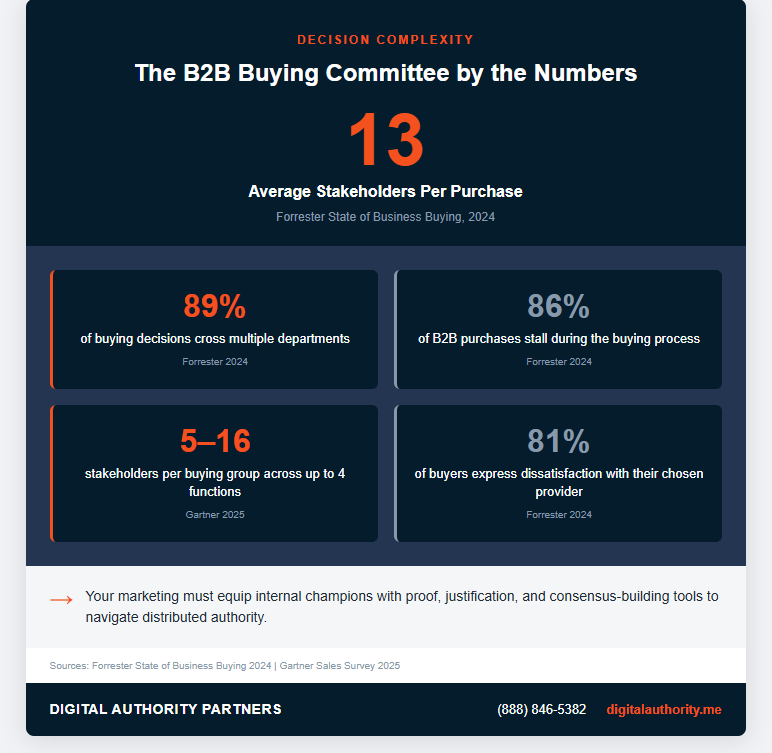
If you sell to businesses, purchasing authority is distributed across multiple stakeholders. Even when one person champions the initiative, the final decision requires alignment from several departments. Finance evaluates cost exposure. Operations assesses implementation impact. IT reviews integration requirements. Leadership considers strategic fit.
Recent research confirms this pattern is growing more complex. According to Forrester’s 2024 State of Business Buying report, the average B2B purchase now involves 13 stakeholders, and nearly 89% of buying decisions cross multiple departments. Gartner’s research shows that buying groups range from five to 16 people across as many as four functions.
That distributed authority changes the role of your marketing. Your messaging cannot simply persuade a single contact. It must hold up in internal discussions, provide clarity strong enough to support a cross-departmental presentation, and give your internal champion the tools to build consensus. When you equip buyers with the right justification materials, you accelerate the approval process rather than waiting for it to play out on its own.
B2B organizations align marketing, sales, and digital channels into a unified growth system, reflecting how structurally different B2B decision environments are from consumer markets.
B2C Authority: Concentrated and Direct
If you market to consumers, decision authority is far more direct. A buyer may read reviews, compare options, or ask friends for recommendations, but the final decision rests with one individual or household. There are fewer formal checkpoints and no procurement process.
Because authority is concentrated, your marketing can prioritize relevance, emotional resonance, and ease of action. The path to conversion is shorter, and your goal is to reduce hesitation and simplify the next step. A strong product page, a compelling social ad, or a well-timed retargeting campaign can move a consumer from consideration to purchase in a single session.
Enablement vs. Acceleration
When authority is distributed, marketing becomes enablement. You equip buyers with arguments, justification, and proof. When authority is concentrated, marketing becomes acceleration. You build familiarity, reduce friction, and drive efficient conversion.
Your strategy only performs when it reflects how decisions are actually approved in your buyer’s environment.
3. Channel Strategy: Where Your Marketing Actually Lives
Channel strategy is where the theoretical differences between B2B and B2C marketing comparison becomes tangible. Choosing the right channels is not just a distribution decision. Your channel selection reflects how buyers prefer to research, evaluate, and move toward a purchase.
B2B Channels Built for Depth and Validation
If you sell to businesses, your channels need to support research, validation, and internal alignment. Your buyers are looking for answers, not inspiration. B2B channels typically prioritize depth and decision support, while B2C channels are built for reach and high-frequency engagement.
Effective B2B channel strategy typically emphasizes high-intent search targeting solution-specific queries, LinkedIn campaigns aimed at defined job titles and industries, webinars and virtual events that educate decision-makers, case studies and white papers that support internal justification, and account-based marketing programs focused on high-value prospects.
These channels create space for technical detail, implementation clarity, and measurable outcomes. Because authority is distributed across multiple stakeholders, your B2B channels must sustain engagement over time. The goal is building confidence across an entire buying group, not just generating a click.
How Do B2C Channels Differ?
If you market to consumers, your channel strategy shifts toward visibility, emotional connection, and ease of action. Your buyers navigate multiple options quickly, and your brand competes for attention in a crowded space.
Effective B2C channel strategy typically emphasizes paid social campaigns designed for rapid reach, influencer and creator partnerships that build credibility, short-form video and visual content that captures attention, retargeting campaigns that reinforce brand recall, and high-volume paid search optimized for transactional intent.
These channels prioritize speed and familiarity. The path to purchase is shorter, and your message must resonate immediately. Where a B2B buyer might engage with your brand over three months before converting, a B2C buyer may see your ad, visit your site, and complete a purchase within the same afternoon.
For consumer brands, partnering with an experienced B2C digital marketing agency can help you optimize this faster cycle by building campaigns specifically designed for direct-response environments.
Choosing the Right Channel Mix
Your channel selection should mirror your buyer’s behavior. That means prioritizing education and enablement in B2B environments, prioritizing emotional clarity and frictionless conversion in B2C, aligning content depth with evaluation complexity, and matching campaign cadence to decision timelines. Measure success based on pipeline quality in B2B and conversion velocity in B2C.
The difference between B2B and B2C marketing becomes tangible in channel execution. Where your marketing lives, and how it behaves in those environments, must reflect how your buyers think and decide.
4. How Do B2B and B2C Brands Measure Marketing ROI?
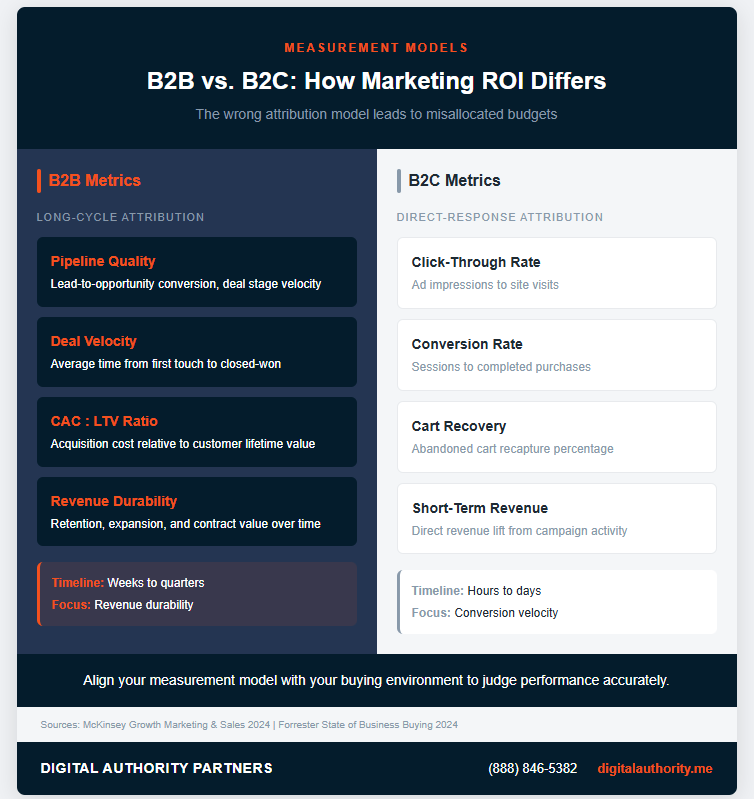
Measurement is where you discover whether your strategy truly fits your operating model. B2B and B2C marketing use fundamentally different attribution frameworks, and applying the wrong model to your business leads to misallocated budgets and inaccurate performance assessments.
B2B Measurement: Pipeline, Revenue, and Long-Term Value
If you operate in a B2B environment, your marketing is measured on pipeline quality, deal velocity, customer acquisition cost relative to lifetime value, and long-term revenue contribution. Attribution models must account for multiple touchpoints, sales team involvement, and extended decision cycles.
A campaign might generate awareness today, nurture interest over two months, and influence a deal that closes next quarter. That complexity makes measurement more demanding. It also makes alignment between your marketing and sales teams essential.
High-performing B2B organizations align marketing metrics with revenue and pipeline outcomes, not just campaign performance. ROI in B2B is about revenue durability, meaning retention, expansion, and contract value over time. Tracking these outcomes through a content analytics framework ensures your team can attribute results accurately across longer decision cycles.
B2C Measurement: Conversion Velocity and Direct Response
If you operate in a B2C environment, your attribution models focus more on direct-response metrics. You measure click-through rates, conversion rates, cart abandonment recovery, and short-term revenue lifts. While lifetime value still matters, the time horizon is shorter and more transactional.
Because buying authority is concentrated and decision cycles move faster, the connection between your marketing action and the purchase outcome is more immediate. Optimization cycles move quickly, and performance media plays a larger role in scaling growth. You can test a new ad creative on Monday and measure its revenue impact by Friday.
B2C lead generation also reflects this faster measurement cycle. Your lead capture strategies, whether through email signups, gated offers, or social campaigns, are optimized for volume and speed rather than the targeted, account-level approach that defines B2B pipeline development.
Why Measurement Differences Shape Your Budget
These attribution differences directly influence how you allocate budget and evaluate campaign effectiveness.
In B2B, your marketing may support fewer but higher-value transactions, with longer payback periods and deeper sales integration. In B2C, your marketing supports higher transaction volume, faster revenue cycles, and more immediate optimization. By aligning your measurement model with your buying environment, you can judge performance accurately and invest with confidence.
5. Content Strategy: Enablement vs. Engagement
Content is the vehicle that carries every other strategic difference into execution. The buyer psychology, decision structure, channel selection, and measurement model you have identified all determine what your content needs to accomplish and how it should be structured.
What Does Effective B2B Content Look Like?
If you market to businesses, your content must serve multiple audiences within a single account. The technical evaluator needs implementation details. The financial decision-maker needs ROI projections. The operational user needs to understand workflow impact. Your content strategy must address all of these perspectives, often within the same campaign.
Effective B2B content tends to be longer, more detailed, and structured around proof. White papers, case studies, comparison guides, and thought leadership articles perform well because they provide the depth that distributed buying groups require. Your content also needs to be shareable within the organization, meaning a VP can forward your white paper to their CFO and it still makes a compelling case.
The emphasis is on education, validation, and internal advocacy. You are not just creating content for the person who finds you. You are creating content that helps that person convince their colleagues. This is another reason why B2B marketing is important at the strategic level: your content directly shapes whether a buying group reaches internal consensus.
What Does Effective B2C Content Look Like?
If you market to consumers, your content strategy prioritizes clarity, emotional impact, and speed. Your buyers make decisions faster, consume content in shorter sessions, and respond to visual storytelling and relatable brand voice more than technical specifications.
Effective B2C content tends to be shorter, more visual, and designed for immediate engagement. Social media posts, short-form video, product demonstrations, user-generated content, and influencer collaborations perform well because they build brand familiarity and drive action quickly.
The emphasis is on resonance and conversion. You are creating content that earns attention in a competitive feed and converts that attention into a purchase. Strong B2C lead generation depends on content that moves fast, connects emotionally, and makes the next step effortless for your buyer.
Aligning Content With Your Business Model
Your content strategy succeeds when it reflects the decision environment your buyers operate in. B2B content functions as enablement, equipping buyers with the tools they need to build internal consensus and justify their investment. B2C content functions as acceleration, building brand connection and reducing the friction between consideration and purchase.
When your content matches the complexity and speed of your buyer’s decision process, every other element of your digital marketing strategy performs more effectively.
Align Your Marketing Strategy With How Your Business Operates
Performance becomes frictionless when strategy aligns with the operating model. If you are evaluating your B2B and B2C digital marketing approach across business and consumer markets, structural clarity at the structural level is the place to start.
Contact Digital Authority Partners to discuss how your marketing strategy can align with your operating model and drive measurable growth across both B2B and B2C environments.
Want To Meet Our Expert Team?
Book a meeting directly here

Related Articles

Demand for therapy is at an all-time high, yet nearly half of the 62 million U.S. adults with a mental illness receiv...


The best health apps turn your phone into a daily tool for tracking habits, managing health conditions, and building ...

A healthcare chatbot gives your patients an always-open front door. It answers a question at midnight, books an appoi...