What Are the Best Ways To Manage Your Local PPC Campaigns?

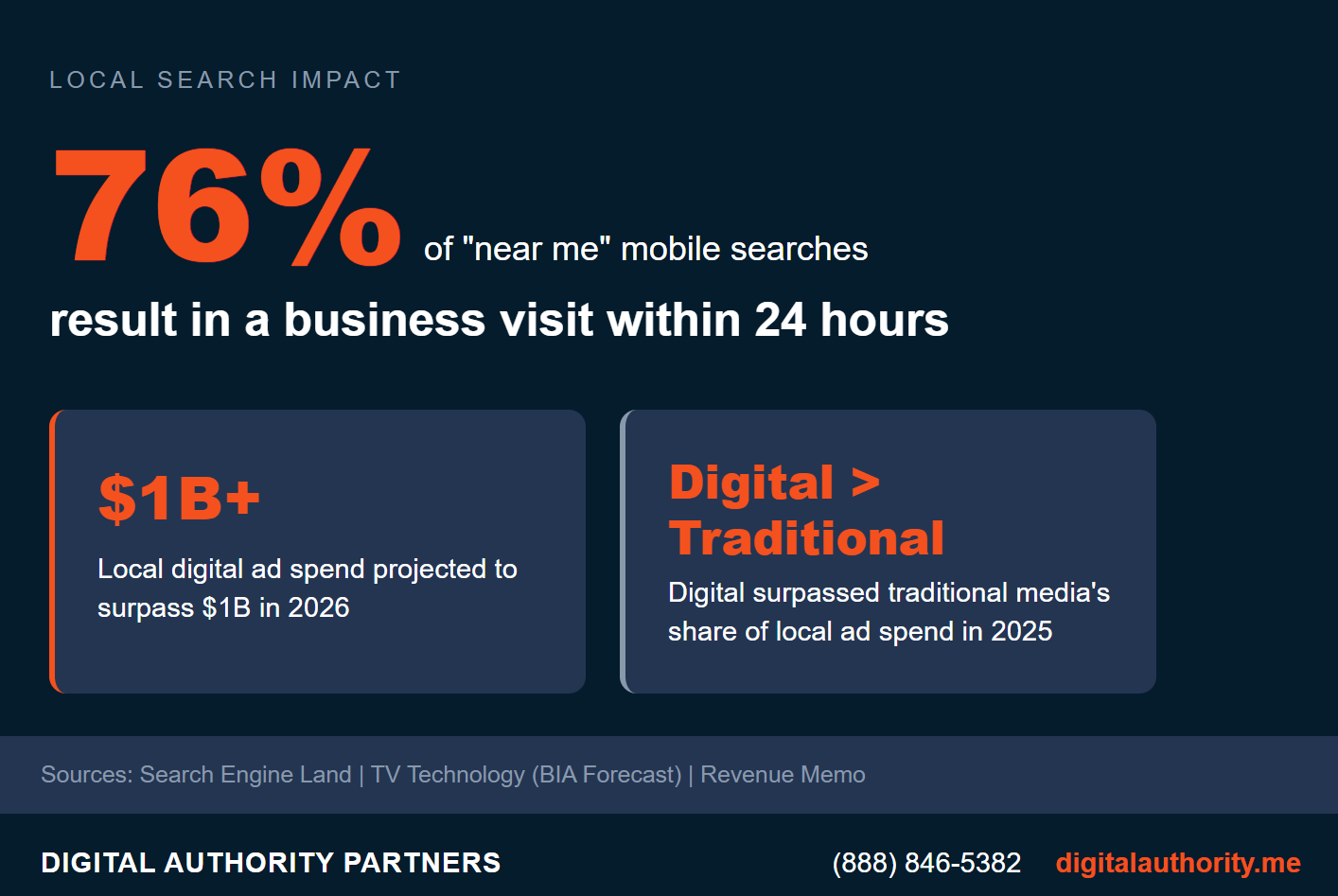
Your customers already search for businesses like yours. With local digital ad spend projected to surpass $1 billion in 2026, every click you pay for must count. Your local business has the opportunity to reach nearby customers the moment they need you, and expert PPC remarketing services can turn customers’ search intent into store visits and booked appointments.
This guide walks you through the strategies that drive stronger local paid search results, from geotargeting and keyword selection to smart bidding, negative keywords, and conversion tracking. Your local neighborhood can become a foundation for lasting growth.
Why Does Local PPC Management Deliver Stronger Results?
Proximity drives results. 76% of “near me” mobile searches result in a business visit within 24 hours. Your small business needs to bridge the gap between ad spend and revenue by capturing demand that already exists in your neighborhood.
Unlike national campaigns, local PPC management focuses your budget on nearby searchers who are already looking for what you offer. Shifting your focus can deliver strong results at your doorstep.
Has the Shift Toward Local Digital Advertising Changed the Game?
The way local businesses compete for attention has changed. Digital channels claimed the majority of local ad spending for the first time in 2025, with digital surpassing traditional media’s share. Paid search opens channels that were previously limited to in-person interactions. A well-managed local PPC campaign lets you:
- Capture high-intent searchers: Reach customers actively looking for your services in your area, often at a lower cost than traditional advertising.
- Engage beyond foot traffic: Connect with your audience through comment sections, message boards, and other digital touchpoints that extend your local presence.
Local searchers expect location-specific results from the moment they type a query, and geotargeted marketing meets that expectation by focusing your budget on the areas where your customers live and search.
Do Geotargeted Campaigns Deliver Higher Returns?
Potential customers searching for “emergency plumber near me” within 5 miles of your shop have far more commercial intent than someone browsing from across the state. That’s where your geotargeted campaign delivers. Local PPC management harnesses this proximity signal to reduce wasted clicks and lift your business’s conversion rates.
Precision lowers your cost per acquisition and raises ad relevance scores, which Google rewards with better positions and lower click costs. Geotargeting puts your ads in front of the right audience. How well those ads perform still comes down to the quality of the campaign behind them.
Build Your Geotargeting and Keyword Foundations
You can control who sees your ads and which searches trigger them with precise location targeting and intentional keyword selection. Both decisions directly shape your cost per lead and the quality of traffic your campaigns attract.
How Do You Select the Right Geographic Parameters?
Your geographic performance data can tell you exactly where your best customers come from. Start with a tight radius around your business and expand only when conversion data supports a wider reach.
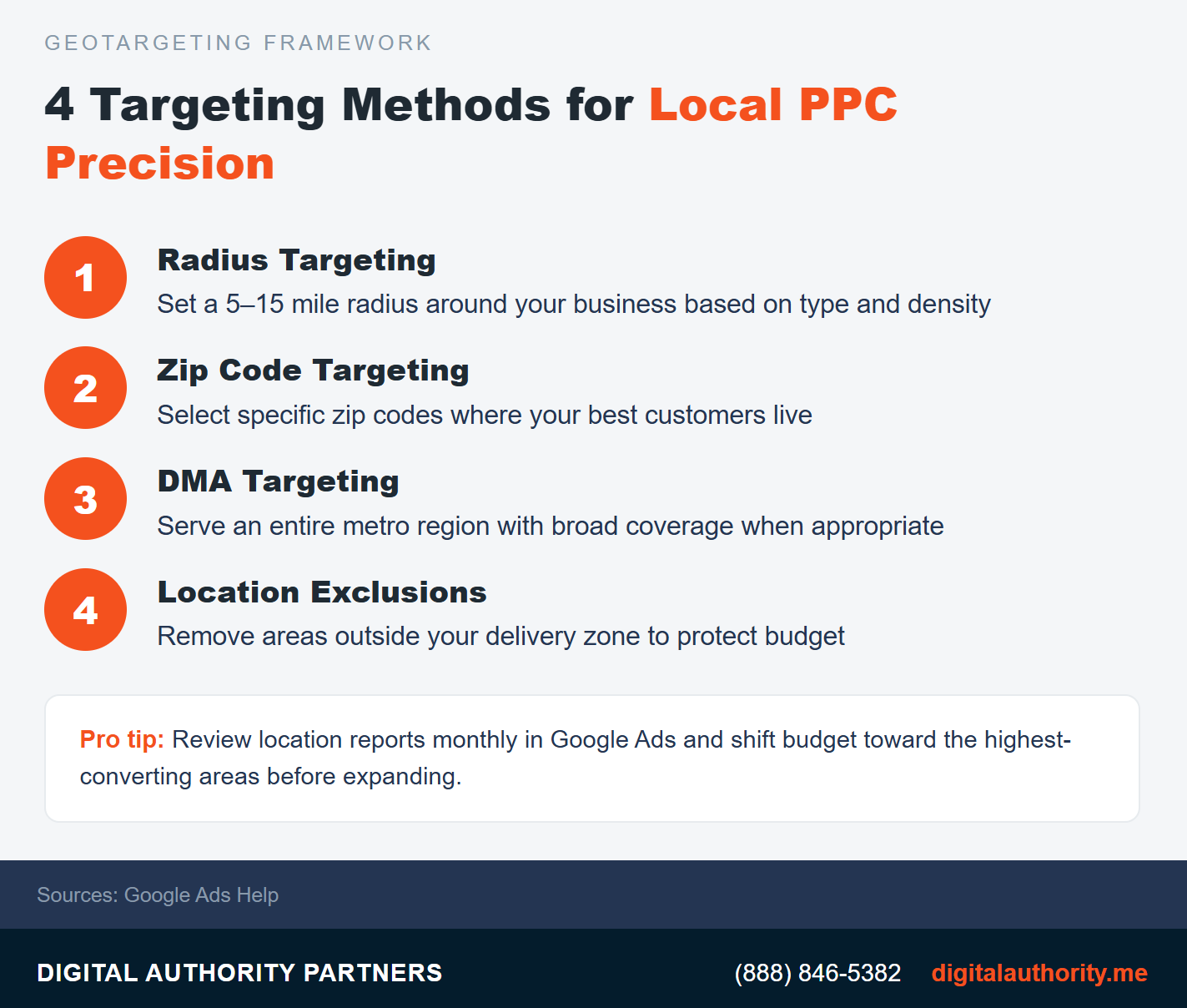
Even a single adjustment can yield immediate improvement. These targeting methods help you define the right boundaries:
- Radius targeting: Set a radius around your physical location or primary service area, typically 5 to 15 miles depending on your business type and population density.
- Zip code targeting: Select specific zip codes where your best customers live, especially when your service area includes noncontiguous neighborhoods or pockets of high demand.
- DMA (Designated Market Area) targeting: Designated market area targeting lets you serve an entire metro region with broad coverage.
- Location exclusions: You should remove areas outside your delivery zone or neighborhood before your budget is exhausted.
Geographic performance changes seasonally and as your business grows. Shift your budget toward the highest-converting areas before expanding your radius, and review your location reports monthly in Google Ads to stay on top of these shifts.
Once you know exactly where your customers come from, that data gives your keyword research a clear starting point. The cities, neighborhoods, and zip codes in your service area become the modifiers that make your search terms locally relevant.
How Do You Develop a High-Intent Local Keyword List?
Your location data shapes every keyword decision. Tools like Google Keyword Planner can filter results to your target service areas, revealing search volume and competition data for each combination.
Because location modifiers do the heavy lifting, pairing this research with your broader digital marketing strategy aligns paid and organic keyword targets. You can build your local keyword list around these three categories:
- Service plus location modifiers: Pair your primary offering with specific city names or neighborhoods, such as “roof repair in Lakeview” or “family dentist in Austin.”
- Near me and proximity terms: Add “near me” to your top service keywords to match the growing volume of proximity-based local searches.
- Long-tail problem phrases: Target specific customer problems tied to your location, such as “same-day AC repair downtown Chicago,” to reach searchers with urgent, high-value needs.
Refresh your keyword list quarterly by reviewing search term reports in Google Ads. New high-performing queries surface regularly and can open short-term opportunities in your local market. Checking competition data for each term helps you prioritize the keywords where your budget will have the most impact.
How Smart Bidding Strategies Can Maximize Local Budgets
Smart bidding has become central to local PPC management in 2026. Automated bid strategies use machine learning to set precise bids at every auction, factoring in device type, time of day, location, and dozens of other signals to maximize your results. Choosing the right bidding model, pacing your budget, and scheduling ads for peak hours all play a critical role.
How Do You Choose the Best Automated Bidding Model?
Over 80% of advertisers now use automated bidding. Selecting the right automated bidding model depends on your strategy. New campaigns without conversion history perform best by focusing on conversions, which pushes for the highest volume within your daily budget while building the data foundation you need.
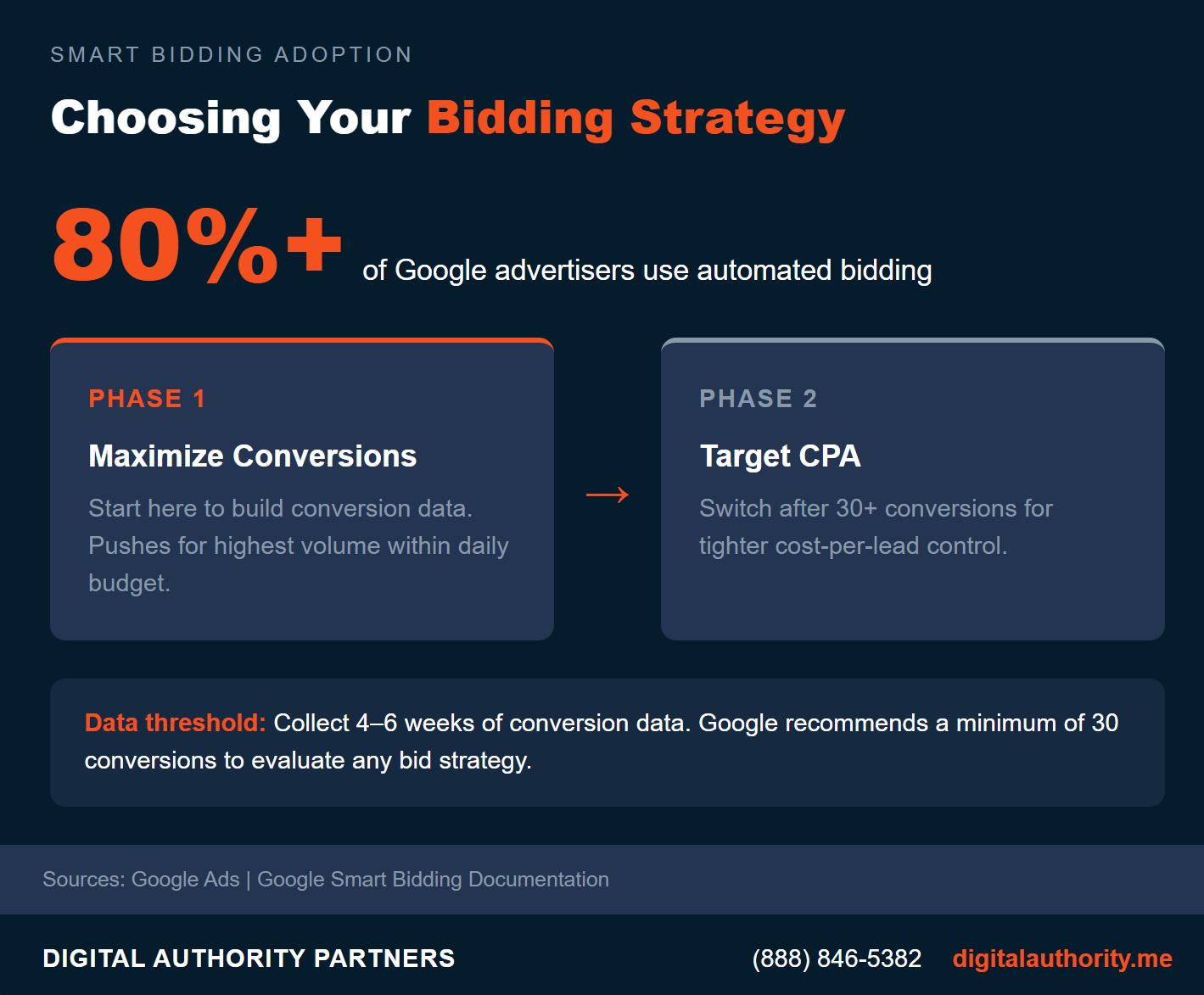
Collect at least four to six weeks of conversion data before adjusting your ad schedule bids. Google’s Smart Bidding documentation recommends a minimum of 30 conversions to evaluate any bid strategy reliably, and many practitioners suggest 50 or more for confidence. You can then switch to Target Cost Per Acquisition (Target CPA) bidding for tighter cost-per-lead control. This shift gives the algorithm enough conversion data to optimize bids around your actual cost targets rather than simply chasing volume.
Once the learning phase concludes, the algorithm adjusts your bids at each auction more quickly and accurately. This automated precision is what makes smart bidding essential for your local paid search campaigns.
How Do You Pace and Allocate a Local Ad Budget?
Allocating your budget correctly prevents overspending early in the month and underdelivering later. Small business PPC management works best when you start with a realistic monthly investment. It’s important to reserve room for testing, but ensure your top-performing campaigns receive the majority:
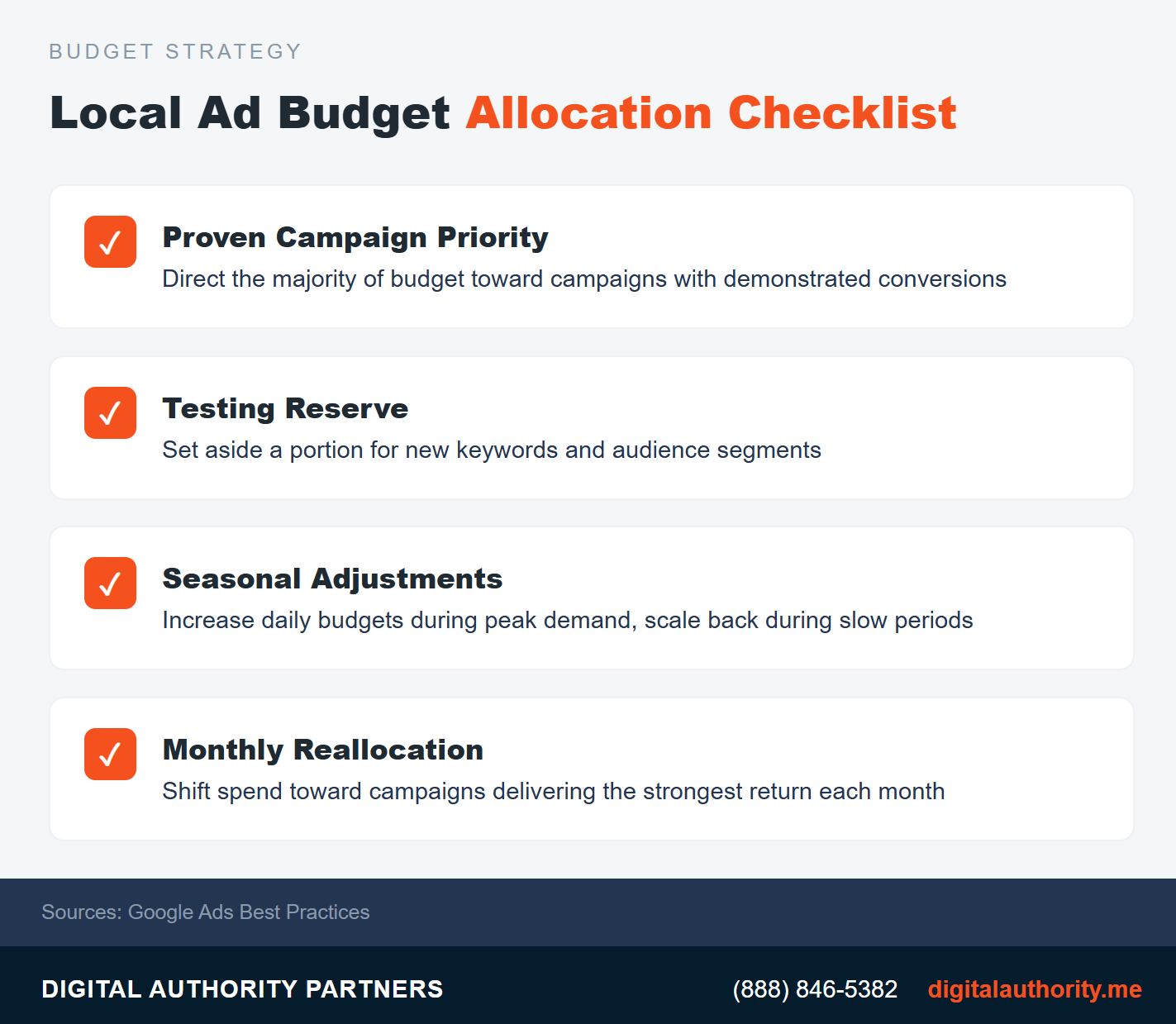
- Proven campaign priority: Direct the majority of your budget toward campaigns and keywords with demonstrated conversion performance.
- Testing reserve: Reserve a portion for experimenting with new keywords and audience segments that could become your next top performers.
- Seasonal budget adjustments: Increase daily budgets during peak demand periods for your industry and scale back during known slow periods.
Review your budget allocation monthly and shift spend toward the campaigns delivering the strongest return. Small, consistent adjustments keep your ad spend aligned with real performance data rather than assumptions.
How Does Dayparting Help You Target Peak Local Hours?
Dayparting schedules your ads to appear during the hours and days when your customers are most likely to convert. Your customers don’t stop shopping when you close your doors.
A restaurant might see booking searches spike between 4 and 7 p.m., while a home services company gets the most calls between 8 and 10 a.m. on weekdays. Understanding your specific patterns lets you concentrate your budget on the hours that generate actual leads.
Your best leads follow a pattern. Google Ads day and hour reports make the pattern visible, showing when visits turn into calls, clicks turn into bookings, and intent turns into revenue. For most service businesses, those moments cluster around working hours, when teams are ready to respond and close the opportunity.
Lean into these peaks and ease back when demand softens. That shift keeps your budget focused on what produces real results.
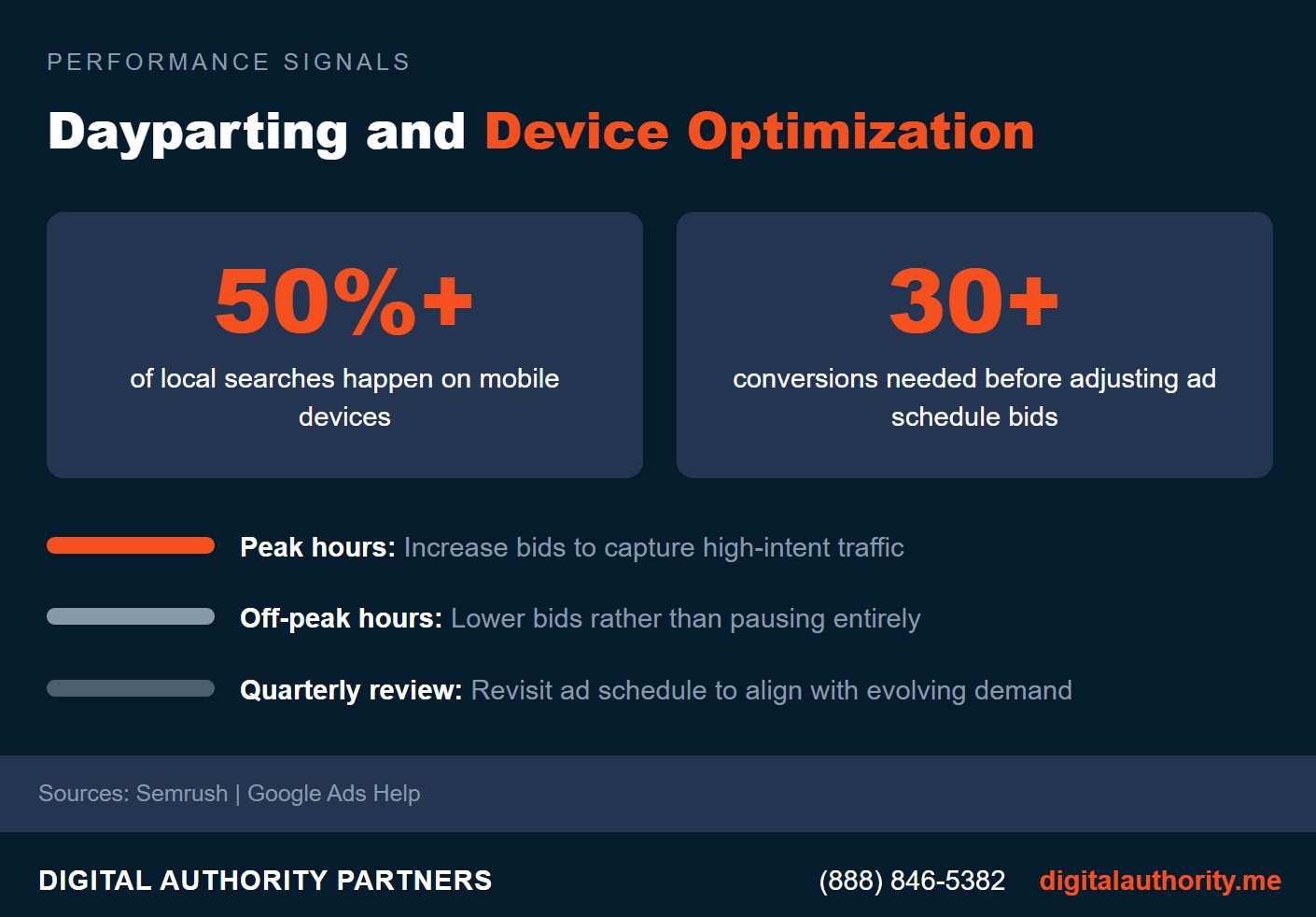
- Pinpoint high-conversion windows: You need at least 30 conversions before you start adjusting bids. Google’s smart bidding strategies require this minimum data threshold to optimize bidding effectively, and many experts recommend reaching 45 to 60 conversions for more reliable patterns.
- Increase bids during top-performing hours: Raising your ad schedule bid adjustments during your highest-converting time blocks makes your ads more competitive in those auctions, helping you capture a larger share of available traffic.
- Scale bids down during slower periods: Lower your bids during overnight and low-intent hours rather than pausing entirely.
- Review and refine keywords: Revisit your ad schedule every quarter to align bid adjustments with evolving demand patterns and seasonal trends.
Localized PPC performance improves significantly when your ad schedule is working. Those patterns play out across every device and platform your customers use, from desktop browsers to mobile apps.
How Do Device and Audience Bid Adjustments Improve Performance?
The modern consumer doesn’t wait until they get home to search for your product. Over 50% of local searches happen on mobile devices, making mobile bid adjustments essential. Google Ads lets you set separate bid multipliers for mobile, tablet, and desktop, so you can target the platform your audience uses.
Your bid adjustments work alongside smart bidding as complementary PPC strategies. Google lets you add an in-market audience for your service category, helping you use smart bidding to prioritize users actively searching for your service.
Each layer gives the algorithm more to work with. Consider hiring a qualified PPC agency if audience layering and device optimization require more time than what you have available. Top marketing agencies offer the advantage of local PPC without the learning curve.
Combine your device and audience signals with your geographic targeting to create a layered local PPC management approach for your business. Knowing which keywords attract your best customers is only half the equation. The other half is knowing which ones waste your budget.
Do Negative Keywords Reduce Wasted Local PPC Ad Spend?
Negative keywords help you filter out searches that look relevant but are unlikely to convert. By excluding terms tied to job seekers, DIY researchers, and bargain hunters, you keep your ad spend focused on the searchers most likely to become customers.
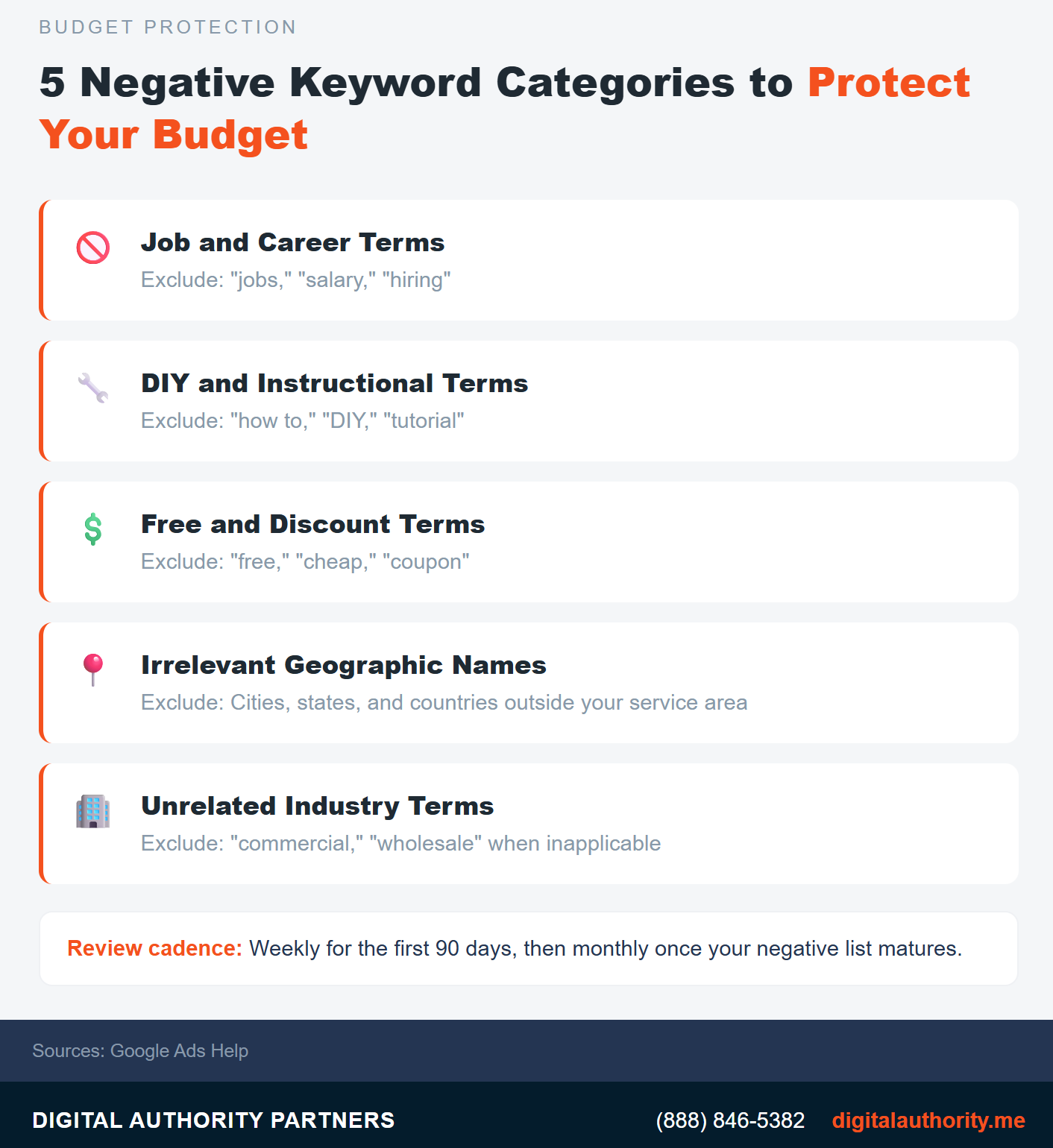
Google’s guide to negative keywords explains how these exclusions protect your budget from low-intent clicks. The following five categories represent the most common sources:
- Job and career terms: Exclude words such as “jobs,” “salary,” and “hiring” to prevent your ads from showing to job seekers.
- DIY and instructional terms: Block “how to,” “DIY,” “tutorial,” and “training” to filter out searchers looking for self-help content.
- Free and discount terms: Filter out “free,” “cheap,” “coupon,” and “discount” to focus your budget on searchers willing to pay for your services.
Irrelevant geographic names: City, state, and country names outside your service area use clicks meant for your location.
- Unrelated industry terms: Exclude keywords from adjacent industries, such as “commercial” for a residential-only business or “wholesale” for a retail-only shop.
Review your search term report weekly during the first 90 days of a new campaign. Once your negative list matures, you can shift to monthly reviews. Knowing which keywords drive conversions and which ones drain budget gives your broader digital strategy a sharper foundation.
How Does Local PPC Connect With SEO, Content, and GEO?
PPC keyword data provides you with a real-time window into what your local customers search. You can bridge your SEO and PPC by serving targeted ads to visitors who found your site through organic search but left without converting. A multi-channel approach to local PPC management creates a full-funnel system that nurtures prospects from first click to final sale. These strategies help you connect your paid and organic efforts:
- Use conversion data from paid campaigns to identify which keywords deserve SEO priority for long-term organic investment.
- Apply your best-performing PPC headlines to blog posts, landing pages, and other assets.
- Build remarketing audiences from your organic traffic and serve tailored PPC ads that bring those visitors back.
- Align your PPC and SEO keyword strategy with generative engine optimization practices to appear in AI-generated search results.
A unified strategy across your paid, organic, content, and generative engine optimization gives your local business the widest possible reach. If you want strong returns, each channel should reinforce the others. This compounding effect lowers your overall cost of customer acquisition over time.
Strengthen Your Local PPC Campaigns To Reach More Customers
Reaching your local audience at the right moment in search helps you grow faster and convert more consistently. A strong local PPC management strategy brings together geotargeting, smart bidding, negative keywords, and optimized landing pages into a system that compounds results over time. When you pair paid search with SEO and content, every channel reinforces the others.
Start turning your ad clicks into loyal customers. Contact a marketing specialist at Digital Authority Partners for a free consultation and let our team build a local PPC strategy tailored to your market.
Want To Meet Our Expert Team?
Book a meeting directly here

Related Articles

Demand for therapy is at an all-time high, yet nearly half of the 62 million U.S. adults with a mental illness receiv...


The best health apps turn your phone into a daily tool for tracking habits, managing health conditions, and building ...

A healthcare chatbot gives your patients an always-open front door. It answers a question at midnight, books an appoi...