Business to Consumer (B2C) Marketing: Ultimate Guide

Business-to-consumer marketing in 2026 is about more than running ads, posting on social, or chasing trends. Building a strategy that scales requires expert digital marketing services built around how your customers actually buy.
Consumer expectations have raised the bar across every touchpoint. Buyers today research faster, compare more readily, and make decisions based on trust as much as price. The brands keeping up are the ones operating with a clear, connected strategy.
In this guide, we break down what modern B2C marketing looks like and how to build a strategy that scales, while still being mindful of budget.
What Is Business-to-Consumer (B2C) Marketing?
Traditionally, business-to-consumer marketing is the process of selling directly to individuals making buying decisions. In 2026, that definition is a starting point rather than a complete picture.
Modern B2C marketing is about understanding how people discover, evaluate, and choose brands when attention is scarce and options are everywhere. Today’s purchase journey is varied. A customer might encounter your brand three times across different channels before they feel confident enough to buy.
When you evaluate what business-to-consumer marketing is today, the better answer is the ability to show up at the right moment, with the right message, in the right format, so the customer’s decisions feel easy.
Whether you’re running a B2C ecommerce brand, a consumer service business, or a subscription product, the goal is the same. Attract the right buyers and give them a reason to come back. Buyers today are more value-conscious, digitally fluent, and selective than ever, persuading brands to rethink how they attract and retain customers.
The brands that succeed understand their customers deeply and build systems around that knowledge.
B2C vs B2B Marketing: What Really Sets Them Apart
At a glance, B2C and B2B marketing can look similar. They use search, social, email, paid media, and content. Both care about conversion and measure performance. But the psychology and pace behind the buying decisions are very different.
Buying Cycle: Speed Versus Structure
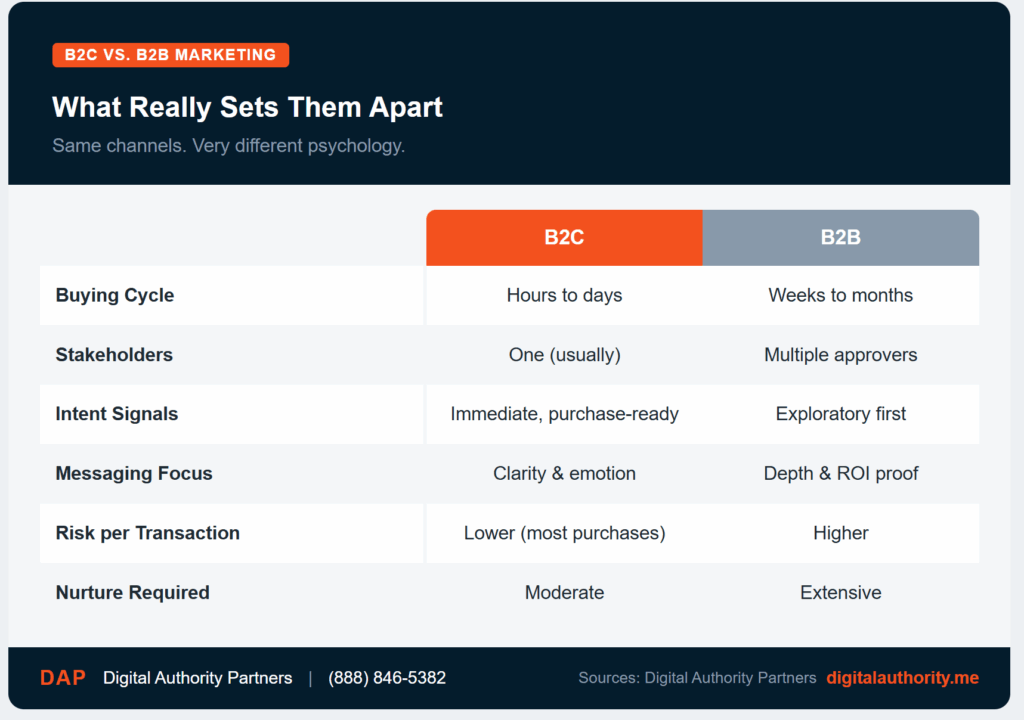
Buying decisions are often made quickly in B2C marketing. A consumer might discover a product, compare options, and purchase within hours. The stakes per transaction are often lower, which makes decisions faster and more intuitive.
There are, however, some high-ticket B2C purchases, like cars, home renovations, luxury goods, elective medical procedures, that involve extended research cycles and significant financial stakes.
The buying cycle is typically longer and more layered in B2B marketing. Multiple stakeholders are involved, and budget approvals matter. Risk tolerance is also lower, and the process is structured. This difference shapes everything from messaging to channel mix.
Intent Signals: Immediate vs Investigative
B2C buyers send strong intent signals. Searches like “best noise-cancelling headphones under $200” or “same-day flower delivery” tell you exactly where someone is in the decision process. B2B intent is frequently exploratory at first, signaling research, though high-intent B2B searches do exist. Because of these different intentions, B2C marketing often focuses on capturing and converting demand quickly, while B2B marketing invests heavily in nurturing and education over time.
Messaging: Clarity Versus Depth
B2C messaging needs to be clear, concise, and compelling. Benefits must be easy to understand immediately, and the value proposition should feel obvious. That does not mean it lacks sophistication, rather, that friction must be minimal. B2B messaging, by contrast, can often afford to go deeper. It often requires proof points, and ROI justification because the financial and operational impact is greater.
Measurement: Volume Versus Lifecycle Economics
In B2C, measurement centers on transaction efficiency and long-term customer value:
- Conversion rate: The percentage of visitors or leads that complete a purchase.
- Cost per acquisition (CPA): What it costs to win each new customer.
- Repeat purchase rate: How often customers return to buy again.
- Customer lifetime value (LTV): The total revenue a customer generates over time.
- Contribution margin: Revenue minus variable costs, revealing true per-unit profitability.
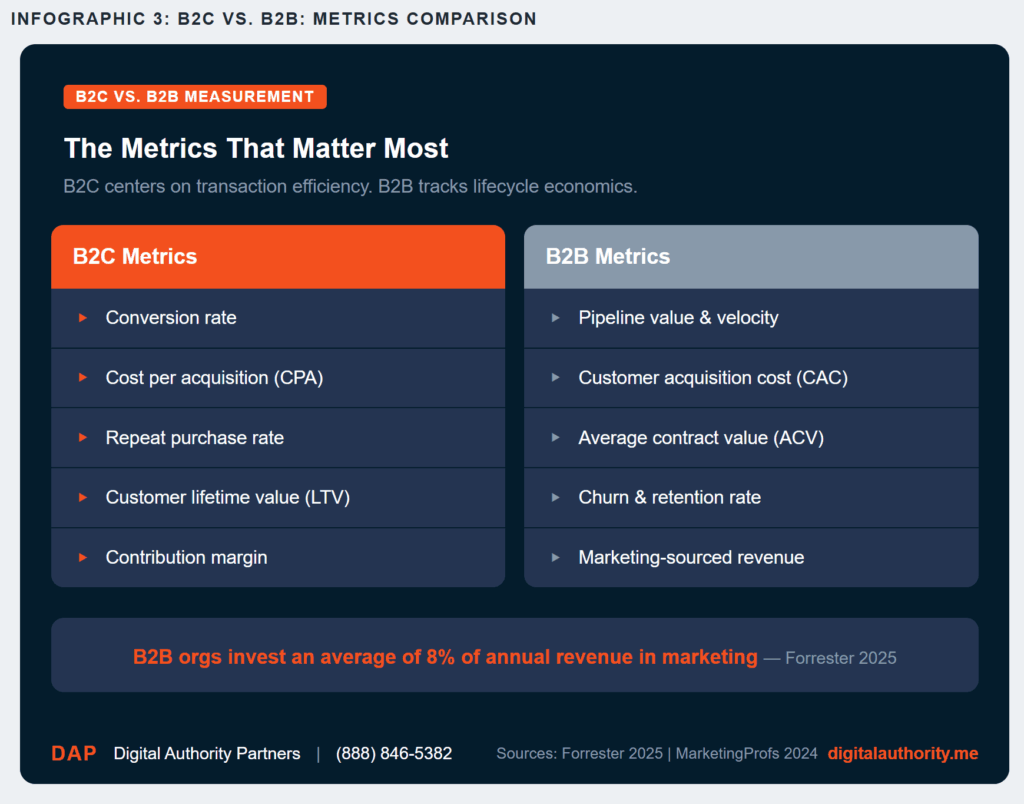
Volume matters in B2C, but profitability across the customer lifecycle matters more. In B2B, measurement reflects longer sales cycles, higher deal values, and relationship-driven growth. B2B organizations invest an average of 8% of annual revenue in marketing, a figure that only makes sense when measurement is tied directly to pipeline and revenue outcomes:
- Pipeline value and velocity: The total value of active deals and how quickly they move through stages.
- Customer acquisition cost (CAC): Typically higher than B2C due to extended sales cycles and multi-stakeholder involvement.
- Average contract value (ACV): The annualized value of a contract, used to assess deal quality.
- Churn and retention rate: The percentage of customers or revenue retained over a given period.
- Sales cycle length: A core efficiency metric that reflects how streamlined the path from lead to close is.
- Marketing-sourced revenue: The share of closed deals that originated from marketing activity, and a metric that is increasingly central to how B2B teams demonstrate ROI.
In B2B, the goal is predictable, high-value revenue from accounts that stay and grow.
The Role of Emotion in B2C
One of the most persistent myths in marketing is that B2C decisions are emotional while B2B decisions are logical. In practice, both involve emotion and logic. The difference lies in how those forces show up and what triggers them.
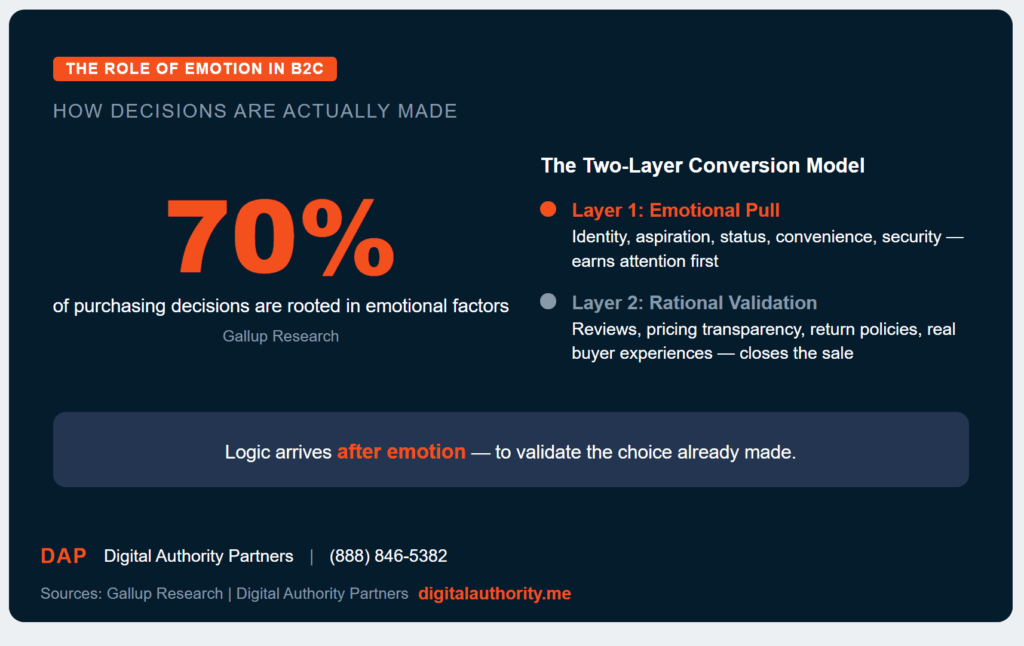
In B2C, emotion drives initial interest. Identity, aspiration, status, convenience, and security all factor into how a consumer perceives a brand before any rational evaluation begins. Gallup research found that roughly 70% of purchasing decisions are rooted in emotional factors, with logic arriving later to validate the choice.
But emotional resonance alone no longer closes the sale. Consumers arrive at purchase decisions with higher expectations than ever, and they expect brands to back feeling with evidence.
Verified reviews, transparent pricing, clear return policies, and real experiences from people like them, these are the signals buyers look for before committing. When those signals are absent or buried, trust weakens and buyers move on without announcing why.
The brands that convert consistently are the ones that do both well. Your messaging earns attention through emotional connection. Your product pages, reviews, and policies make the rational case that the emotional pull was justified. When those two layers work together, conversion improves and customers return.
How Consumer Behavior Has Changed in the Digital Era
Consumer behavior has shifted in ways that reward brands that provide convenience and speed. Buyers today research more thoroughly and make decisions across more touchpoints than before. Understanding where those shifts are happening is the starting point for any B2C strategy worth building.
Attention Follows Multiple Channels
Your customer’s path to purchase rarely runs in a straight line. They might discover your product through a short-form video, search for it later on Google, check reviews on a third-party site, and only commit after reading a few testimonials from real buyers.
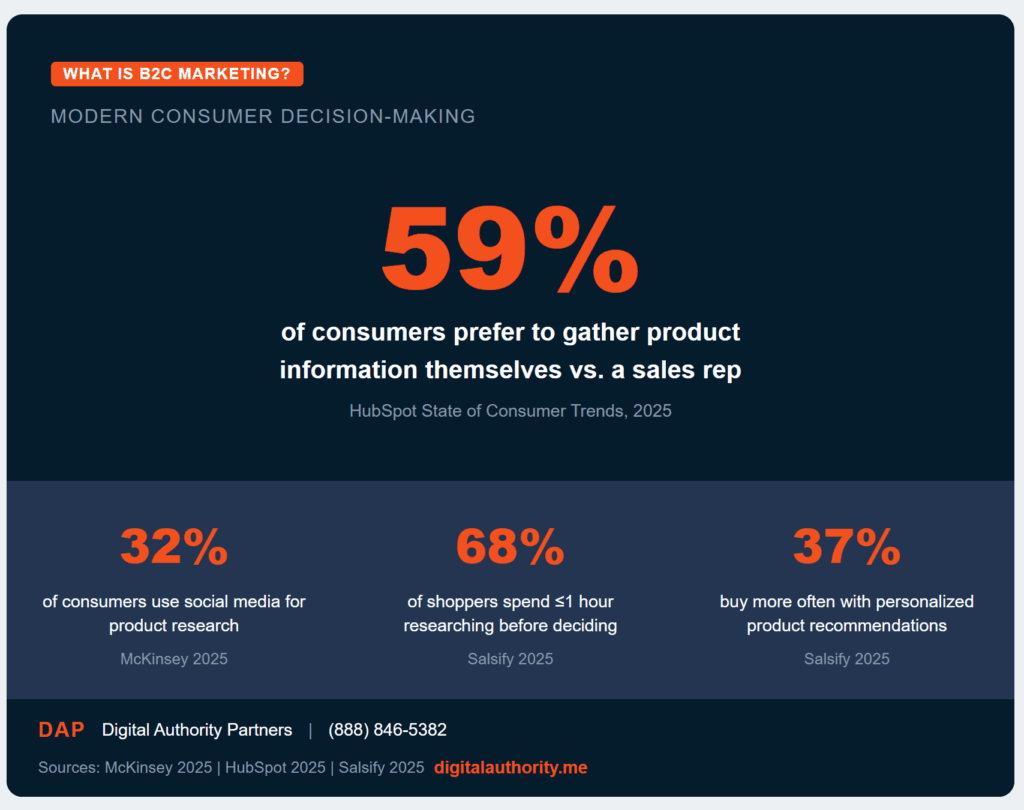
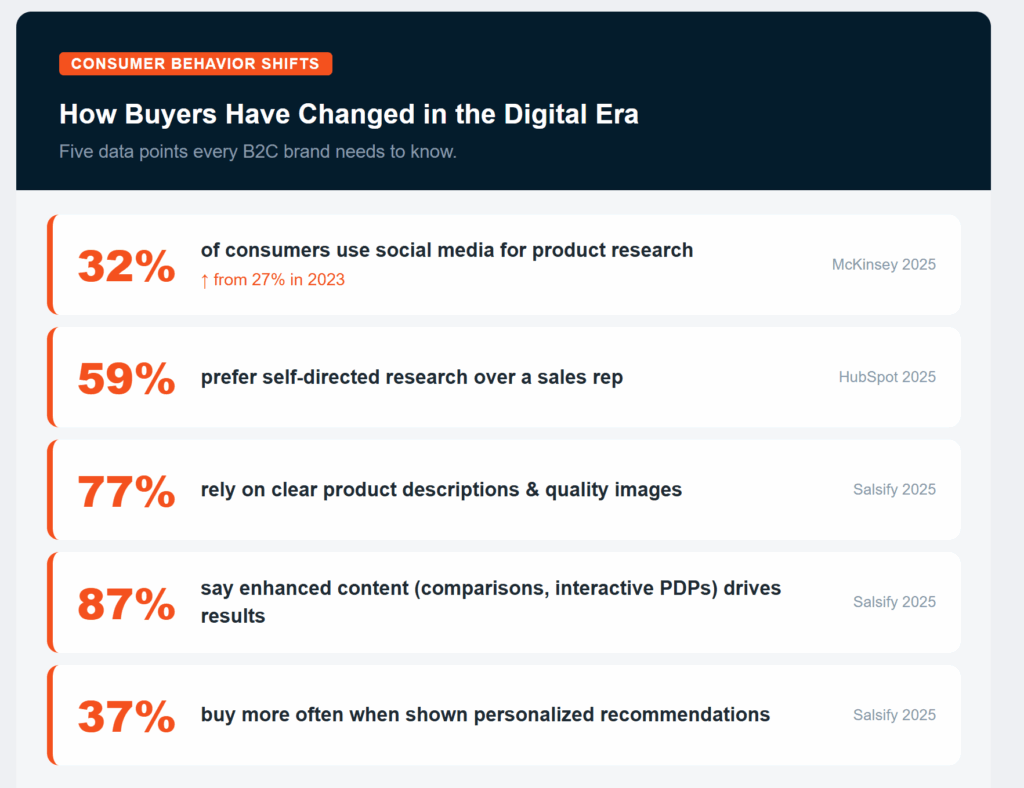
According to McKinsey’s 2025 State of Consumer report, social media use for product research has grown to 32% of consumers on average, up from 27% in 2023. With discovery happening across so many surfaces, brand consistency across channels is no longer optional. Trust builds naturally when your messaging and visual identity feel cohesive across platforms. Buyers also notice when your brand feels disconnected from one platform to the next.
Comparison Is Part of the Process
Most consumers do their homework before committing to a purchase. They compare pricing, scan reviews, check return policies, and evaluate competitors, often within a single session. HubSpot’s 2025 State of Consumer Trends report found that 59% of consumers prefer to gather product information themselves rather than engaging with a sales representative.
That means your product pages, FAQs, and supporting content carry much of the persuasion work. Brands that make it easy to find answers and compare options give buyers the confidence to move forward. Those that make the process harder simply lose the sale to a competitor who made it easier.
Trust Signals Drive Conversion
Consumers are willing to buy, and they want to feel good about it. Verified reviews, transparent pricing, clear return policies, and visible guarantees all reduce the perceived risk of a purchase. Salsify’s 2025 Ecommerce Pulse Report found that 77% of shoppers rely on clear product descriptions and high-quality images when making purchase decisions, and that enhanced content like comparison features and interactive product detail drives results for 87% of shoppers.
Convenience Shapes the Experience
Speed and simplicity have become baseline expectations. Buyers want fast page loads, smooth checkout flows, and mobile-optimized experiences that work without friction. According to the same Salsify research, 68% of shoppers spend an hour or less researching a product before deciding.
Buyers move to the next option rather than working through the difficulty when an experience feels slow or complicated. Removing friction at every stage of the purchase, from landing page to confirmation screen, directly improves conversion and reduces abandonment.
Personalization Builds Loyalty
Consumers now expect brands to recognize them. Relevant product recommendations, timely follow-ups after a browse session, and acknowledgment of past purchases all signal that a brand is paying attention.
37% of shoppers say personalized product recommendations encourage them to buy more often, and more than a third are willing to share personal data in exchange for a more tailored experience. Personalization does not require complex infrastructure to start. Even basic segmentation and behavioral triggers can meaningfully improve engagement and repeat purchase rates.
Taken together, these shifts point to one clear direction for modern business-to-consumer marketing. Campaigns that treat each channel in isolation leave too much on the table. The brands gaining ground are the ones that show up consistently, make the buying process easy, and give customers a reason to return. That understanding shapes everything from funnel design to channel selection to budget allocation.
How the Modern B2C Funnel Works
The traditional funnel assumes buyers move in one direction, from awareness into consideration, then into a purchase. That model made sense when consumers had fewer options and less information. Today’s purchase journey works differently.
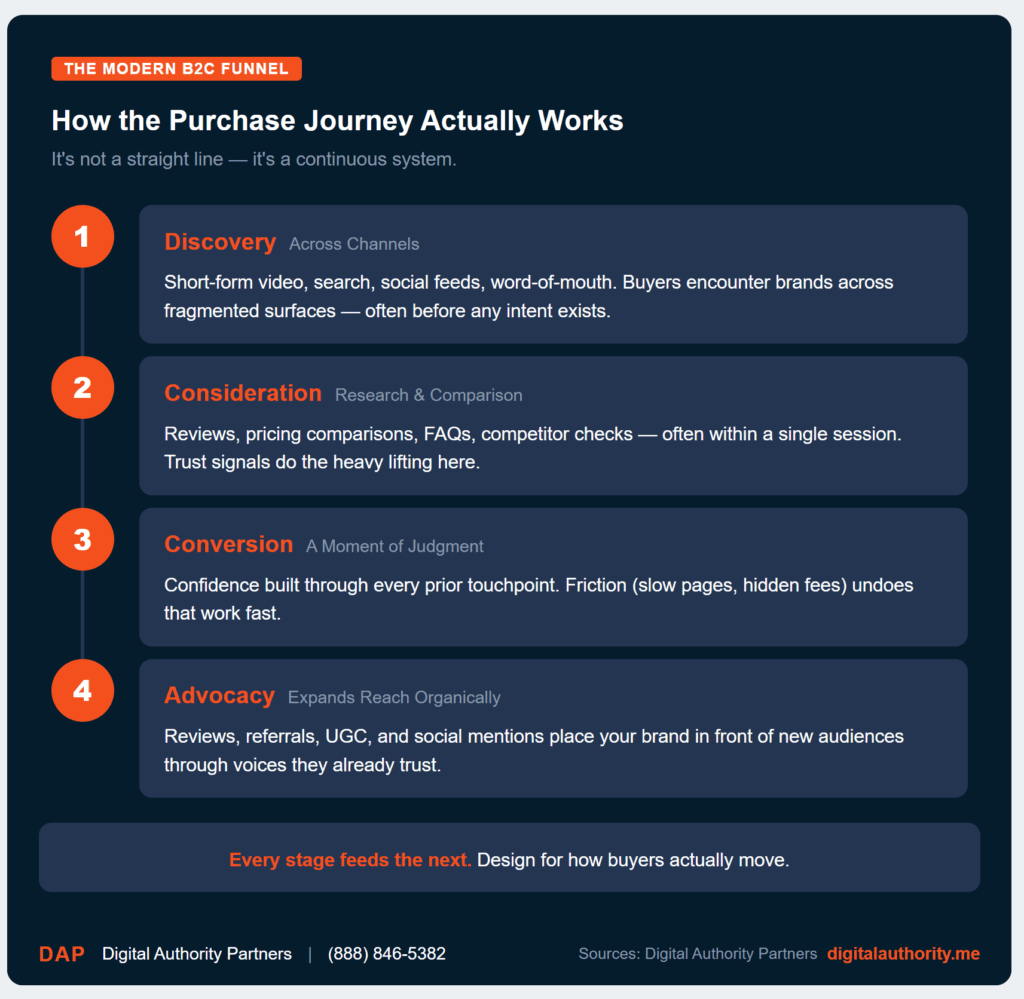
A B2C buyer might find your brand through a short-form video, search for it the following evening, forget about it for a week, see a retargeting ad, check reviews, compare prices on their phone, and finally purchase after reading one reassuring testimonial. No single channel drove that decision. Every touchpoint played a role.
Discovery Happens Across Channels
Buyers no longer enter a structured funnel. They encounter brands across a fragmented mix of platforms, search results, social feeds, and word-of-mouth recommendations. A brand that shows up in only one place will be invisible when a buyer is ready to act somewhere else. Broad, consistent visibility is what keeps you in consideration throughout a buyer’s journey, wherever that journey takes them.
Conversion Is a Decision, Not a Destination
Conversion is often treated as the goal of the funnel. For the buyer, it is a moment of judgment. They are deciding whether they feel confident enough to move forward. That confidence is built long before the checkout page through every piece of content and every interaction they have had with your brand.
Friction at the conversion stage, whether it is a cluttered checkout, hidden fees, or slow page load, undoes that work quickly. Removing that friction is one of the highest-return investments a B2C brand can make.
Advocacy Expands Your Reach Without Expanding Your Budget
Satisfied customers generate growth that paid media cannot fully replicate. Reviews, referrals, user-generated content, and organic social mentions put your brand in front of new audiences through voices those audiences already trust.
Word-of-mouth has always influenced purchasing decisions, but in a digital environment where recommendations surface instantly and publicly, its impact is compounded. Your most effective marketing asset is a customer who had a great experience and wants to talk about it.
The B2C funnel is not a straight line and it is not a closed loop. It is a continuous system where every stage feeds the next. When you design your marketing around how buyers actually move, results build on each other over time. The next step is knowing which channels drive results at each stage.
What Are the Core B2C Marketing Channels?
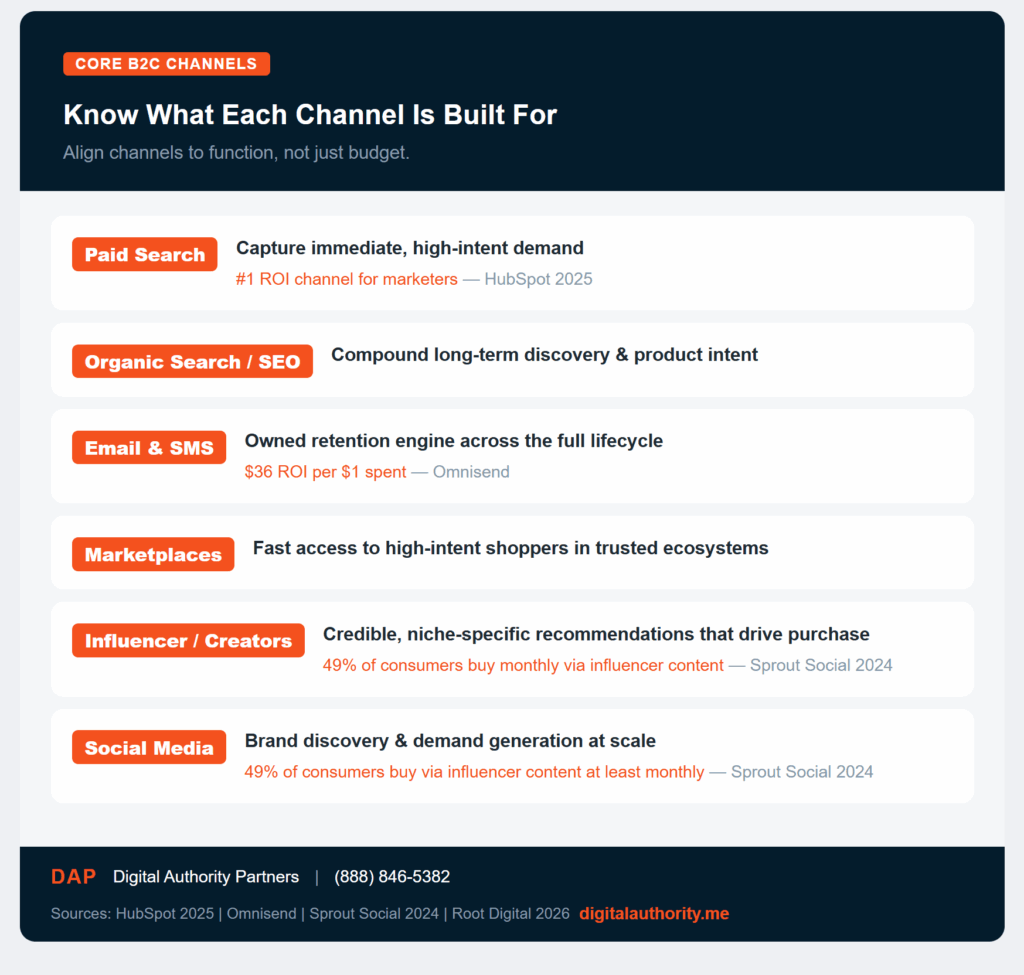
Effective business-to-consumer marketing is about knowing which channels capture intent, which build demand, which generate interest, and which turn interest into revenue. Each channel serves a distinct function, and they can fulfil their roles well when you align them around a shared strategy.
Paid and Organic Search
Search is where intent becomes visible. When someone types “best running shoes for flat feet” or “same-day florist near me,” they are telling you exactly where they are in the decision process. In B2C marketing, that intent is often close to purchase.
Paid search lets you appear immediately for high-intent queries. You bid on keywords and pay when someone clicks. It is particularly effective for:
- Seasonal promotions and limited-time offers
- New product launches that need fast visibility
- Urgent purchase needs where timing drives conversion
- Rapid creative testing across audiences and messaging angles
Organic search takes longer to build but compounds over time. Strong B2C SEO earns rankings for the keywords your buyers use when comparing options and looking for local products or services.
Content aligned with product and category pages turns research traffic directly into purchase intent. According to the HubSpot State of Marketing Report 2025, website, blog, and SEO efforts rank as the top ROI-generating channel for marketers, ahead of paid social and content marketing.
Email and SMS
Email and SMS are owned channels, which means you control everything from the list to timing. That ownership makes them uniquely valuable in a B2C system built around retention.
Email generates an average return of $36 for every $1 spent, making it one of the highest-ROI channels available to B2C marketers. SMS performs well alongside it for time-sensitive communications. Together, they support the full customer lifecycle:
- Welcome sequences that set expectations and build early loyalty
- Abandoned cart recovery that brings buyers back before they move on
- Post-purchase follow-up that strengthens satisfaction and encourages repeat visits
- Replenishment reminders, loyalty campaigns, and winback flows for lapsed buyers
When these sequences are automated and behavior-triggered, they work continuously in the background to improve repeat purchase rates without adding media spend.
Marketplaces and Retail Media
For ecommerce brands, marketplaces like Amazon and Walmart Marketplace offer immediate access to high-intent shoppers in ecosystems they already trust. Retail media networks extend that reach further by letting you target buyers who are actively browsing related product categories.
The advantages are real. Built-in buyer intent, platform credibility, and fast exposure to large audiences can accelerate sales, especially for newer brands still building direct traffic. The tradeoff is limited control over customer data and brand presentation. Marketplaces work best as one part of a diversified B2C channel mix, not as a standalone growth strategy.
Creators and Influencer Marketing
Influencer marketing has shifted from a follower-count game to a credibility and fit model. Partnerships with creators who have established trust within a specific niche deliver something traditional advertising cannot, a recommendation that feels personal.
The numbers reflect this. One survey found that a staggering 49% of consumers make purchases because of influencer content at least once a month. Another survey showed that 77% of consumers favor creator content over professionally scripted ads.
The brands seeing the strongest results from this channel are not running one-off sponsored posts. They are building ongoing partnerships with creators whose audiences already align with their ideal buyer.
B2C Marketing Strategies That Scale
Scaling in B2C marketing is rarely about doing more. It is about doing the right things in the right order and aligning them into a cohesive system. If you invest heavily in channels before solidifying your positioning, offer structure, or retention mechanics, performance will plateau quickly and acquisition costs will climb. Sustainable growth comes from strategic alignment across your full customer journey.
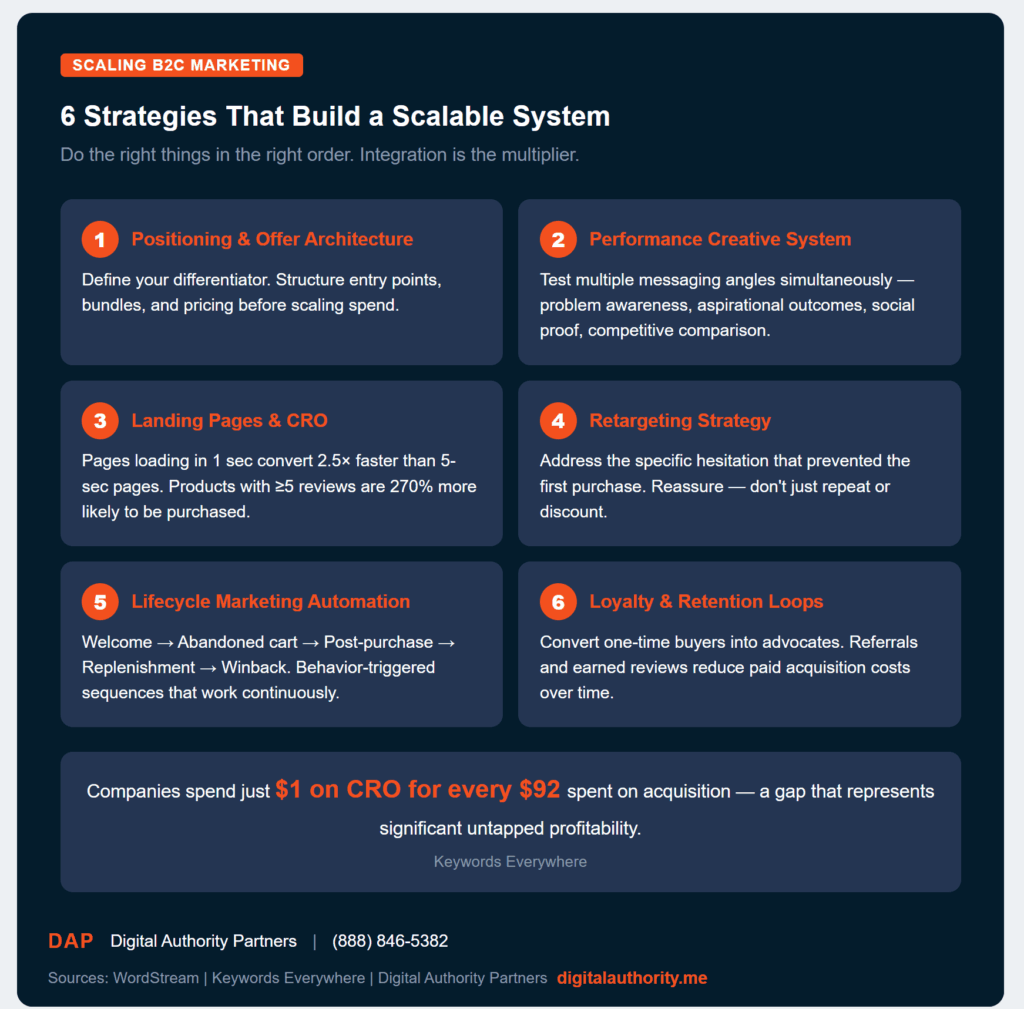
Positioning and Offer Architecture
Your positioning needs to be clear and defensible before you increase paid budgets or expand into new channels. In competitive B2C markets, differentiation rarely comes from features alone. It comes from how clearly you communicate value and how effectively you remove uncertainty from the buying decision.
Offer architecture plays a central role in positioning, and you can do the following to prioritize it:
- Structure your offers with intention
- Create logical entry points for first-time buyers
- Design bundles that increase average order value
- Present pricing in a way that feels transparent and justified
Your guarantees, return policies, and delivery expectations are not secondary considerations. They are strategic levers that directly reduce purchase friction. You can see conversion rates improve, before you even add a single dollar of additional traffic spend, when your positioning is sharp.
Performance Creative System
Creative performance has a direct impact on your cost efficiency. Your audience sees a high volume of content every day, which means creative fatigue sets in faster than most brands expect. If you want to scale paid channels effectively, you cannot rely on a single campaign concept. You need a repeatable framework for testing.
A strong performance creative system develops multiple messaging angles simultaneously and tests them consistently across formats and audiences. Effective creative addresses different buyer motivations, including:
- Problem awareness for buyers who recognize a need but have not yet chosen a solution
- Outcome aspirations for buyers motivated by what life looks like after the purchase
- Competitive comparisons for buyers actively evaluating alternatives
- Social proof for buyers who need reassurance from people like them
The goal is not to find one winning ad and run it until it stops working. It is to build a testing cadence that continuously generates better-performing creative over time.
Landing Pages and Conversion Optimization
Your traffic acquisition and conversion optimization need to work together. Driving qualified traffic without a refined on-site experience creates cost pressure without the returns to match.
Pages that load in one second convert at 2.5 times the rate of pages that take five seconds, and products with as few as five reviews are 270% more likely to be purchased than those with none. These are not marginal gains. They represent the difference between a paid channel that scales profitably and one that bleeds budget.
An intentional landing page and CRO program helps you do the following:
- Clarify value propositions
- Improve trust signal placement
- Streamline mobile experiences
- Remove checkout friction
Ongoing A/B testing and user behavior analysis help you find bottlenecks and address them systematically. Despite this, companies spend just $1 on CRO for every $92 they spend on acquiring new customers, a gap that represents significant untapped profitability for most B2C brands.
Retargeting Strategy
Retargeting remains one of the most effective tools available to you in B2C, but execution matters more than ever. Repetitive messaging and reflexive discounting can train your audience to wait for a deal rather than buy at full price. Your retargeting works best when it reinforces relevance rather than simply repeating the original pitch.
Instead of restating an offer, use retargeting to address the specific hesitation that prevented a first purchase. Surface customer testimonials, clarify delivery timelines, answer common objections, or showcase real product use cases.
When your message fits the platform and the moment, retargeting feels like a helpful reminder rather than a pressure tactic. The goal is to provide reassurance during moments of uncertainty, not to chase buyers into a transaction they are not ready to make.
Lifecycle Marketing Automation
For most B2C businesses, the first purchase is the most expensive one to earn. Your profitability builds in subsequent transactions. Lifecycle marketing automation connects your messaging directly to buyer behavior, ensuring the right communication reaches the right customer at the right moment.
A well-built lifecycle program covers the full arc of the customer relationship:
- Welcome sequences that orient new subscribers and build early brand confidence
- Abandoned cart flows that recover revenue from buyers who were close to purchasing
- Post-purchase communications that strengthen satisfaction and encourage a return visit
- Replenishment reminders timed to natural product usage cycles
- Winback campaigns that re-engage customers before they lapse entirely
Automation does not replace personalization. When designed thoughtfully, it delivers more relevant communication at greater scale than manual outreach could sustain. Over time, a strong lifecycle program improves your customer lifetime value and creates a more predictable revenue base.
Loyalty and Retention Loops
Retention strategies convert your one-time buyers into long-term customers. Loyalty programs, referral incentives, early-access launches, and personalized rewards give your customers reasons to stay engaged beyond the first transaction. Customers who feel recognized buy again more quickly, require less persuasion, and often become advocates who bring others in organically.
That advocacy matters at a system level. Word-of-mouth referrals and earned reviews reduce your dependence on paid acquisition over time, lowering overall customer acquisition costs and making growth more predictable as your brand matures.
Scaling your B2C marketing means integrating positioning, creative, conversion optimization, lifecycle engagement, and retention into a strategy where each element supports the others. When that alignment is in place, performance compounds. Acquisition becomes more efficient, retention strengthens, and customer lifetime value grows in ways that no single channel tactic can produce on its own.
Build a B2C Marketing System Designed for Growth With Digital Authority Partners
Effective business-to-consumer marketing is not built on a single channel or a one-off campaign. When your positioning, channels, creative, and lifecycle programs all work together, your acquisition becomes more efficient, your retention improves, and your customer lifetime value grows.
That kind of alignment can only happen with intention and expertise. Digital Authority Partners (DAP) builds B2C marketing strategies grounded in data and structured around your customer journey at every stage. Connect with the DAP team to start building a strategy around how your customers actually buy.
Want To Meet Our Expert Team?
Book a meeting directly here

Related Articles

Demand for therapy is at an all-time high, yet nearly half of the 62 million U.S. adults with a mental illness receiv...

The best health apps turn your phone into a daily tool for tracking habits, managing health conditions, and building ...

A healthcare chatbot gives your patients an always-open front door. It answers a question at midnight, books an appoi...