The ABA Intake Form Benchmark: What 150 Clinic Websites Show

Research by Rhi Cecil, who leads original research at Digital Authority Partners and designed the scoring codebook and sample frame for this study. Published August 2026.
How this was measured: Automated desk audit of 150 US ABA and autism therapy clinic websites, collected July 2026. Every scoring rule was written down before collection, and a second detector built on deliberately different logic was run across all 150 clinics. No clinic was contacted and no client or patient data was used. One clinic in the sample is a Digital Authority Partners client. It entered through the same random draw as every other row, and no score was adjusted.
The ABA Intake Form Benchmark: What 150 Clinic Websites Show
| IN SHORTDigital Authority Partners audited 150 US ABA and autism therapy clinic websites in July 2026, scoring each on six intake signals a family can check without picking up the phone. Almost every clinic publishes an ABA intake form. Fewer publish what a family needs around it: a stated reply time, a real appointment slot, an instant way to make contact, and intake answers written so an AI assistant can lift them. Average readiness across the sample is 2.70 of six, and no clinic passed all six signals.92 percent publish an inquiry form, the one signal the field has settled.9 percent state how fast they will reply to a family inquiry.Only 15 percent let a family see real availability and book a time, while 41 percent settle for a request form dressed up as booking.16 percent offer an instant contact surface such as chat, a chatbot or a text widget.17 percent carry question markup around their intake answers. At Florida’s Medicaid floor rate, one family completing an average course of therapy is worth about $40,000.Source: the ABA intake benchmark study, Digital Authority Partners, August 2026. 150 clinic websites across 48 states, collected July 2026. |
Most ABA clinics publish an ABA intake form with a phone number near it. Across the 150 clinic websites we audited in July 2026, 92 percent give a family a way to make contact online, which makes the form the one intake signal the field has settled.
Around that form are three questions a family asks before they commit:
- When will someone reply?
- Can I book a slot today?
- Will my plan be accepted?
Our audit scored all 150 sites on six signals covering those questions, and the results give any clinic a short list of moves that cost close to nothing.
What 150 ABA intake pages scored
We scored six signals, each observable on a public clinic website and verifiable by anyone who visits the same page: an inquiry form, insurance clarity, real online booking, a stated response time, an instant contact surface, and intake content a machine can read and cite.
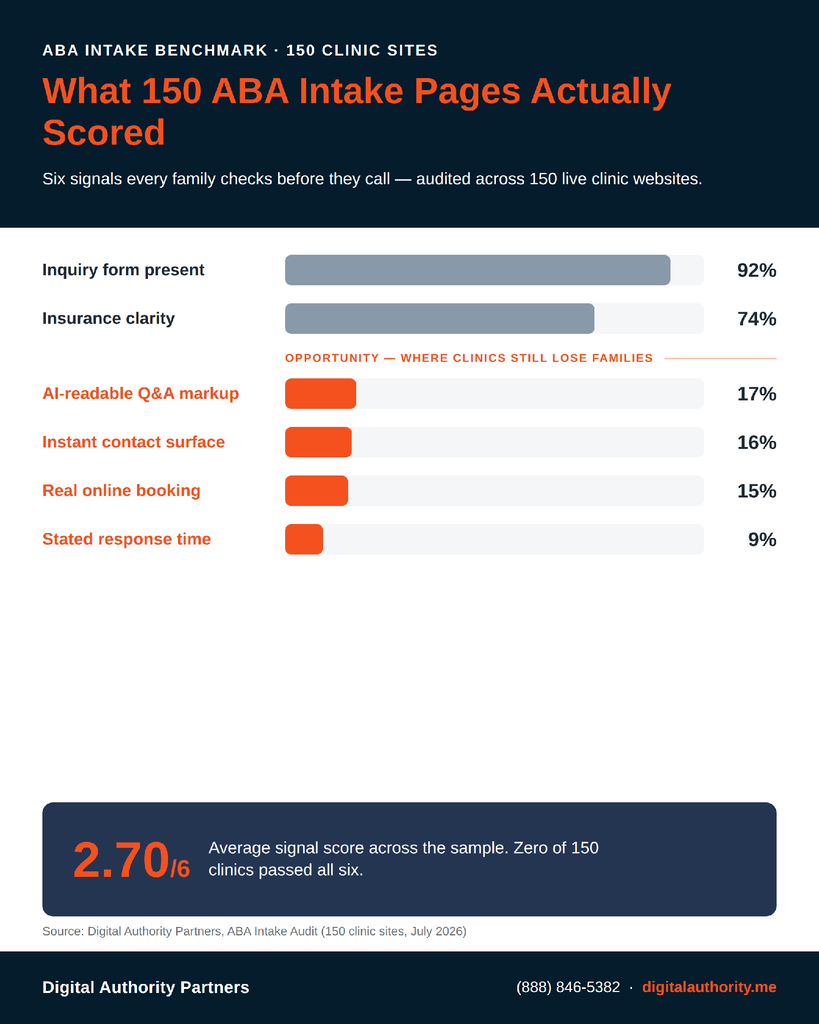
Two of the six describe the field. Inquiry forms reach 92 percent and insurance clarity reaches 74 percent, so their absence is the exception. The other four are where a clinic can still take ground.
- A stated response time: 9 percent
- Real online booking: 15 percent
- An instant contact surface: 16 percent
- Question markup around intake answers: 17 percent
Average readiness across the sample is 2.70 of six. Seven clinics reached five signals. Zero reached all six. Every clinic in the sample is competing on the same three lowest-scored signals, and each one is a change a clinic makes to its own website without waiting on anyone.
The scheduling illusion: 38 clinics look bookable
We recorded scheduling in two tiers. Tier one is true booking, where a family sees availability and selects a time. Tier two is an appointment request, where a family submits a form asking to be scheduled and then waits.
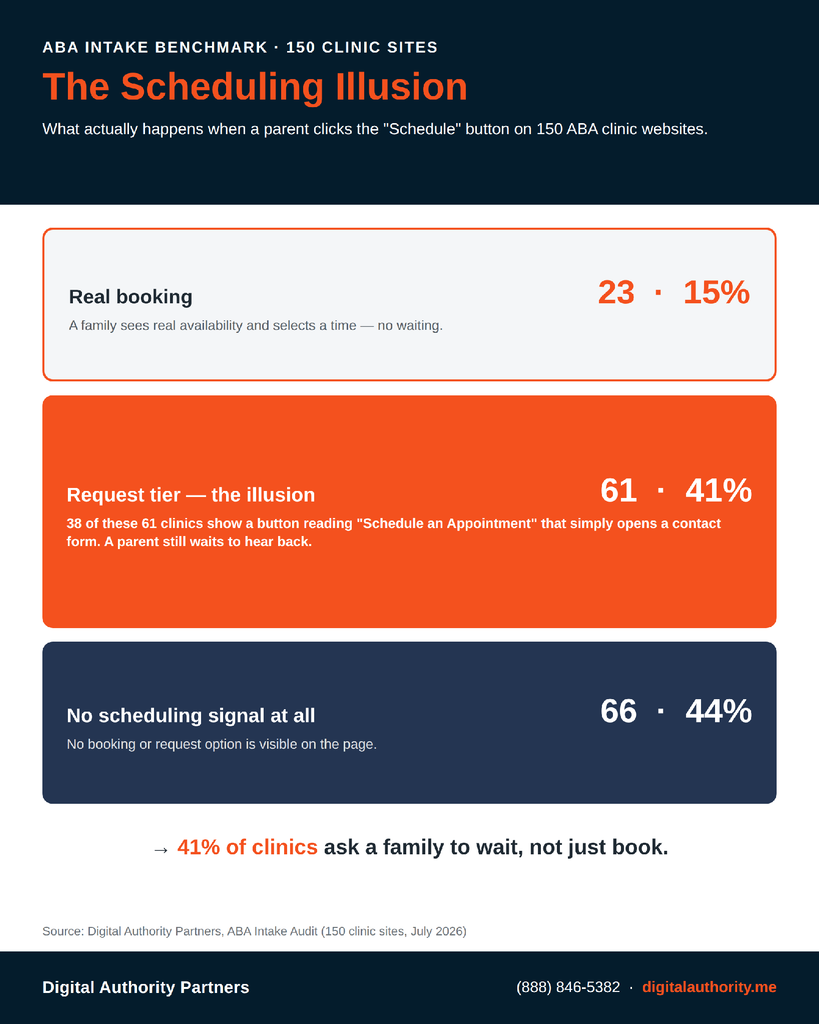
61 clinics offer the request tier. 23 offer real booking. The 38 clinics in between present a button reading Schedule an appointment that opens a contact form, and a parent experiences that as one more thing to wait on.
Try this on your own site: can a parent walk away with a specific date and time already on their calendar? If the best you offer is a submitted form and a promise to follow up, you’re one of the 41 percent asking families to wait.
13 clinics out of 150 say how fast they will reply
13 clinics state a bounded timeframe for answering a family inquiry. We set the bar deliberately low, since any unit of time counted.
Wording that passed
- “Fill out the form below and a member of our intake team will reach out to you within one business day.”
- “We typically respond within 4 hours.”
Wording that did not
- “As little time as possible”
- “Immediate access to care”
- “We’ll get them in quickly”
A hedge is fine. “We typically respond within 24 hours” passed, because the bounded number is the observable commitment. A parent comparing three clinics can act on a number.
This signal costs the least of the six to fix. It needs no software, no integration and no vendor. It needs a window your intake team can hold, published next to every form.
Seventeen percent write their intake answers so an engine can lift them
Families increasingly open with an assistant rather than a search box, and assistants answer with specific clinics. Our AI Visibility Gap research found that the citation layer runs on different rules from the ranking layer: across 1,127 URLs and five AI engines, 60 percent of the URLs cited came from domains invisible to traditional SEO monitoring tools.
Two thirds of the sample carries valid structured data, and much of it arrives by default from a website builder or an SEO plugin. Question markup, the structured data that marks a page as carrying explicit questions with direct answers, appears on just 17 percent of clinic sites. Those 26 clinics carry 430 valid question-and-answer pairs between them, averaging roughly 17 pairs each.
| THE CAVEAT THAT CHANGES WHAT YOU SHOULD DOMarkup on its own has not shown to buy AI citations. Ahrefs tracked 1,885 pages that added JSON-LD against 4,000 matched controls between August 2025 and March 2026. Citations in Google AI Overviews fell 4.6 percent, and the movement in Google AI Mode and ChatGPT was indistinguishable from zero. Google retired FAQ rich results on 7 May 2026 and no longer recommends FAQPage markup for search appearance.What our 17 percent tracks is the editorial decision underneath the code. A clinic carrying valid question markup has almost always written its intake answers as explicit questions with direct, self-contained answers in crawlable text, because that is what the markup describes. Those answers are the liftable part, and the markup is how our audit found them. |
What one family is worth
The benchmark measures what clinics do. The stakes come from public data anyone can check. Florida’s Medicaid fee schedule, effective 1 January 2026, pays CPT 97153, the code for technician-delivered direct therapy, at $12.26 per fifteen minutes. That is $49.04 an hour, and it is the lowest rate among the ten state schedules we checked.
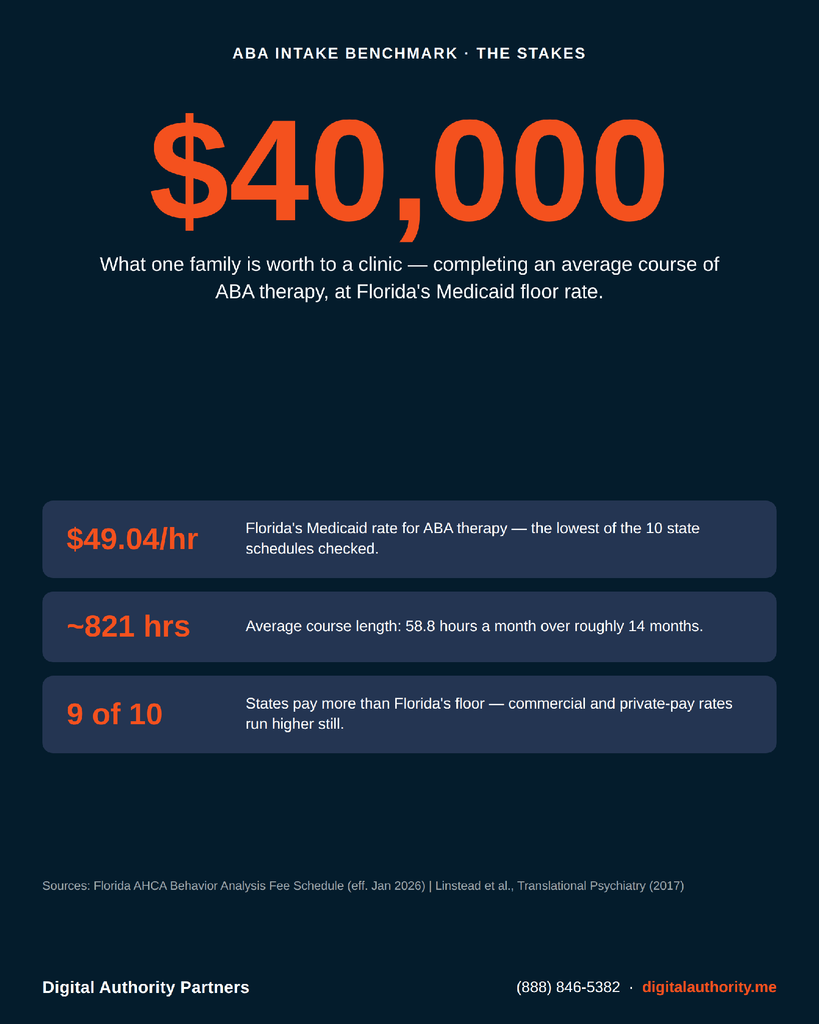
The largest peer-reviewed sample followed 1,468 children with autism across eight states and recorded an average of 58.8 hours a month over a course averaging just under 14 months. That is roughly 821 hours of therapy per family.
At Florida’s floor rate, one family completing an average course is worth about $40,000. Nine of the ten states we checked pay more, and commercial and private-pay rates sit higher again. A clinic that takes two days to reply is competing for that family against a clinic that answers in four hours.
Score your own ABA intake form in three questions
Answer these against your own site, as a parent would see it. Each yes is a point.
- Does any page state a bounded timeframe for replying, in a unit of time a parent can act on?
- Can a parent see real availability and select a time without speaking to anyone?
- Are your intake answers published as explicit questions with direct answers in crawlable text?
These are the three lowest-scored signals in the study, and they pass at 9, 15 and 17 percent. A clinic scoring two or three here is already ahead of most of the field on the part that decides whether a family waits.
Three moves for your own ABA intake form this week
Here are three fixes that cost nothing and can move a clinic above the sample average inside a week:
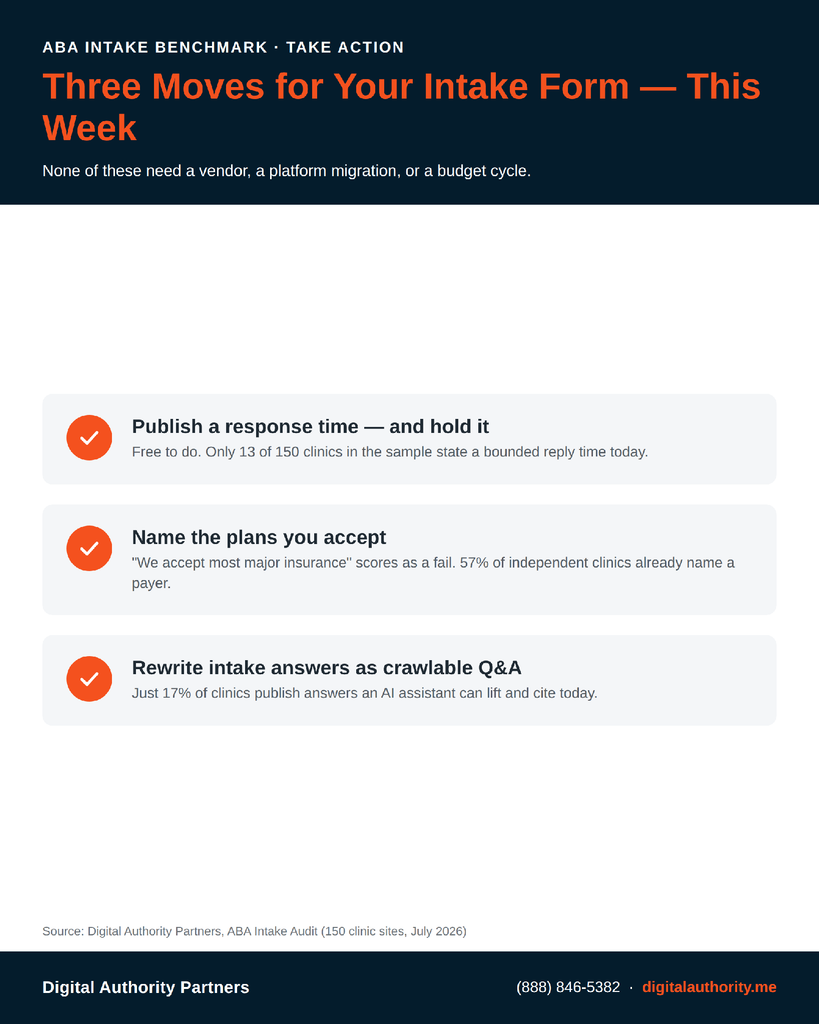
1. Publish a response time and hold it: Free, and the rarest signal in the sample. Pick a window your intake team can meet on its worst day and put it beside every form. 13 clinics in 150 have done this, so the ground is open at every operator size.
2. Name the plans you accept: “We accept most major insurance” scored as a fail in our audit, because a family cannot self-qualify from it. Name at least one payer, or your state Medicaid program, or offer a benefits verification flow. Fifty-seven percent of independent clinics currently give a family that answer, against every national operator in the sample.
3. Rewrite your intake answers as questions: Take the eight or ten questions your intake coordinator answers on every first call and publish each as a heading with a direct answer underneath, in plain crawlable text. Keep each answer self-contained, so it still makes sense lifted out of the page. Add the markup if your platform makes it cheap, treating it as entity clarity. The writing is the part an engine can use.
A clinic that does those three moves is above the sample average inside a week at close to no cost. None of the three needs a vendor, a platform migration or a budget cycle. Those moves close the response gap; the demand side, meaning how families find you at all, is a separate question we cover in how to get ABA clients.
Get the full benchmark
You now have a score out of three. What this page cannot tell you is whether that score is good. The report carries the six-question version of the check and the full readiness distribution across 150 clinics, so a score becomes a position.
It also carries the signal-by-signal pass rates, the readiness gradient across independent, regional and national operators on verified bases, the ten-state rate band behind the $40,000 figure with its credential-tier caveat, five moves ordered by effort, and the complete method, scoring rules and known limits.
| Download the ABA intake benchmarkDownload the ABA intake benchmarkFree download. No sales call required. |
Or send us your clinic URL. We will run the same six-signal audit against your site and send back your score with the evidence string behind every pass and fail, at no cost. It is the same automated pass that produced the 150 rows in this study.
Digital Authority Partners works with healthcare operators on search, paid and web, including as a marketing agency for ABA clinics. On the technical side of intake, our patient intake platform rebuild for Interlace Health took site health from 66 to 98 and average search position from 35 to 15.
Frequently asked questions
Parents and clinic owners ask a few questions after seeing this data. Here are direct answers to the ones that come up most:
What should an ABA intake form include?
Beyond the contact fields, the page around the form has to answer three things a family checks before submitting: how fast someone will reply, whether their plan is accepted, and whether they can take a time now. In our 150-clinic audit, 92 percent published a form and 9 percent published a reply time.
How fast should an ABA clinic respond to a family inquiry?
The study scores whether a clinic states a bounded timeframe at all, rather than prescribing one. Any unit of time counted, from four hours to one business day. 15 clinics in 150 stated one.
What is the difference between online booking and an appointment request?
True booking shows a family real availability and lets them select a time. An appointment request collects a form and puts the family back in a queue. Forty-one percent of clinics offer the request tier and 15 percent offer real booking.
Does an ABA intake form template solve this?
A template gives you the fields to collect. The rates in this study describe what surrounds those fields, which is where the sample separates: a stated reply time, a bookable slot, a named payer, and answers written so an assistant can lift them.
Does adding FAQ schema get an ABA clinic cited by AI assistants?
Not on the available evidence. Ahrefs tracked 1,885 pages adding JSON-LD against 4,000 controls and found no meaningful citation lift, and Google retired FAQ rich results in May 2026. Self-contained answers to real intake questions are what travels. Markup only describes that writing; it doesn’t replace it.
Want To Meet Our Expert Team?
Book a meeting directly here

Related Articles
United States shoppers spent $326.7 billion online in the first quarter of 2026, according to the U.S. Census Bureau....


One in four Americans turns to AI for health and medical information, and nearly 14 million skipped a doctor’s visit ...

Demand for therapy is at an all-time high, yet nearly half of the 62 million U.S. adults with a mental illness receiv...