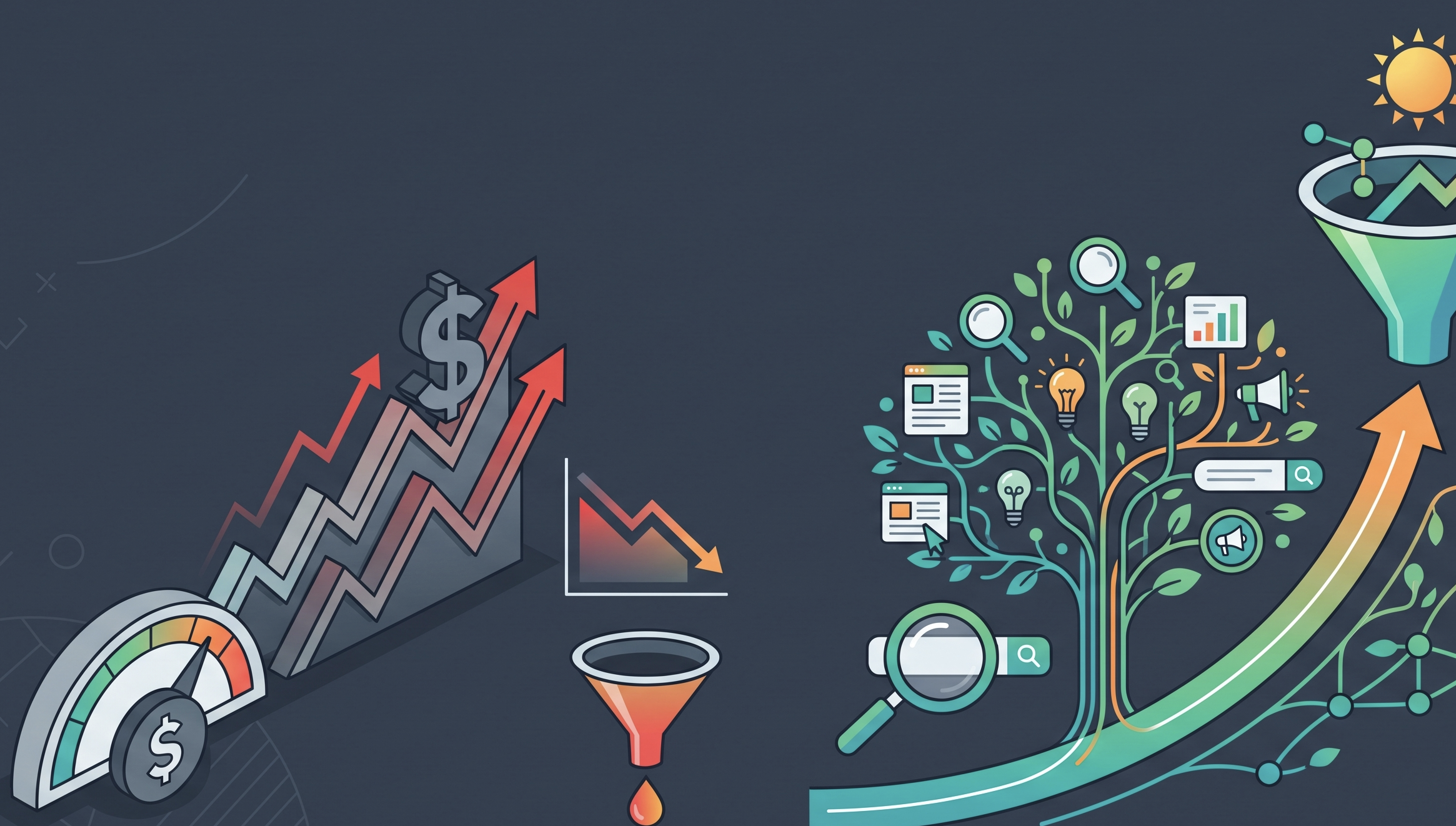
How SEO Reduces CAC: A SaaS Playbook

The latest US digital ad spending forecast projects the market will grow from $317 to $490 billion between 2024 and 2029. For your Software-as-a-Service (SaaS) company, that climb raises the cost of every paid signup, so learning how SEO reduces CAC in SaaS gives you a durable way to grow through organic reach.
This guide shows you how Search Engine Optimization (SEO) becomes a channel that lowers your Customer Acquisition Cost (CAC) and builds a pipeline that compounds. You will see what metrics to track, why paid channels push acquisition costs up, and how organic search brings those costs down. That work sits at the center of what our experienced SaaS marketing agency delivers.
What Is CAC and Why Does It Matter for SaaS?
CAC is the total cost of turning a prospect into a paying customer. This one number tells you and your investors how efficiently your SaaS business grows, and it shows whether each new account earns back what you spent to win it.
Knowing how to reduce customer acquisition cost in SaaS starts with measuring the number honestly. When each account returns more than you spend to win it, your margins widen, and every funding round gets easier.
How to Calculate CAC
The formula stays direct. Add every dollar of sales and marketing spend across a period, then divide them by the number of new buyers you acquired. For example, if you spend $50,000 in a quarter and win 100 customers, your CAC is $500 per customer.
A fully loaded customer acquisition cost formula rolls up salaries, tools, and ad spend into one per-account figure, so your SaaS teams always know the real economics of SEO growth and exactly where to lower that cost. Track it monthly by channel to see which sources bring in customers efficiently and which ones spend more than they return.
How to Read Your LTV to CAC Ratio
Acquisition cost makes the most sense next to Lifetime Value (LTV), what your buyers would be worth over time. Harvard Business School faculty point to a a healthy LTV-to-CAC ratio of at least 3-to-1, meaning each customer returns roughly three times what you spend to win them.
Clear that bar, and each account can fund your next round of growth, which is how you build a self-sustaining pipeline. LTV rises with retention and expansion, while your CAC falls as lower-cost channels carry more of the load. Monitor the ratio by source to see which channels drive profitable growth and to guide smarter budget decisions over time.
Once you weigh CAC against lifetime value, a natural question follows. If organic search lowers that cost, why do so many SaaS teams still lean hardest on paid search?
How Does Paid Search Shape Your SaaS CAC?
Pay-Per-Click (PPC) advertising earns its place in SaaS growth because it captures high-intent demand faster than SEO. It puts your product in front of buyers the moment they start looking. The trade-off is cost, since paid search grows pricier as auctions get more competitive, and it resets to zero the moment you pause spending.
Recent benchmarks tracking the rising Google Ads click costs put the 2025 average at $5.42, up from $4.66 a year earlier, across 87% of industries. Each increase in the cost to acquire a SaaS customer through paid channels adds up over time.
A few habits keep your paid spending efficient while you build a stronger organic foundation:
- Target buyer intent: The right keywords turn more clicks into paying customers.
- Strengthen landing pages: A sharper design lifts conversion rates and raises the value of every visit.
- Layer in SEO: An owned, well-curated web presence carries demand you would otherwise pay for.
- Track blended CAC: Channel-level measurement shows where organic search takes the load.
Run well, professional PPC management services reach buyers at the moment they are ready to act and feed your pipeline right away. Pair that speed with an organic engine, so paid search handles urgency, while SEO lowers your blended acquisition cost over time.
Paid search buys attention by the click, and that meter keeps running. Organic search works the other way. You build the asset once, and it keeps returning qualified visitors, which is where SEO changes the math on acquisition cost.
How Do SEO and PPC Compare for SaaS CAC?
Both approaches earn a role in your SaaS marketing budget, and the two behave in opposite ways once you measure cost. Paid search delivers reach the moment you fund it, while organic search compounds into an owned asset that keeps drawing buyers long after you publish. The table below shows how the two compare on the factors that shape your blended acquisition cost.
| Factor | Paid Search (PPC) | Organic Search (SEO) |
|---|---|---|
| Time to first results | Immediate once the campaign is live | Builds over three to six months |
| Cost per visit | Rises as auction competition grows | Trends toward zero as pages rank |
| Traffic when spend stops | Disappears the moment you pause | Keeps flowing from ranked pages |
| Effect on blended CAC | Holds steady or climbs over time | Falls as organic carries more volume |
| Buyer intent | High, tied to targeted keywords | High, tied to the searcher’s own query |
| Value over time | Resets each billing cycle | Compounds like an appreciating asset |
| Scaling economics | Grows with every extra click | Flattens as your content library expands |
| Main lever to manage | Bid discipline and tight targeting | Consistent publishing and quality |
| Best-fit role | Fast launches and demand spikes | Durable, lower-cost growth |
| Measurement | Clear per-click attribution | Credit across a longer buyer journey |
Your PPC campaign holds a fairly flat cost per acquisition, so scaling it means spending proportionally more. SEO starts slower, then pays you back. Every ranked page you add trims the price of winning your next SaaS customer.
Each channel solves a different problem, so treat the split as a timeline. Early on, paid search does the heavy lifting while your library of ranked pages is still small. As rankings mature, organic search absorbs more of the volume, and your overall acquisition cost keeps falling.
How SEO Reduces CAC in SaaS
Understanding how SEO reduces CAC in SaaS comes down to one structural difference. Organic search skips the per-click charge, so once a page ranks, it keeps drawing qualified visitors at no added cost for each one.
Commercial demand for that visibility runs high. Advertisers spent $114.2 billion on US search advertising revenue in 2025, a signal of how much buyer intent flows through the channel every day. Capturing a share of that demand organically brings in customers from the same high-value queries at no per-click cost.
How SEO Lowers Your Cost per Lead
Organic search lowers the cost per lead by removing the recurring per-visit charge. A blog post or product page that ranks well earns clicks around the clock at no marginal cost, so the more traffic it draws, the lower your average acquisition cost falls.
That efficiency compounds as your content library grows. Choosing your SaaS SEO agency carefully helps you prioritize the pages most likely to convert. Over time, organic search carries more of your pipeline while asking for less CAC each quarter.
How Compounding Returns Build Over Time
Paid traffic pauses the moment your spend does, while an owned presence keeps building. Every ranked page, internal link, and earned mention adds to a base that grows more valuable the longer you invest.
One analysis describes it as a cost-effective organic growth channel where small, consistent efforts snowball into outsized traffic. Content you publish this quarter still generates signups years from now. Your blended acquisition cost keeps falling as organic sources carry a larger share of new customers.
How Search Intent Improves Lead Quality
Search intent turns visitors into better-fit buyers. When someone searches for a specific solution or a pricing detail, they are already evaluating a purchase, and your job is to help them arrive informed and ready to decide.
That is how to reduce CAC while protecting your budget, because higher-intent visitors convert at a stronger rate and shorten your sales cycles. Eventive, the leading platform for independent film, worked with DAP to turn searches into a qualified pipeline. Focusing on buyers already searching for their solution meant each new customer cost less to win.
Organic search rewires the economics of growth, trading your per-click meter with an appreciating asset. Knowing that organic search lowers your customer acquisition costs for SaaS is the first step. Turning that insight into a repeatable plan is where execution takes over.
Build an SEO Strategy That Targets CAC Reduction
An SEO strategy that targets CAC reduction starts with intent. Your goal is to rank for the searches your best-fit prospects make, then guide them from first questions to final decision with content that does the selling.
The strongest strategies to reduce your customer acquisition costs for SaaS map every page to a stage of the buyer journey and give readers a clear next step. Prioritize the terms most closely tied to a purchase and then build authority around them. Point each asset toward a concrete action, whether that is a free trial or a product demo.
Which Keywords Lower Acquisition Cost?
The keywords that lower acquisition costs sit closest to the buying decision. Bottom-of-funnel terms like best tools, alternatives, and pricing queries signal that a searcher is ready to act, so they convert far better than broad, high-volume phrases.
Targeting these first is how SEO reduces CAC in SaaS and helps you win qualified buyers and spares you the spend of educating the entire market. Each ranked page then keeps returning those ready-to-buy visitors at no added spend. Your cost per signup drops with every new term you own.
How Should Content Map to the Buyer Journey?
Top-of-funnel guides build awareness and topical authority, drawing new prospects to your site. As their interest sharpens, your middle-of-funnel comparisons and use cases help them weigh their options. Bottom-of-funnel pages, like pricing and demos, then convert visitors who are already evaluating you.
Content marketing is now near-universal, with 90% of marketers using it in their approach, and that widespread adoption of content marketing reflects how central it has become to lead generation. A well-mapped library keeps buyers moving without a sales rep in the room, so organic search feeds sales-ready prospects at every step of the funnel.
A strategy built around intent and journey stage turns SEO into a predictable acquisition engine. The final piece is evidence. Clear numbers on lower acquisition costs keep leadership investing.
How Do You Measure SEO’s Impact on CAC?
Measuring SEO’s impact on CAC means connecting organic search to revenue. Start by isolating the customers who arrived through unpaid channels, then calculate their acquisition cost separately from your paid channels.
Compare that figure over time and against other sources, and the trend usually favors organic as rankings mature. Clear attribution turns SEO from a cost line into a documented growth driver your finance team trusts.
With these numbers in hand, you can watch organic search lower acquisition cost quarter after quarter, which gives finance and leadership a clear reason to reinvest. That evidence carries your SaaS growth engine forward.
Frequently Asked Questions
Still weighing where organic search fits your roadmap? These quick answers cover the questions SaaS teams ask most about SEO and acquisition cost.
How Long Before SEO Reduces CAC for a SaaS Company?
Most SaaS companies see organic SEO traction within three to six months, and a clear reduction in CAC usually follows over the next year. The timeline shortens when you prioritize high-intent pages and publish consistently, so early focus pays off later.
Is SEO Cheaper Than PPC for SaaS?
Over time, yes. Paid search charges for every click and pauses when budgets do, while organic keeps returning visitors at a low marginal cost. Most teams run both, using ads for speed and SEO to lower blended acquisition cost as rankings compound.
How Do You Calculate Organic CAC?
Divide your total organic investment, including content, tools, and staff, by the customers won through unpaid channels in the same period. Review it monthly by source to see how that acquisition cost falls as your library of pages matures.
Does SEO Still Lower CAC With AI Overviews in Search?
Yes. AI Overviews mostly appear on informational queries, while commercial and comparison searches still send you high-intent clicks. Structuring content so AI engines cite it keeps organic a low-cost source of qualified SaaS buyers.
Build a Lower-Cost Growth Engine
Every paid signup costs a little more as competition for attention grows, and an owned channel is what eases that pressure. SEO turns content into an asset that keeps winning customers long after you publish it, pulling your CAC down while your pipeline builds. For SaaS teams, owning attention turns a recurring rental expense into compound growth.
Book a strategy session to map an approach that lowers your CAC and builds a pipeline that strengthens over time. At Digital Authority Partners (DAP), we show you where organic search fits your growth model, so talk to our SEO team today and watch how it cuts your SaaS acquisition costs firsthand.
Want To Meet Our Expert Team?
Book a meeting directly here

Related Articles

Demand for therapy is at an all-time high, yet nearly half of the 62 million U.S. adults with a mental illness receiv...

The best health apps turn your phone into a daily tool for tracking habits, managing health conditions, and building ...

A healthcare chatbot gives your patients an always-open front door. It answers a question at midnight, books an appoi...