
Keyword Research for Healthcare: How To Find the Terms Patients Search

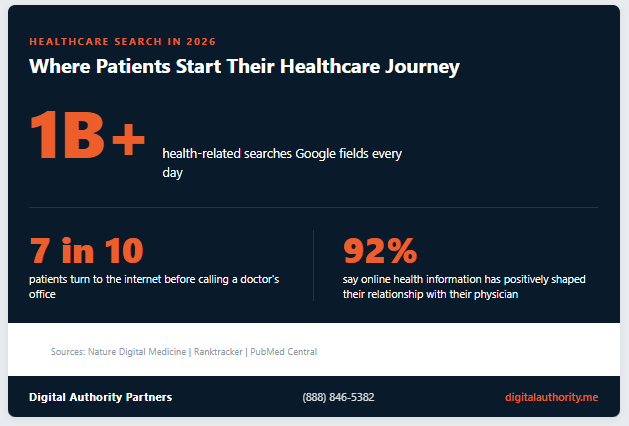
A massive 7 in ten people turn to the internet before they ever call a doctor’s office. That means your next patient is almost certainly searching right now. Google fields more than 1 billion health-related searches every day, and most of those searches end with a patient choosing a provider. Keyword research for healthcare determines whether your practice shows up in those moments or your competitor does.
For more, see our guide on Optometry SEO Agency.
This guide covers patient intent, long-tail strategy, local keyword selection, and what AI Overviews mean for your visibility going forward. Let the best SEO agencies for healthcare build a strategy around how your patients actually search.
How Keyword Research for Healthcare Differs From General SEO
Patients search for healthcare with urgency. When your practice matches their language, you earn their confidence before the first appointment. Search is where that relationship begins. In fact, 92% of people say accessing health information online has positively shaped their relationship with their physician. Two factors set healthcare keyword strategy apart from every other industry.
Patient Intent Follows a Clinical Journey
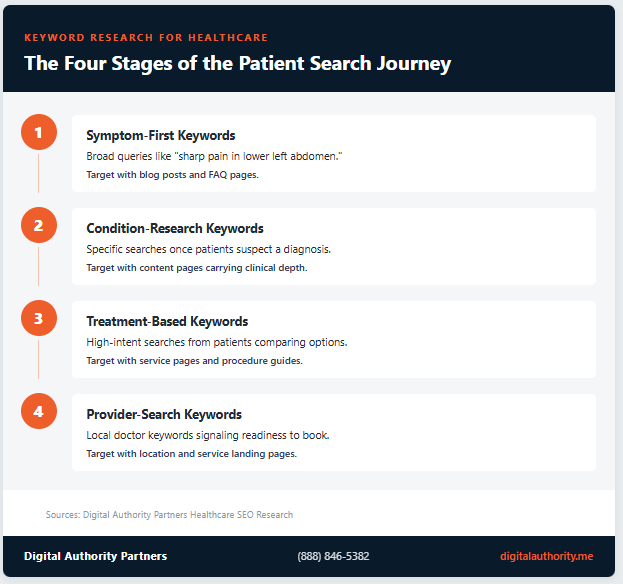
Patients search with the focus of someone who needs a real answer fast. That urgency defines every query they make, and it can follow a predictable pattern. Smart keyword research for healthcare means mapping your content to every stage of that journey:
- Symptom-first keywords: Broad, high-volume queries like “sharp pain in lower left abdomen” that mark the start of the patient journey. Target these with blog posts and FAQ pages.
- Condition-research keywords: More specific searches that begin once patients suspect a diagnosis. Target these with content pages that carry authentic clinical depth.
- Treatment-based keywords: High-intent searches from patients comparing options. Target these with your service pages and procedure guides.
- Provider-search keywords: Local, transactional doctor keywords like “general surgeon accepting new patients near me” that signal a patient ready to book an appointment. Target these with your location and service landing pages.
People who search transactional terms are ready to act. Prioritize your strongest content and most authoritative pages here first. Next, develop the earlier journey stages to build credibility and reach patients before a competitor does.
Healthcare Trust Standards Raise the Ranking Bar
Google classifies medical content as Your Money or Your Life (YMYL). Your medical content can influence a person’s health, so it must meet higher quality standards before it ranks. Here is how you meet those standards:
- Demonstrate your experience and expertise: Include clinician credentials and a visible clinical-review date on every page. Depth of firsthand experience is what wins rankings in healthcare search.
- Back your claims with authoritative sources: Peer-reviewed research and government health agencies signal to Google’s quality raters that your healthcare SEO is verified.
- Build topical authority first: Cluster supporting content around your core subtopics so Google sees a proven pattern of depth across your medical practice.
- Keep content medically current: Refresh statistics, update clinical claims, and add a visible reviewed date to maintain ranking authority.
Patients choose providers they can trust. Build that trust into your content strategy from the start, and your keyword investment will compound with every update.
Trust sets the bar for ranking at all. The next question is which keywords to target once you have earned the right to compete.
What Are the Most Searched Health Keywords?
The most searched keywords for healthcare fall into predictable patterns that mirror how patients make decisions. These patterns form the foundation of effective keyword research for any medical practice. Target the right categories, and you reach patients who are already searching for care.
How Do Specialty-Specific Keywords Shape Your Search Strategy?
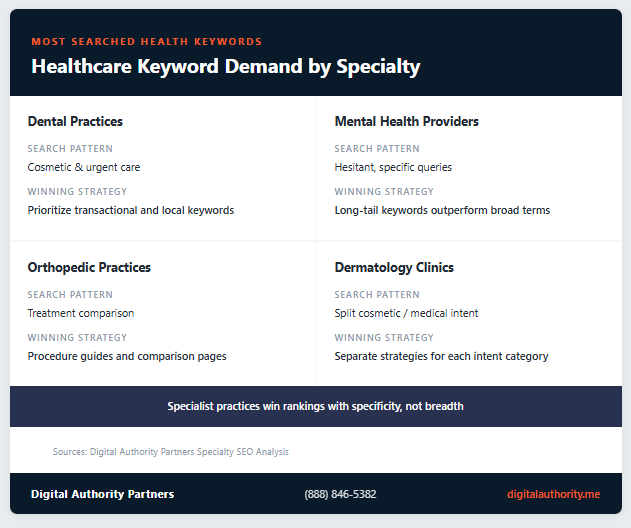
Keyword demand looks different depending on your specialty. A dental practice competes for entirely different terms than a mental health clinic, and the search behavior driving patients to each one follows its own distinct pattern. Broad healthcare keywords rarely win rankings for specialist practices. Specificity is your strategy. The most searched health keywords by specialty share a common structure, but the intent, volume, and competition behind each vary significantly. Here is how the major specialties break down:
- Dental practices: Search demand centers on cosmetic and urgent care terms where high-volume keywords dominate. Prioritize transactional and local keywords over informational content.
- Mental health providers: Patients search hesitantly and specifically, so long-tail keywords consistently outperform broad terms. Trust signals in your content matter more here than in any other specialty.
- Orthopedic practices: Treatment comparison keywords drive significant traffic. Target phrases like “knee replacement alternatives” with procedure guides and comparison pages.
- Dermatology clinics: Search splits sharply between cosmetic and medical intent. keep your content strategy separate for each intent category rather than blending them on a single page.
Each practice demands a different content format and approach to healthcare keyword research. Matching the right keywords to your speciality helps your practice stay visible by speaking to your patients in a language they understand.
How Do You Bridge Clinical Jargon and Patient Language?
Patients search the way people think, in plain language. Where you might think of myocardial infarction, your patients search for heart attack symptoms. Bringing the two ways of thinking about the same subject together is how you win rankings.
Healthcare keywords drawn from patient vocabulary consistently outperform clinical terminology in search volume and click-through rates, which lifts on-page engagement. For that reason, your content strategy needs to be deliberate. Google Autocomplete and the People Also Ask panel offer a practical keywords search technique, surfacing the exact phrases patients type when they are searching for answers, comparing options, or ready to book.
When your content develops around your patients’ vocabulary, you combine what your practice offers and what your patients actually find online. Pair each discovered phrase with its clinical equivalent, and your content serves search engines and your medical audience at once.
The closer your keyword strategy mirrors how patients naturally search, the more relevant your content becomes to the people who need your care most. Keywords now reach further than a results page. They surface in voice responses and generative summaries, which change how patients discover your content.
How AI Overviews Change the Healthcare Keywords you Target
AI is changing how patients search for healthcare, and your keyword research for healthcare needs to change with it. Google now answers broad informational queries directly on your results page in an easy-to-digest way. Knowing where AI steps in and where your own search strategy takes over is what sharpens your healthcare keyword decisions.
Adapt Your Keyword Strategy for Zero-Click Health Queries
AI Overviews have reduced click-through rates by 58% for thousands of healthcare keywords. Broad, factual queries now resolve inside the search results page without a single click. Effective healthcare keyword research means focusing on the terms where your patients still click through to your site.
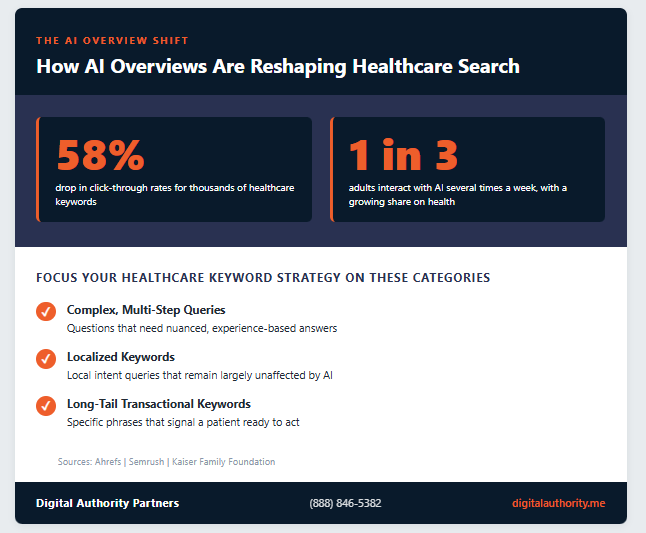
Focus your healthcare keyword strategy on these three categories:
- Complex, multi-step queries: Questions that require nuanced, experience-based answers. AI provides generic responses, so your content can go deeper with clinical context and specifics.
- Localized keywords: Local intent queries drive some of the highest conversion rates in healthcare search and remain largely unaffected by AI-generated results.
- Long-tail transactional keywords: Specific, intent-rich phrases signal a patient ready to act. These queries are too specific for AI to resolve, which makes them a high-return target for your service and booking pages.
Shifting toward these categories keeps informational content in the mix. It also means strengthening informational pages to go deeper than any AI Overview can. Practices that thrive work with AI, not against it. Structuring your content for generative engines is how you stay authoritative wherever patients search next.
Structure Content for Generative Engine Visibility
One in three adults interacts with AI at least several times a week, and a growing share of those interactions involves health questions. Generative engines cite your pages, placing your practice inside the answers patients receive. Getting cited means building content that AI can read, trust, and quote.
Generative engine optimization is the next evolution of healthcare search strategy. Position your content for citation within the AI answer, and your practice secures visibility in a channel growing faster than traditional organic search.
Implement Effective Healthcare Keyword Research With Digital Authority Partners
Your next patient is looking for you right now, on a phone at a kitchen table or a laptop at work. Effective keyword research for healthcare puts you in front of them with the right keywords at key times, from the first symptom search to the final booking decision. Track which terms are gaining ground, which are holding steady, and where your strongest patient engagement is coming from.
Ready to put the most searched health keywords to work? Contact Digital Authority Partners today. Our team builds healthcare keyword strategies rooted in your specialty, patients, and local market, and we measure every result. Reach out to DAP to start building your online visibility today.
Want To Meet Our Expert Team?
Book a meeting directly here

Related Articles

IN SHORT Digital Authority Partners audited 150 US ABA and autism therapy clinic websites in July 2026, scoring each ...


Your phone can walk you through a panic attack faster than most clinics can return a call. More than one billion peop...

United States shoppers spent $326.7 billion online in the first quarter of 2026, according to the U.S. Census Bureau....