How to Use Geofencing During Trade Shows

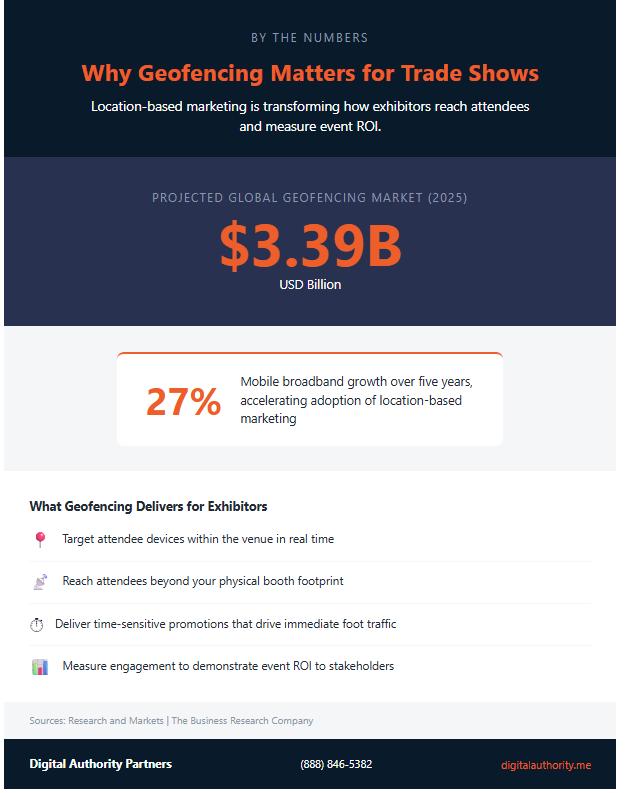
The global geofencing market is projected to reach $3.39 billion in 2025, and trade show exhibitors are fueling that growth. Geofencing during tradeshows lets you deliver targeted mobile ads to attendees the moment they step into a venue, a nearby hotel, or a transportation hub.
Companies across industries, including those partnering with a Las Vegas digital marketing agency, are using this technology to turn physical event attendance into a measurable digital marketing channel. This article covers why geofencing matters for exhibitors, how the technology works, and how to build a campaign that drives booth traffic and generates clear event ROI.
Why Does Geofencing Matter for Trade Shows?
Geofencing during trade shows connects your message with prospects who are physically present at a conference or expo. Rather than relying on foot traffic alone, you reach high-intent attendees with relevant messaging exactly when they are exploring solutions on the show floor.
A common question among first-time exhibitors is whether geofencing is effective in crowded environments. The answer lies in precision. You deliver targeted ads to specific devices entering defined event locations, cutting through the noise that makes trade show marketing so competitive.
Research shows that mobile broadband grew 27% over five years, and increased device connectivity continues to accelerate the adoption of location-based marketing. Here is what that precision looks like in practice for exhibitors:
- Target attendee devices within the venue: Digital geofences placed around convention centers allow your marketing team to identify devices entering the event space and serve ads in real time.
- Reach attendees who never pass your booth: Geofencing lets your brand reach visitors who stay in other sections of the show floor, extending your reach beyond your physical footprint.
- Deliver timely promotions: An ad might invite attendees to claim a limited giveaway or join a scheduled product demonstration within the next hour, creating urgency that drives immediate foot traffic.
- Measure performance to demonstrate event ROI: Engagement insights help you demonstrate the business value generated by your trade show investment to leadership and stakeholders.
When exhibitors combine precise targeting with relevant messaging, geofencing transforms passive exposure into active engagement. This capability raises a natural follow-up: how does the technology actually work?
How Does Geofencing Work During Trade shows?
The technology operates by establishing virtual geographic boundaries around real-world locations. Geofencing uses these boundaries during trade shows to deliver targeted advertising to attendees’ mobile devices. Many organizations collaborate with agencies specializing in geofencing campaign management to handle targeting parameters, ad distribution, and campaign optimization.
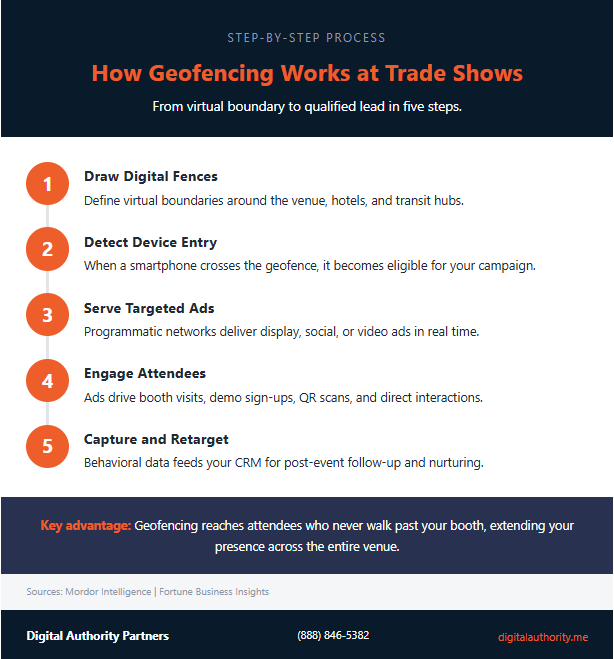
Here is the step-by-step process:
- Draw digital fences around event locations: Your marketing team creates virtual boundaries around specific geographic areas, such as a convention center, an adjacent hotel block, or a conference parking structure.
- Trigger ads when devices enter the zone: When a smartphone crosses the geofence boundary, advertising platforms mark that device as eligible for your campaign messaging.
- Deliver ads through programmatic networks: Programmatic advertising networks instantly serve mobile display ads, social promotions, or video content to the identified device.
- Reach attendees with active location services: Event apps frequently encourage attendees to enable location services, giving your campaign access to a large share of the audience.
Consider a practical example. Your company exhibits at a major healthcare IT conference in Las Vegas. You draw a geofence around the convention center and the two closest hotel properties. An attendee checks into her hotel on the morning of day one, and your campaign serves a mobile display ad promoting a live product demonstration at your booth.
She taps the ad, saves the session time, and visits your booth that afternoon. That single interaction, triggered by a virtual boundary she never saw, creates a qualified lead your sales team can follow up on within hours.
These automated processes allow you to maintain consistent digital communication with attendees throughout the event. To sharpen your approach further, it helps to understand how geofencing differs from a related tactic: geotargeting.
Geofencing vs Geotargeting: What’s The Difference?
Location-based advertising often uses the terms geofencing and geotargeting interchangeably, yet they represent distinct marketing approaches. Geofencing vs geotargeting differs primarily in precision. For companies investing in geofencing in tradeshow marketing, understanding this distinction helps you reach the right audience with the right method.
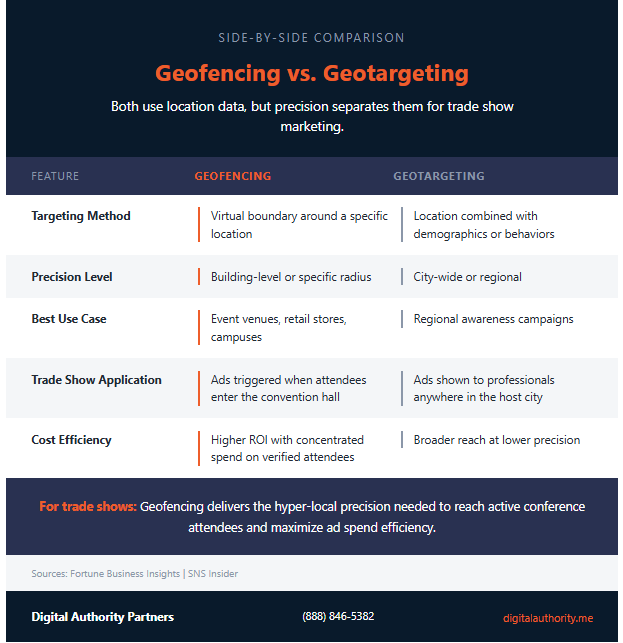
When you want to isolate trade show attendees from the larger city population, precise geographic boundaries become essential. A tightly drawn geofence around a convention center lets you reach event participants without spending ad dollars on unrelated consumers elsewhere in the city.
|
While geotargeting supports broader awareness campaigns, geofencing provides the hyper-local precision required to reach active conference attendees. With that distinction clear, the next step is building a structured campaign around the full event lifecycle.
What Does a Winning Geofencing Strategy Look Like?
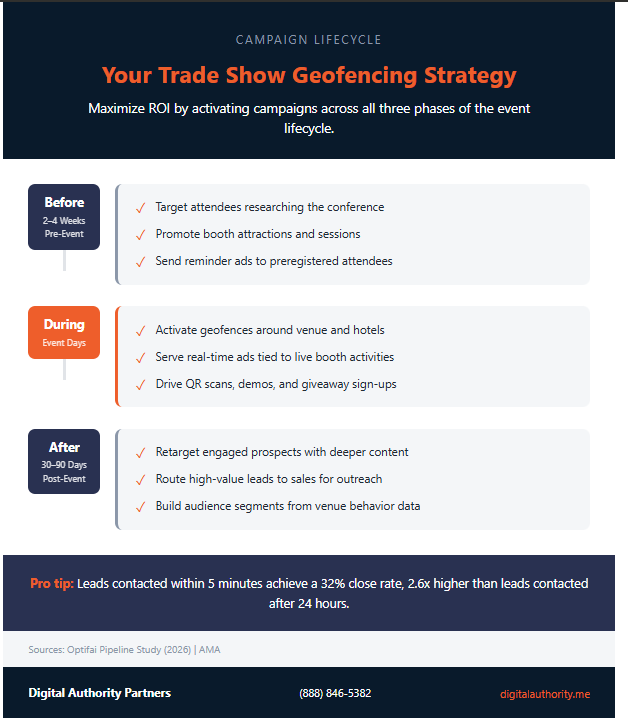
A successful event campaign requires a structured geofencing strategy that aligns with every phase of the trade show lifecycle. By planning campaigns before, during, and after the event, you can maximize the value of geofencing during tradeshows and turn brief booth visits into lasting relationships.
Before the Event: Pre-Show Planning
Strong results begin long before the trade show doors open. Preparing campaigns in advance ensures your brand appears in front of attendees while they plan their event schedules. Many marketing teams activate geofencing event strategies early to build awareness and anticipation.
Effective pre-event preparation includes the following tactics:
- Target likely attendees early: Marketing platforms can identify individuals researching the conference, helping you place your message before attendees finalize their schedules.
- Promote booth attractions and sessions: Teaser ads highlighting your product launches, guest speakers, or special presentations encourage attendees to prioritize your booth.
- Remind preregistered attendees to visit: Targeted reminder campaigns keep your brand top of mind as attendees map out their show floor plans.
Thoughtful pre-show planning builds early visibility and primes attendees to seek out your brand once the event begins.
During the Event: On-Site Engagement
Once the show floor opens, you activate real-time campaigns that respond to attendee movement. Geofencing becomes a powerful driver of booth visits and on-site engagement at trade shows, amplifying brand recognition alongside strong B2B branding strategies.
On-site tactics that drive results include the following:
- Place geofences around key event locations: Set boundaries around the venue, nearby hotels, and transportation hubs to capture attendees arriving from different directions throughout the day.
- Serve real-time promotional ads: Messaging tied to live booth activities encourages immediate action, whether that means attending a product demonstration, booking an expert consultation, or joining a networking session.
- Encourage quick engagement: Digital ads can direct attendees straight to your booth with simple interactions such as scanning a QR code or entering a giveaway.
Real-time campaigns help you transform passive event attendance into meaningful engagement opportunities.
After the Event: Follow-Up and Retargeting
The conclusion of a trade show marks the beginning of an equally important marketing phase. Extending your geofencing in tradeshow marketing campaigns into the post-event window keeps your brand visible to attendees who interacted with you on the show floor. This window is critical.
A 2026 study of 939 B2B companies found that leads contacted within five minutes achieved a 32% close rate, 2.6 times higher than leads contacted after 24 hours. Attendees who engaged with your ads on-site are already primed for deeper conversations, making that follow-up window even more valuable.
Your retargeting window typically extends 30 to 90 days after the event, depending on your sales cycle length and the complexity of your offering. During this period, you have the advantage of behavioral data from the show floor that most competitors never capture.
Post-event retargeting turns short conversations into productive sales relationships:
- Continue delivering relevant ads: Serve follow-up messaging to attendees and similar audiences during the days following the event while your brand remains fresh in their memory.
- Retarget engaged prospects with deeper content: Individuals who clicked on ads or visited your booth receive case studies, webinars, or white papers that move them further into your pipeline.
- Identify high-value prospects for sales outreach: Location and engagement data help you pinpoint decision-makers for timely, personalized follow-up from your sales team.
These post-event strategies strengthen lead nurturing and pipeline development long after the event wraps. To get the most from each phase, apply the following best practices to your campaign execution.
Best Practices for Geofencing Campaigns
Successful campaigns require thoughtful planning and consistent optimization. During tradeshows top-performing advertisers combine precise targeting with compelling messaging that reflects the energy of the event environment through geofencing. Privacy, transparency, and consent also play a growing role in geofencing for tradeshow marketing.
Keep the following best practices in mind when designing your location-based campaigns:
- Keep geofences tight around key locations: Smaller geographic boundaries around event venues or booth areas increase relevance for attendees and concentrate your ad spend where it matters most.
- Use short, clear ad copy: Trade show visitors respond to concise messaging. Direct calls to action encouraging a booth visit drive immediate interaction.
- Align ads with on-floor promotions: Coordinating digital ads with giveaways or demonstrations creates a seamless experience for attendees who encounter your booth.
- Monitor campaign performance daily: Real-time analytics allow you to shift budget toward entrances or event zones with the highest engagement.
- Respect privacy through transparent tracking: Request user permission and rely on aggregated data for targeting. Resources such as the location verification framework highlight responsible methods for managing location data.
Applying these practices helps you create focused campaigns that resonate with attendees and drive meaningful booth engagement. The next step is connecting that engagement data to your sales infrastructure.
How Can Exhibitors Integrate Geofencing Data With CRM Platforms?
Integrating geofencing data with your customer relationship management (CRM) platform during trade shows closes the gap between ad engagement and sales follow-up. Automated interfaces route captured mobile device interactions into your active sales pipeline, enriching prospect profiles with location-based behavioral insights from the show floor.
Here is how that integration creates value for your sales team:
- Trigger personalized email sequences automatically: The moment a prospect interacts with your mobile ad, your CRM initiates a tailored follow-up sequence.
- Enrich contact records with attendance data: Verified physical attendance data improves lead-scoring accuracy and helps your team prioritize outreach.
- Route high-priority alerts to sales representatives: When target accounts enter the exhibition hall, your reps receive real-time notifications.
- Build audience segments based on venue behavior: Segment prospects dynamically based on the specific venue zones they visited, enabling more relevant post-event messaging.
Connecting your location data with your sales systems ensures your team captures the full value of every event interaction. With that infrastructure in place, you can measure exactly what your investment produces.
Measuring Geofencing ROI During Tradeshows
Measuring performance ensures you understand the full value generated by your location-based campaigns. By tracking specific engagement metrics, you can evaluate how geofencing during tradeshows contributes to lead generation and overall marketing ROI.
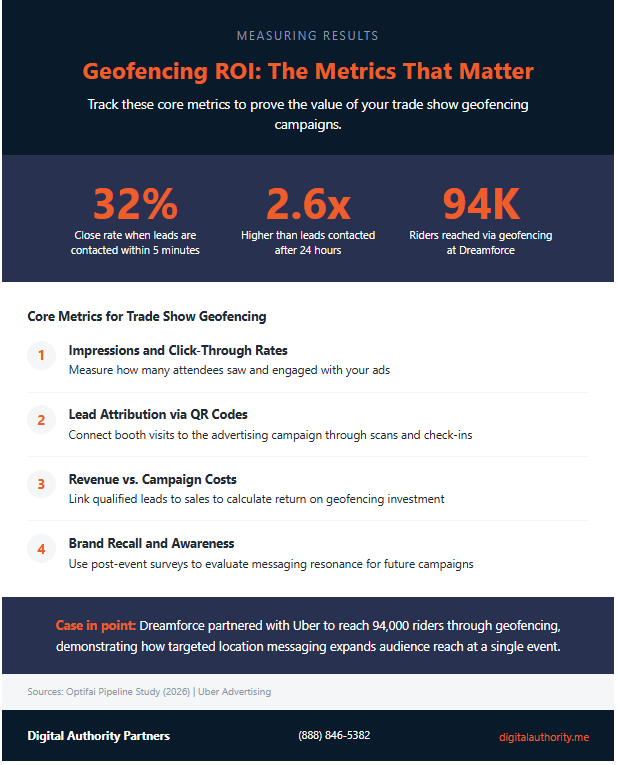
Effective measurement focuses on these core metrics.
- Impressions and click-through rates: These metrics indicate how many attendees encountered your ads and how many engaged with them, giving you a baseline for campaign reach.
- Lead attribution through QR codes: Track booth interactions via QR code scans and digital check-ins, connecting physical visits to the advertising campaign.
- Revenue compared with campaign costs: By connecting qualified leads to eventual sales, you gain a clear picture of the return generated by their geofencing investment.
- Brand recall and awareness: Quick post-event surveys can reveal how well your messaging resonated with the audience, informing creative decisions for future events.
Large-scale events demonstrate the power of these strategies. Dreamforce partnered with Uber to reach 94,000 riders through geofencing, showing how targeted location messaging can dramatically expand audience reach at a single event. When you measure performance consistently, you gain insights that refine every future campaign.
Tracking these metrics across multiple events also reveals patterns that sharpen your overall trade show strategy. You may discover that geofencing around hotel properties generates higher click-through rates than venue-only campaigns, or that post-event retargeting within the first 48 hours produces stronger lead quality than broader follow-up windows. Each data point builds a clearer picture of what drives ROI for your specific audience and industry vertical.
Turn Trade Show Attendance Into Measurable Pipeline Growth
Trade shows remain one of the most valuable channels for B2B relationship building. A thoughtful geofencing strategy amplifies those opportunities through precise, data-driven targeting across the full event lifecycle. Increase booth traffic and strengthen brand awareness among high-intent audiences, and create clear attribution for your marketing investment.
The exhibitors who see the strongest results combine geofencing with solid digital infrastructure, compelling content, and consistent measurement. Contact Digital Authority Partners to design an advanced geofencing campaign that turns your next trade show into a measurable growth engine for your business.
Want To Meet Our Expert Team?
Book a meeting directly here

Related Articles

Demand for therapy is at an all-time high, yet nearly half of the 62 million U.S. adults with a mental illness receiv...

The best health apps turn your phone into a daily tool for tracking habits, managing health conditions, and building ...

A healthcare chatbot gives your patients an always-open front door. It answers a question at midnight, books an appoi...