7 Fintech Marketing Strategies You Should Try in 2026

What separates a fintech brand that earns long-term loyalty from one that relies on new customers? The unification of your marketing strategy is the answer. You unlock greater efficiency when you combine your advertising channels, joining the 84% of marketers who report stronger year-over-year performance.
This article highlights seven fintech marketing strategies designed to build trust, strengthen customer acquisition, and position your brand as a financial authority. Explore why fintech and financial digital marketing services deliver outcomes that general marketing firms rarely match, and learn what sets financial advertising apart.
What Makes Fintech Marketing Unique?
Fintech marketing involves specialized strategies that help your financial technology company promote and streamline how customers access and interact with digital financial services. Effective marketing is what connects your fintech product to people who benefit from it most.
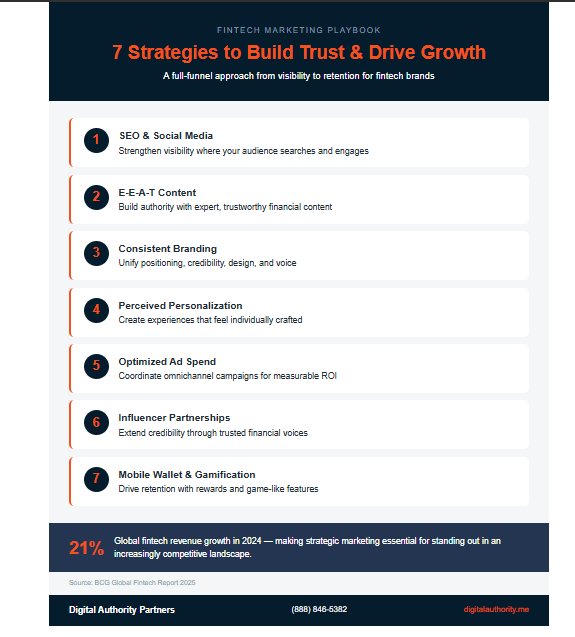
Global fintech revenues grew 21% in 2024, driven largely by digital payments and embedded finance expansion. Capitalizing on that growth requires effective marketing strategies for fintech companies ready to compete in an increasingly crowded space. Payments and consumer lending remain the most crowded segments, making strategic marketing essential for standing out.
Implementing practical growth strategies helps your finance company stay relevant and build trust with users by accounting for long decision-making cycles and demonstrating financial credibility. A strong fintech marketing strategy also strengthens your topical authority with search engines.
Build Trust and Drive Growth With These 7 Fintech Marketing Strategies
Capturing consumers’ attention in fintech is only the beginning. The marketing funnel is a complex, nonlinear structure that guides users through consideration and comparison stages over an extended period. Your prospects evaluate two fintech apps side by side before they commit to one. Trust is what brings them back to yours.
The foundation of any effective fintech marketing plan starts with where your customers already are: on their phones and across social media. You can build a full-funnel approach with these seven strategies, moving from the broadest audience-building tactics to the most targeted execution plays.
1. Prioritize SEO and Social Media to Strengthen Your Fintech Visibility
Search engine optimization (SEO) increases your brand’s visibility so users can find you on search engine results pages. Marketing teams use SEO techniques as part of fintech growth strategies to capture high-intent traffic. Social media extends that reach by creating spaces where prospects search for opinions and do comparisons.
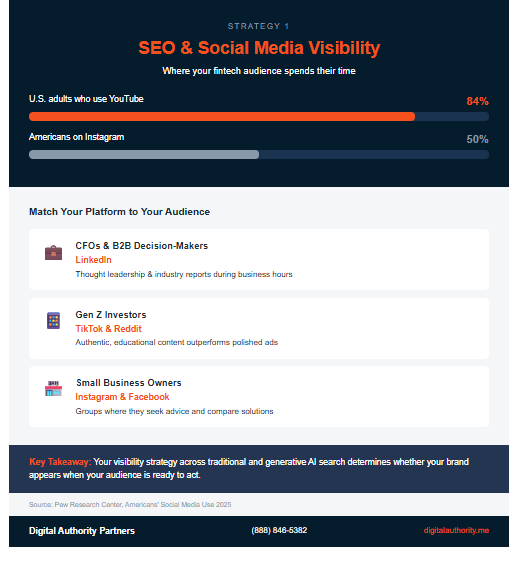
Where should you focus? Social media users are everywhere. A substantial 84% of adults use YouTube, and 50% of Americans use Instagram too. Implementing a fintech marketing solution that identifies who your audience is and where they spend their time helps you use resources most effectively. Start with your client profile when conducting your fintech strategic planning:
- Target mid-market CFOs: Thought leadership and industry reports perform best on LinkedIn, where finance decision-makers are active during business hours and actively evaluating vendors.
- Reach Gen Z crypto investors: Authentic, educational content on TikTok and Reddit outperforms polished ads with this audience, who prioritize credibility over production value.
- Connect with small business owners: Instagram and Facebook groups are where this segment actively seeks cash-flow advice and compares solutions, making them high-value channels for fintech brands.
Your visibility strategy across traditional and generative AI search determines whether your brand appears when your audience is ready to act. The content you publish is what keeps your audience engaged once you build authority with your fintech marketing strategy.
2. Create E-E-A-T Content to Build Fintech Authority
Valuable content establishes your authority and builds the trust your audience needs before they’ll hand over financial information. In fintech, where people are making decisions about their money, demonstrating Experience, Expertise, Authoritativeness, and Trustworthiness (E-E-A-T) is essential. Google’s search quality guidelines explicitly prioritize E-E-A-T for Your Money or Your Life (YMYL) topics, which include all financial services content.
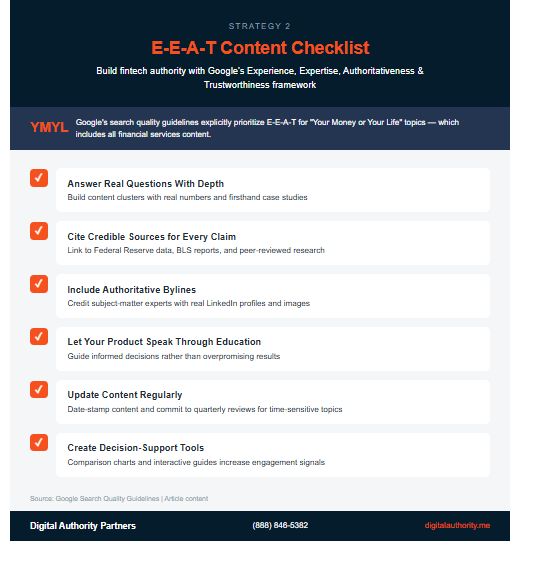
Here’s how to create E-E-A-T-optimized marketing strategy for fintech content:
- Answer real questions with depth: Build content clusters around real numbers and firsthand case studies that demonstrate expertise rather than summarizing what competitors have already covered.
- Cite credible sources for every claim: Link to authoritative research or regulatory documents to substantiate your data and reinforce trustworthiness with both readers and Google.
- Let your product speak through education: Guide readers through what each financial choice can yield so they make informed decisions with your brand as the resource that got them there.
- Update content regularly: Date-stamp your content and commit to quarterly reviews for time-sensitive topics so your authority signals stay current.
- Create decision-support tools alongside articles: Comparison charts and interactive guides keep users on your site longer, which signals meaningful engagement to Google.
Educate prospects and convince them that you deserve their trust. The best fintech marketing campaigns get this right and then amplify it through consistent strategy and branding.
3. Ensure Consistent Branding Across Your Fintech Marketing Strategy
Everything that comes from your marketing office should present your fintech company’s identity. The culture and the demographics you target shape your branding. In an industry where products are functionally similar and switching costs are low, your brand voice and image are what set you apart.
Strong fintech branding rests on four core elements:
- Define your positioning: Clarify exactly what you offer and how it helps your specific consumer.
- Establish brand credibility: Build trust through regulatory compliance badges, security messaging, social proof, and brand partnerships.
- Develop a design language: Align your visuals with your positioning and your target audience’s aesthetic preferences.
- Adapt your communication style: Tailor your voice for young investors or B2B executives while maintaining consistency across all channels.
Customers who recognize your brand at first glance are more likely to feel a personal connection to your product. That sense of familiarity opens the door to a more personalized experience, which is where deeper engagement begins.
4. Use Perceived Personalization to Drive Fintech Engagement
When a budgeting app sends you a savings tip based on your spending patterns, it signals that the brand understands your individual needs. That feeling is perceived personalization, and it’s one of the most effective tools in your fintech marketing strategy.
Your customer’s belief that your fintech service understands them and provides individual attention goes beyond generic emails. It uses technology to recognize returning customers, understand their preferences, and surface relevant financial insights at the right moment.
Research shows that perceived personalization strengthens brand engagement by fostering positive emotional attachment and increasing customers’ sense of status within the brand ecosystem. Personalized dashboards, proactive financial recommendations, and tailored content solidify messaging while respecting boundaries.
The more precisely you personalize the experience, the more data you generate about what your audience responds to, which in turn leads to smarter decisions about where to invest your ad spend.
5. Optimize Ad Spend Across Channels
Research shows that 66% of marketers allocate up to 30% of their programmatic budgets to siloed channel execution. Taking an omnichannel approach as part of your fintech marketing strategy turns that spending into coordinated performance.
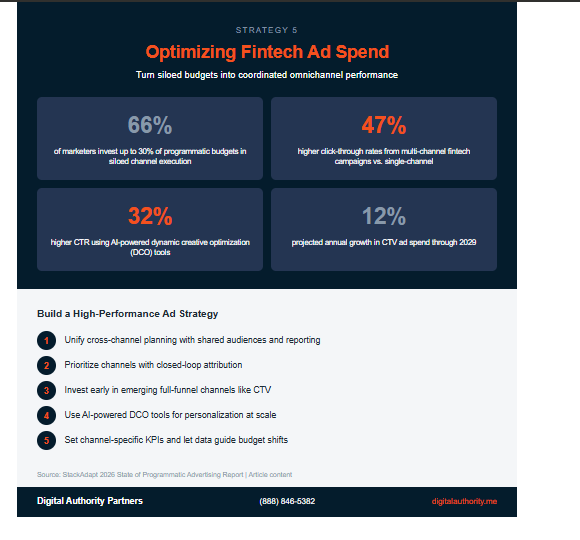
The results speak for themselves. Multi-channel fintech campaigns deliver 47% higher click-through rates than single-channel approaches. Top-performing fintech marketers shift budgets toward programmatic channels, including Google and social media advertising, enabling real-time tracking and optimization.
Here’s how to build a high-performance fintech ad strategy:
- Unify cross-channel planning: Run a coordinated strategy with shared audiences and unified reporting, while adjusting content for each channel.
- Prioritize channels with closed-loop attribution: Programmatic display, paid search, and paid social share first-party data and conversion events. Start here.
- Use AI-powered dynamic creative optimization (DCO) tools: These tools automatically assemble ads based on real-time data, delivering personalization at scale.
- Set channel-specific key performance indicators (KPIs): Track awareness metrics for each advertising channel you use, and let that data guide your budget adjustments.
Precision targeting and unified measurement give you the performance data to prove what’s working. Data makes it easier to evaluate potential partners who can extend your reach into new audience segments.
6. Build Influencer Partnerships for Fintech Credibility
Partnering with fintech influencers connects your brand with social media creators who hold an authoritative position in finance and already have your target audience’s trust. A well-matched influencer marketing strategy amplifies your message through a voice your prospects already follow.
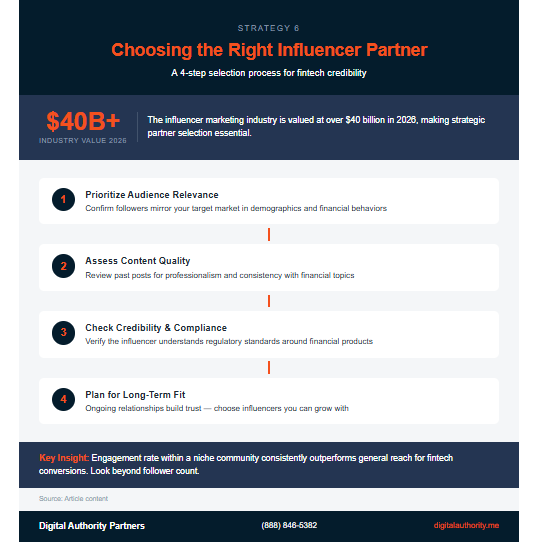
Strategic alignment is everything when choosing an influencer. Start by matching audience demographics and values to your product positioning, then look beyond follower count. Engagement rate within a niche community consistently outperforms general reach for fintech conversions. These tips can help you choose the right social media partner:
- Prioritize audience relevance: Confirm that the influencer’s followers mirror your target market in demographics and financial behaviors.
- Assess content quality: Review past posts for professionalism and consistency with financial topics.
- Check credibility and compliance: Verify that the influencer understands and adheres to regulatory standards for financial products.
- Plan for long-term fit: Choose influencers you can grow with as one-off campaigns build awareness, while ongoing relationships build trust.
While influencers expand your reach on social media, a mobile-first product experience keeps new users engaged after they arrive. Increasing your ROI by focusing on retention, helping to grow repeat customers.
7. Improve Retention With Gamification for Mobile Wallets
A mobile wallet provides an effective way to connect with consumers who already interact with your fintech product daily. Digital wallets create fierce competition among payment platforms. Gamification, the application of game-like features such as challenges and rewards, encourages people to use the platform more often and stay loyal to it.
Marketing teams should confirm that mobile and desktop sites limit widgets and that content organization supports intuitive navigation. Keep web copy concise and pair it with visual elements, such as fintech infographics and icons with large fonts to support ADA compliance.
Fintech apps that award points for completing financial literacy modules or hitting savings milestones turn routine interactions into engaging experiences. When users earn badges for paying bills on time or reaching a savings goal, they return to the app because it feels rewarding.
Developing and planning your fintech marketing strategies takes time and regular assessment. Each of these seven strategies works on its own, but the greatest results come when you coordinate them under a unified plan. That level of orchestration is where a specialized marketing partner makes the difference.
Why Choose a Fintech-Specialized Marketing Firm?
Choosing between a specialized and general digital marketing is a strategic decision. General firms excel at broad brand visibility, but fintech brands benefit from a partner who understands your regulatory environment and the trust your audience demands.
High-level marketing leadership, such as a fractional chief marketing officer, can guide your team in crafting messaging that resonates with a compliance-aware audience and builds lasting credibility.
What Regulatory Expertise Should a Fintech Agency Have?
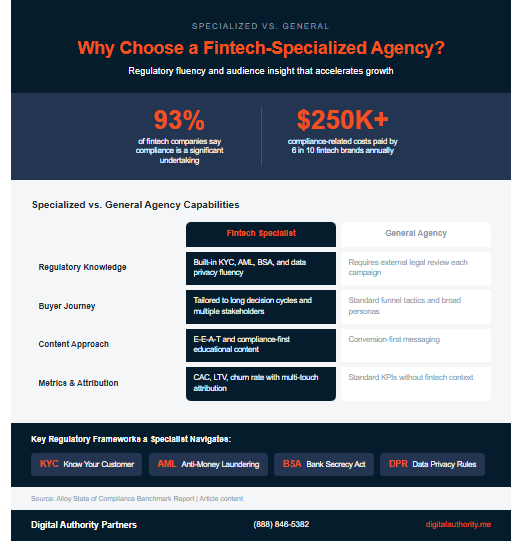
Navigating regulatory compliance is a massive hurdle for the fintech industry, challenging 93% of companies, and costing over 6 in 10 brands at least $250,000 in a single year. Expert leadership helps your marketing team meet advertising requirements strategically while still driving growth. Marketing for fintech aligns you with strict standards that influence messaging and targeting strategies.
Understanding core compliance frameworks protects your business and your customers:
- Know Your Customer (KYC): Verify your customers’ identities before opening accounts to ensure the integrity of the financial system.
- Anti-Money Laundering (AML): Monitor and report suspicious transactions to protect your platform from illegal activity.
- Bank Secrecy Act (BSA): Record and report large or unusual transactions to support essential government oversight.
- Data Privacy Rules: Handle your customers’ personal data transparently and only with their explicit consent.
A firm that specializes in marketing for fintech understands how to operate within these standards while still accelerating growth. Build compliant campaigns from the start and reduce legal exposure by collaborating effectively with your internal compliance teams.
How Do Specialized Firms Navigate Fintech Buyer Journeys?
Fintech marketing solutions require the understanding that your audience often has longer decision cycles and higher trust thresholds than those in typical consumer markets. General agencies may rely on broad personas and standard funnel tactics, while fintech-focused strategies develop messaging that addresses financial literacy levels and multiple decision-makers.
A fractional CMO with experience in fintech knows how to speak to individual users and business stakeholders. They lead your team in tailoring content to each stage of the journey and connecting you with influencers they’ve worked with in the past. This governance results in more relevant messaging and a sense of personalization that resonates with a diverse client base.
Achieve Growth With Fintech Marketing Solutions From Digital Authority Partners
Fintech marketing rewards audience-centered strategy over generic campaigns. In a sector where trust drives every decision, results come from understanding exactly how your buyers think and what moves them to act.
Digital Authority Partners (DAP) builds compliant, conversion-focused content marketing plans tailored for fintech companies. Ready to partner with a fintech service agency that knows this landscape? Contact the team at DAP today and turn your marketing into a measurable growth driver.
| |
Want To Meet Our Expert Team?
Book a meeting directly here

Related Articles

New innovations in fintech (financial technologies) are allowing financial institutions to serve customers in novel a...


Financial services marketing refers to the collective use of marketing tactics employed by marketers in the financial...

San Diego is one of the most sought-after locations for startups and established companies alike. The beautiful weath...