The Byline Blind Spot: What 497 Pages Reveal About How AI Picks Its Sources

New from Digital Authority Partners (DAP): a 497-page data study on AI content optimization and what makes AI engines cite one page over another.
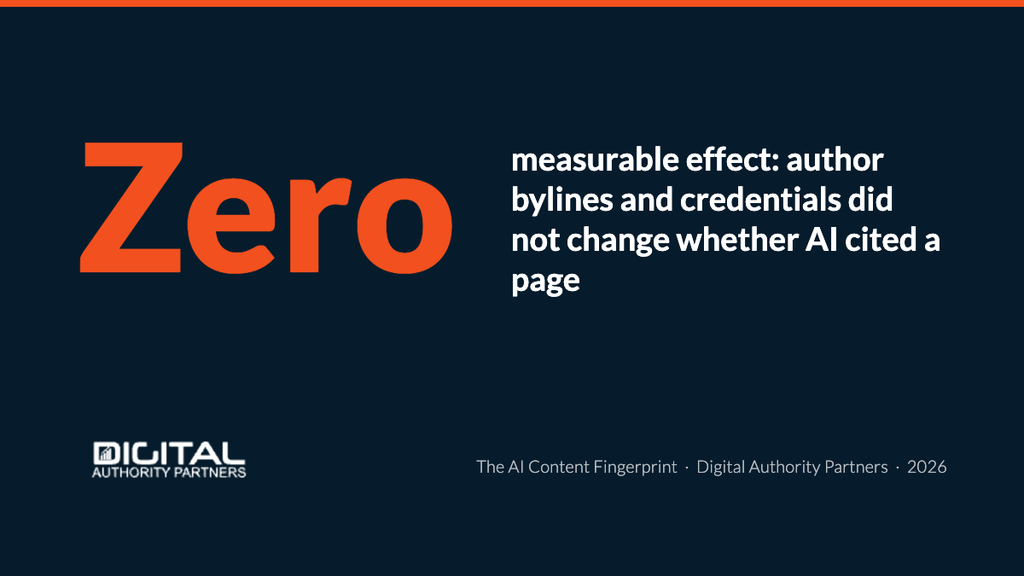
For two years, marketing teams have invested in author bios and credential lines, trusting that the signals that win Google’s confidence would carry into AI content optimization. As a generative engine optimization agency, we put that assumption to the test, scoring 497 pages on 12 content characteristics and modeling which ones line up with getting cited. The headline result rewards the brands paying attention. Author bylines and credentials had zero measurable effect on whether an AI engine cited a page.
We call this the Byline Blind Spot, and it reframes AI content optimization from the ground up. An AI system does not read a bio box and weigh an author’s credibility the way a person does. Instead, it selects sources based on how a page is constructed and on what the wider web already says about the brand behind it. If you own content spend, that single finding lifts the E-E-A-T conversation off the individual page and raises it to the level of your brand. That shift is the opening, and it favors the brands that read the data early.
What We Measured in the AI Content Optimization Study
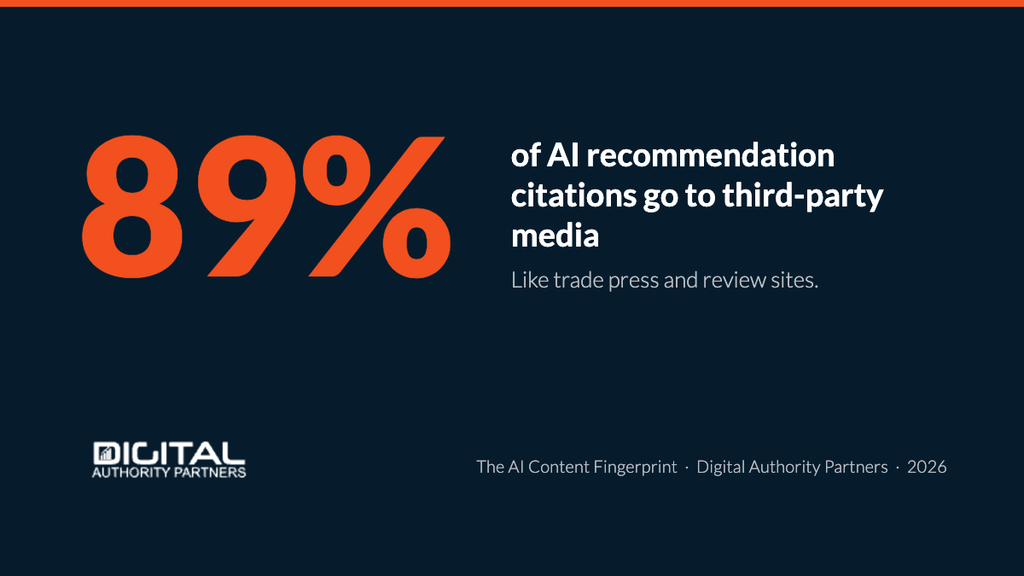
The AI Content Fingerprint study is the companion to our AI Visibility Gap study, published in June. The first study measured what AI search does. Sixty percent of AI citations never appear in the organic top 20, only 33% survive for a month, and 89% of recommendation citations point to third-party media, such as trade press and review sites. This study answers the question every client asks next. What earns a citation in the first place?
We took 497 organic Google results spanning 30 queries, six industries, and five intent types, then scored each page on 12 content signals covering structure, sourcing, transparency, and content type. Two independent reviewers classified the judgment-based signals, so the scoring holds up under scrutiny. Every finding here is correlational, tracing the traits that cited pages tend to share. Together those traits reveal the levers AI content optimization can pull, and the patterns proved consistent enough to reshape how a mid-market brand should spend.
The Editorial Premium
The strongest predictor of a citation turned out to be the type of content on the page. The pattern is clearest when you line the formats up side by side:
| Content Type | AI Citation Rate |
| Reference and encyclopedia pages | 75.0% |
| Editorial articles | 57.8% |
| Landing and service pages | 25.0% |
| Forum posts | 8.3% |
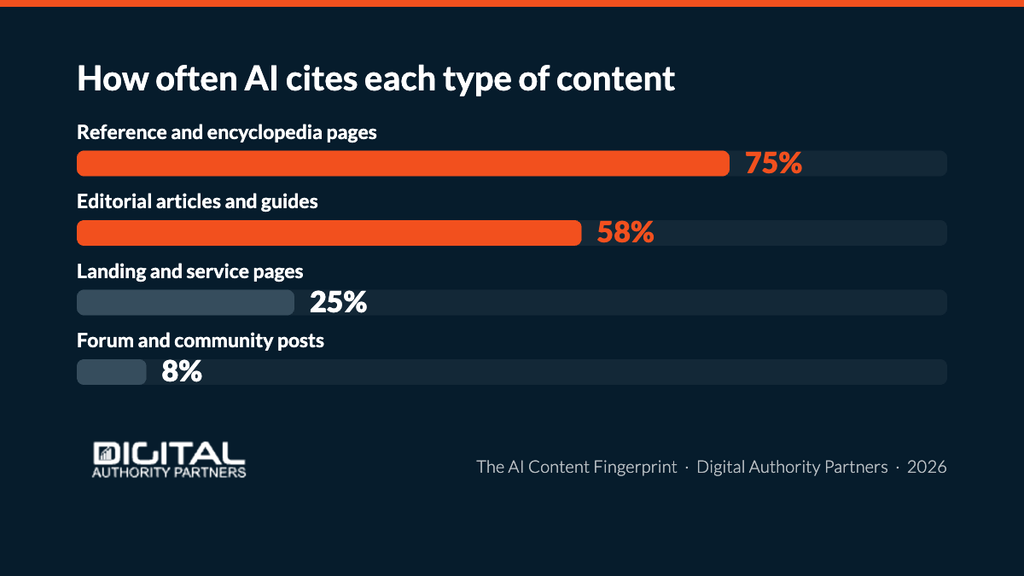
Editorial articles, the pieces that explain a topic, drew citations 57.8% of the time, close to seven times as often as forum posts. Reference and encyclopedia pages sat at the top of the ladder.
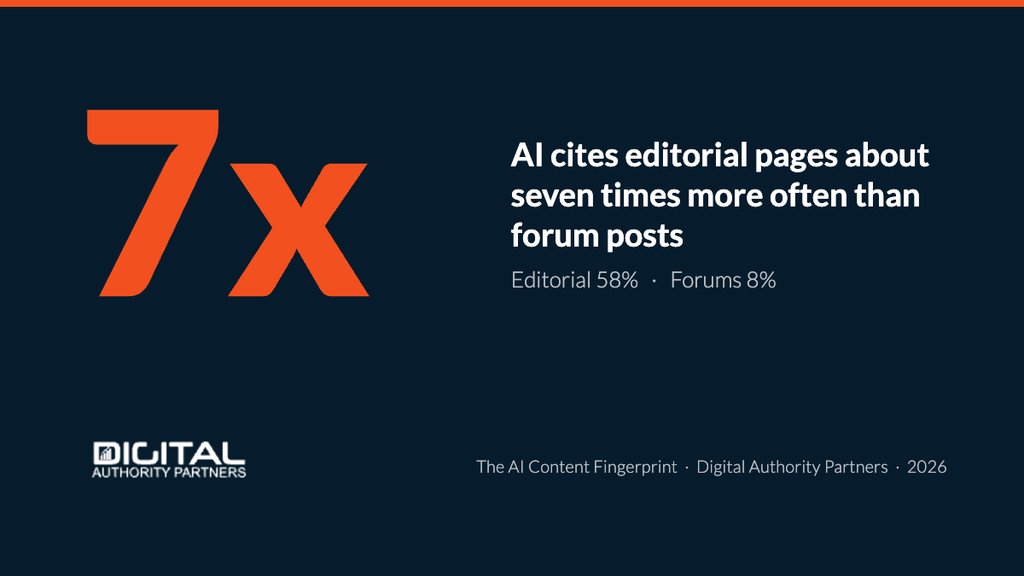
The number that should redirect your budget is the one for sales pages. Landing and service pages, the ones most companies fund most heavily, earned a citation just 25.0% of the time, less than half the editorial rate. AI engines reach for content that teaches a category. The format you publish in shapes your odds of a citation before a single word is written.
We call this the Editorial Premium, and it points to a clear move. The path to an AI citation runs through the content that explains your category, so that is where your next dollar of content spend belongs.
Structure Beats Size
The finding with the biggest implication for smaller brands compares how much a page’s construction matters against the size of the domain behind it. A model that sees only how a page is assembled predicts an AI citation 70.9% of the time. That model reads heading depth, outbound links, schema, and visible dates, and nothing about the domain itself. Add the website’s overall size and authority, and the model climbs to 75.2%, a gain of 4.3 points.
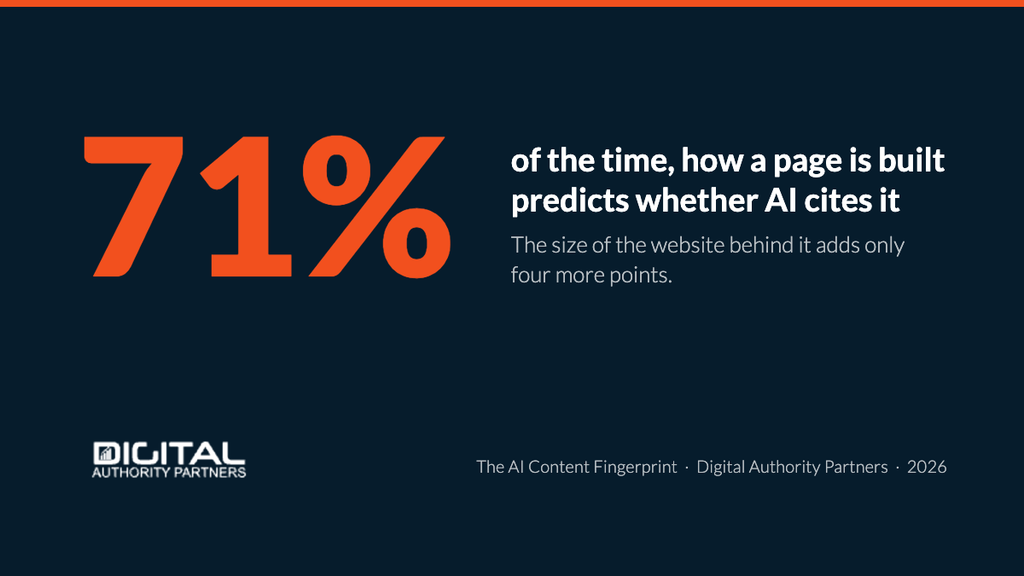
Read that gap the right way, and it is good news for any brand competing against a larger domain. Domain authority accumulates slowly and sits largely outside your control in the near term, while the way you assemble a page is something you can change this quarter. A mid-market site that publishes in the formats AI engines favor has a real path to citations against competitors many times its size. Structure is the lever you can pull today.
What Kind of Authority Does AI Read?
Since author bylines carry no measurable weight with AI engines, the natural question is where the trust signals live instead. Our data points up a level, to your brand. The authority that moves AI engines rests on what the broader web says about a company. That includes an accurate Wikipedia presence, structured data that tells machines who you are, earned media and third-party coverage, and consistent brand mentions across the sites that language models learn from. This is the brand-level half of what generative engine optimization involves, and it also drives getting cited by ChatGPT, which leans on training memory more than live retrieval.
One caution keeps this in proportion. Author-level E-E-A-T still earns its budget. Google search rewards those signals, and human readers trust content more when they can see who wrote it and why that person is qualified. Keep funding bylines, verified credentials, expert review, and clear author pages, both for people and for Google. The AI layer simply asks for something more, namely, brand-level authority that AI engines recognize when they assemble an answer. The two run in parallel, and our guide on how to build an AI SEO strategy shows how to fund both without shortchanging either.
The Citations That Last Have a Shape
AI citations move. Our first study found that only 33% survive a month, so every win has to be re-earned. That raised a sharper question for this study. Among the pages that held their citations across all three measurement waves, what did the durable set share?
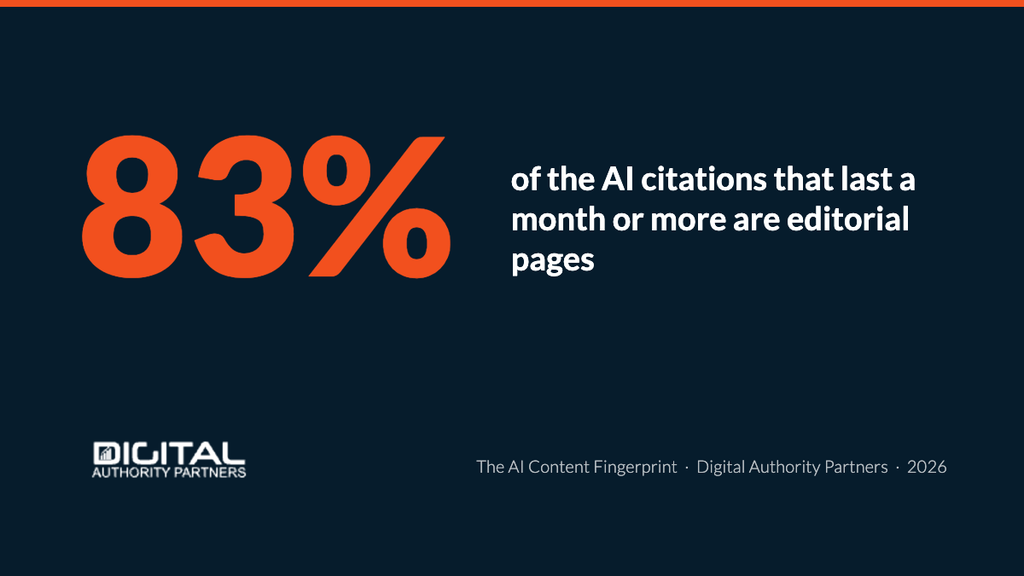
The persistent pages shared a recognizable profile. Of the pages that kept their AI citations across every wave, 83% were editorial articles, and they carried deeper heading structure, more links to credible sources, and richer schema than the average page in the sample. These traits travel together, so the useful way to read them is as one profile of a well-constructed page rather than a checklist of separate levers to pull.
One more trait defined the durable set, and it is the one most worth remembering. The pages AI keeps citing read as human-written. We checked all 74 persistent pages for signs of AI authorship and found none of the usual tells. Of those, 49% were published before ChatGPT launched in November 2022, and another 26% came from institutional publishers where machine writing is unlikely. AI drafting tends to flatten rhythm and vocabulary, and the distinctive expert voice that makes a page worth citing is exactly what flattening erases. A human voice with a point of view is becoming a durable advantage.
The Opening for Brands That Move First
Put the findings together, and a clear strategy emerges. Editorial content that explains your category earns citations at more than double the rate of the sales pages most budgets favor. How you assemble a page rivals the size of your domain, which means you can compete against far larger brands. The trust that AI reads lives at the brand level, in Wikipedia, structured data, and earned media, so that work belongs on your roadmap alongside on-page SEO. Our guide on how GEO differs from SEO shows where the two approaches diverge. The citations that last go to well-structured, editorial, human-written pages that get refreshed on a regular cadence.
The question every client asks, how to get cited by AI, now has a data-backed answer. The brands that publish what AI reaches for will earn the citations, and the window is wide open while most of the market still optimizes for signals AI does not read. Move first, and those citations are yours to claim.
Our full report walks through all of it, from the signal-by-signal breakdown of what predicts a citation to the four-layer AI Citation Content Profile that the durable pages share. It also includes a 90-day playbook for acting on the findings, with a clear who-owns-what split across content, SEO, and PR. The report runs 14 pages, takes about 10 minutes to read, and downloads free with no sales call required.
Download the AI Content Fingerprint study to get the full model, the content-type ladder, and the 90-day roadmap. If you want us to handle the AI content optimization work for you, explore our generative engine optimization services, or schedule a strategy consultation for a read on where your own pages sit against the profile.
Want To Meet Our Expert Team?
Book a meeting directly here

Related Articles

Demand for therapy is at an all-time high, yet nearly half of the 62 million U.S. adults with a mental illness receiv...


The best health apps turn your phone into a daily tool for tracking habits, managing health conditions, and building ...

Your pharma marketing may already be working better than your reports show. In a 2026 NBER study, healthcare marketer...