
Conversational AI in Healthcare: 17 Real Use Cases

Twenty-two percent of Americans now get health information from AI chatbots at least sometimes, yet just 18% of those users call that information highly accurate. That gap is your opening. Conversational AI in healthcare has moved well past the scripted Alexa skills that filled search results back in 2019, and patients have made their preference clear: they want fast, judgment-free answers, but they don’t yet trust what they’re getting.
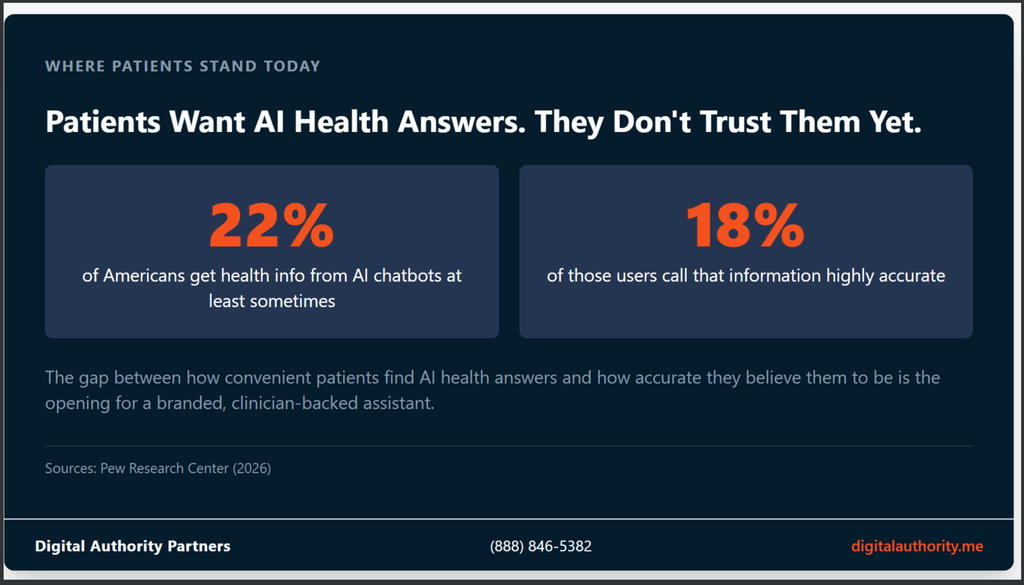
This guide covers 17 use cases working right now across three channels: voice assistants in patient rooms and homes, text chatbots on websites and portals, and generative assistants that blur the line between them. Digital Authority Partners (DAP) serves as your next healthcare marketing agency for more than 200 healthcare organizations, having partnered with more than 200 healthcare organizations to close exactly this kind of trust gap.
What Counts as Conversational AI in Healthcare Today?
“Conversational AI in healthcare” gets used as a catch-all, but it actually covers three distinct channels, each solving a different problem for a different audience. Sorting your use case into the right one saves you from wasting budget on the wrong technology, because the strategy, the compliance burden, and the audience shift completely from one channel to the next. Most digital transformation in healthcare trends treat the three as separate programs for that reason.
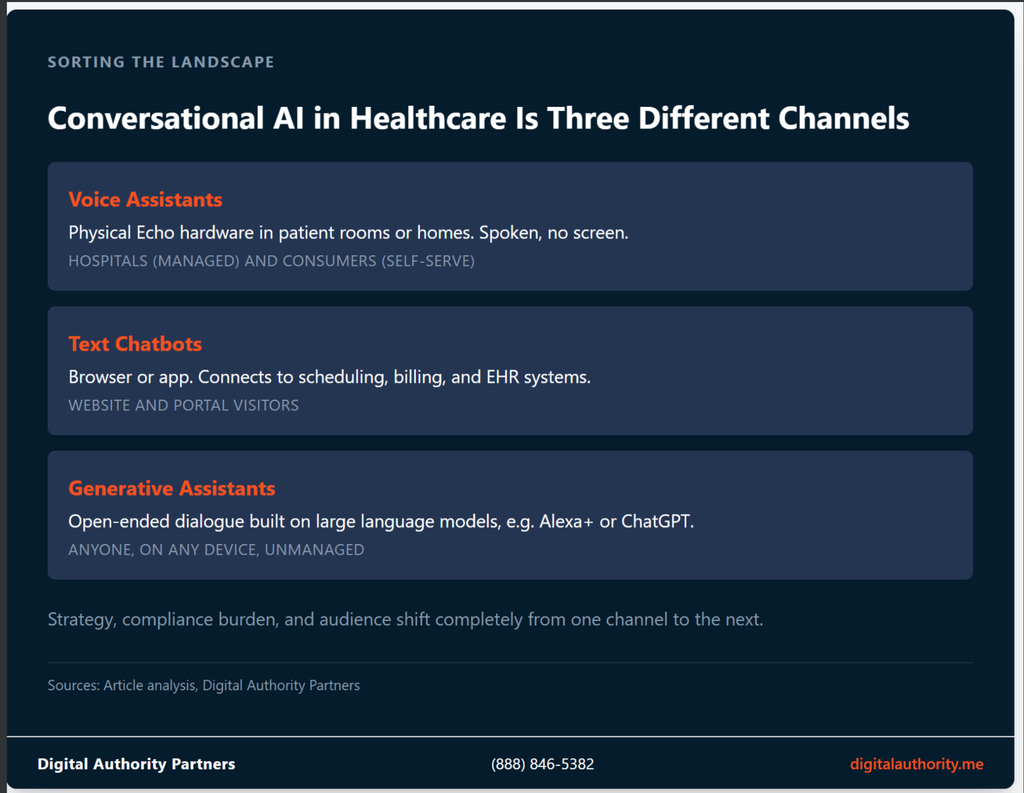
Voice Assistants in Patient Rooms and Homes
This channel runs on physical Amazon Alexa hardware, meaning Echo devices in a hospital room or at home. A patient asks a question out loud, and the device answers, with no screen or app required. Hospitals access it through a managed enterprise program built for healthcare settings, while individual consumers simply buy an Echo and use whatever skills are publicly available. That access difference, managed for hospitals, self-serve for consumers, is what separates a clinical deployment from a home gadget.
Text Chatbots on Websites and Patient Portals
This channel runs in a browser or an app, where the patient types instead of talks. A chatbot connects to your scheduling system, billing platform, and electronic health record (EHR) software, which makes it the workhorse of patient self-service. Most health system websites already have one running.
Generative Assistants That Hold Real Conversations
This third channel replaces scripted command-and-response with open-ended dialogue built on large language models. Amazon’s Alexa+ belongs here, and so does the ChatGPT window a patient opens at midnight to make sense of a lab result. It’s also the fastest-growing of the three, and the one no health system controls.
Much of what people read about Alexa in healthcare a few years ago simply no longer exists. The table below lines up the 2018 and 2019 picture against where things actually stand.
| What People Read About in 2018 and 2019 | Where It Stands Today |
|---|---|
| Third-party HIPAA-eligible skills from Boston Children’s, Livongo, Atrium Health, and Swedish Health Connect | Program closed to new third-party developers in December 2022, with the associated patient data deleted |
| Alexa Together caregiver monitoring subscription | Discontinued in May 2025 and replaced by the narrower Alexa Emergency Assist |
| Alexa patent for detecting colds and flu from a user’s voice | Never shipped as a consumer feature |
| Amazon Care telehealth service | Shut down in 2022 |
| PillPack as a standalone acquisition | Folded into Amazon Pharmacy, still operating as PillPack by Amazon Pharmacy |
| Narrow command-based skills for single tasks | Alexa+ generative assistant, free to United States Prime members since February 2026 |
Where Does Amazon’s Healthcare Business Stand Now?
Amazon has placed several overlapping bets on healthcare, and only a handful directly involve conversational AI. The full picture still matters, because the bets that paid off show you exactly where Amazon will keep investing next.
From Drugstore.com to Amazon Pharmacy
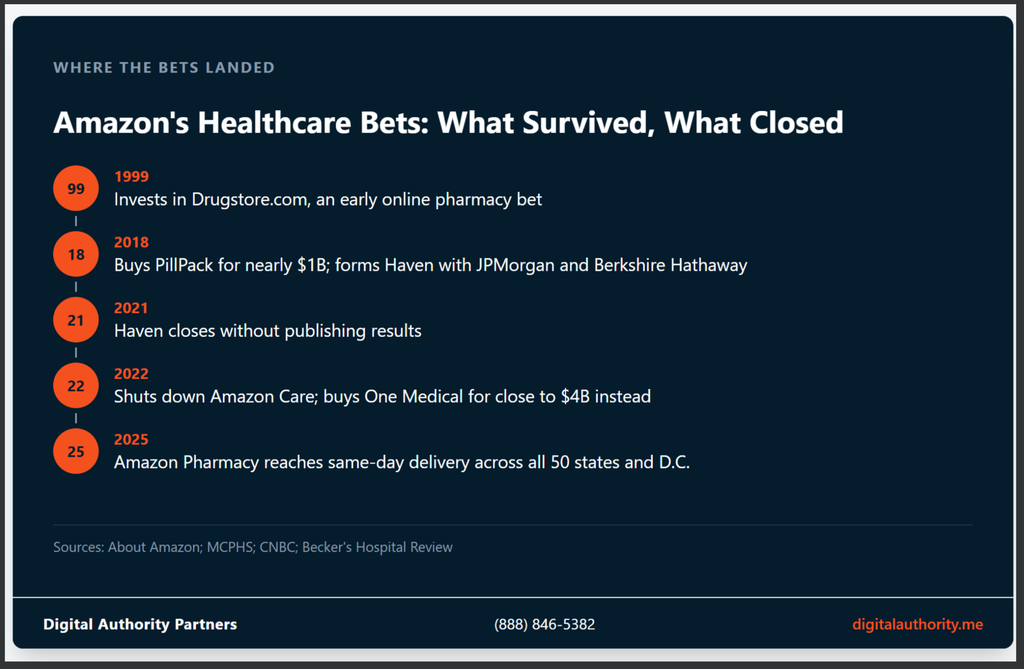
Amazon’s interest in pharmacy goes back further than most people realize. The company first invested in Drugstore.com in 1999 and added to that stake in 2000, but the online pharmacy never turned a profit and eventually shut down under a mix of regulatory and competitive pressure. Amazon returned to the space in 2018 with a nearly billion-dollar PillPack acquisition, buying an online pharmacy licensed in all 50 states and folding it into Amazon Pharmacy.
That pharmacy arm has since become the most active piece of the portfolio. Amazon Pharmacy reached same-day delivery in all 50 states and Washington, D.C., during 2025, with plans to reach nearly 4,500 United States cities and towns by the end of 2026. Delivery methods shift by geography: e-bikes cover Manhattan, while ferries and horses serve remote spots such as Mackinac Island, Michigan.
Telehealth Ventures That Amazon Retired
Not every attempt worked. Amazon joined JPMorgan Chase and Berkshire Hathaway to form Haven in 2018, a venture meant to lower healthcare costs for their combined employees. Haven closed in early 2021 without publishing results.
Amazon then shut down the Amazon Care service in 2022 and bought primary care provider One Medical for close to $4 billion instead. One Medical now integrates with Amazon Pharmacy directly, so patients in Los Angeles can collect prescriptions from kiosks inside clinic lobbies. Membership runs $199 a year. Anyone weighing a similar service should first be clear on the differences between telemedicine and telehealth, since the two carry different licensing and reimbursement rules.
Clinical Data Tools Built for Developers
On the data side, Amazon Comprehend Medical remains active as a HIPAA-eligible service that pulls medications, diagnoses, and other details out of clinical notes and maps them to standard codes such as ICD-10-CM and SNOMED CT. Health systems and pharmaceutical companies, including Fred Hutchinson Cancer Research Center and Roche use it to process clinical text at volume. This is infrastructure rather than a patient-facing assistant. It has quietly outlasted most of Amazon’s louder healthcare launches.
Ideas Amazon Explored but Never Built
In 2018, Amazon filed a patent describing a way for Alexa to detect a cold or the flu from changes in a user’s voice. No Alexa device has ever shipped that feature. Around the same time Amazon explored acquiring Confer Health, a startup building in-home diagnostic kits, but those talks collapsed too.
Neither idea made it to market, and that pattern says something about Amazon’s appetite here. The Centers for Medicare and Medicaid Services reported that national health expenditures reached $5.3 trillion in 2024, or 18% of gross domestic product. Amazon wants a share of that without patients ever opening an app, and conversational AI in healthcare is one of the routes it keeps testing, shipped features or not.
How Do Hospitals Use Voice Assistants in Patient Rooms?
The clearest foothold for conversational AI in healthcare sits inside hospital rooms, through a managed program called Alexa Smart Properties for Healthcare. Hospitals use it to deploy and manage fleets of devices across patient rooms, and it remains active and openly marketed in 2026. The following six use cases are what those deployments actually deliver.
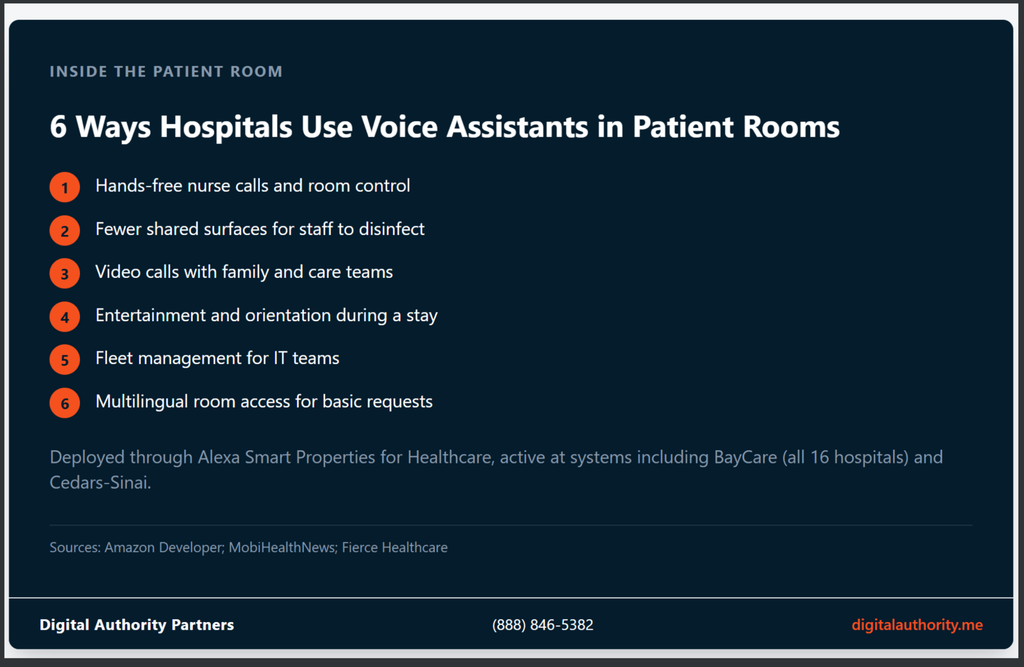
1. Hands-Free Nurse Calls and Room Control
Patients recovering from surgery or living with limited mobility can call for a nurse, adjust the lights, or change the television channel without reaching for anything. Cedars-Sinai staff have described the feature as easier for patients of every age than a traditional remote or call button. The gain is immediate for anyone who physically cannot reach a bedside control.
2. Fewer Shared Surfaces to Disinfect
A voice command replaces a physical remote, a light switch, and a phone handset all at once. That cuts the number of shared surfaces staff disinfect between patients, a benefit hospitals leaned on heavily through and after the COVID-19 pandemic. Infection control teams tend to be the fastest internal champions of a pilot for exactly this reason.
3. Video Calls With Family and Care Teams
Amazon added video calling support for hospitals, which lets patients video call relatives or clinicians from an Echo Show even when the other person is on a phone or laptop. Neither end needs matching hardware anymore. Phone system integration arrived alongside it, routing calls with caller identification so staff know which patient is reaching out before they pick up.
4. Entertainment and Orientation During a Stay
Patients ask for news, weather, music, or the WiFi password, and hospitals report this helps pass the time during longer admissions. It sounds minor next to clinical features. Yet it consistently drives the satisfaction scores that justify the next phase of a rollout, because small comforts are what patients remember about a stay. This is often the first use case that persuades a board that conversational AI in healthcare earns its budget.
5. Fleet Management for Information Technology Teams
Alexa Smart Properties gives hospital technology staff a web dashboard and application programming interfaces to provision, monitor, and update hundreds of devices at once. Usage analytics come with it, so facilities teams can see which features patients genuinely use. Individual device management stopped being viable well before most systems reached a full campus rollout.
6. Multilingual Room Access for Patients With Limited English
Alexa supports multiple languages on compatible devices, which gives hospitals a way to offer basic room control and information to patients who do not speak English. This covers routine requests only. Clinical communication still requires a qualified medical interpreter, and treating a smart speaker as a substitute creates both a safety problem and a compliance one.
Several health systems have deployed the program at meaningful scale. The table below shows who runs it and how.
| Health System | How They Use Alexa Smart Properties |
|---|---|
| BayCare Health System | Deployed across all 16 Florida hospitals as of 2025, covering room settings and hands-free staff communication |
| Cedars-Sinai | One of the earliest large deployments, used for nurse calls and routine patient requests |
| Boston Children’s Hospital | Early adopter of both consumer and hospital-facing programs, including post-surgery recovery tracking |
| Phoenix Children’s Hospital | Gives young patients more control over their stay while reducing routine staff interruptions |
BayCare has taken this deployment furthest, running Alexa in all 16 of its hospitals, and staff report that some patients now expect to find a device in the room. Craig Anderson, BayCare’s director of innovation, said the technology helps position a facility as forward-thinking, which drives patient preference. Amazon states that no voice recordings are stored and that hospitals can disable device cameras entirely. That addresses the objection compliance teams raise first.
What Can Patients Do With Voice Assistants at Home?
Roughly one in three United States adults owns a smart speaker, according to a Pew Research Center survey of 5,119 adults conducted in February 2026, which puts this hardware in more homes than smart thermostats and robot vacuums combined. That installed base is where consumer conversational AI in healthcare actually reaches people. These five use cases work on a personal device today, with no hospital program involved.
7. Medication and Appointment Reminders
Alexa’s built-in reminders and routines let patients set recurring prompts for medications, refills, and appointments without any separate skill. Family caregivers with permission can configure these remotely for a parent who finds a phone app difficult. For maintenance medications taken over years, a spoken prompt in the kitchen beats a notification buried on a lock screen.
8. Hands-Free Emergency Response
Patients living alone can reach emergency services or a designated contact by voice through Alexa Emergency Assist. This covers the safety function that Alexa Together used to bundle with daily activity tracking, before Amazon discontinued that subscription in May 2025. Anyone marketing to families based on the old Alexa Together feature set is describing something Amazon no longer sells. No direct replacement exists for the daily check-in piece.
9. First Aid Guidance From the Mayo Clinic Skill
Mayo Clinic’s First Aid skill still runs on Alexa devices, giving spoken step-by-step guidance for burns, cuts, sprains, and similar everyday injuries. Mayo built it for information only and directs users to seek immediate care for anything serious. It survived the 2022 shutdown precisely because it never touched protected health information (PHI).
10. Chronic Condition Check-Ins Through Connected Devices
Blood pressure cuffs, glucose monitors, and wearables increasingly pair with Alexa so a patient can ask for the latest reading or a trend summary rather than opening another app. Coverage depends entirely on the device manufacturer’s integration, so verify before recommending anything to patients. Chronic disease management was one of the two areas Amazon’s original Alexa health team focused on, alongside maternal health. It remains the strongest consumer fit. Pairing it with the mobile apps in the healthcare industry that already hold a patient’s readings is the practical route in.
11. Fitness, Nutrition, and Mental Wellness Support
Alexa’s wellness skill library covers guided workouts, meditation prompts, and food logging that patients managing weight, stress, or a chronic condition can use hands-free. These skills sit outside HIPAA’s scope because they never handle protected health information, which is exactly why they are still available when the clinical skills are not. The compliance ceiling here doubles as a compliance advantage.
How Do Healthcare Chatbots Serve Patients Online?
Text-based conversational AI in healthcare has taken a quieter path than voice and ended up more widely deployed. Voice assistants in healthcare get the headlines, while the text channel handles the volume. These six use cases are where healthcare chatbots quietly earn their keep.
12. Round-the-Clock Answers Without a Phone Queue
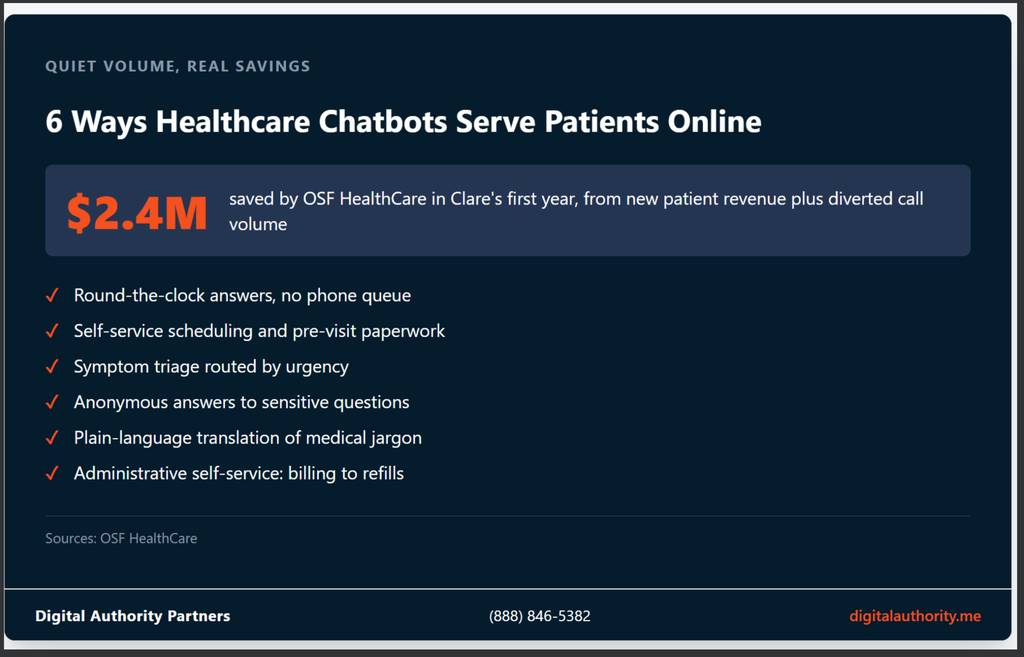
Availability is what patients notice first. A chatbot answers a question about clinic hours, a billing statement, or a medication side effect the moment someone asks, at 2 a.m. or on a Sunday, with no hold music and no callback. OSF HealthCare built its virtual assistant Clare around this idea, letting patients check symptoms, schedule, pay a bill, or reach a live nurse through one interface at any hour. OSF reported $2.4 million in savings during Clare’s first year, drawn from new patient revenue plus call volume diverted from its contact center.
13. Self-Service Scheduling and Pre-Visit Paperwork
Chatbots connected to a scheduling platform let patients book, reschedule, or cancel without calling the front desk, and the better integrations display real-time provider availability rather than a request form. Many also collect medical history and insurance details before arrival, which shortens check-in and retires the clipboard ritual. Automated reminders through the same channel cut no-show rates. Post-visit follow-ups deliver care instructions while they still matter, which is the same mechanic behind marketing telehealth services for providers.
14. Symptom Triage That Routes Patients by Urgency
A symptom checker asks a structured set of questions and recommends a next step, whether that is self-care, urgent care, or an emergency department. Well-built ones categorize inquiries by urgency and say plainly that this is triage rather than diagnosis. That distinction carries more than ethical weight. It has regulatory teeth, and it is the one place where conversational AI in healthcare crosses from marketing into compliance, as the section on rules below explains.
15. Anonymous Answers to Sensitive Questions
Here is the advantage text has that voice structurally cannot match. A patient can ask a chatbot about a sexually transmitted infection, a mental health symptom, or substance use without saying it aloud in a room where family might hear, and without giving a name. Voice assistants broadcast into shared space by design. For entire categories of care where shame delays treatment, the private channel is the only one that gets used at all. That makes text the right first investment for behavioral health, sexual health, and addiction recovery service lines, regardless of how good voice gets.
16. Plain-Language Translation of Medical Jargon
Chatbots break complex terminology into language patients understand, using analogies and everyday comparisons instead of clinical vocabulary. This matters more than it sounds. KFF’s tracking poll found 19% of adults had used AI to get explanations of medical tests, lab results, or diagnoses. Patients are already doing this translation work somewhere, so a health system’s own assistant becomes the version that can be accurate about that system’s own results.
17. Administrative Self-Service From Billing to Refills
The unglamorous category carries the most volume. Chatbots handle patient registration, medication refill requests, insurance verification, billing questions, medical history updates, specialist referrals, and the standing library of frequently asked questions, all without a staff member touching them. Some health systems point the same technology inward, letting employees resolve payroll and leave questions through a bot instead of a human resources queue. Administrative load is a documented driver of clinical burnout, so shifting it returns value well beyond the cost line.
What Do Chatbots Give a Healthcare Marketing Team?
The patient-facing benefits get most of the attention, but the real strategic value is quieter: a chatbot is the only channel on your site where patients tell you, in their own words, exactly what they came for.
Patient Insight That Shapes Your Content Roadmap
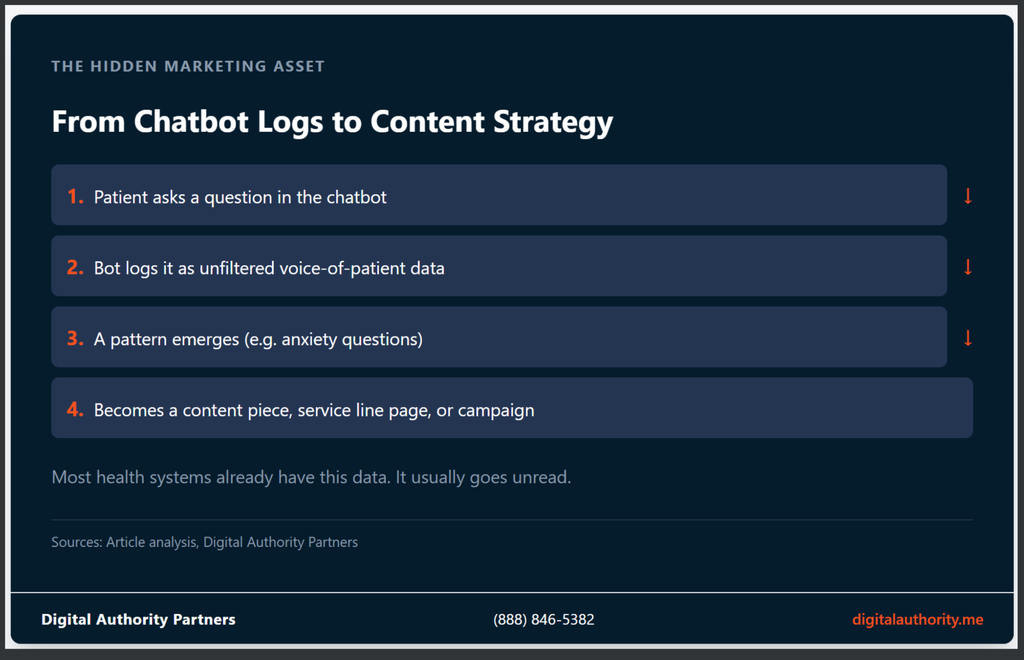
Every conversation doubles as unfiltered voice-of-patient research. If a clinic’s bot logs a steady stream of anxiety management questions, that is a validated signal to build content, a service line page, or a provider recruitment campaign around it, months before that demand surfaces in keyword tools. This is the closest thing to a free research panel most health systems have. It usually goes unread. Most health systems have this data sitting unread. Route those logs into how healthcare content marketing works and a support tool becomes a demand-discovery engine.
Personalization Built on Records and Scheduling Data
Chatbots wired into EHR and scheduling systems can reference a patient’s own appointment history, care plan, or allergy list rather than serving generic answers. An allergy flag can suppress a recommendation that would otherwise be actively unsafe. Patients rate this kind of response as more useful than a static page. It is also where a chatbot starts to resemble a lightweight version of what Alexa Smart Properties does in a hospital room, connecting a conversational surface to systems that already hold the patient’s information.
Lead Capture and Service Line Attribution
Every chatbot conversation produces contact details, stated intent, and a record of which service lines generate the most questions. Tied into your digital healthcare analytics for providers reporting, that data reveals which pages send patients to the bot confused, which is a content problem disguised as a support problem. The catch is that none of this works unless somebody owns the transcripts. In most organizations, nobody does.
Where Do Voice and Text Actually Diverge?
Voice and text solve overlapping problems in different physical situations, so the choice between them is rarely either-or. A chatbot lives on a website or portal: the patient types, and it fits the moment someone is already researching a provider or checking a result online. Alexa lives on a device: the patient speaks, and it fits the moment their hands are busy, in a hospital bed, a car, or a kitchen mid-task.
Privacy is where the two channels genuinely part ways, and the data is uncomfortable for both. This is the trade-off most conversational AI in healthcare planning skips. KFF found that 77% of adults are concerned about the privacy of medical information shared with AI tools, while 41% of AI health users had uploaded personal medical data anyway. Among those who uploaded, 65% remained concerned afterward.
Voice exposes the content of a question to anyone in earshot. Text exposes it to a log file. Patients weigh those two risks differently depending on what they are asking about, which is the real argument for running both rather than picking a favorite.
A health system building a full patient engagement strategy deploys each where it fits: a chatbot for the website and portal funnel, voice for the physical spaces where a keyboard is impractical. Neither replaces the other. Pick one purely because it is cheaper to launch and you usually rebuild inside two years. Our experience across healthcare engagements is that the second channel gets approved faster when the first arrives with clean measurement attached, which is the case for a unified digital experience for patients rather than a sequence of pilots.
How Are Generative Assistants Changing Patient Conversations?
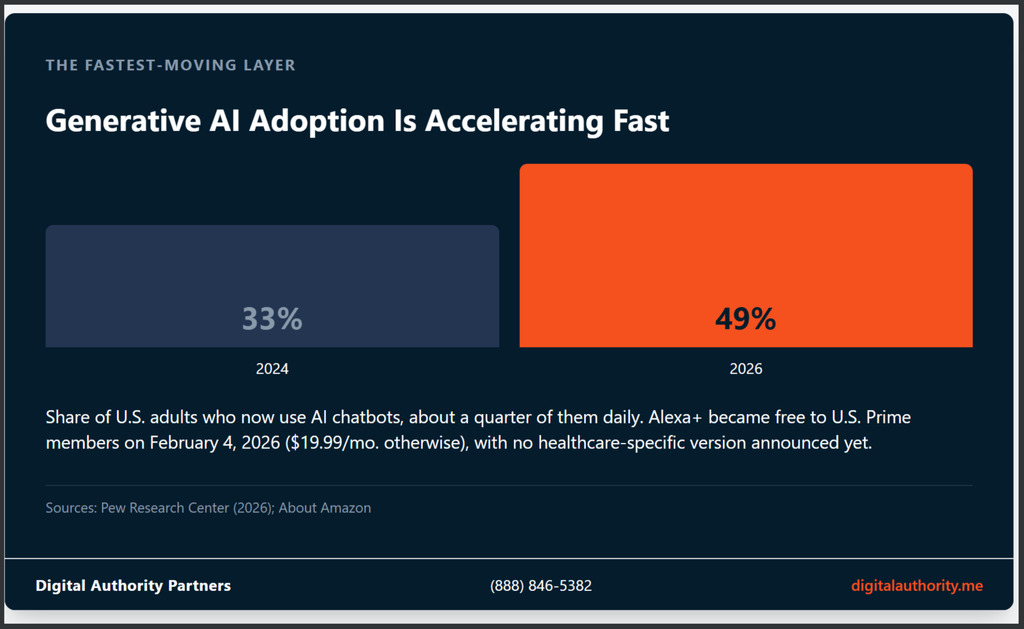
Generative assistants are the fastest-moving layer of conversational AI in healthcare, and the one health systems control least. Pew found that 49% of United States adults now use AI chatbots, up from 33% in 2024, with about a quarter using them daily.
Alexa+ Brings Open-Ended Dialogue Into the Home
Alexa+, Amazon’s generative overhaul of the assistant, became free to all United States Prime members on February 4, 2026, after a year of early access, and costs $19.99 a month for anyone outside Prime. Amazon reported that early access users engaged with it two to three times more than with the original Alexa. No healthcare-specific version has been announced. The conversational format still fits a follow-up question about a symptom or a billing statement far better than the old rigid skill structure ever did.
Patients Already Use General Assistants for Health Questions
Whether or not a health system participates, patients are using these AI assistant tools. KFF’s February and March 2026 poll found 32% of adults had turned to AI for physical or mental health advice, 27% had looked up symptoms, and 16% had used it to decide whether to see a doctor at all. Usage skews young, with 36% of adults ages 18 to 29 using AI for physical health advice.
The trust picture is where the opportunity for conversational AI in healthcare sits. Pew found 48% of chatbot health users call the information highly convenient while only 18% call it highly accurate, and slightly more say it is inaccurate than say it is accurate. DAP’s own AI visibility gap study found that ChatGPT returned zero citations on 97% of your-money-or-your-life queries covering health, legal, and financial topics.
These assistants routinely answer health questions confidently without showing a source, and patients notice. A branded assistant carrying your clinicians’ names answers a problem patients have already identified themselves. The full AI visibility study for 2026 breaks down which sources these engines do cite.
Clinicians Use Generative Tools to Draft Patient Replies
Adoption on the provider side has outpaced most forecasts. The American Medical Association’s 2026 survey of nearly 1,700 physicians found that 81% now use AI professionally, more than double the 2023 figure. Some 19% use it to draft responses to patient portal messages, and 70% view it as a way to automate the tasks that drive burnout.
Patients accept this with one firm condition. A JAMA Network Open study published in July 2026 found that patients described AI drafting as acceptable only where a clinician reviews, corrects, and stays accountable for the message, and all 40 participants wanted to be told AI was involved. Physicians hold their own reservations, with 88% of AMA respondents concerned about erosion of clinical skill and nearly half strongly opposed to patients using AI to interpret radiology or pathology results.
Prescription Chatbots Reach the Regulatory Frontier
The clearest signal of where this goes next arrived in 2026. The Food and Drug Administration (FDA) granted breakthrough status to RecovryAI, a large language model chatbot prescribed to patients for the 30 days after joint replacement surgery. The designation doesn’t mean RecovryAI is approved yet, only that the FDA has agreed to work with it more closely on the path there. The chatbot checks in twice daily about sleep, activity, and diet, answers questions, then escalates to a care team when something looks wrong.
A prescribed conversational assistant is a genuinely new category. It sits a long way from a website widget answering questions about parking. It’s worth tracking alongside the other top digital health trends 2026 brings.
What Do the Rules Say About Conversational AI in Healthcare?
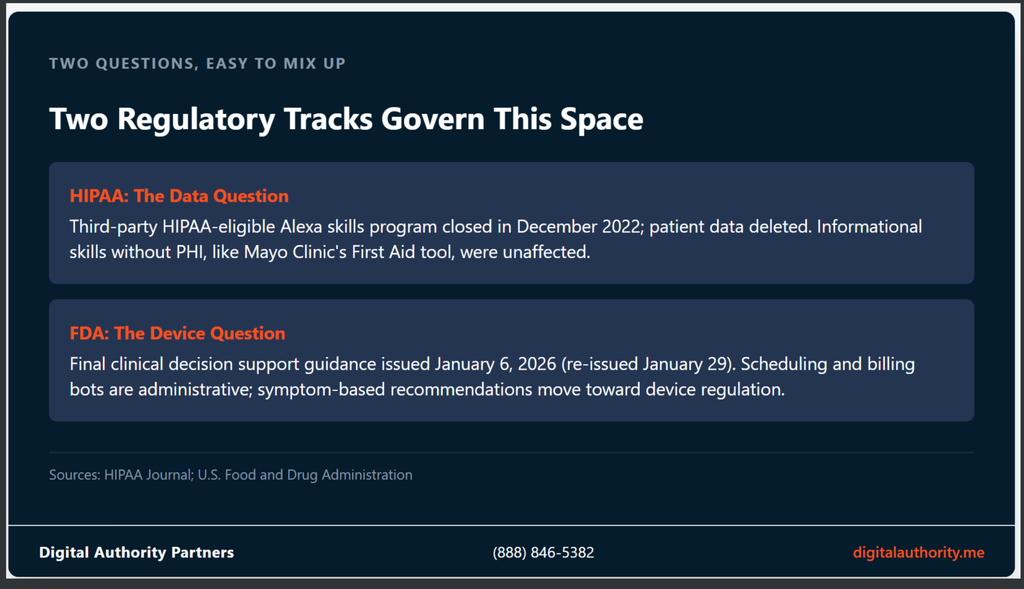
Two separate regulatory questions govern this space, and mixing them up is the most common, and most expensive, mistake a marketing team can make. One question is about patient data. The other is about whether your assistant counts as a medical device.
HIPAA and the End of Third-Party Health Skills
If you remember Alexa skills from Boston Children’s Hospital, Livongo, Swedish Health Connect, Cigna, Atrium Health, or Express Scripts that could exchange protected health information, those specific skills no longer work. Amazon ended its invite-only HIPAA-eligible Alexa skills program in December 2022, deleted the associated patient data, then stopped supporting it.
Amazon had launched that program in April 2019 with six skills covering urgent care scheduling, chronic condition monitoring, and post-surgery recovery, positioning it as the start of a healthcare ecosystem. Three years later, it walked the program back rather than expanding it, which suggests the invite-only model never scaled the way Amazon expected.
The shutdown only touched skills handling protected health information under a business associate agreement. Informational skills such as Mayo Clinic’s First Aid tool were unaffected and still run. For a chatbot, the equivalent requirements are HIPAA compliance with documented certification, encrypted transmission, informed consent before collecting health data, data minimization, plus a privacy policy patients can actually find. The mechanics closely mirror HIPAA-compliant texting for apps. Every message the bot sends also falls under the broader rules for healthcare digital marketing and HIPAA.
The FDA Line Between Administrative and Clinical Tools
The regulatory picture shifted meaningfully this year. FDA issued a final clinical decision support software guidance on January 6, 2026, re-issued on January 29, clarifying which decision support functions fall outside the definition of a device under the 21st Century Cures Act and which remain regulated.
The practical read for a marketing or digital team is straightforward. A chatbot that schedules appointments, verifies insurance, or answers billing questions is administrative and falls outside device regulation. A tool that recommends a course of action based on a patient’s symptoms moves toward the line. FDA states explicitly that its digital health policies still apply to software intended for use by patients or caregivers, so patient-facing triage is not automatically exempt. Build the symptom checker with your compliance and regulatory teams in the room from the first scoping call rather than after launch.
Frequently Asked Questions About Conversational AI in Healthcare
These questions come up consistently once the use cases are clear. Each one covers ground the sections above do not, from budgeting a pilot to measuring whether conversational AI in healthcare is paying for itself.
How Long Does a Hospital Voice Deployment Take to Pilot?
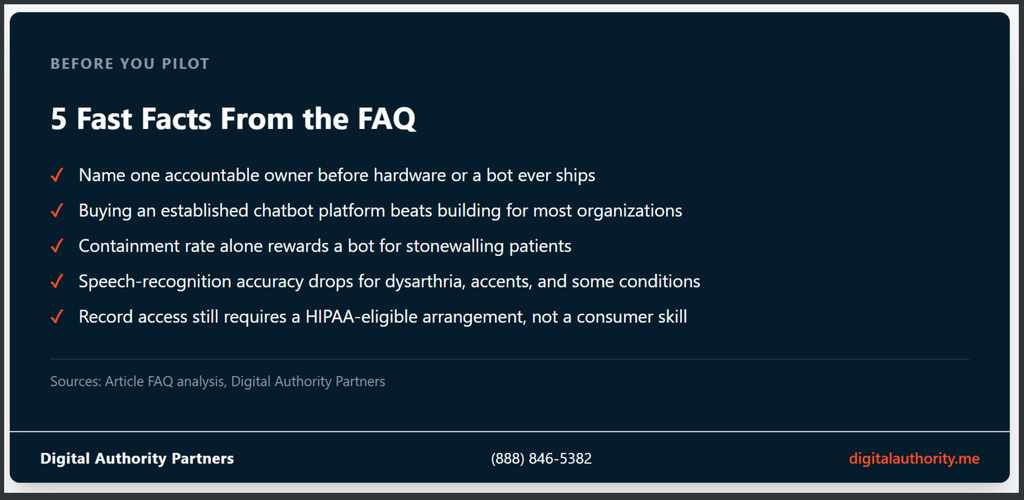
Amazon does not publish standard pricing or timelines for Alexa Smart Properties for Healthcare, and costs vary with device count, custom skill development, and which solution provider a system engages. Health systems typically start with a limited number of rooms before scaling, following the pattern BayCare and Cedars-Sinai used. Treat the first phase as a facilities and patient experience project rather than a technology purchase, because the operational questions around cleaning, theft, and device replacement surface faster than the technical ones.
Who Owns a Conversational AI Project Internally?
Ownership is the most common reason these projects stall. Voice deployments need facilities, information technology, infection control, and compliance aligned before hardware is ordered, while chatbots need marketing, patient access, and whoever administers the scheduling platform. Name a single accountable owner at the start. That prevents the standoff where a bot goes live, and no team reads its transcripts.
Can a Patient Use Alexa to Access Their Medical Records?
Not through a standard consumer skill. Real record data requires a HIPAA-eligible arrangement built directly with Amazon under a business associate agreement, which is available inside hospital deployments and not through the public skills store. Patients wanting record access are better served by a portal, which is also where a chatbot can help them navigate.
Do Voice Assistants Work for Patients With Speech Differences?
Recognition accuracy drops for patients with dysarthria, strong accents, or conditions affecting speech, and this is a real accessibility limit rather than a temporary gap. Any deployment serving neurological, stroke recovery, or geriatric populations should keep conventional call buttons and screen-based alternatives in place alongside voice. Two routes to the same request is the accessible answer.
Should a Healthcare Organization Build or Buy a Chatbot?
Buying an established platform and integrating it is the right call for the large majority of organizations, because the compliance certifications, EHR connectors, and escalation logic are the expensive parts and they already exist. Custom builds make sense where a service line has a genuinely unusual intake process. For most teams adopting conversational AI in healthcare, the build-versus-buy question matters far less than who maintains the conversation flows after launch.
How Do You Measure Whether Any of This Is Working?
Containment rate, meaning the share of conversations resolved without a human, is the standard operational metric, and on its own it rewards a bot for stonewalling patients. Pair it with escalation quality, appointment completion, and call volume diverted, then track no-show rates for appointments booked through the assistant against those booked by phone.
OSF’s reported $2.4 million figure came from combining diverted call volume with new patient revenue rather than one number alone. Measurement is a reporting exercise before it is a technology one, so 10 digital healthcare analytics for providers belongs in the project plan from week one.
Does Conversational AI Help or Hurt Search Visibility?
Chatbot content sits behind an interface and is not itself indexable, so it contributes nothing directly to organic rankings. The indirect effect is real, because transcripts reveal the questions patients ask in their own phrasing, which is the raw material for pages that do rank. Working with a healthcare SEO agency for providers to convert recurring bot questions into indexable content is where the search value actually comes from. The same transcripts also feed voice search SEO marketing strategy, since spoken queries follow the same conversational phrasing.
Build Your Conversational AI Strategy Around Both Channels
The organizations getting real returns here stopped treating voice and chat as competing technology purchases and started treating them as two doors into the same patient relationship, which is why their pilots survive a second budget cycle. Conversational AI in healthcare rewards the team that picks a channel on evidence rather than on launch cost.
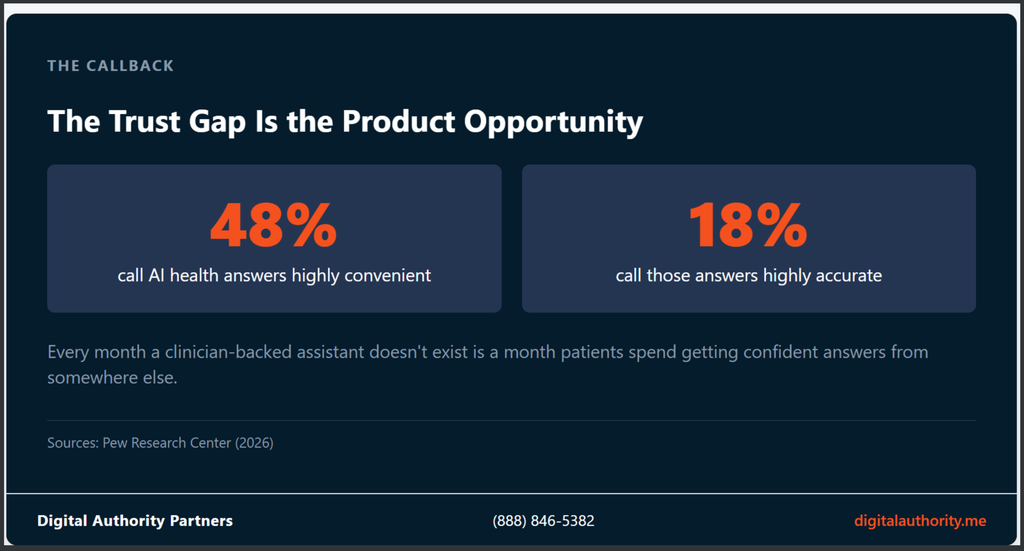
That reframes the number this article opened with. Patients finding AI health answers convenient but not accurate is not a reason to wait for the technology to mature, because the trust gap is itself the product opportunity. The assistant carrying your clinicians’ authority is the only one positioned to close it. Every month it does not exist is a month your patients spend getting confident answers from somewhere else.
Schedule a consultation with the Digital Authority Partners healthcare team to map where a hospital voice pilot, a patient-facing chatbot, or a generative assistant strategy fits your organization’s next 12 months. Our team will show you which channel your patients already reach for, what it costs to run properly, and how to turn conversation data into content that brings the next patient through the door. For a wider view of how artificial intelligence in healthcare is reshaping clinical and administrative work beyond conversation, that guide covers the shift in depth.
Want To Meet Our Expert Team?
Book a meeting directly here

Related Articles

AI in digital health has moved from research labs into daily care. A phone camera can now screen for diseases that on...

Patients rarely choose a doctor the way they did 10 years ago. Before they call your office, they search, read review...

Most people looking for a dentist begin in the same place: the search bar. A 2026 Pew Research Center study found tha...