
Creating an Amazing Content Marketing Strategy for Dentists

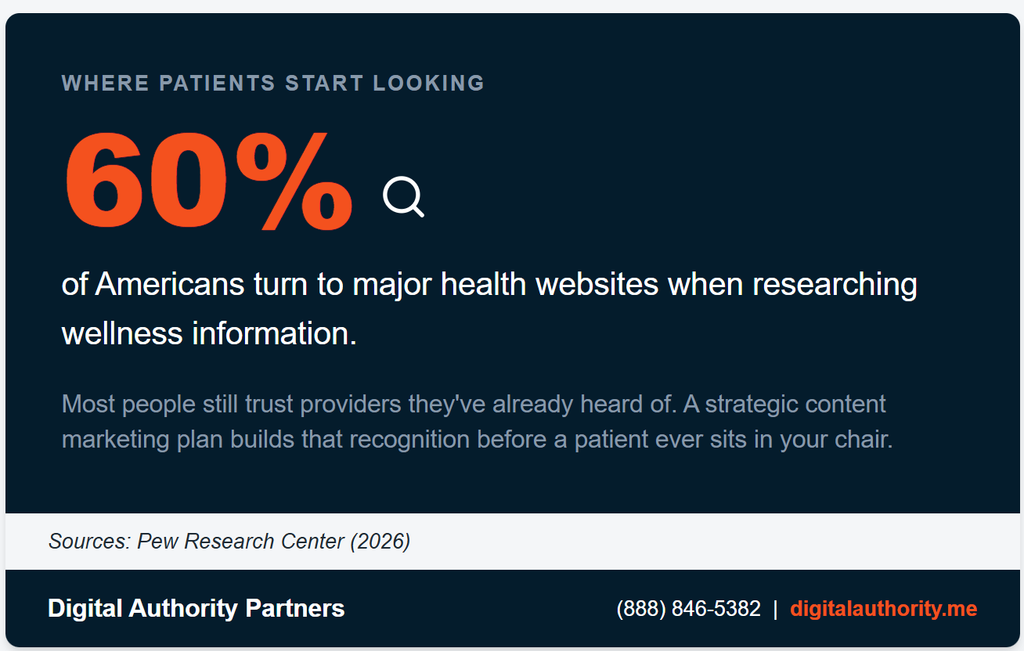
Most people looking for a dentist begin in the same place: the search bar. A 2026 Pew Research Center study found that 60% of Americans turn to major health websites for wellness information. Most still place their trust in providers they already know, and you can earn that trust long before someone sits in your chair. A strong dentist content marketing strategy is how you get there.
In this guide, you’ll get a clear definition of dental content marketing, five strategies that consistently attract new dental patients, a simple way to measure your results, and the patient-privacy habits that keep your practice credible. Each strategy is ready to put to work in your practice this week.
How Does Content Marketing Turn Dental Searches Into Booked Patients?
Content marketing for a dental practice means publishing the answers patients already search for, before they ever call your office. A patient comparing invisible aligners to metal braces, or researching a chipped tooth, is deciding who to trust weeks before they book. Many of these searches happen on a phone, often late at night, and the practice with a clear, reassuring answer is the one that earns the saved bookmark or the morning phone call.
The practice that answers those questions first usually earns the appointment. You meet patients at the exact moment they are deciding where to go, right when your answer matters most. Done well, marketing your dental practice with content works in three ways:
- Creates brand awareness by showing up in your community’s search journey.
- Advertises your expertise through clear, informative posts and resources.
- Attracts new patients by explaining the services you offer and why they matter.
At Digital Authority Partners (DAP), we’ve watched educational content outperform hard-sell advertising for healthcare clients time and again. Better still, most of these tactics, from increasing site traffic with content to SEO marketing techniques for dentists, cost little more than your time and consistency.
Why Does Content Marketing Work for Dental Practices?
Dental care isn’t optional, but which dentist gets the appointment is a choice patients now make online. A 2024 study in the National Library of Medicine reported that about 65% of U.S. adults had recently visited a dentist. Patients are clearly looking, and content marketing helps them find you first.
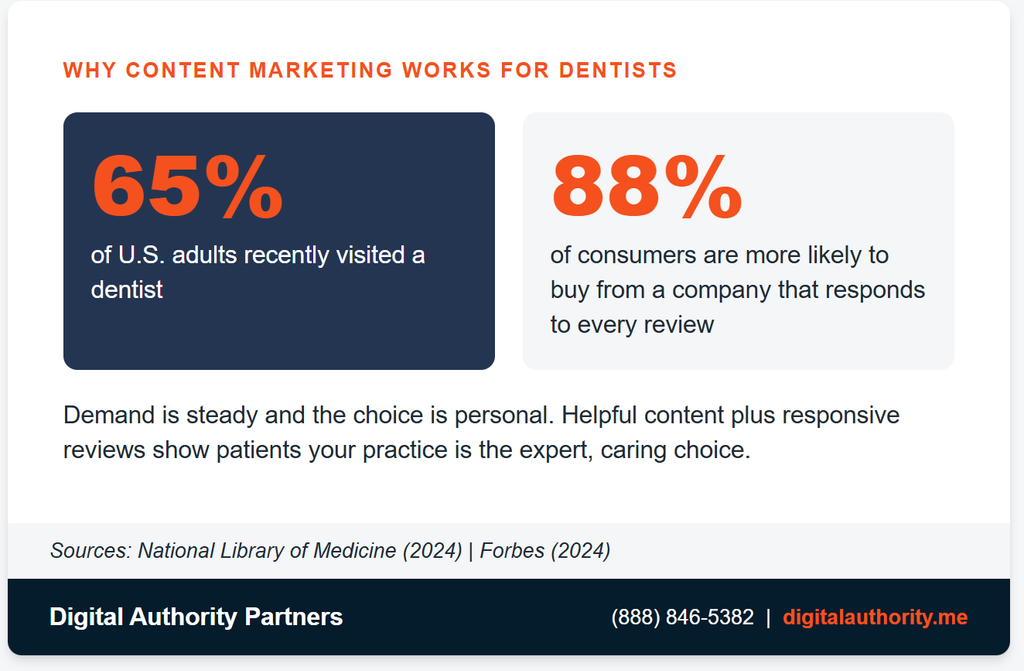
Reviews often settle that choice. A 2024 Forbes report on reviews found that 88% of consumers are more likely to choose a business that responds to all of its reviews, positive or negative. For a dental practice, that means every reply to a Google review does double duty: it reassures the patient who wrote it and nudges everyone still comparing dentists toward booking with you.
In our healthcare work at DAP, the practices that pull ahead answer patient questions clearly and consistently, month after month, until search engines and patients both treat them as the local authority. That authority builds slowly and pays off for years. It also protects you from competitors, because a deep library of trusted answers is far harder to displace than a single ad campaign.
This is where content marketing for a dental practice pays off. Every blog post, profile, and video answers a real question and leaves a trail back to your practice. Over time, those answers convert into rankings, reviews, and a steady stream of new patients.
5 Dentist Content Marketing Strategies That Attract Patients
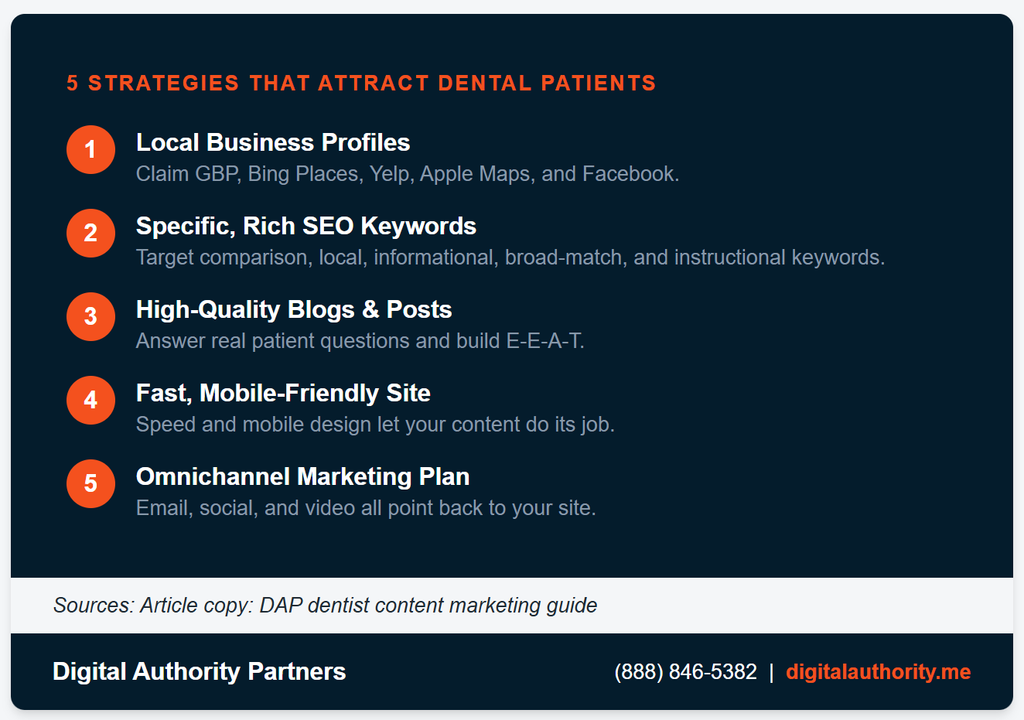
Here are five strategies your dental practice can put to work today. Each one also builds in the SEO that dentists need to rank, and each one explains how and why it works.
1. Create Local Business Profiles
Appearing in local searches is one of the most impactful wins in content marketing for dentists. When someone searches for a nearby clinic, claimed profiles put your name, hours, and reviews right where they are looking. Search engines are not the only tools patients use, so claim or set up profiles across the platforms they trust:
- Claim your Google Business Profile, which also controls how you appear on Google Maps.
- Set up Bing Places for Business to reach Bing, Yahoo, and Microsoft Copilot’s local answers.
- Claim your Yelp business page.
- Verify your Apple Business listing, the platform Apple renamed from Apple Business Connect in 2026, to control how you appear on Apple Maps.
- Manage pages in Meta Business Suite for your Facebook and Instagram presence.
Consistency matters most: your name, address, and phone number should match exactly across every platform, since search engines read conflicting details as a sign of an unreliable listing.
Complete profiles make you easy to find and easy to choose. Patients who look for nearby clinics see your reviews, hours, contact details, and photos before they call. Keep every listing current, and invite happy patients to leave reviews. These organic listings pair well with paid efforts, too: PPC attracts new dental patients quickly, while the trust you build through profiles and reviews keeps them coming back.
2. Use Specific, Rich SEO Keywords
The right keywords draw the right attention from search engines. Focus on the terms real patients type when they are deciding where to go. These types work well for a dental content marketing plan:
- Comparison keywords: Patients weigh their options before booking, searching phrases like dental implants vs. dentures to decide which treatment fits their needs.
- Local keywords: Location terms like San Diego dental clinic anchor you in local results. Include two or three nearby cities you serve.
- Informational keywords: People research procedures, so target phrases like types of dental fillings.
- Broad-match keywords: Specific phrases such as ceramic braces for adults capture patients who already know what they want, and these terms often convert better than broader searches.
- Instructional keywords: Prioritize educational searches like how to floss properly and what to expect during a root canal.
A bonus of these terms is that most are long-tail, meaning four words or more. The more specific the keyword, the lower the search volume, and the higher your odds of ranking and reaching a patient who is ready to book.
3. Write High-Quality Blogs and Posts
Writing great dental content is one of the best ways to show your expertise. Producing content is faster than video, and you can keep the quality high. Strong marketing content for dentists makes your website appealing for three reasons:
- Well-made content tells search engines and patients that you understand your subject deeply.
- Content that experts and readers reference signals authority in your field.
- Accurate, reliable content builds the trust that medical topics deserve.
Google evaluates content based on Experience, Expertise, Authoritativeness, and Trustworthiness (E-E-A-T). Google added Experience in 2022 to reward first-hand knowledge, a natural advantage for practicing dentists. You can meet that bar without sounding like a research paper by using accessible formats that do the job well:
- How-to posts for everyday dental care.
- Guides to common procedures and what to expect.
- Comparison and ranking lists patients can act on.
Group related posts into topic clusters, where several supporting articles link back to one in-depth service page. Clusters show search engines you cover a subject thoroughly, and they guide patients from a general question toward the treatment page where they can book.
Even your best writing only works when patients can reach it quickly, which puts the spotlight squarely on how your website performs.
4. Make Your Website Fast and Mobile-Friendly
Search engines reward sites that give people a great experience, and phone speed is a big part of that. Google reads the mobile version of your site first, so a fast, mobile-friendly design directly supports your content marketing for dentists. A few mobile-first guidelines get you started:
- Keep booking buttons and phone numbers visible without scrolling, and give each page one clear next step.
- Match Google’s recommended mobile load times by optimizing photos and images.
- Use original, high-quality images that stay crisp on mobile screens.
A fast, welcoming site lets your great content do its job. A mobile-friendly site helps you avoid dental website mistakes and keep patients moving toward an appointment.
5. Build an Omnichannel Marketing Plan
Patients move between email, social media, and video before they ever call your office, so your content should show up in each place. As part of your plan, a dental practice might:
- Email potential leads about free consultations for first-time patients.
- Post special prices or discounted services on the clinic’s Facebook page.
- Share short, helpful videos on the clinic’s YouTube or Instagram.
Video works harder than the other channels because patients can see your team and your office before they ever call. A friendly two-minute clip that walks a patient through a procedure provides the same reassurance as a first phone call, making video one of the most persuasive tools in dental practice content marketing.
The goal is to publish content built for each platform and point every touchpoint back to your website, where patients can book a visit, ask a question, or request a quote.
Which Content Should a Dental Practice Create First?
You don’t have to do everything at once. When we onboard a new dental or healthcare client, we sequence the work so the fastest wins come first and early momentum funds the rest. A smart content marketing plan for dentists usually follows this order:
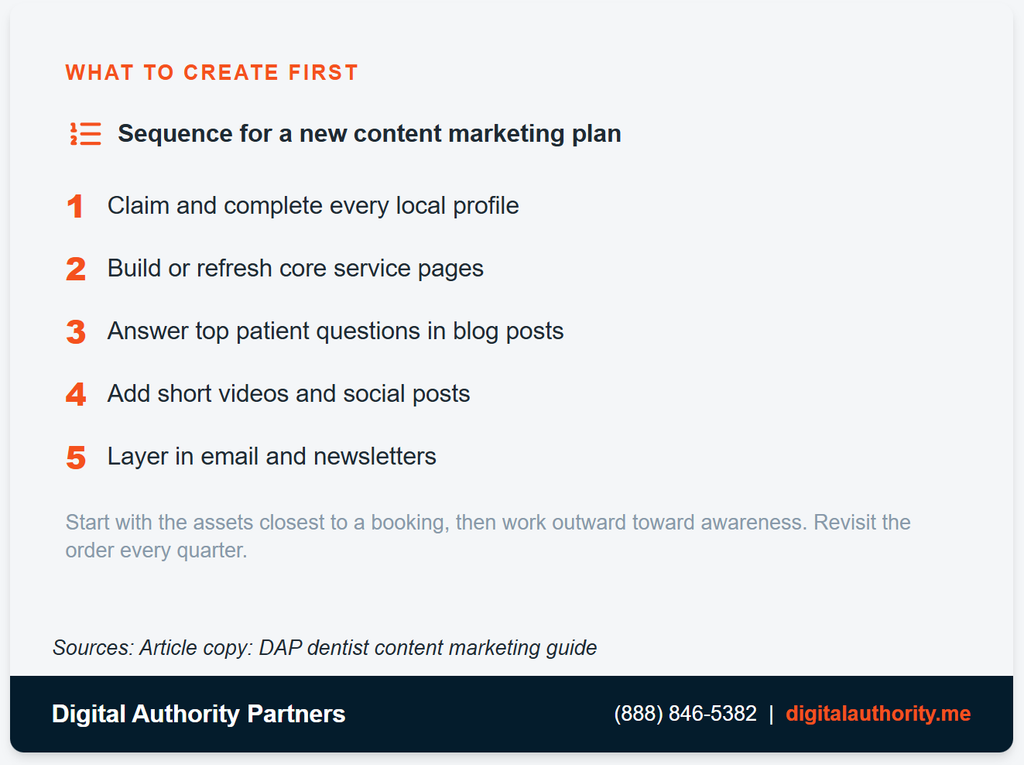
- Claim and complete every local profile, since this is the quickest path to visibility and reviews.
- Build or refresh your core service pages so each treatment has a clear, optimized home.
- Answer your top patient questions in blog posts, starting with the ones that lead to booking decisions.
- Add short videos and social posts that repurpose the content you’ve already written.
- Layer in email and newsletters to keep past patients coming back and referring others.
Start with the assets closest to a booking, then work outward toward awareness. A new practice building visibility should weigh local profiles and service pages first. An established practice with steady traffic can invest earlier in blogging and video, where the payoff is authority and reach.
Revisit this order every quarter. Your rankings, reviews, and patient mix will shift every few months, so reassess which content type deserves attention next. A quick quarterly review keeps your effort focused on what moves the needle right now.
How Do You Measure Content Marketing Success?
Measuring results turns guesswork into an actionable strategy. The good news is that content marketing for a dental practice is easy to track, so you can see which topics and channels fill chairs. Focus on the outcomes that grow your schedule, and watch these signals month over month:
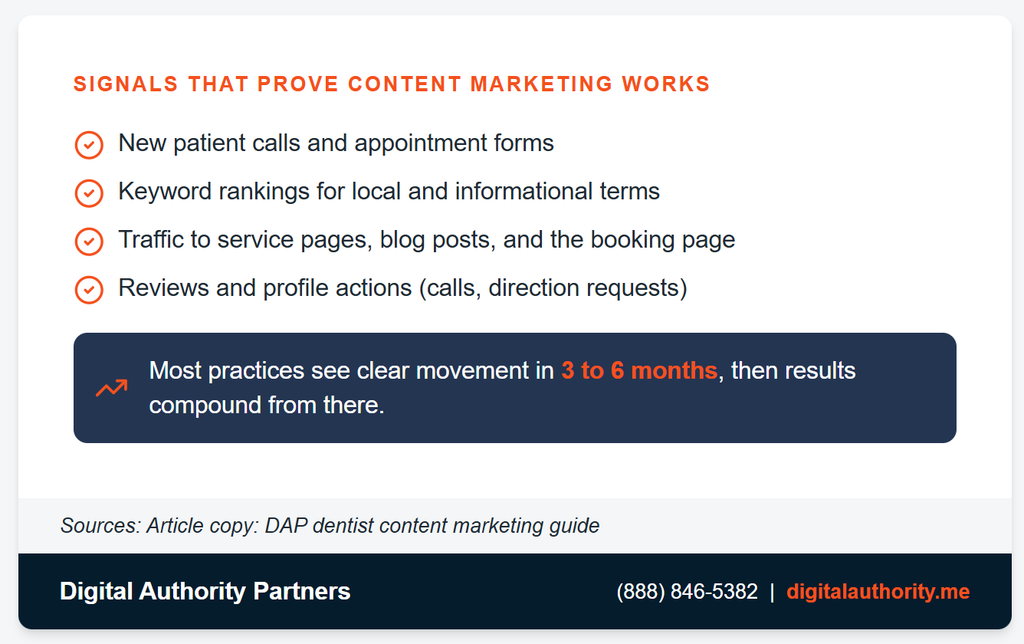
- New patient calls and forms: track calls and appointment requests from organic search and each profile.
- Keyword rankings: monitor the local and informational terms you’re targeting.
- Traffic to key pages: watch service pages, top blog posts, and your booking page.
- Reviews and profile actions: count new reviews and clicks to call or get directions.
A few free tools make this straightforward. Google Business Profile insights show how many patients called or asked for directions, Google Search Console reveals which queries bring you traffic, and a dedicated call-tracking number ties phone bookings back to the page that earned them. Check these dashboards once a month, and pair them with a quick note of how many new patients mention finding you online, so the numbers connect back to real appointments.
Content and SEO usually show clear movement in three to six months, then compound from there. When a topic drives calls, write more like it. When a channel goes quiet, move that time to a channel with better returns. Expect gradual, compounding gains that build quarter over quarter, and judge progress by the trend line across several months.
How Do You Keep Dental Content Compliant?
Marketing a dental practice comes with clear rules, and following them protects both your patients and your reputation. Patient privacy sits at the center of dental marketing. The Health Insurance Portability and Accountability Act (HIPAA) governs how you handle protected health information, so treat any patient detail, image, or review response as regulated until you have written permission to use it. The American Dental Association offers helpful ADA marketing and advertising guidance rooted in its code of professional conduct. Build these habits into your dental content marketing from day one:
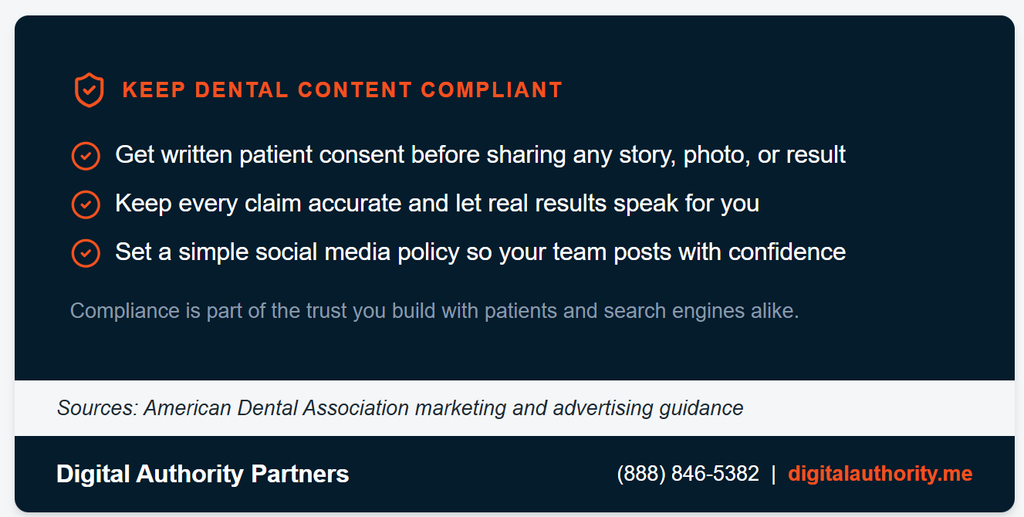
- Get written patient consent before you share any story, photo, or treatment result.
- Keep every claim accurate, and let real results speak for you.
- Set a simple social media policy so your whole team posts with confidence.
- Respond to reviews without confirming that someone is a patient, since even acknowledging treatment can disclose protected information.
Compliance is part of the trust you build. It keeps your content credible with patients and search engines alike.
Frequently Asked Questions
Still weighing whether content marketing is worth the effort for your practice? These are the questions dentists ask us most:
Does Content Marketing Help Dentists Rank on Google?
It does. Helpful, well-structured content gives Google relevant pages to rank, while local profiles and reviews strengthen your presence in map results. Paired with a fast, mobile-friendly site, content marketing for dentists is one of the most reliable ways to climb the local search rankings.
How Do You Do Social Media Marketing for Dentists?
Post consistently, share genuine value, and tailor each post to the platform. Short educational videos on oral hygiene and common procedures perform especially well. Answer common questions on camera so patients get to know and trust your team before they ever visit.
Is Blogging Still Worth It for Dentists?
Yes. A well-run blog remains one of the most cost-effective parts of content marketing for your dental practice. It builds topical authority, answers patient questions, and gives search engines fresh, relevant pages to rank. Focus on quality and helpfulness over volume.
How Often Should Dentists Publish Content?
A steady cadence beats occasional bursts. Many practices do well with one quality blog post every week or two, a few social posts a week, and current profiles. In dental content marketing, the consistency you can sustain wins.
Turn Dental Content Into New Patients
Your future patients are already searching, reading reviews, and comparing dentists online before they call. Content marketing is how your practice shows up in those moments and earns the appointment. Start local, because claimed profiles and reviews put you in front of nearby patients first, then write for people, because helpful, accurate content builds the trust that turns readers into booked patients.
Reach patients across search, social, email, and video, track the calls and appointments that matter, and protect patient privacy with ADA-aligned habits in every post. A consistent content marketing program for your dental practice compounds over time, turning one-time searchers into loyal patients.
Ready to fill more chairs? Digital Authority Partners builds content marketing for dentists that ranks, educates, and converts for dental and healthcare practices. Work with our SEO experts to map a plan around your services, your city, and your goals. Tell us where you want to grow, and we’ll show you the best path there.
Want To Meet Our Expert Team?
Book a meeting directly here

Related Articles

Demand for therapy is at an all-time high, yet nearly half of the 62 million U.S. adults with a mental illness receiv...


AI in digital health has moved from research labs into daily care. A phone camera can now screen for diseases that on...

Nearly every local search ends in one of three spots. The U.S. has 8.3 million business establishments, and 7.1 milli...