
How Healthcare Content Marketing Works for You And Your Patients

Most patients start with a search, not a phone call. They type their symptoms into Google, compare providers online, and read reviews long before they consider dialing your office. A strong healthcare content marketing program answers those searches with real information, exactly when someone needs it. Good marketing is how you earn trust and turn an online search into a scheduled visit.
The same articles that educate a worried parent at midnight also feed your search rankings. Pairing content with healthcare SEO keeps your practice visible as patient behavior shifts toward search and AI tools. In this guide, you’ll learn what this approach involves and the benefits it delivers. You’ll also see two real examples of content that performs and the four steps to build a campaign that works.
The Emergence of Healthcare Content Marketing
Healthcare content marketing grew alongside the health-conscious internet user. As broadband access spread and search engines became the default first stop for medical questions, patients started researching symptoms and treatments before they ever called a doctor. Hospitals, medical journals, and health organizations responded by publishing accessible information online, giving patients a reliable alternative to guesswork.
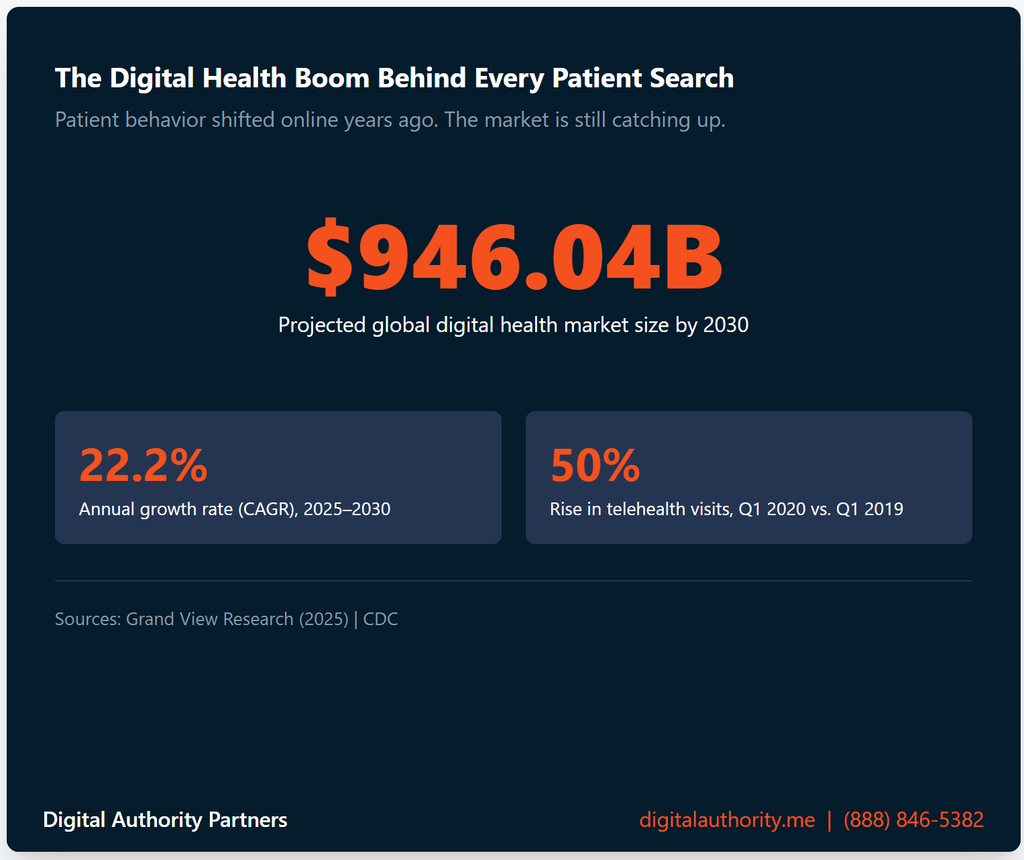
The Centers for Disease Control and Prevention tracked how fast that shift accelerated during the pandemic: telehealth visits rose 50% in the first quarter of 2020 alone compared to the same period in 2019. Patients who got comfortable making health decisions on a screen during that period have largely stayed that way.
The 2025 Grand View Research report Digital Health Market Size To Reach $946.04 Billion By 2030 captures the trajectory of healthcare marketing. It projected the global digital health market will reach $946.04 billion by 2030, a 22.2% annual growth rate from 2025.
Healthcare organizations that publish genuinely useful content are best positioned to capture that growth, since patients increasingly research their options online before they ever call a provider. A well-developed healthcare marketing program reaches more patients, educates them, and positions you as the expert you already are. Practices that publish consistently build a library of content that keeps compounding, with each new page adding to the authority of the last.
What Healthcare Content Marketing Involves
Healthcare content marketing means publishing the information patients are already searching for, then using it to build trust before they ever contact your practice. The content you create to reach patients can take several forms:
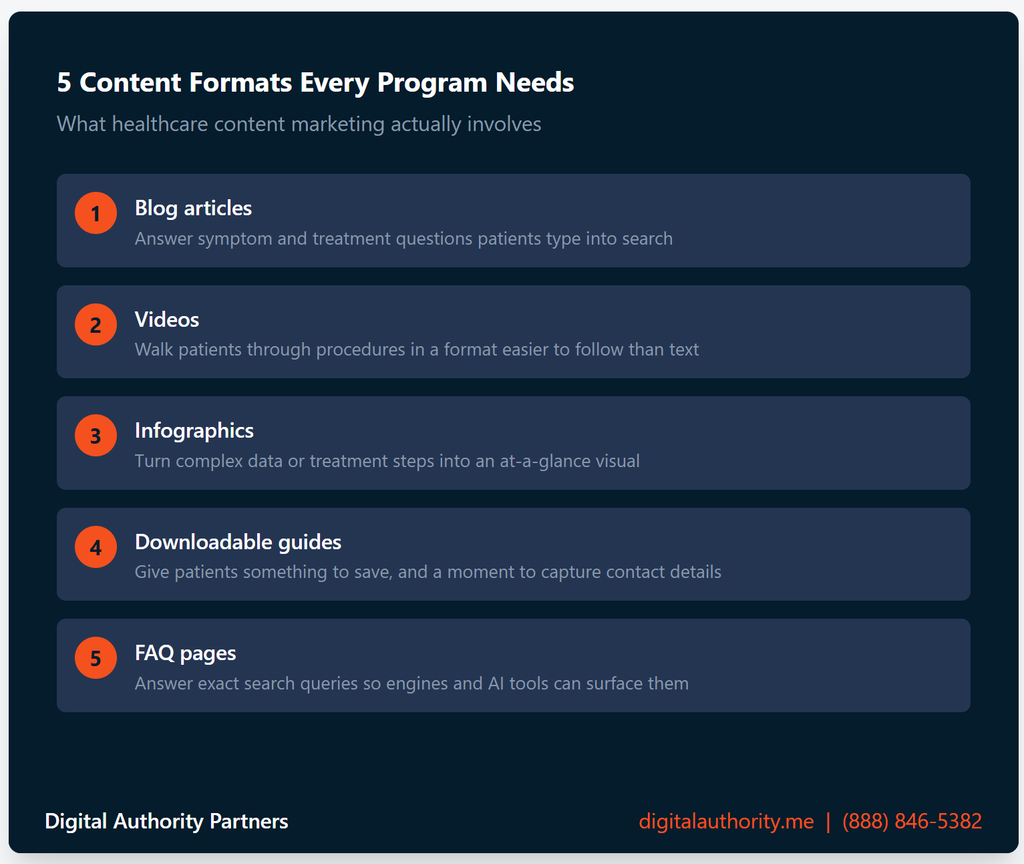
- Blog articles: Answer the specific questions patients type into search engines, from symptom explanations to treatment comparisons.
- Videos: Walk patients through procedures or conditions in a format that’s easier to follow than text alone.
- Infographics: Turn complex data, anatomy, or treatment steps into something patients can grasp at a glance.
- Downloadable guides: Give patients something worth saving, while creating a natural moment to capture contact details.
- FAQ pages: Answer the exact questions patients search for, formatted so search engines and AI tools can surface them directly.
The goal of content isn’t a hard sell. Each piece adds to a library of trustworthy answers, and that library builds your reputation over time. A patient who finds your explanation of a symptom or treatment clearer than anywhere else remembers your practice when it’s time to book.
Healthcare content marketing scales with your goals. A solo practitioner might publish one well-researched article a month and still outrank a hospital system’s thin, generic page on that same topic. A larger system can run dozens of content clusters across service lines at once. The scale changes, but the principle doesn’t: you earn attention by being genuinely useful, then convert that attention into appointments.
This approach works because it mirrors how people make health decisions. Patients gather information first, weigh their options, and only then reach out to a provider they already trust. Content lets you show up helpfully at every stage of that journey, so you’re the familiar name when the decision arrives.
4 Benefits of Healthcare Content Marketing
A good marketing campaign goes beyond a simple return on investment. It shows your patients the real value of your services, and it earns their confidence before the first appointment.
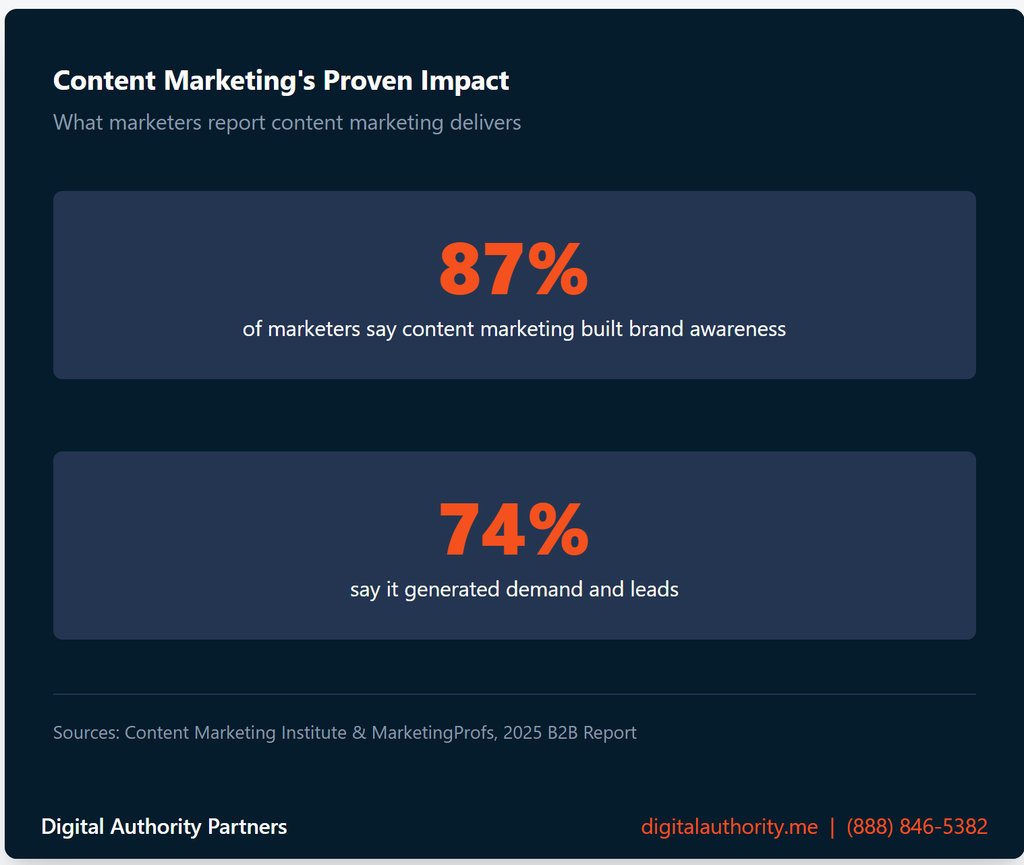
The data on content marketing’s impact is strong. The Content Marketing Institute and MarketingProfs 2025 B2B report found that 74% of marketers say content marketing generated demand and leads last year, and 87% said it built brand awareness. Consider these four benefits before you develop your own content:
1. Connecting With Your Patients
High-quality, well-formulated information helps you connect with and guide your patients. For example, a pediatrician can write about the different stages of childhood growth and gain the trust of parents who appreciate learning about their children’s developmental milestones.
Adding videos, infographics, podcasts, and charts helps patients understand complex medical topics. When you give patients a real chance to comprehend a difficult subject, you build a relationship that lasts.
2. Promoting Your Services and Products
Well-crafted content promotes your medical services just as effectively as a sales page, without reading like one. Showcase each service you offer on its own page, whether that’s a specific procedure, a diagnostic test, or a specialty program, so patients searching for that exact service find a clear, dedicated answer.
An effective way to build content that promotes your practice or brand is to build pages around the keywords your audience uses. Each page then answers the questions that actually decide a booking: what the service involves, how long it takes, and how to prepare. That specificity is what turns a page visit into an appointment.
3. Improving Local Traffic
Clear, informative content encourages your website visitors to book a consultation. Imagine a reader who finally understands a complex procedure through your video, photos, and text. Having learned from your content, that reader trusts your practice and decides to visit your clinic.
Patient referrals compound the effect. When you give satisfied patients an easy way to share testimonials, they pass your pages along and recommend your services to friends and family. A single helpful article can reach an entire family deciding where to seek care.
4. Building Your Authority
Well-written material reflects your authority in your field. Research summaries, video presentations, infographics, data, and reviews all signal that your practice is credible and that you are an expert. Original material shows expertise and strengthens your online reputation.
Healthcare content marketing starts with market research, but there is something more valuable that you already have. You understand your audience’s pain points and their decisions. With that insight, you create more engaging content that patients want to share.
Types of Healthcare Content That Earn Patient Trust
Patients absorb information in different ways, so a strong program uses several formats. Each one answers a different need along the patient journey, from the first symptom search to the moment someone books:
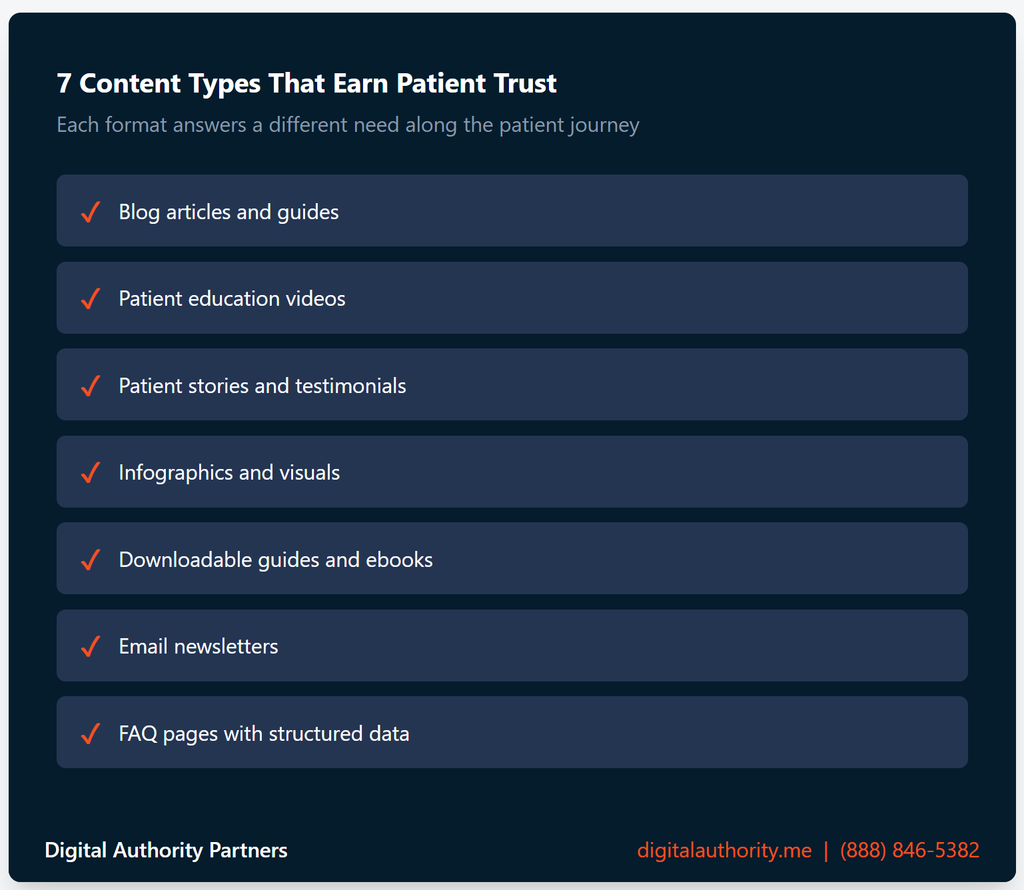
- Blog articles and guides answer the specific questions patients type, and they form the backbone of your search visibility.
- Patient education videos explain procedures and conditions in a way text can’t, and they keep visitors on your pages longer.
- Patient stories and testimonials turn real outcomes into social proof that reassures the next person deciding whether to call.
- Infographics and visuals make complex data, anatomy, or treatment steps easy to grasp at a glance.
- Downloadable guides and ebooks give patients something to keep, and they create a natural moment to capture contact details.
- Email newsletters keep your practice top of mind between visits and bring past readers back to new content.
- FAQ pages with structured data answer common questions directly and help your content surface in search features and AI answers.
No single format is the outright best. The strongest programs connect these formats into a loop. One search visitor becomes several touchpoints, reading an article, watching a video, then downloading a guide before they ever reach out. That layered experience builds real trust, and it gives patients more reasons to choose you.
How Content Grows Your Practice: Two Healthcare Examples
Most marketing spend stops working the day you stop paying for it. Content behaves differently. Each article you publish keeps ranking, keeps earning links, and keeps citing your expertise long after it goes live, so the value stacks instead of resetting. Two Digital Authority Partners clients show the long-term benefits of content marketing clearly:
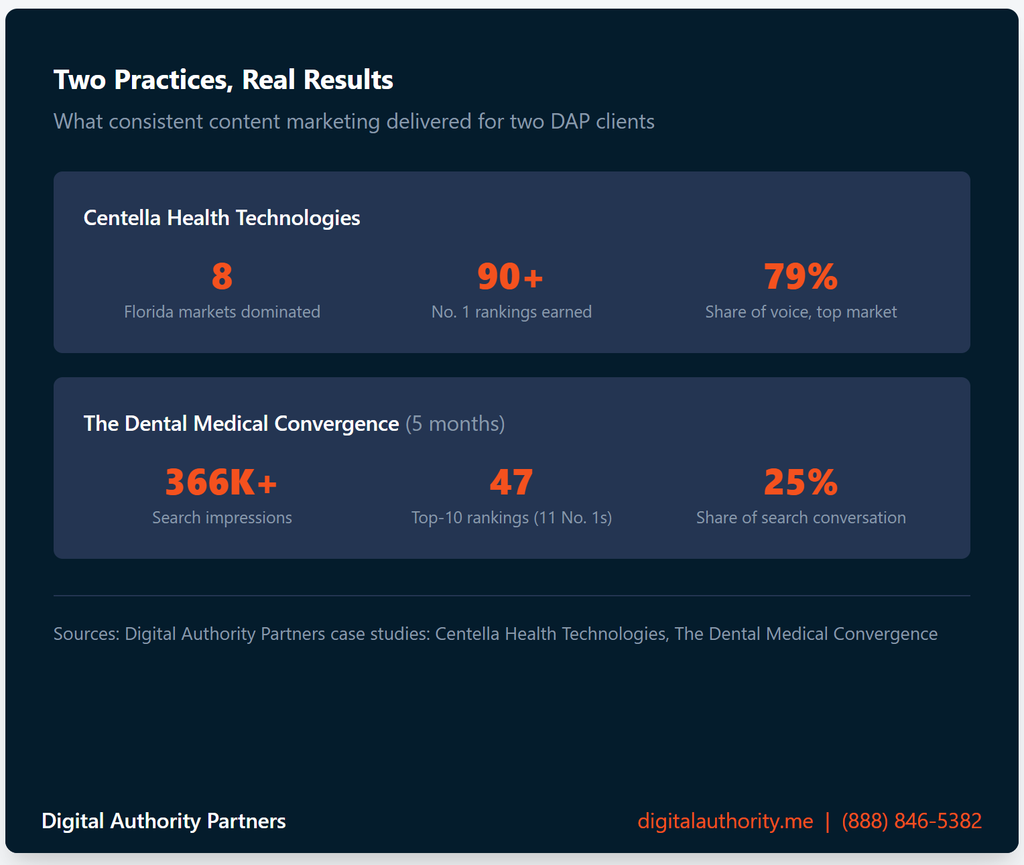
Centella Health Technologies
Centella Health Technologies, a Siemens Healthineers Advanced Partner in South Florida, had no search visibility despite more than 60 years in business. A combined content strategy and local SEO program built city-specific pages and a steady blog around their imaging solutions.
The payoff shows up in the Centella Health Technologies case study. Centella came to dominate eight Florida markets, earned 90 or more #1 rankings, and reached a 79% share of voice in its top market. Each new page compounded the authority of the last, so growth accelerated over time.
The Dental Medical Convergence
The Dental Medical Convergence, a nonprofit educating patients on the link between oral and systemic health, had the medical expertise but no online audience to reach it. Clustered content answering real patient questions, published consistently under a credentialed author, changed that.
The Dental Medical Convergence case study documents the climb. In five months, the organization reached more than 366,000 search impressions and earned 47 top-10 rankings, including 11 #1 rankings, capturing 25% of the search conversation for its core topics. Consistent content turned a brand-new site into one of the most-visible authorities on its subject.
Both stories share one lesson. The growth only happens when you commit to publishing over many months. Each piece adds to a foundation that keeps paying you back, which is why content rewards patience more than almost any other channel.
4 Steps to a Successful Healthcare Content Marketing Strategy
Healthcare content marketing involves more than writing articles and adding keywords. A successful healthcare content marketing strategy takes careful planning, creative thinking, and ongoing analysis. Here are the four steps to build your strategy:
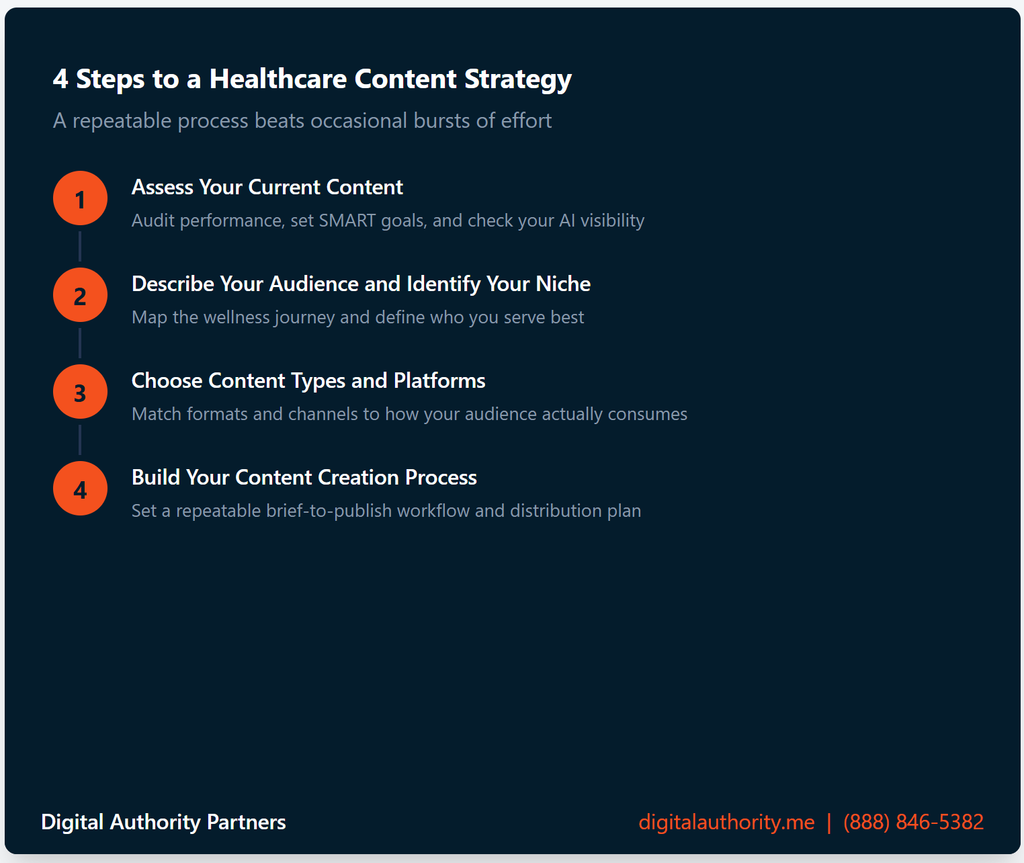
1. Assess Your Current Content
Start by auditing your current content to find areas for improvement. An audit evaluates how well your pages engage your audience and which topics they liked most. It also assesses keyword performance and other metrics. More patients now ask AI tools for advice before choosing a provider, so you also need to understand how you appear in AI-driven recommendations.
Once your assessment is complete, set your goals using the SMART framework. Your goals should be specific, measurable, attainable, realistic, and time-bound. SMART goals account for your patients’ challenges, your budget, and your stakeholders. You can use this approach whether you want to improve traffic, increase leads, or build authority in your field.
2. Describe Your Audience And Identify Your Niche
After you set your goal, describe your target market and define your niche. Understand your audience’s issues as they move through the wellness journey. This matters because you need content that supports prospective patients every step of the way.
Defining your niche gets easier once you have a clear picture of your market. From there, you develop specialized, well-targeted content. Instead of general dental care content, for example, a dentist could create focused content on expert teeth whitening to reach a specific group of patients.
3. Choose Content Types and Platforms
Different content types work for different audiences and platforms. If you’re a dermatologist, your audience may value visual content more than text. Videos and photos of various skin conditions are easier to understand than long blocks of writing.
Publish your content on social media, your website, video channels, and other platforms your patients use. Experiment with different formats across those platforms and see which ones engage your audience best.
4. Build Your Content Creation Process
Creating content consistently is tough. In a typical healthcare content marketing agency, writers work from a creative brief that tells them what to write and which guidelines to follow. That structure keeps quality high and the calendar full. Before you create content, make a plan that tracks every part of the program. Map your distribution strategy too, so your content reaches the right patient at the right time. What does that mean for you? A repeatable process beats occasional bursts of effort every time.
Common Content Marketing Mistakes to Avoid
Even a well-funded program stalls when a few fundamentals slip. Steer clear of these patterns and your content has a much better chance of ranking and converting:
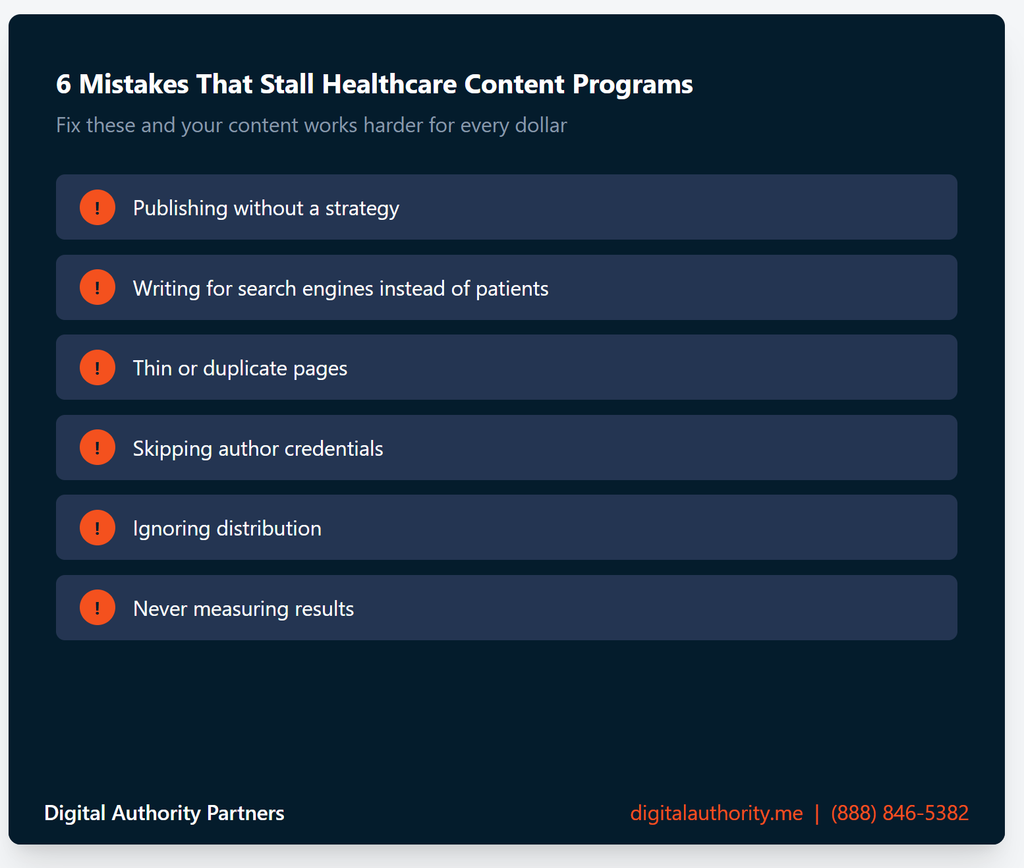
- Publishing without a strategy. Random posts rarely rank. Map topics to patient questions and to your service lines before you write a word.
- Writing for search engines instead of patients. Match the intent behind the search. A patient who types a symptom wants reassurance and clarity. Give them that, and the appointment tends to follow.
- Thin or duplicate pages. Several shallow pages on the same topic compete with each other. One thorough, well-structured page wins instead.
- Skipping author credentials. Health content is held to a higher standard, so publish under a named clinician or expert with a real bio. This signals trust to both patients and search engines.
- Ignoring distribution. A great article that no one sees earns nothing. Share each piece through email, social channels, and internal links from related pages.
- Never measuring. Without a baseline, you can’t tell what’s working. Track results from day one and let the data guide your next topics.
Fix these, and your healthcare content marketing works harder for every dollar you put into it.
How to Build Trust Into Your Healthcare Content
Health information sits in a category search engines treat with extra care, because the stakes for patients are real. Google looks for signals of experience, expertise, authoritativeness, and trust (E-E-A-T). Patients look for the same signals, even if they don’t know the acronym. You build that trust in concrete ways:
- Publish under a named clinician or qualified expert, link to a full bio that lists their credentials and experience.
- Cite reputable sources for every claim, and link out to the research behind your statistics.
- Keep medical information current, and add a clear last-reviewed date so readers know the page is maintained.
Accuracy protects your patients and your reputation at once. Route any clinical guidance through qualified review before it goes live, and keep marketing language out of anything that reads as medical advice. A page that overpromises an outcome does more harm than good.
Structure helps too. Clear headings, short paragraphs, and direct answers make your content easier for patients to follow.
Structure helps too. Clear headings, short paragraphs, and direct answers make your content easier for patients to follow, and they make your results easier for search engines and AI tools to cite. The Dental Medical Convergence earned 47 top-10 rankings in five months because every article paired credentialed authorship with a clean, answer-first structure. Trust is the currency of healthcare content marketing. Earn it on every page, and the rankings, the citations, and the appointments tend to follow.
Measuring Healthcare Content Marketing
You can’t improve what you don’t measure. Track the metrics that connect content to patient growth: organic traffic, keyword rankings, time on page, and the consultations or calls each page generates. Set a baseline before you publish, then review the trend every month, pairing the numbers with context.
A page that ranks well but converts poorly may need a stronger call to action. A page that converts but gets little traffic may need better promotion. Watch assisted conversions too, since patients often read several pages across visits before they book.
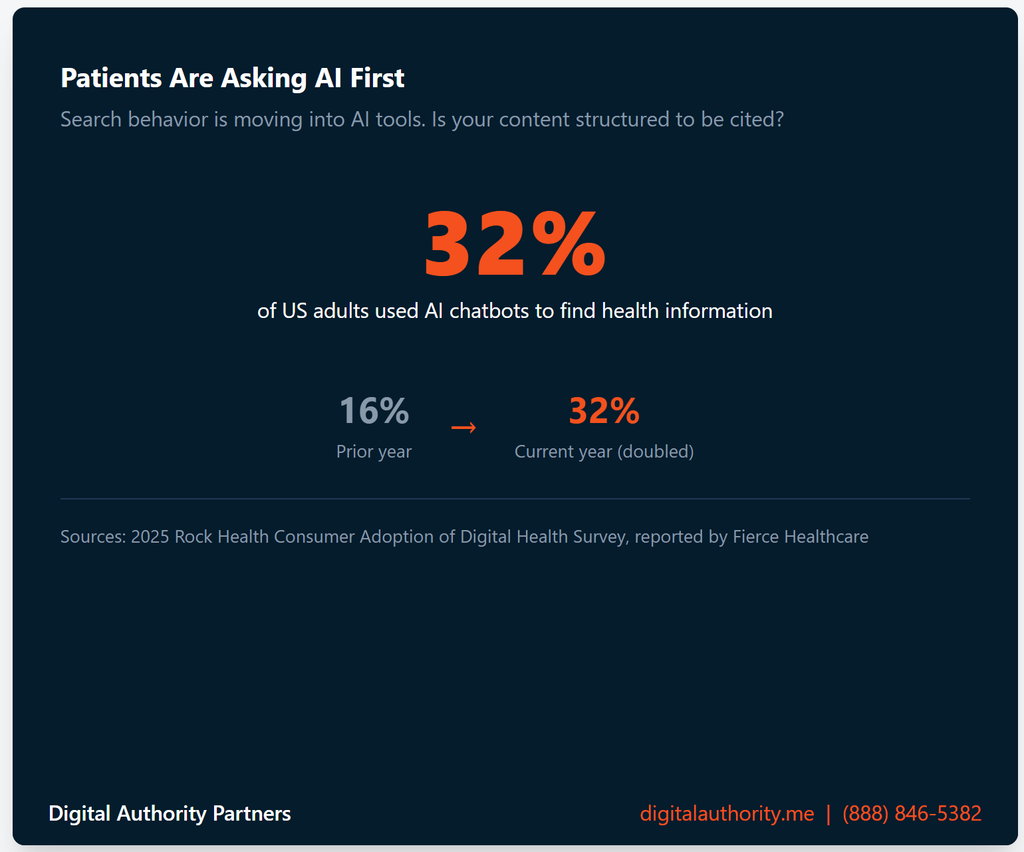
Search behavior is also moving into AI tools, and your measurement has to follow. A 2025 Rock Health Consumer Adoption of Digital Health Survey, reported by Fierce Healthcare, found that 32% of US adults used AI chatbots to find health information. That’s double the 16% from the year before. If your content isn’t structured for AI search, those patients never see your practice. Track which of your pages get cited in AI Overviews and chatbot answers, then build the question-and-answer formatting that earns those citations.
How Does AI Search Change Healthcare Content Marketing?
AI tools now answer many health questions directly, citing the sources they trust. To appear in those answers, structure your content with clear questions, direct answers, and credible references. Practices that adapt early are more likely to capture visibility their competitors miss. Clear formatting and credible sourcing are what make an AI engine comfortable quoting your page.
How to Get Your Healthcare Marketing Program Off the Ground
You don’t need a massive budget or a full content team to begin. You need a focused plan and the discipline to keep going. Start small and specific:
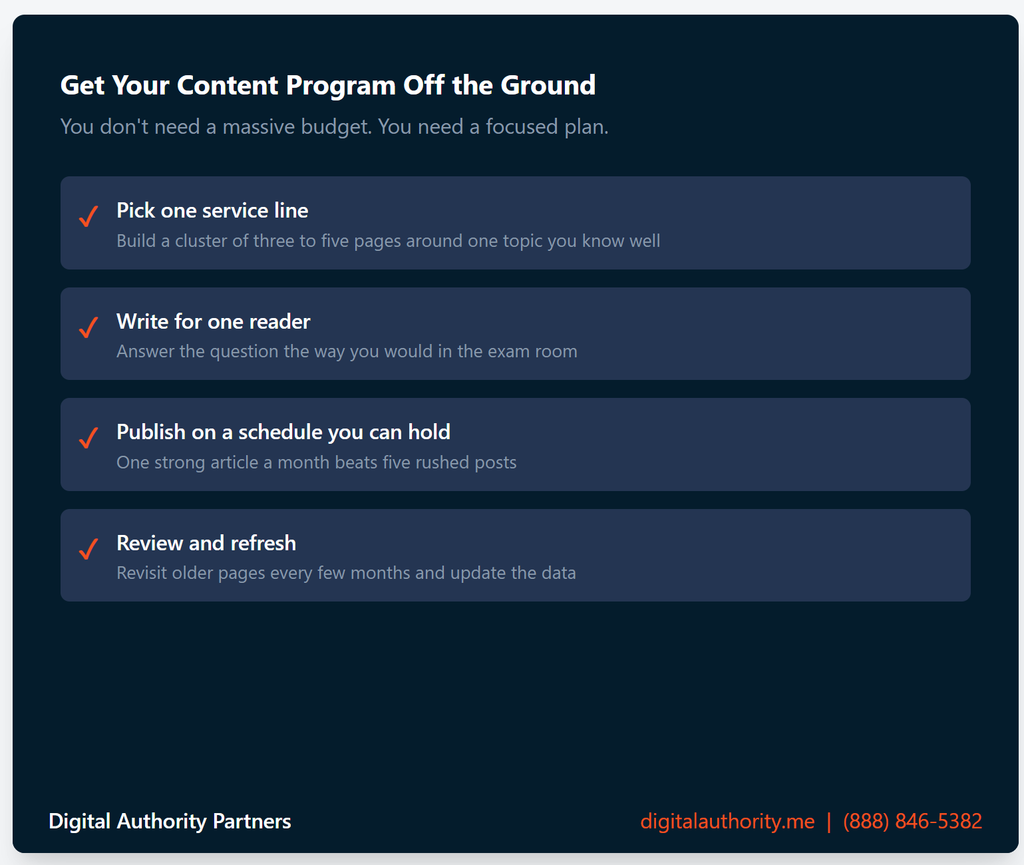
- Pick one service line or patient question you know well, and build a cluster of three to five pages around it. A pillar page that explains the topic in depth, supported by articles that answer related questions, gives search engines a clear signal of expertise.
- Write for one reader at a time. Picture the patient typing the query at 11 p.m., and answer the question the way you would in the exam room. Plain language, real reassurance, and a clear next step beat jargon every time.
- Publish on a schedule you can hold. One strong, well-researched article a month outperforms five rushed posts that no one finishes. Consistency is what lets the compounding effect take hold over time.
- Review and refresh. Revisit older pages every few months, update the data, and add answers to the new questions patients are asking.
Both case studies above grew exactly this way, one cluster at a time. Build it patiently, and your healthcare content marketing becomes an asset that keeps working while you sleep. The earlier you start, the sooner the compounding begins.
Frequently asked questions
Here are direct answers to the questions healthcare marketers ask most often about building and running a content program:
How Does Healthcare Content Marketing Help a Medical Practice Grow?
It grows your practice by reaching patients during online research, demonstrating your expertise, and converting that trust into appointments. The Dental Medical Convergence, a Digital Authority Partners client, captured 25% of the search conversation for its core topics within five months of consistent publishing. The effect compounds as your library of helpful content grows.
What Types of Content Work Best in Healthcare?
Blog articles, patient-education videos, infographics, downloadable guides, FAQ pages, and patient stories all perform well. The best mix depends on your specialty and your patients. Visual formats suit fields like dermatology, while in-depth articles suit complex topics patients want to understand fully. Most practices find that a connected mix outperforms any single format on its own.
How is Healthcare Content Marketing Different from Healthcare Advertising?
Advertising rents attention and stops the moment you stop paying. A healthcare content marketing strategy earns attention with information patients value, and each piece keeps working long after publication. Content also builds the credibility that paid ads alone rarely achieve.
How Long Does Healthcare Content Marketing Take to Show Results?
Most practices see meaningful movement in rankings and traffic within three to six months, with stronger gains after a year of consistent publishing. The timeline depends on your starting authority and how competitive your topics are. The Dental Medical Convergence built to 47 top-10 rankings within five months of consistent publishing, showing how quickly a well-executed program can gain traction.
Is Healthcare Content Marketing Compliant With Patient Privacy Rules?
Yes, when handled correctly. You build content around general education and search demand, never around protected patient information. Reputable healthcare content marketing programs keep HIPAA in mind, cite credible sources, and route any clinical claims through qualified review.
How Do I Measure the ROI of Content Marketing?
Connect each page to outcomes you care about: organic traffic, leads, consultation requests, and new patients. Set a baseline before publishing, then track the trend monthly. Assisted conversions and AI-search citations matter too, since patients often read several pages before they book. Over time, the cost per new patient from content usually falls well below paid channels.
How Does Content Marketing Support Healthcare SEO?
Content gives search engines the pages, keywords, and authority signals they rank. Every well-optimized article expands the queries your site can answer. That’s why content marketing and healthcare SEO work best as one program rather than two separate efforts.
Should Small Practices Invest in Healthcare Content Marketing?
Yes. Small practices often win precisely because they can own a focused niche that larger systems ignore. A focused effort lets you compete on depth and relevance, where a small practice holds every advantage over a sprawling system. A handful of excellent pages on a specific service or condition can outrank a hospital’s thin coverage of the same topic.
Elevate Your Healthcare Content With Digital Authority Partners
Content marketing is one of the most valuable parts of digital marketing for healthcare. High-quality content helps your practice reach patients, build your brand, and prove your expertise, and the returns compound the longer you stay consistent. A clear healthcare content marketing strategy turns scattered effort into steady patient growth.
Call Digital Authority Partners to find out how a healthcare content marketing strategy can grow your practice, or schedule a meeting to talk through your goals with our team.
Want To Meet Our Expert Team?
Book a meeting directly here

Related Articles

Demand for therapy is at an all-time high, yet nearly half of the 62 million U.S. adults with a mental illness receiv...


AI in digital health has moved from research labs into daily care. A phone camera can now screen for diseases that on...

Nearly every local search ends in one of three spots. The U.S. has 8.3 million business establishments, and 7.1 milli...