Healthcare PPC Agency: Benefits, Costs, and How To Choose One

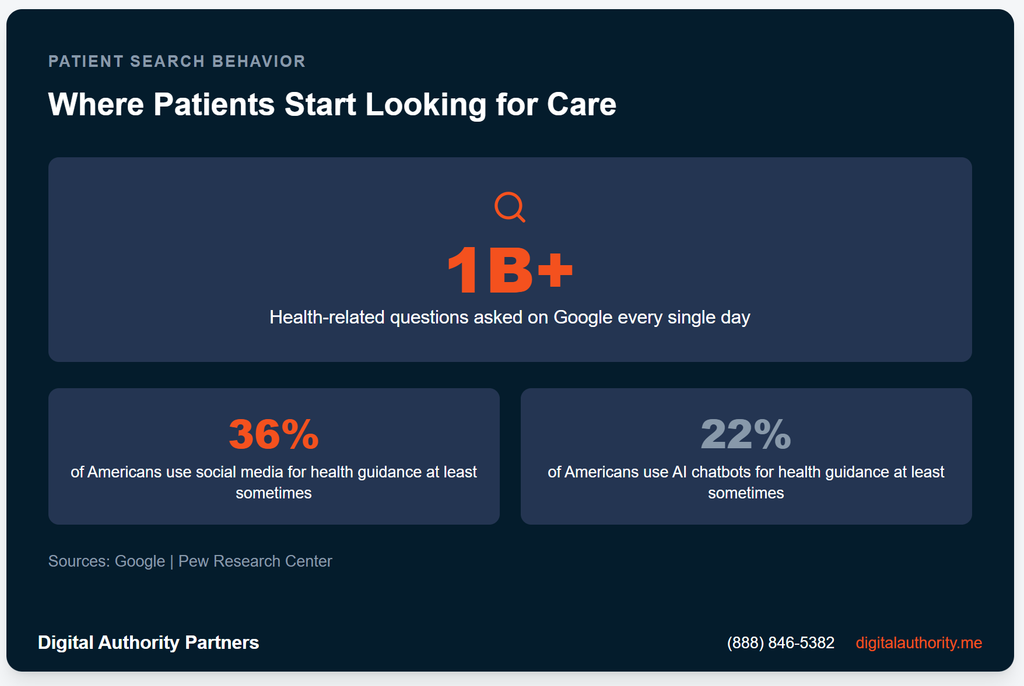
Patients reach for Google before they call for an appointment. The number of patients using search for care is extraordinary: Google receives more than 1 billion health questions every day, and that number keeps climbing as more people research symptoms, specialists, and treatment options before they ever pick up the phone.
A PPC (Price-Per-Click) healthcare agencies help your practice appear be front of that search volume at the exact moment intent peaks, ahead of your competitors, so those searches turn into booked appointments instead of a competitor’s.
This guide breaks down what healthcare PPC agencies do and how to choose the right partner for your practice. You’ll also see how our full-service healthcare marketing agency approaches paid search, with a focus on the precision that turns ad spend into booked appointments.
Why Do Patients Start Their Care Search on Google?
Healthcare is a research-heavy decision, and that research starts online. A 2026 Pew Research Center study found that Americans lean on digital sources for health guidance. It reported that 36% use social media and 22% use AI chatbots at least sometimes.
This behavior rewards visibility at the decision point. When someone searches for a symptom or a specialist, the first results shape who they call. Paid search puts your practice in that power position. That is why a specialist focuses on high-intent terms rather than broad awareness.
What Is a Healthcare PPC Agency?
Healthcare PPC agencies plan, build, and manage pay-per-click advertising campaigns for your medical practice, so every part of your paid search program works together. Here’s what that covers:
- Pay-per-click billing: You pay only when someone clicks your ad, so your budget follows real patient interest instead of guesswork.
- Keyword strategy: Your agency identifies and bids on the searches most likely to bring in ready-to-book patients.
- Landing pages and ad copy: Every ad connects to a page built to convert that specific search, not a generic homepage.
- Bidding strategy: Ongoing bid management keeps your cost per click in check as competition shifts.
A 2025 report found that healthcare and pharma digital ad spending will reach $24.77 billion this year, up 13.3% year over year, according to eMarketer. That growth means more providers are bidding on the same searches, which raises both the cost per click and the value of an agency that spends efficiently. Most healthcare PPC agencies run Google Search as the core channel, then extend into paid social on Meta and connect the two through remarketing. The right mix depends on your goals, your service lines, and your local competition.
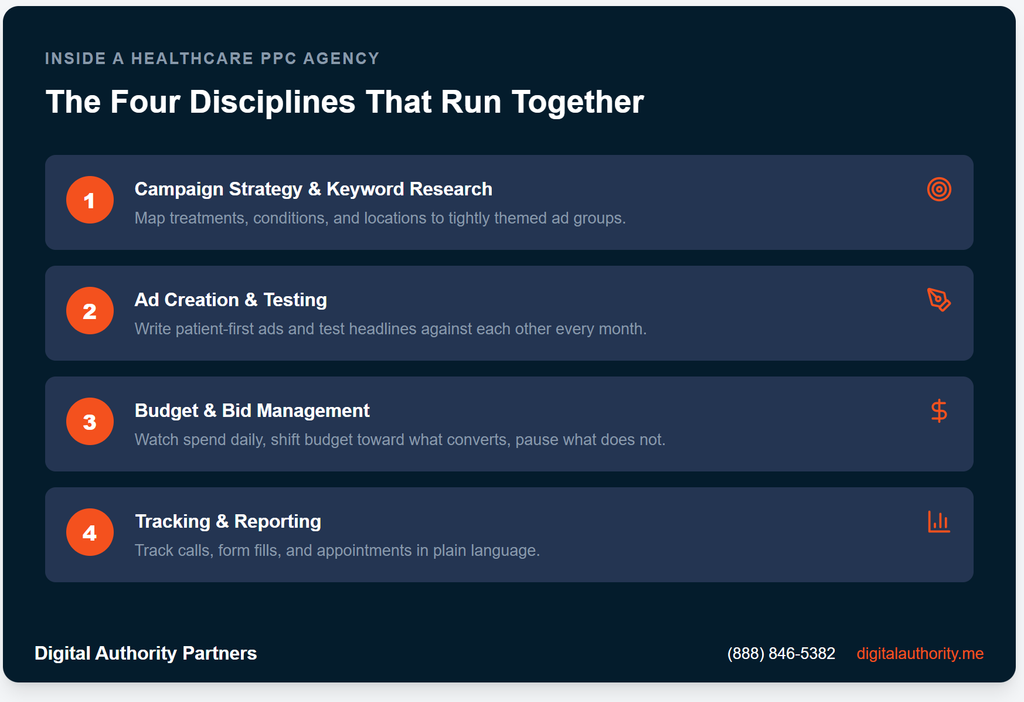
In our work managing paid search for physicians, we see the same pattern, and understanding the formula to success is why best marketing partners specialize. Campaigns built by people who know medical search behavior convert better than generic ones. The team already knows the keywords, ad policies, and patient journey from previous experience. The strategy works because we put these insights together in a way that works for your practice. Day to day, that work breaks down into four core disciplines:
- Campaign strategy and keyword research: Your agency researches the treatments, conditions, and locations your patients search for, then maps them to tightly themed ad groups that keep your ads relevant and your cost per click in check.
- Ad creation and testing: A skilled team writes clear, patient-first ads and tests headlines against each other every month, since small copy changes often lift bookings more than budget increases do.
- Budget and bid management: Your agency watches spend daily, shifts budget toward what converts, and pauses what does not, protecting your return when competition pushes costs higher during peak seasons.
- Tracking and reporting: A good partner tracks calls, form fills, and appointments, then reports them in plain language so you can tie spend to real patient growth.
These four disciplines only work when a team runs them together, which is the real value of hiring a dedicated healthcare PPC agency instead of managing campaigns in-house. Strategy, creative, budget, and reporting all feed into each other, and a partner who treats them as one connected system keeps your ad spend focused on the patients most likely to book.
What Are the Benefits of PPC for Healthcare Companies?
PPC and SEO both bring patients to your site, but they work differently. SEO builds organic rankings over months, while PPC buys visibility at the top of results today. A healthy program often runs both, which is why many providers pair paid search with healthcare SEO for medical practices. A healthcare PPC agency helps your practice capture these core benefits:
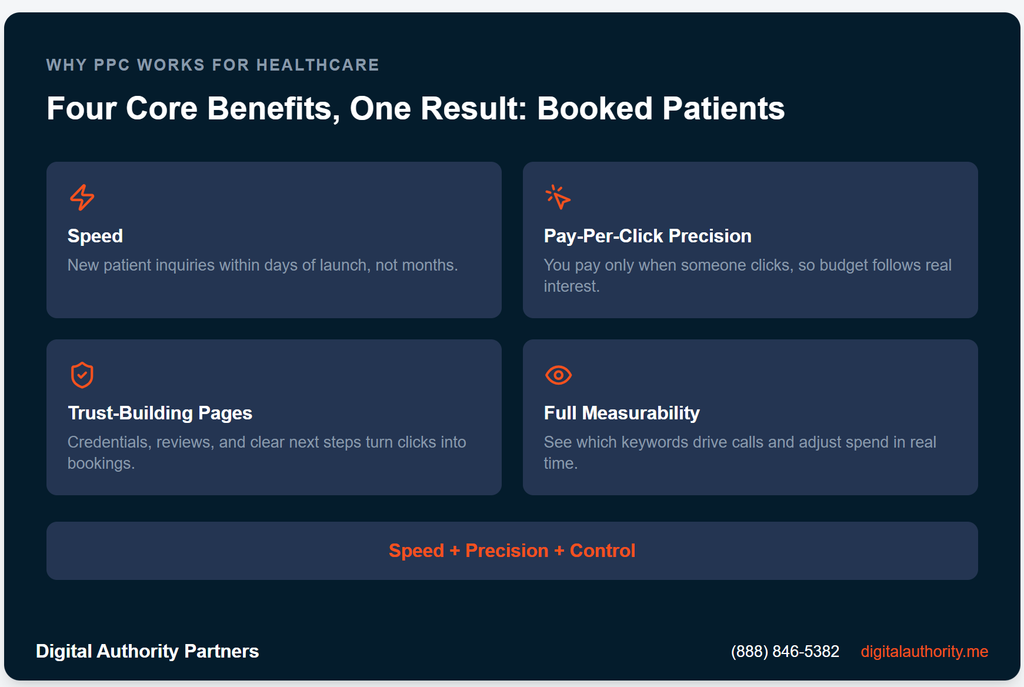
- Speed: Campaigns can start driving new patient inquiries within days of launch, instead of the months organic rankings take to build.
- Pay-per-click precision: You pay only when someone clicks, so your budget follows real interest instead of guesswork.
- Trust-building landing pages: Healthcare is personal, and patients weigh trust before they book. Strong ads and landing pages lead with credentials, reviews, and clear next steps, turning a click into a scheduled visit.
- Full measurability: Paid search is measurable from click to booked appointment. You can see which keywords drive calls, which waste spend, and adjust in real time.
Together, these advantages come down to speed, precision, and control: the three things a specialized agency is built to deliver.
How Much Does Healthcare PPC Cost in 2026?
The real cost of healthcare PPC is not what you pay per click. It is what you pay to book a new patient. Your specialty sets the starting point, since competitive fields draw higher bids and raise the price of every click, with your location, keyword intent, and quality score shaping the number from there. A well-built campaign brings that cost down over time by sending budget only to the searches most likely to convert.
Beyond media spend, most practices pay a monthly management fee to their agency. What you get for that fee is the difference between a campaign that drains the budget and one that fills the schedule. For a deeper look at returns, see our guide to boosting ROI on PPC for hospitals and these tips for effective healthcare PPC.
The question that matters is not what PPC costs, but what a booked patient is worth to you. When a single new patient carries strong lifetime value, even a higher cost per lead pays for itself quickly. A healthcare PPC agency helps you protect that math with sharper targeting and higher quality scores.
How Does a Healthcare PPC Agency Stay HIPAA Compliant?
Compliance is where healthcare advertising gets challenging for other agencies, and where inexperience gets expensive. Ad platforms treat health data with extra caution. Google’s own healthcare and medicines advertising policy restricts how you target and remarket to people with sensitive conditions, and serious violations can suspend your account.
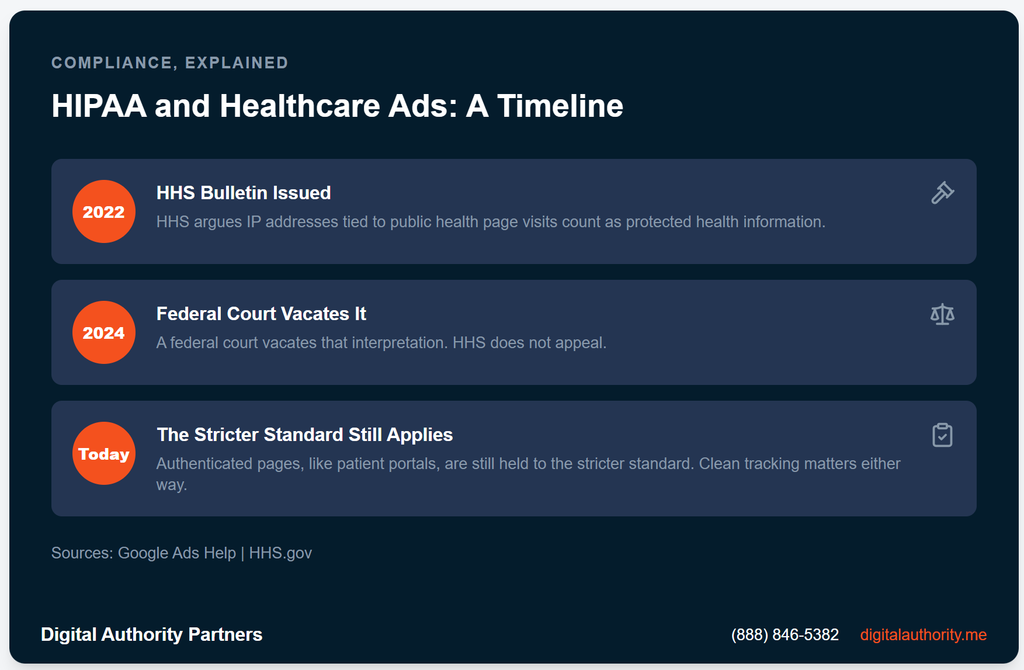
Privacy law adds another layer of complexity. Under HIPAA rules from the HHS, you must keep protected health information out of your ad tracking. A 2022 HHS bulletin argued that IP addresses tied to visits to public health pages counted as protected health information, but a federal court vacated that interpretation in 2024, and HHS did not appeal.
The stricter standard for authenticated pages, like patient portals, hasn’t moved. A seasoned team still sets up conversion tracking so no protected data reaches Google or Meta, using server-side tagging where needed and keeping forms and call tracking clean, regardless of how the legal debate settles.
Building compliance into every campaign from the start strengthens your work rather than limiting it. Get this right, and you capture demand without exposing the practice to risk.
What Happens in the First 90 Days of a PPC Campaign?
A good PPC onboarding follows a clear arc, and the first 90 days set the foundation for everything that follows. Here is the shape of that work with an experienced healthcare PPC agency:
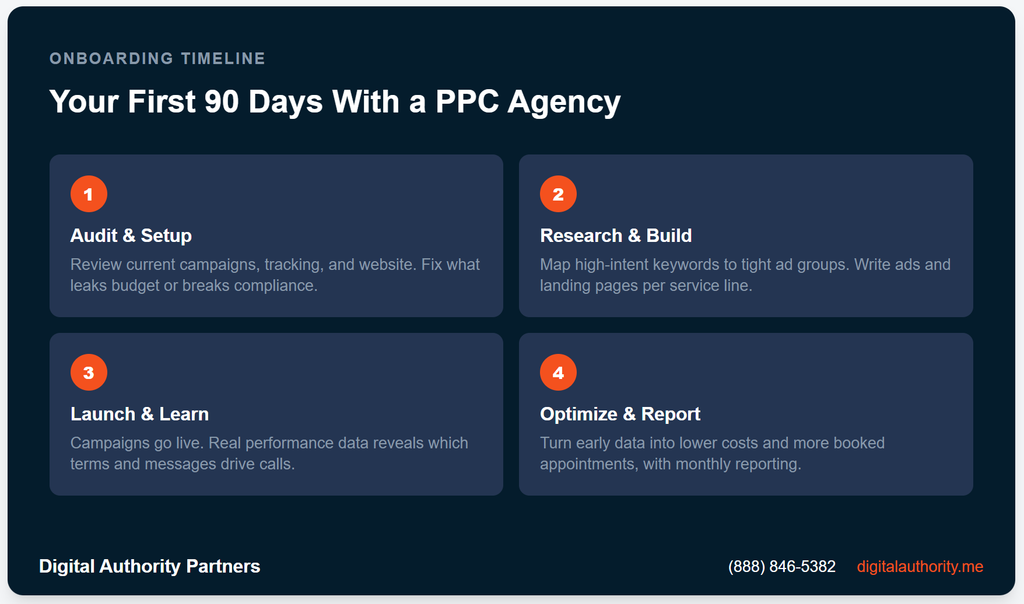
- Audit and setup: Review your current campaigns, tracking, and website, then fix what leaks budget or breaks compliance.
- Research and build: Your team maps high-intent keywords to tight ad groups and writes ads and landing pages for each service line.
- Launch and learn: As campaigns go live, you gather real performance data that reveals which terms and messages drive calls.
- Optimize and report: Turn early data into lower costs and more booked appointments, with clear monthly reporting.
Every step in that 90-day arc builds on the one before it. By the time month three closes, your campaign runs on real performance data, your team understands your patients, and your spend ties directly to booked appointments. That progress depends on choosing the right partner to run it.
How to Choose the Right Healthcare PPC Agency
Not every agency understands medical advertising. When you evaluate a partner, weigh the following five things before you sign. Each one separates a specialist from a generalist who will learn on your budget:
- Healthcare experience: A team that has already run medical campaigns knows the keywords, the ad policies, and what makes patients book.
- Compliance fluency: HIPAA and platform rules get handled by design, not discovered after a suspension.
- Transparent reporting: You should see spend, leads, and cost per patient reported in plain terms, not buried in jargon.
- Full-funnel support: Ads only perform when they connect to conversion-ready landing pages, call tracking, and healthcare content marketing that supports patients through the full decision process.
- Proven results: Case studies should show exactly how campaigns connected to appointments and revenue, not just clicks.
Ask any agency how they handle HIPAA, how they report results, and which healthcare accounts they have run. Their answers reveal whether you are hiring a specialist or funding a learning curve.
What Results Can You Expect From PPC?
Results depend on your specialty, budget, and offer, so treat any promise of a fixed number with caution. Benchmarks still give you a realistic frame of reference, and a well-run campaign should land at or ahead of those numbers within the first few months.
The lever that moves the most is quality. Tight keyword themes, strong landing pages, and clean tracking lower your cost per lead over time. A healthcare PPC agency earns its fee by improving that math month over month, not by spending more.
Should You Hire an Agency or Build In-House?
You can run PPC yourself, and plenty of practices start here. The real question is whether your team has the time and expertise to do it well while competition and costs rise. The comparison below shows the trade-offs at a glance.
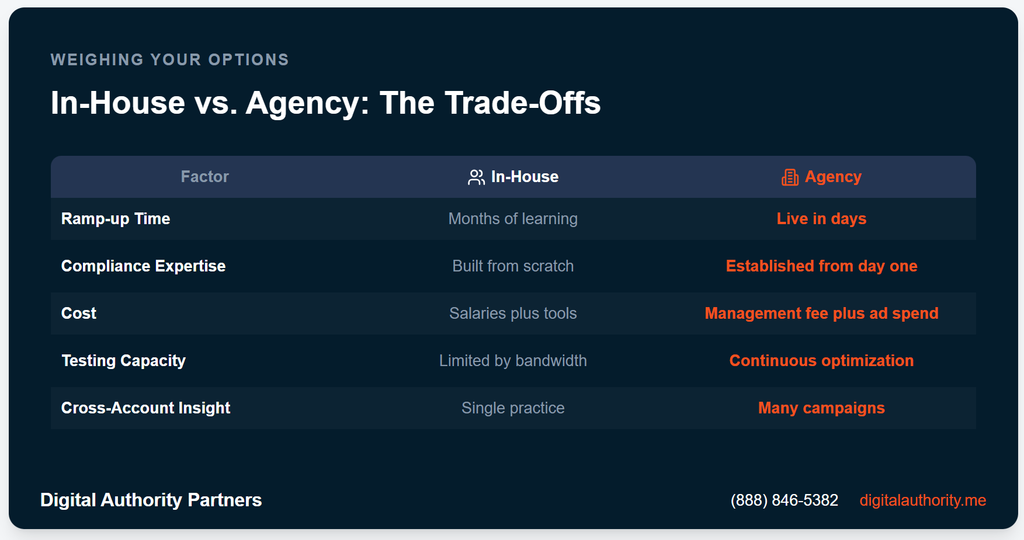
| Factor | In-house | With an agency |
|---|---|---|
| Ramp-up time | Months of learning | Live in days |
| Compliance expertise | Built from scratch | Established from day one |
| Cost | Salaries plus tools | Management fee plus ad spend |
| Testing capacity | Limited by bandwidth | Continuous optimization |
| Cross-account insight | Single practice | Many campaigns |
You’re busy caring for patients, not tuning bids. Outsourcing lets you focus on what you do best while specialists focus on results. If you would rather grow than experiment, a healthcare PPC agency is usually the faster, safer path.
Healthcare PPC Frequently Asked Questions
These questions come up in nearly every conversation about healthcare PPC, and the answers help you evaluate your options with confidence. Read through them before you start comparing agencies:
What does a healthcare PPC agency do day to day?
It researches keywords, writes and tests ads, manages bids and budget, tracks calls and appointments, and reports results. The goal is steady, compliant patient growth from your paid search spend.
How fast does healthcare PPC start working?
A healthcare PPC agency can bring new patient inquiries within days of launch. That speed is one reason to pair paid search with SEO, which builds more slowly over months.
Is PPC or SEO better for healthcare?
They serve different goals. PPC delivers fast, targeted visibility you pay for, while SEO builds durable organic rankings over time. Most providers get the strongest results by running both together.
What healthcare services can you advertise with PPC?
You can advertise most treatments and conditions, from dentistry and dermatology to physical therapy and hospitals. Some sensitive categories face extra restrictions, which is why platform policy expertise matters.
What ROI can healthcare companies expect from PPC?
Returns depend on your specialty, offer, and patient lifetime value. Because paid search is measurable end to end, you can tie spend to booked appointments and improve return over time.
Does a healthcare PPC agency manage Google Ads and paid social?
Yes. A healthcare PPC agency can run Google Ads and paid social on Meta and other platforms, then use remarketing to reach patients across devices. The mix depends on your goals and audience.
Why hire a specialist instead of a general agency?
A healthcare specialist already understands medical search behavior, compliance rules, and patient decisions. That knowledge produces stronger campaigns than a generalist learning your industry on your budget.
Is PPC for hospitals different from PPC for doctors?
Yes. Hospital campaigns span many service lines and face greater competition, while individual doctor campaigns focus on specialty keywords and appointment-driven ads.
Get Started With a Healthcare PPC Agency Today
Patients make decisions quickly, and the top of Google is where many of those decisions start. A healthcare PPC agency turns that intent into booked appointments while keeping your campaigns compliant and efficient.
Ready to turn searches into patients? Partner with a healthcare PPC agency that builds compliant, measurable campaigns, then schedule a free consultation with our paid media team to map your first 90 days.
Want To Meet Our Expert Team?
Book a meeting directly here

Related Articles

The best health apps turn your phone into a daily tool for tracking habits, managing health conditions, and building ...


A healthcare chatbot gives your patients an always-open front door. It answers a question at midnight, books an appoi...

Nearly all HITRUST-certified environments stayed breach-free last year, which is why HITRUST certification has become...